SUBSCRIBE TO OUR FREE NEWSLETTER
Daily news & progressive opinion—funded by the people, not the corporations—delivered straight to your inbox.
5
#000000
#FFFFFF
To donate by check, phone, or other method, see our More Ways to Give page.
Daily news & progressive opinion—funded by the people, not the corporations—delivered straight to your inbox.
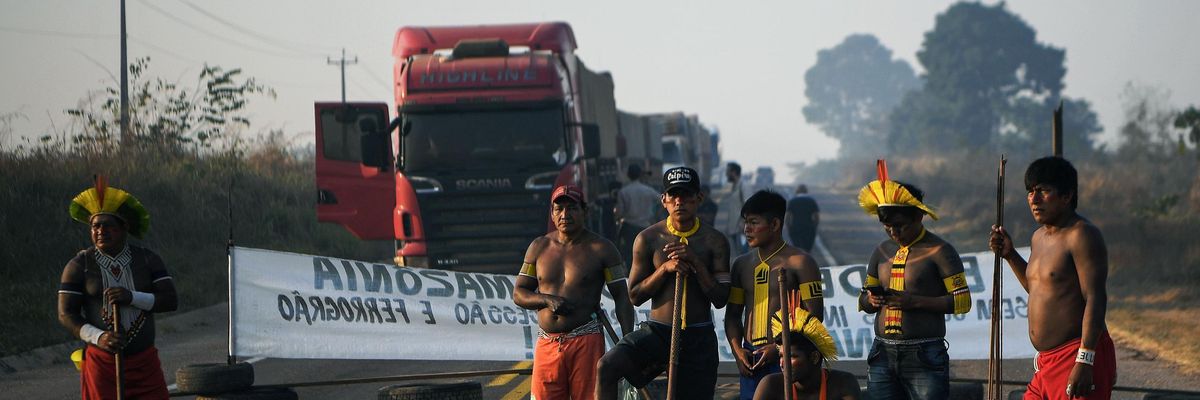
Members of the Kayapo tribe block the BR163 highway during a protest outside Novo Progresso in Para state, Brazil on August 17, 2020. Indigenous protesters blocked the major transamazonian highway to protest the lack of governmental support during the Covid-19 pandemic and illegal deforestation in and around their territories. (Photo: Carl De Souza/AFP via Getty Images)
Encouraged by President Jair Bolsonaro, deforestation in Brazil's Amazon rainforest surged to its highest annual level in a decade over the past year, with researchers warning that the accelerated destruction of the critical carbon sink is imperiling the ability to keep planetary heating below the Paris climate agreement's 1.5oC target.
" Brazil is going against the global climate agenda that is seeking to urgently reduce greenhouse gas emissions."
--Carlos Souza, Imazon
Imazon, a Brazilian research institute whose mission is to promote conservation and sustainable development, reported Thursday that from August 2020 to July 2021, 10,476 square kilometers of Amazon rainforest were destroyed, a 57% increase over the previous 12-month period.
"In July alone, 2,095 km2 were deforested, 80% more than in the same month in 2020," said Imazon. "This area is larger than the city of Sao Paulo."
According to the institute, the northeastern state of Para suffered the most severe deforestation in July, losing 771 square kilometers, an area about the size of Austin, Texas. Additionally, seven out of the 10 Indigenous territories most affected by forest destruction during the 12-month period were located in the state.
"Deforestation is still out of control," Imazon researcher Carlos Souza told The Guardian. "Brazil is going against the global climate agenda that is seeking to urgently reduce greenhouse gas emissions."
Imazon said that "at this rate, we will not be able to keep global warming below 1.5oC, a target defined in the Paris agreement.
Often called the "lungs of the planet" for its role in keeping CO2 emissions in check, the massive 2.1 million square mile Amazon rainforest is one of the most biodiverse places on the planet, boasting some three million plant and animal species. Nearly a million Indigenous people from over 300 tribes--including some who have never had any contact with the outside world--also call the Amazon home.
However, since taking office in 2019, Bolsonaro has strongly encouraged economic development including logging, mining, expansion of agricultural activity, and the construction of a major highway and dam in the region.
Despite the devastation caused by these and other activities, the Bolsonaro administration has vowed to accelerate Amazon exploitation, claiming the region is "unproductive" and "desert-like." The administration has also slashed funding for federal agencies tasked with catching and prosecuting illegal farmers and loggers, who are responsible for around 90% of Amazon deforestation, according to Greenpeace Brazil.
The new Imazon data was released two days after the publication of a study in the journal Global Change Biology showing that the impact of Amazon deforestation on rainfall amounts can be up to four times greater than estimated by scientists. The researchers concluded that vegetation loss could result in a 55% to 70% reduction in annual precipitation.
This study's results "strongly indicated that current estimates of precipitation effects of land-cover changes in the Amazon are underestimated, affecting not just the Amazon basin itself but also the surrounding basins such as the La Plata and Orinoco basins," its researchers said.
Imazon says there are many things people can do to help combat Amazon deforestation, including eliminating or limiting beef consumption, buying wood products made from trees in replanted forests, and voting for politicians "who prioritize an environmental agenda" over economic development.
Dear Common Dreams reader, It’s been nearly 30 years since I co-founded Common Dreams with my late wife, Lina Newhouser. We had the radical notion that journalism should serve the public good, not corporate profits. It was clear to us from the outset what it would take to build such a project. No paid advertisements. No corporate sponsors. No millionaire publisher telling us what to think or do. Many people said we wouldn't last a year, but we proved those doubters wrong. Together with a tremendous team of journalists and dedicated staff, we built an independent media outlet free from the constraints of profits and corporate control. Our mission has always been simple: To inform. To inspire. To ignite change for the common good. Building Common Dreams was not easy. Our survival was never guaranteed. When you take on the most powerful forces—Wall Street greed, fossil fuel industry destruction, Big Tech lobbyists, and uber-rich oligarchs who have spent billions upon billions rigging the economy and democracy in their favor—the only bulwark you have is supporters who believe in your work. But here’s the urgent message from me today. It's never been this bad out there. And it's never been this hard to keep us going. At the very moment Common Dreams is most needed, the threats we face are intensifying. We need your support now more than ever. We don't accept corporate advertising and never will. We don't have a paywall because we don't think people should be blocked from critical news based on their ability to pay. Everything we do is funded by the donations of readers like you. When everyone does the little they can afford, we are strong. But if that support retreats or dries up, so do we. Will you donate now to make sure Common Dreams not only survives but thrives? —Craig Brown, Co-founder |
Encouraged by President Jair Bolsonaro, deforestation in Brazil's Amazon rainforest surged to its highest annual level in a decade over the past year, with researchers warning that the accelerated destruction of the critical carbon sink is imperiling the ability to keep planetary heating below the Paris climate agreement's 1.5oC target.
" Brazil is going against the global climate agenda that is seeking to urgently reduce greenhouse gas emissions."
--Carlos Souza, Imazon
Imazon, a Brazilian research institute whose mission is to promote conservation and sustainable development, reported Thursday that from August 2020 to July 2021, 10,476 square kilometers of Amazon rainforest were destroyed, a 57% increase over the previous 12-month period.
"In July alone, 2,095 km2 were deforested, 80% more than in the same month in 2020," said Imazon. "This area is larger than the city of Sao Paulo."
According to the institute, the northeastern state of Para suffered the most severe deforestation in July, losing 771 square kilometers, an area about the size of Austin, Texas. Additionally, seven out of the 10 Indigenous territories most affected by forest destruction during the 12-month period were located in the state.
"Deforestation is still out of control," Imazon researcher Carlos Souza told The Guardian. "Brazil is going against the global climate agenda that is seeking to urgently reduce greenhouse gas emissions."
Imazon said that "at this rate, we will not be able to keep global warming below 1.5oC, a target defined in the Paris agreement.
Often called the "lungs of the planet" for its role in keeping CO2 emissions in check, the massive 2.1 million square mile Amazon rainforest is one of the most biodiverse places on the planet, boasting some three million plant and animal species. Nearly a million Indigenous people from over 300 tribes--including some who have never had any contact with the outside world--also call the Amazon home.
However, since taking office in 2019, Bolsonaro has strongly encouraged economic development including logging, mining, expansion of agricultural activity, and the construction of a major highway and dam in the region.
Despite the devastation caused by these and other activities, the Bolsonaro administration has vowed to accelerate Amazon exploitation, claiming the region is "unproductive" and "desert-like." The administration has also slashed funding for federal agencies tasked with catching and prosecuting illegal farmers and loggers, who are responsible for around 90% of Amazon deforestation, according to Greenpeace Brazil.
The new Imazon data was released two days after the publication of a study in the journal Global Change Biology showing that the impact of Amazon deforestation on rainfall amounts can be up to four times greater than estimated by scientists. The researchers concluded that vegetation loss could result in a 55% to 70% reduction in annual precipitation.
This study's results "strongly indicated that current estimates of precipitation effects of land-cover changes in the Amazon are underestimated, affecting not just the Amazon basin itself but also the surrounding basins such as the La Plata and Orinoco basins," its researchers said.
Imazon says there are many things people can do to help combat Amazon deforestation, including eliminating or limiting beef consumption, buying wood products made from trees in replanted forests, and voting for politicians "who prioritize an environmental agenda" over economic development.
Encouraged by President Jair Bolsonaro, deforestation in Brazil's Amazon rainforest surged to its highest annual level in a decade over the past year, with researchers warning that the accelerated destruction of the critical carbon sink is imperiling the ability to keep planetary heating below the Paris climate agreement's 1.5oC target.
" Brazil is going against the global climate agenda that is seeking to urgently reduce greenhouse gas emissions."
--Carlos Souza, Imazon
Imazon, a Brazilian research institute whose mission is to promote conservation and sustainable development, reported Thursday that from August 2020 to July 2021, 10,476 square kilometers of Amazon rainforest were destroyed, a 57% increase over the previous 12-month period.
"In July alone, 2,095 km2 were deforested, 80% more than in the same month in 2020," said Imazon. "This area is larger than the city of Sao Paulo."
According to the institute, the northeastern state of Para suffered the most severe deforestation in July, losing 771 square kilometers, an area about the size of Austin, Texas. Additionally, seven out of the 10 Indigenous territories most affected by forest destruction during the 12-month period were located in the state.
"Deforestation is still out of control," Imazon researcher Carlos Souza told The Guardian. "Brazil is going against the global climate agenda that is seeking to urgently reduce greenhouse gas emissions."
Imazon said that "at this rate, we will not be able to keep global warming below 1.5oC, a target defined in the Paris agreement.
Often called the "lungs of the planet" for its role in keeping CO2 emissions in check, the massive 2.1 million square mile Amazon rainforest is one of the most biodiverse places on the planet, boasting some three million plant and animal species. Nearly a million Indigenous people from over 300 tribes--including some who have never had any contact with the outside world--also call the Amazon home.
However, since taking office in 2019, Bolsonaro has strongly encouraged economic development including logging, mining, expansion of agricultural activity, and the construction of a major highway and dam in the region.
Despite the devastation caused by these and other activities, the Bolsonaro administration has vowed to accelerate Amazon exploitation, claiming the region is "unproductive" and "desert-like." The administration has also slashed funding for federal agencies tasked with catching and prosecuting illegal farmers and loggers, who are responsible for around 90% of Amazon deforestation, according to Greenpeace Brazil.
The new Imazon data was released two days after the publication of a study in the journal Global Change Biology showing that the impact of Amazon deforestation on rainfall amounts can be up to four times greater than estimated by scientists. The researchers concluded that vegetation loss could result in a 55% to 70% reduction in annual precipitation.
This study's results "strongly indicated that current estimates of precipitation effects of land-cover changes in the Amazon are underestimated, affecting not just the Amazon basin itself but also the surrounding basins such as the La Plata and Orinoco basins," its researchers said.
Imazon says there are many things people can do to help combat Amazon deforestation, including eliminating or limiting beef consumption, buying wood products made from trees in replanted forests, and voting for politicians "who prioritize an environmental agenda" over economic development.