SUBSCRIBE TO OUR FREE NEWSLETTER
Daily news & progressive opinion—funded by the people, not the corporations—delivered straight to your inbox.
5
#000000
#FFFFFF
To donate by check, phone, or other method, see our More Ways to Give page.
Daily news & progressive opinion—funded by the people, not the corporations—delivered straight to your inbox.
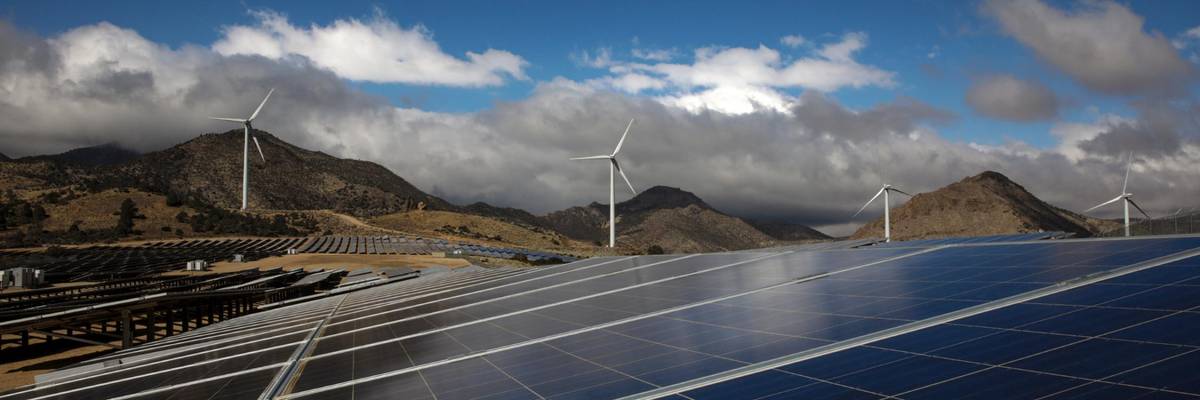
The Pine Tree Wind Farm and Solar Power Plant is located in Tehachapi Mountains in Kern County, California. (Photo: Irfan Khan/Los Angeles Times via Getty Images)
Climate campaigners and experts welcomed new renewable power projections released Tuesday by the Paris-based International Energy Agency.
Despite the coronavirus pandemic, the amount of renewable electricity capacity added last year soared by 45% to 280 gigawatts (GW), an increase that the IEA's analysis expects to become the "new normal."
Driven by "huge additions of solar and wind," the increase in 2020 was the greatest year-on-year jump since 1999. The IEA forecasts that about 270 GW of renewable capacity will be added this year, followed by nearly 280 GW in 2022.
In other words, as Greenpeace put it in a Tuesday tweet about the agency's new report: "The future of energy? Bright and breezy."
"Wind and solar power are giving us more reasons to be optimistic about our climate goals as they break record after record. Last year, the increase in renewable capacity accounted for 90% of the entire global power sector's expansion," IEA executive director Fatih Birol said in a statement.
"Governments need to build on this promising momentum through policies that encourage greater investment in solar and wind, in the additional grid infrastructure they will require, and in other key renewable technologies such as hydropower, bioenergy, and geothermal," Birol added. "A massive expansion of clean electricity is essential to giving the world a chance of achieving its net-zero goals."
Ahead of a global climate summit planned for November, governments are in the process of revealing their updated commitments to cut greenhouse gas emissions in line with the Paris agreement's more ambitious goal of limiting global temperature rise this century to 1.5degC. One analysis released last week found that nations' latest targets put the planet on track for 2.4degC of warming by 2100.
While greater government ambition and action is clearly needed to meet international goals, the latest projections still provided some hope. Heymi Bahar, lead author of the IEA's new report, told The Guardian that the 2020 renewables boom was "unprecedented."
Bahar told the newspaper that record-level auctions for new renewable power projects by governments coupled with increased private business investments represents serious "momentum" and is set to become "the new normal for renewable energy."
The IEA's new numbers for the next couple years notably have been revised upward by over 25% from the agency's November estimates.
Carbon Brief pointed out Tuesday that "the IEA has repeatedly raised its expectations for wind and solar over the past decade, drawing fire from critics that say--in the words of a 2019 Reuters article--that it has 'underplay[ed] the speed at which the world could switch renewable sources of energy."
Though action is needed across various industries worldwide to reduce planet-heating emissions, the energy sector is by far the biggest contributor. As the World Resources Institute noted in December, "The top three greenhouse gas emitters--China, the European Union, and the United States--contribute 41.5% of total global emissions, while the bottom 100 countries only account for only 3.6%."
The IEA projects some shifts among top polluters in the years ahead:
China is at the center of global renewable demand and supply, accounting for around 40% of global renewable capacity growth for several years. In 2020, China's share rose to 50% for the first time due to a rush to complete projects before government subsidies were phased out. In 2021-22 renewables growth in China is set to stabilize at levels that are below the 2020 record but still over 50% above where it was during the 2017-19 period. Any slowdown in China in the coming years will be compensated for by strong growth in Europe, the United States, India, and Latin America where government support and falling prices for solar PV and wind continue to drive installations.
The Guardian reported that the new IEA forecasts don't take into account recent pledges from U.S. President Joe Biden, who took office in January and has since vowed to halve the nation's emissions over the next decade. Though the plan represents a major shift from his predecessor, climate justice campaigners argue it is "not good enough" and more must be done.
This country and this world are at a monumental crossroads. US voters have an opportunity to beat back the forces of fascism and confront the billionaires who are rigging the economy, our media system, and our democracy, making it increasingly impossible for ordinary people to get by. We’re not just talking about the election. We’re talking about what must be done once these fascist elements are vanquished from power. We need a bolder set of solutions than what either major party has so far been willing to offer and a working-class movement ready to fight like hell for it. Trump didn't emerge from nowhere. The conditions that fueled MAGA authoritarianism were created by decades of radical neoliberal economic policies and a corrupt political system dominated by corporate interests. They slashed taxes on the super-rich, promising that the benefits would trickle down. They said giveaways to the corporate titans would make life more affordable for the rest of us. It was all bullshit. And when a bitter, betrayed populace searches for someone to blame, right-wing demagogues have little trouble finding scapegoats. People know when they're being lied to, but you won't hear any of this from the corporate media. Only independent journalism—powered and funded by people who believe in building a better world—can deliver truly trustworthy daily news. If you share our vision, please contribute whatever you can to sustain our work. |
Climate campaigners and experts welcomed new renewable power projections released Tuesday by the Paris-based International Energy Agency.
Despite the coronavirus pandemic, the amount of renewable electricity capacity added last year soared by 45% to 280 gigawatts (GW), an increase that the IEA's analysis expects to become the "new normal."
Driven by "huge additions of solar and wind," the increase in 2020 was the greatest year-on-year jump since 1999. The IEA forecasts that about 270 GW of renewable capacity will be added this year, followed by nearly 280 GW in 2022.
In other words, as Greenpeace put it in a Tuesday tweet about the agency's new report: "The future of energy? Bright and breezy."
"Wind and solar power are giving us more reasons to be optimistic about our climate goals as they break record after record. Last year, the increase in renewable capacity accounted for 90% of the entire global power sector's expansion," IEA executive director Fatih Birol said in a statement.
"Governments need to build on this promising momentum through policies that encourage greater investment in solar and wind, in the additional grid infrastructure they will require, and in other key renewable technologies such as hydropower, bioenergy, and geothermal," Birol added. "A massive expansion of clean electricity is essential to giving the world a chance of achieving its net-zero goals."
Ahead of a global climate summit planned for November, governments are in the process of revealing their updated commitments to cut greenhouse gas emissions in line with the Paris agreement's more ambitious goal of limiting global temperature rise this century to 1.5degC. One analysis released last week found that nations' latest targets put the planet on track for 2.4degC of warming by 2100.
While greater government ambition and action is clearly needed to meet international goals, the latest projections still provided some hope. Heymi Bahar, lead author of the IEA's new report, told The Guardian that the 2020 renewables boom was "unprecedented."
Bahar told the newspaper that record-level auctions for new renewable power projects by governments coupled with increased private business investments represents serious "momentum" and is set to become "the new normal for renewable energy."
The IEA's new numbers for the next couple years notably have been revised upward by over 25% from the agency's November estimates.
Carbon Brief pointed out Tuesday that "the IEA has repeatedly raised its expectations for wind and solar over the past decade, drawing fire from critics that say--in the words of a 2019 Reuters article--that it has 'underplay[ed] the speed at which the world could switch renewable sources of energy."
Though action is needed across various industries worldwide to reduce planet-heating emissions, the energy sector is by far the biggest contributor. As the World Resources Institute noted in December, "The top three greenhouse gas emitters--China, the European Union, and the United States--contribute 41.5% of total global emissions, while the bottom 100 countries only account for only 3.6%."
The IEA projects some shifts among top polluters in the years ahead:
China is at the center of global renewable demand and supply, accounting for around 40% of global renewable capacity growth for several years. In 2020, China's share rose to 50% for the first time due to a rush to complete projects before government subsidies were phased out. In 2021-22 renewables growth in China is set to stabilize at levels that are below the 2020 record but still over 50% above where it was during the 2017-19 period. Any slowdown in China in the coming years will be compensated for by strong growth in Europe, the United States, India, and Latin America where government support and falling prices for solar PV and wind continue to drive installations.
The Guardian reported that the new IEA forecasts don't take into account recent pledges from U.S. President Joe Biden, who took office in January and has since vowed to halve the nation's emissions over the next decade. Though the plan represents a major shift from his predecessor, climate justice campaigners argue it is "not good enough" and more must be done.