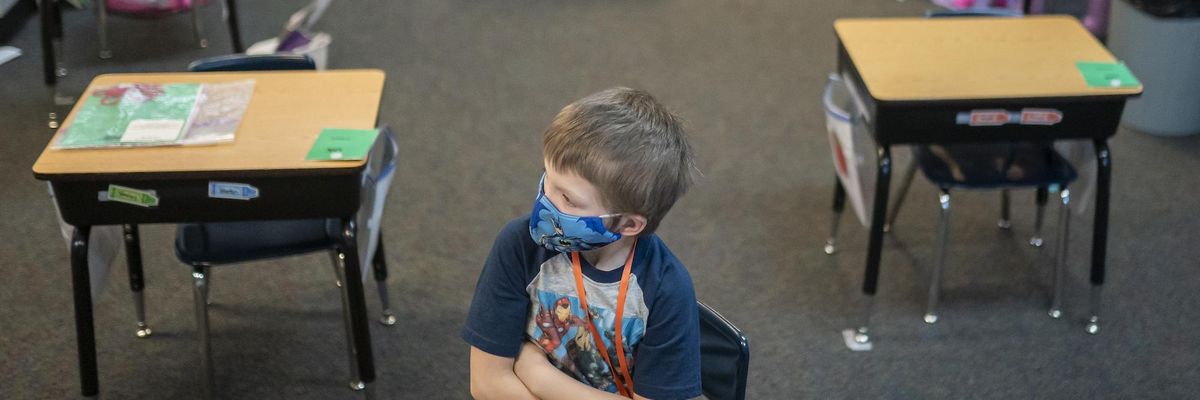
A first grade student at the Green Mountain School listens to his teacher on February 18, 2021 in Woodland, Washington. (Photo: Nathan Howard/Getty Images)
Washington State Lawmakers Approve Capital Gains Tax on Wealthiest to Fund Public Education
"This is the most equitable change to Washington state's upside-down tax code in nearly 90 years," says the Washington State Budget and Policy Center.
Gov. Jay Inslee declared it "a good day in Washington state" after lawmakers on Sunday approved a 7% capital gains tax to fund public education.
Senate Bill 5096 passed in a 25-24 vote, and, according to Inslee, "will help us address our upside-down tax system."
The measure imposes a 7% tax on the sale of stocks, bonds, or other capital assets where the profit exceeds $250,000. That revenue will "fund K-12 education, early learning, and child care, and advance our paramount duty to amply provide an education to every child in the state," the bill states.
The raised funds will go to the Education Legacy Trust Account, with an annual cap on those deposits of $500 million. Any additional funds raised will be directed to the Common School Construction Account.
Democrats in the state Senate asserted that tax will hit only about 0.23% of taxpayers and will enable the state "to deliver the critical early learning services and care that our kiddos need for success--throughout school and life."
The tax is expected to affect about 7,000 of the state's residents. It has exemptions including all real estate, retirement accounts, livestock, agricultural land, fishing privileges, and family-owned small businesses.
Democratic state Sen. June Robinson, the bill's sponsor, heralded its passage as an "important step to rebuild our unfair tax code [that] was taken after years of work, years of dialogue, and thousands of voices calling for this policy."
"We've heard that people from every part of our state are ready to move toward a healthier, stronger future together," said Robinson, "and it's time for the wealthiest among us to pay their fair share for that future."
According to the Washington State Budget and Policy Center, which provided research for the legislative proposal, the bill marks "a critical move toward fixing Washington state's inequitable and racist tax code. It's even more meaningful because it comes on the heels of another big win toward making our state tax code more progressive, the passage of the Working Families Tax Credit." The group explained:
This is the most equitable change to Washington state's upside-down tax code in nearly 90 years. Our regressive tax code currently relies on the people with the lowest incomes to pay the largest percentage of state and local taxes as a share of income. This has been especially damaging to people who are Black, Indigenous, and people of color (BIPOC)--because they face higher average tax rates than wealthy white households as a result of racist policies, like redlining and employment discrimination, that have excluded them from access to wealth and opportunity. It has also prevented our state from having necessary resources to adequately invest in the needs of BIPOC communities. ESSB 5096 would be paid for almost entirely by wealthy white people who have benefited from policies and systems that channel resources to them, and it would increase their taxes by a mere 0.9%.
Meanwhile, taxing capital gains will not only increase investment in communities, but it will also help jumpstart our state economy and create nearly 20,000 jobs per year. The tax revenue will also help our state avoid the mistakes of the last recession by providing a permanent replacement for temporary federal recovery funds. This is a commonsense move to ensure there's long-term funding when federal funding--which is an important bridge to recovery--runs out.
Declaring passage of Senate Bill 5096 a "victory," the Cascadia Advocate, a publication of the Northwest Progressive Institute, cautioned, "Our work is not done, of course." The group pointed to a potential legal challenge or "a challenge from the opposition in the form of an initiative to the people for 2021 or (more likely) an initiative to the legislature for 2022."
For now, the bill now heads to Inslee, who said Sunday that it "has been one of my priorities for years."
We are at a crossroads
This country and this world are at a monumental crossroads. In a few short weeks, US voters will have an opportunity to beat back the forces of fascism and confront the billionaires who are rigging the economy, our media system, and our democracy, making it increasingly impossible for ordinary people to get by. We’re not just talking about the election. We’re talking about what must be done once these fascist elements are vanquished from power. We need a bolder set of solutions than what either major party has so far been willing to offer and a working-class movement ready to fight like hell for it. Trump didn't emerge from nowhere. The conditions that fueled MAGA authoritarianism were created by decades of radical neoliberal economic policies and a corrupt political system dominated by corporate interests. They slashed taxes on the super-rich, promising that the benefits would trickle down. They said giveaways to the corporate titans would make life more affordable for the rest of us. It was all bullshit. And when a bitter, betrayed populace searches for someone to blame, right-wing demagogues have little trouble finding scapegoats. People know when they're being lied to, but you won't hear any of this from the corporate media. Only independent journalism—powered and funded by people who believe in building a better world—can deliver truly trustworthy daily news. Our Fall Campaign is underway, and we need your help. To power our newsroom through the rest of the year, we need to raise $125,000 by midnight on October 31. So if you share our vision, please contribute whatever you can to sustain our work. |
Gov. Jay Inslee declared it "a good day in Washington state" after lawmakers on Sunday approved a 7% capital gains tax to fund public education.
Senate Bill 5096 passed in a 25-24 vote, and, according to Inslee, "will help us address our upside-down tax system."
The measure imposes a 7% tax on the sale of stocks, bonds, or other capital assets where the profit exceeds $250,000. That revenue will "fund K-12 education, early learning, and child care, and advance our paramount duty to amply provide an education to every child in the state," the bill states.
The raised funds will go to the Education Legacy Trust Account, with an annual cap on those deposits of $500 million. Any additional funds raised will be directed to the Common School Construction Account.
Democrats in the state Senate asserted that tax will hit only about 0.23% of taxpayers and will enable the state "to deliver the critical early learning services and care that our kiddos need for success--throughout school and life."
The tax is expected to affect about 7,000 of the state's residents. It has exemptions including all real estate, retirement accounts, livestock, agricultural land, fishing privileges, and family-owned small businesses.
Democratic state Sen. June Robinson, the bill's sponsor, heralded its passage as an "important step to rebuild our unfair tax code [that] was taken after years of work, years of dialogue, and thousands of voices calling for this policy."
"We've heard that people from every part of our state are ready to move toward a healthier, stronger future together," said Robinson, "and it's time for the wealthiest among us to pay their fair share for that future."
According to the Washington State Budget and Policy Center, which provided research for the legislative proposal, the bill marks "a critical move toward fixing Washington state's inequitable and racist tax code. It's even more meaningful because it comes on the heels of another big win toward making our state tax code more progressive, the passage of the Working Families Tax Credit." The group explained:
This is the most equitable change to Washington state's upside-down tax code in nearly 90 years. Our regressive tax code currently relies on the people with the lowest incomes to pay the largest percentage of state and local taxes as a share of income. This has been especially damaging to people who are Black, Indigenous, and people of color (BIPOC)--because they face higher average tax rates than wealthy white households as a result of racist policies, like redlining and employment discrimination, that have excluded them from access to wealth and opportunity. It has also prevented our state from having necessary resources to adequately invest in the needs of BIPOC communities. ESSB 5096 would be paid for almost entirely by wealthy white people who have benefited from policies and systems that channel resources to them, and it would increase their taxes by a mere 0.9%.
Meanwhile, taxing capital gains will not only increase investment in communities, but it will also help jumpstart our state economy and create nearly 20,000 jobs per year. The tax revenue will also help our state avoid the mistakes of the last recession by providing a permanent replacement for temporary federal recovery funds. This is a commonsense move to ensure there's long-term funding when federal funding--which is an important bridge to recovery--runs out.
Declaring passage of Senate Bill 5096 a "victory," the Cascadia Advocate, a publication of the Northwest Progressive Institute, cautioned, "Our work is not done, of course." The group pointed to a potential legal challenge or "a challenge from the opposition in the form of an initiative to the people for 2021 or (more likely) an initiative to the legislature for 2022."
For now, the bill now heads to Inslee, who said Sunday that it "has been one of my priorities for years."