SUBSCRIBE TO OUR FREE NEWSLETTER
Daily news & progressive opinion—funded by the people, not the corporations—delivered straight to your inbox.
5
#000000
#FFFFFF
To donate by check, phone, or other method, see our More Ways to Give page.
Daily news & progressive opinion—funded by the people, not the corporations—delivered straight to your inbox.
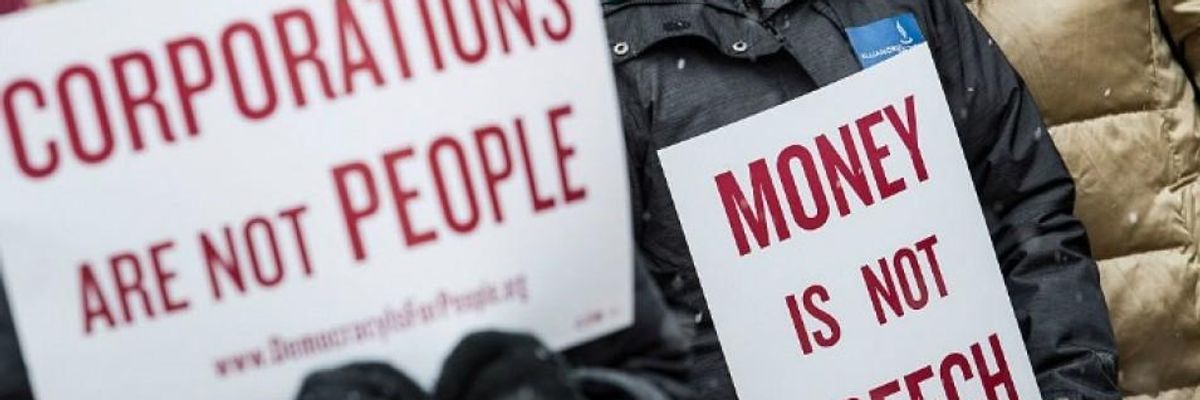
Rep. Pramila Jayapal (D-Wash.) and dozens of House Democrats introduced the We the People Amendment--which would reverse the Supreme Court's Citizens United ruling and end corporate personhood--on April 6, 2021. (Photo: Drew Angerer/Getty Images)
Reaffirming that "corporations are not people and money is not speech," Rep. Pramila Jayapal on Tuesday led 50 members of Congress in introducing a constitutional amendment to end corporate personhood, reverse the Supreme Court's Citizens United v. Federal Election Commission ruling, and "put power back into the hands of people."
"After the most expensive election in American history in which special interests poured millions in dark money into campaigns across this country, the We the People Amendment finally returns the power to the people."
--Rep. Pramila Jayapal
The We the People Amendment (pdf) would establish that "the rights extended by the Constitution are the rights of natural persons only" and that "artificial entities, such as corporations, limited liability companies, and other entities... have no rights under this Constitution."
Furthermore, the proposed amendment states that "the privileges of artificial entities shall be determined by the people through federal, state, or local law."
The measure follows an election cycle that saw an unprecedented $14.4 billion in total spending on federal contests, with Joe Biden's presidential campaign becoming the first ever to raise over $1 billion from donors, according to the Center for Responsibile Politics' (CRP) transparency watchdog OpenSecrets.
Nine of the 10 most expensive Senate races in U.S. history also occurred last year, and CRP reported a shift to large donation strategies, with the top 10 donors--who mostly gave to political action committees (PACs) unfettered by spending limits under Citizens United--pouring a staggering $640 million into 2020 races.
"After the most expensive election in American history in which special interests poured millions in dark money into campaigns across this country, the We the People Amendment finally returns the power to the people, ends corporate constitutional rights, reverses Citizens United, and ensures that our democracy is really of the people, by the people--not corporations," Jayapal (D-Wash.) said Tuesday.
The We the People Amendment follows the January re-introduction in the House of the Democracy for All Amendment, a bipartisan constitutional amendment that would give states and the federal government the ability to limit how money is raised and spent in U.S. elections. It also grants the states and Congress the power to differentiate between natural and corporate persons.
The new proposed amendment comes as state and local governments attempt to tackle the problem of corporate campaign spending. In California, Democratic state Assembly members Alex Lee and Ash Kalra recently introduced AB-20, the Clean Money Act of 2021, which would outlaw candidates for state office from accepting campaign contributions from businesses.
Speaking Tuesday at a Zoom press conference ahead of a San Francisco Board of Supervisors vote on a resolution backing AB-20, Kalra tied the bill to Jayapal's proposed constitutional amendment, calling the measures "complimentary."
"Each individual should have an equal voice in the elections process, but big corporate donations skew the narrative and creates a fracture in our democracy and hurts those of us who don't have the resources to compete," he said.
"Just moments ago, Congresswoman Jayapal introduced a bill in Washington, D.C. to overturn Citizens United and strip away corporate personhood," Kalra added. "So AB-20 is in alignment with what we need to do as a nation. We can't just rely on that bill at the federal level without us doing what we need to do at the local level."
Press conference host Jackie Fielder--an Indigenous educator and activist who, unlike her opponent, took a clean money pledge in her grassroots-driven yet ultimately unsuccessful 2020 bid for the California Senate--said she strongly supports banning corporate campaign contributions.
"It was incredibly challenging to face an incumbent who has long taken money from corporations," Fielder told Common Dreams. "My opponent could call any corporation with business before the legislature and secure 'max-out' donations."
"In the end, that meant he could be on TV, radio, and several mail pieces while we could only afford a few mail pieces and talking directly to voters," she added.
Dear Common Dreams reader, It’s been nearly 30 years since I co-founded Common Dreams with my late wife, Lina Newhouser. We had the radical notion that journalism should serve the public good, not corporate profits. It was clear to us from the outset what it would take to build such a project. No paid advertisements. No corporate sponsors. No millionaire publisher telling us what to think or do. Many people said we wouldn't last a year, but we proved those doubters wrong. Together with a tremendous team of journalists and dedicated staff, we built an independent media outlet free from the constraints of profits and corporate control. Our mission has always been simple: To inform. To inspire. To ignite change for the common good. Building Common Dreams was not easy. Our survival was never guaranteed. When you take on the most powerful forces—Wall Street greed, fossil fuel industry destruction, Big Tech lobbyists, and uber-rich oligarchs who have spent billions upon billions rigging the economy and democracy in their favor—the only bulwark you have is supporters who believe in your work. But here’s the urgent message from me today. It's never been this bad out there. And it's never been this hard to keep us going. At the very moment Common Dreams is most needed, the threats we face are intensifying. We need your support now more than ever. We don't accept corporate advertising and never will. We don't have a paywall because we don't think people should be blocked from critical news based on their ability to pay. Everything we do is funded by the donations of readers like you. When everyone does the little they can afford, we are strong. But if that support retreats or dries up, so do we. Will you donate now to make sure Common Dreams not only survives but thrives? —Craig Brown, Co-founder |
Reaffirming that "corporations are not people and money is not speech," Rep. Pramila Jayapal on Tuesday led 50 members of Congress in introducing a constitutional amendment to end corporate personhood, reverse the Supreme Court's Citizens United v. Federal Election Commission ruling, and "put power back into the hands of people."
"After the most expensive election in American history in which special interests poured millions in dark money into campaigns across this country, the We the People Amendment finally returns the power to the people."
--Rep. Pramila Jayapal
The We the People Amendment (pdf) would establish that "the rights extended by the Constitution are the rights of natural persons only" and that "artificial entities, such as corporations, limited liability companies, and other entities... have no rights under this Constitution."
Furthermore, the proposed amendment states that "the privileges of artificial entities shall be determined by the people through federal, state, or local law."
The measure follows an election cycle that saw an unprecedented $14.4 billion in total spending on federal contests, with Joe Biden's presidential campaign becoming the first ever to raise over $1 billion from donors, according to the Center for Responsibile Politics' (CRP) transparency watchdog OpenSecrets.
Nine of the 10 most expensive Senate races in U.S. history also occurred last year, and CRP reported a shift to large donation strategies, with the top 10 donors--who mostly gave to political action committees (PACs) unfettered by spending limits under Citizens United--pouring a staggering $640 million into 2020 races.
"After the most expensive election in American history in which special interests poured millions in dark money into campaigns across this country, the We the People Amendment finally returns the power to the people, ends corporate constitutional rights, reverses Citizens United, and ensures that our democracy is really of the people, by the people--not corporations," Jayapal (D-Wash.) said Tuesday.
The We the People Amendment follows the January re-introduction in the House of the Democracy for All Amendment, a bipartisan constitutional amendment that would give states and the federal government the ability to limit how money is raised and spent in U.S. elections. It also grants the states and Congress the power to differentiate between natural and corporate persons.
The new proposed amendment comes as state and local governments attempt to tackle the problem of corporate campaign spending. In California, Democratic state Assembly members Alex Lee and Ash Kalra recently introduced AB-20, the Clean Money Act of 2021, which would outlaw candidates for state office from accepting campaign contributions from businesses.
Speaking Tuesday at a Zoom press conference ahead of a San Francisco Board of Supervisors vote on a resolution backing AB-20, Kalra tied the bill to Jayapal's proposed constitutional amendment, calling the measures "complimentary."
"Each individual should have an equal voice in the elections process, but big corporate donations skew the narrative and creates a fracture in our democracy and hurts those of us who don't have the resources to compete," he said.
"Just moments ago, Congresswoman Jayapal introduced a bill in Washington, D.C. to overturn Citizens United and strip away corporate personhood," Kalra added. "So AB-20 is in alignment with what we need to do as a nation. We can't just rely on that bill at the federal level without us doing what we need to do at the local level."
Press conference host Jackie Fielder--an Indigenous educator and activist who, unlike her opponent, took a clean money pledge in her grassroots-driven yet ultimately unsuccessful 2020 bid for the California Senate--said she strongly supports banning corporate campaign contributions.
"It was incredibly challenging to face an incumbent who has long taken money from corporations," Fielder told Common Dreams. "My opponent could call any corporation with business before the legislature and secure 'max-out' donations."
"In the end, that meant he could be on TV, radio, and several mail pieces while we could only afford a few mail pieces and talking directly to voters," she added.
Reaffirming that "corporations are not people and money is not speech," Rep. Pramila Jayapal on Tuesday led 50 members of Congress in introducing a constitutional amendment to end corporate personhood, reverse the Supreme Court's Citizens United v. Federal Election Commission ruling, and "put power back into the hands of people."
"After the most expensive election in American history in which special interests poured millions in dark money into campaigns across this country, the We the People Amendment finally returns the power to the people."
--Rep. Pramila Jayapal
The We the People Amendment (pdf) would establish that "the rights extended by the Constitution are the rights of natural persons only" and that "artificial entities, such as corporations, limited liability companies, and other entities... have no rights under this Constitution."
Furthermore, the proposed amendment states that "the privileges of artificial entities shall be determined by the people through federal, state, or local law."
The measure follows an election cycle that saw an unprecedented $14.4 billion in total spending on federal contests, with Joe Biden's presidential campaign becoming the first ever to raise over $1 billion from donors, according to the Center for Responsibile Politics' (CRP) transparency watchdog OpenSecrets.
Nine of the 10 most expensive Senate races in U.S. history also occurred last year, and CRP reported a shift to large donation strategies, with the top 10 donors--who mostly gave to political action committees (PACs) unfettered by spending limits under Citizens United--pouring a staggering $640 million into 2020 races.
"After the most expensive election in American history in which special interests poured millions in dark money into campaigns across this country, the We the People Amendment finally returns the power to the people, ends corporate constitutional rights, reverses Citizens United, and ensures that our democracy is really of the people, by the people--not corporations," Jayapal (D-Wash.) said Tuesday.
The We the People Amendment follows the January re-introduction in the House of the Democracy for All Amendment, a bipartisan constitutional amendment that would give states and the federal government the ability to limit how money is raised and spent in U.S. elections. It also grants the states and Congress the power to differentiate between natural and corporate persons.
The new proposed amendment comes as state and local governments attempt to tackle the problem of corporate campaign spending. In California, Democratic state Assembly members Alex Lee and Ash Kalra recently introduced AB-20, the Clean Money Act of 2021, which would outlaw candidates for state office from accepting campaign contributions from businesses.
Speaking Tuesday at a Zoom press conference ahead of a San Francisco Board of Supervisors vote on a resolution backing AB-20, Kalra tied the bill to Jayapal's proposed constitutional amendment, calling the measures "complimentary."
"Each individual should have an equal voice in the elections process, but big corporate donations skew the narrative and creates a fracture in our democracy and hurts those of us who don't have the resources to compete," he said.
"Just moments ago, Congresswoman Jayapal introduced a bill in Washington, D.C. to overturn Citizens United and strip away corporate personhood," Kalra added. "So AB-20 is in alignment with what we need to do as a nation. We can't just rely on that bill at the federal level without us doing what we need to do at the local level."
Press conference host Jackie Fielder--an Indigenous educator and activist who, unlike her opponent, took a clean money pledge in her grassroots-driven yet ultimately unsuccessful 2020 bid for the California Senate--said she strongly supports banning corporate campaign contributions.
"It was incredibly challenging to face an incumbent who has long taken money from corporations," Fielder told Common Dreams. "My opponent could call any corporation with business before the legislature and secure 'max-out' donations."
"In the end, that meant he could be on TV, radio, and several mail pieces while we could only afford a few mail pieces and talking directly to voters," she added.