SUBSCRIBE TO OUR FREE NEWSLETTER
Daily news & progressive opinion—funded by the people, not the corporations—delivered straight to your inbox.
5
#000000
#FFFFFF
To donate by check, phone, or other method, see our More Ways to Give page.
Daily news & progressive opinion—funded by the people, not the corporations—delivered straight to your inbox.
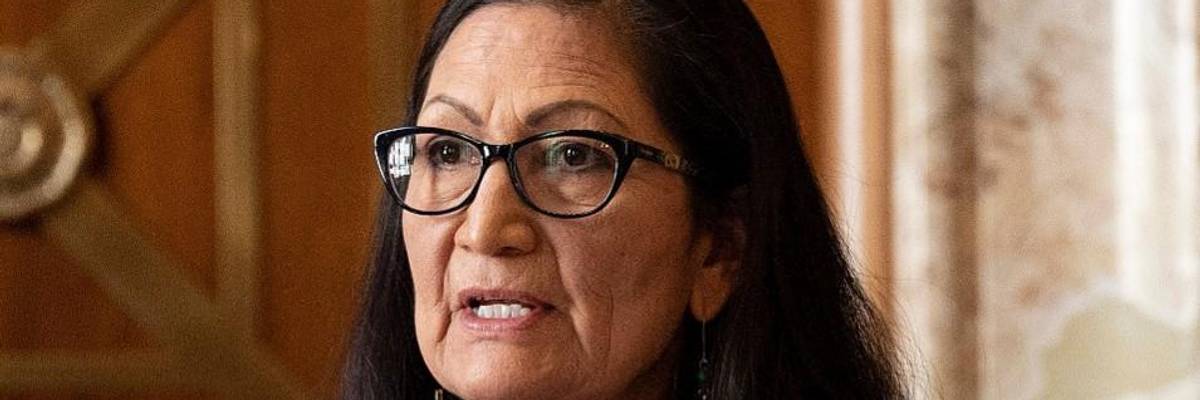
On April 1, 2021 U.S. Interior Secretary announced a new Bureau of Indian Affairs unit dedicated to the investigation of missing and murdered Indigenous people. (Photo: Tom Williams/CQ-Roll Call, Inc. via Getty Images)
Human rights defenders on Friday applauded the announcement by U.S. Interior Secretary Deb Haaland that the Bureau of Indian Affairs will establish a unit tasked with investigating missing and murdered Indigenous people.
"Violence against Indigenous peoples is a crisis that has been underfunded for decades. Far too often, murders and missing persons cases in Indian country go unsolved and unaddressed, leaving families and communities devastated."
--Interior Secretary
Deb Haaland
The Interior Department said in a statement Thursday that "approximately 1,500 American Indian and Alaska Native missing persons have been entered into the National Crime Information Center throughout the U.S., and approximately 2,700 cases of murder and nonnegligent homicide offenses have been reported to the federal government's Uniform Crime Reporting program."
The agency said that the new Missing & Murdered Unit (MMU) "will help put the full weight of the federal government into investigating these cases and marshal law enforcement resources across federal agencies and throughout Indian country."
The MMU will build on the work of Operation Lady Justice, a task force on missing and murdered Indigenous people launched in 2019.
"Investigations remain unsolved often due to a lack of investigative resources available to identify new information from witness testimony, re-examine new or retained material evidence, and review fresh activities of suspects," the Interior Department statement said. "The MMU, in addition to reviewing unsolved cases, will immediately begin working with tribal, BIA, and FBI investigators on active missing and murdered investigations."
Haaland--the first Native American Cabinet secretary in U.S. history--said Thursday that "violence against Indigenous peoples is a crisis that has been underfunded for decades. Far too often, murders and missing persons cases in Indian country go unsolved and unaddressed, leaving families and communities devastated."
"The new MMU unit will provide the resources and leadership to prioritize these cases and coordinate resources to hold people accountable, keep our communities safe, and provide closure for families," Haaland continued. "Whether it's a missing family member or a homicide investigation, these efforts will be all hands on deck."
"We are fully committed to assisting tribal communities with these investigations, and the MMU will leverage every resource available to be a force-multiplier in preventing these cases from becoming cold case investigations," she added.
According to the Coalition to Stop Violence Against Native Women, Indigenous women are murdered at 10 times the national average. Statistics from the U.S. Centers for Disease Control and Prevention show homicide is the third-leading cause of death among American Indian and Alaska Native girls and women ages 10 to 24 and the fifth-leading cause of death for those between the ages of 25 and 34.
A 2016 National Institute of Justice report (pdf) found that 84% of Indigenous women have experienced violence in their lifetimes, 41% had been physically injured by intimate partners, and 67% were concerned for their safety.
Two years later, a survey (pdf) published by the Seattle-based Urban Indian Health Institute reported 5,712 cases of missing and murdered Indigenous girls in 2016, of which only 116 were logged in the U.S. Department of Justice's federal missing persons database.
May 5 is National Day of Awareness for missing and murdered Native women and girls.
This country and this world are at a monumental crossroads. US voters have an opportunity to beat back the forces of fascism and confront the billionaires who are rigging the economy, our media system, and our democracy, making it increasingly impossible for ordinary people to get by. We’re not just talking about the election. We’re talking about what must be done once these fascist elements are vanquished from power. We need a bolder set of solutions than what either major party has so far been willing to offer and a working-class movement ready to fight like hell for it. Trump didn't emerge from nowhere. The conditions that fueled MAGA authoritarianism were created by decades of radical neoliberal economic policies and a corrupt political system dominated by corporate interests. They slashed taxes on the super-rich, promising that the benefits would trickle down. They said giveaways to the corporate titans would make life more affordable for the rest of us. It was all bullshit. And when a bitter, betrayed populace searches for someone to blame, right-wing demagogues have little trouble finding scapegoats. People know when they're being lied to, but you won't hear any of this from the corporate media. Only independent journalism—powered and funded by people who believe in building a better world—can deliver truly trustworthy daily news. If you share our vision, please contribute whatever you can to sustain our work. |
Human rights defenders on Friday applauded the announcement by U.S. Interior Secretary Deb Haaland that the Bureau of Indian Affairs will establish a unit tasked with investigating missing and murdered Indigenous people.
"Violence against Indigenous peoples is a crisis that has been underfunded for decades. Far too often, murders and missing persons cases in Indian country go unsolved and unaddressed, leaving families and communities devastated."
--Interior Secretary
Deb Haaland
The Interior Department said in a statement Thursday that "approximately 1,500 American Indian and Alaska Native missing persons have been entered into the National Crime Information Center throughout the U.S., and approximately 2,700 cases of murder and nonnegligent homicide offenses have been reported to the federal government's Uniform Crime Reporting program."
The agency said that the new Missing & Murdered Unit (MMU) "will help put the full weight of the federal government into investigating these cases and marshal law enforcement resources across federal agencies and throughout Indian country."
The MMU will build on the work of Operation Lady Justice, a task force on missing and murdered Indigenous people launched in 2019.
"Investigations remain unsolved often due to a lack of investigative resources available to identify new information from witness testimony, re-examine new or retained material evidence, and review fresh activities of suspects," the Interior Department statement said. "The MMU, in addition to reviewing unsolved cases, will immediately begin working with tribal, BIA, and FBI investigators on active missing and murdered investigations."
Haaland--the first Native American Cabinet secretary in U.S. history--said Thursday that "violence against Indigenous peoples is a crisis that has been underfunded for decades. Far too often, murders and missing persons cases in Indian country go unsolved and unaddressed, leaving families and communities devastated."
"The new MMU unit will provide the resources and leadership to prioritize these cases and coordinate resources to hold people accountable, keep our communities safe, and provide closure for families," Haaland continued. "Whether it's a missing family member or a homicide investigation, these efforts will be all hands on deck."
"We are fully committed to assisting tribal communities with these investigations, and the MMU will leverage every resource available to be a force-multiplier in preventing these cases from becoming cold case investigations," she added.
According to the Coalition to Stop Violence Against Native Women, Indigenous women are murdered at 10 times the national average. Statistics from the U.S. Centers for Disease Control and Prevention show homicide is the third-leading cause of death among American Indian and Alaska Native girls and women ages 10 to 24 and the fifth-leading cause of death for those between the ages of 25 and 34.
A 2016 National Institute of Justice report (pdf) found that 84% of Indigenous women have experienced violence in their lifetimes, 41% had been physically injured by intimate partners, and 67% were concerned for their safety.
Two years later, a survey (pdf) published by the Seattle-based Urban Indian Health Institute reported 5,712 cases of missing and murdered Indigenous girls in 2016, of which only 116 were logged in the U.S. Department of Justice's federal missing persons database.
May 5 is National Day of Awareness for missing and murdered Native women and girls.