SUBSCRIBE TO OUR FREE NEWSLETTER
Daily news & progressive opinion—funded by the people, not the corporations—delivered straight to your inbox.
5
#000000
#FFFFFF
To donate by check, phone, or other method, see our More Ways to Give page.
Daily news & progressive opinion—funded by the people, not the corporations—delivered straight to your inbox.
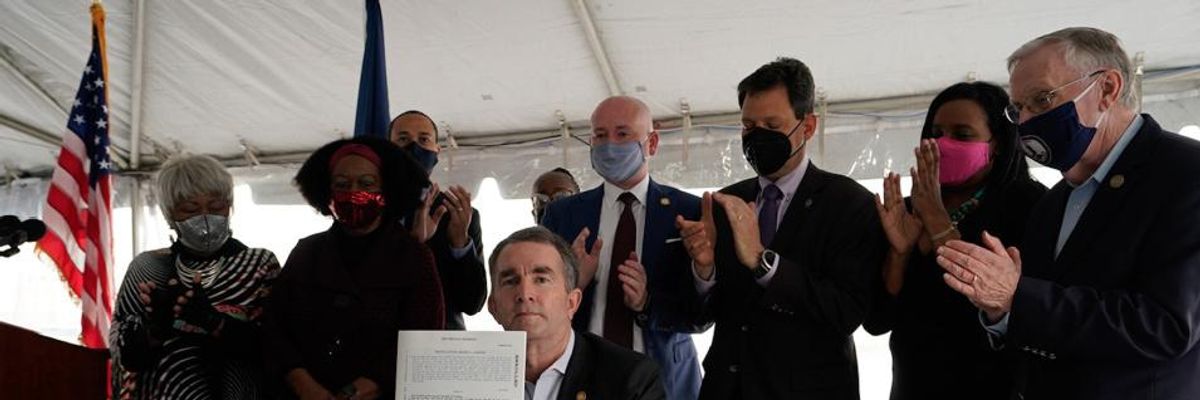
Virginia Gov. Ralph Northam signed legislation abolishing the death penalty statewide at a ceremony outside the Greensville Correctional Center.
Human rights advocates applauded after Democratic Gov. Ralph Northam on Wednesday signed legislation that makes Virginia the 23rd state--and the first in the South--to abolish the death penalty.
"The death penalty system is fundamentally flawed--it is inequitable, ineffective, and it has no place in this commonwealth or this country."
--Gov. Ralph Northam
Northam signed the legislation--which was approved by lawmakers last month--at a ceremony outside the Greensville Correctional Center, home to the state's execution chamber. Virginia has a long history of capital punishment with at least 1,391 documented executions.
"Over our 400-year history, Virginia has executed more people than any other state," Northam noted. "The death penalty system is fundamentally flawed--it is inequitable, ineffective, and it has no place in this commonwealth or this country."
"Virginia has come within days of executing innocent people, and Black defendants have been disproportionately sentenced to death," the governor said. "Abolishing this inhumane practice is the moral thing to do. This is a truly historic day for Virginia, and I am deeply grateful to those who have fought tirelessly and for generations to put an end to capital punishment in our commonwealth."
Kristina Roth, senior advocate for Criminal Justice Programs at Amnesty International USA, welcomed Northam's anticipated move and echoed his critiques of the practice.
"The death penalty is irreversible, it is ineffective, and it does not deter crime," Roth said. "The way the death penalty is carried out is painful, violent, and inhumane, and it is targeted in this country disproportionately against communities of color. The use of the death penalty as a punishment is outdated, fundamentally broken, and must end once and for all."
"Virginia, once a stronghold of the Confederacy, now becomes the first southern state to end the ultimate denial of human rights that is the death penalty," she added.
"The use of the death penalty as a punishment is outdated, fundamentally broken, and must end once and for all."
--Kristina Roth, Amnesty International USA
Highlighting the commonwealth's "sordid past with the use of the death penalty against Black people, applied arbitrarily," Roth pointed out that "a Black defendant in Virginia is three times more likely to be sentenced to death if the victim is white rather than Black."
Other supporters of the legislation also emphasized how the death penalty has affected people of color in Virginia for centuries.
"Virginia's legacy on the death penalty was so closely connected to its history of slavery and lynching," said Rev. Dr. LaKeisha Cook of Virginia Interfaith Center for Public Policy. "Now that it is coming to an end, we can start a new chapter that embraces an evidence-based approach to public safety: one that values the dignity of all human beings and is focused on transforming the justice system into one rooted in fairness, accountability, and redemption."
Sarah Craft, Death Penalty Program director at Equal Justice USA said that "Virginia will become the first former Confederate state to abolish capital punishment following a year that saw the dismantling of 168 Confederate symbols across the nation--and nearly half of them in the commonwealth alone."
"This is the final action of a crushing blow against the death penalty, one of our nation's most visible and egregious responses to violence," she added. "It is part of our country's reckoning with a deep and wide legacy of racial injustice."
In a tweet Wednesday, U.S. Sen. Tim Kaine (D-Va.) celebrated his state's action and promised he would "continue to push legislation in the Senate to end the death penalty at the federal level."
While Virginia joins 22 other states and Washington, D.C. that have outlawed capital punishment, members of Congress and President Joe Biden face growing pressure to end the practice at the federal level. After a 17-year hiatus, former President Donald Trump resumed executions in 2019, despite concerns about the drug protocol and global calls for an end to the death penalty.
Trump oversaw what critical lawmakers called a "frenzied and unprecedented" spree of federal executions. As a candidate, Biden vowed to work on passing a bill that would eliminate the death penalty "at the federal level, and incentivize states to follow the federal government's example." Earlier this month, United Nations human rights experts urged him to do everything he can to end all U.S. executions.
Amnesty's Roth said Wednesday that the 13 federal executions carried out under Trump "raised the specter of the same irreparable problems we know the death penalty has at all levels, including racial bias, the executions of people with intellectual disabilities, and arbitrariness of defendants sentenced to death."
"This step from Virginia is a welcome unintended consequence of the Trump execution spree," she said. "We hope to see more states work to retire this most extreme punishment to where it belongs--as a relic of the past, not a part of our future."
Dear Common Dreams reader, It’s been nearly 30 years since I co-founded Common Dreams with my late wife, Lina Newhouser. We had the radical notion that journalism should serve the public good, not corporate profits. It was clear to us from the outset what it would take to build such a project. No paid advertisements. No corporate sponsors. No millionaire publisher telling us what to think or do. Many people said we wouldn't last a year, but we proved those doubters wrong. Together with a tremendous team of journalists and dedicated staff, we built an independent media outlet free from the constraints of profits and corporate control. Our mission has always been simple: To inform. To inspire. To ignite change for the common good. Building Common Dreams was not easy. Our survival was never guaranteed. When you take on the most powerful forces—Wall Street greed, fossil fuel industry destruction, Big Tech lobbyists, and uber-rich oligarchs who have spent billions upon billions rigging the economy and democracy in their favor—the only bulwark you have is supporters who believe in your work. But here’s the urgent message from me today. It's never been this bad out there. And it's never been this hard to keep us going. At the very moment Common Dreams is most needed, the threats we face are intensifying. We need your support now more than ever. We don't accept corporate advertising and never will. We don't have a paywall because we don't think people should be blocked from critical news based on their ability to pay. Everything we do is funded by the donations of readers like you. When everyone does the little they can afford, we are strong. But if that support retreats or dries up, so do we. Will you donate now to make sure Common Dreams not only survives but thrives? —Craig Brown, Co-founder |
Human rights advocates applauded after Democratic Gov. Ralph Northam on Wednesday signed legislation that makes Virginia the 23rd state--and the first in the South--to abolish the death penalty.
"The death penalty system is fundamentally flawed--it is inequitable, ineffective, and it has no place in this commonwealth or this country."
--Gov. Ralph Northam
Northam signed the legislation--which was approved by lawmakers last month--at a ceremony outside the Greensville Correctional Center, home to the state's execution chamber. Virginia has a long history of capital punishment with at least 1,391 documented executions.
"Over our 400-year history, Virginia has executed more people than any other state," Northam noted. "The death penalty system is fundamentally flawed--it is inequitable, ineffective, and it has no place in this commonwealth or this country."
"Virginia has come within days of executing innocent people, and Black defendants have been disproportionately sentenced to death," the governor said. "Abolishing this inhumane practice is the moral thing to do. This is a truly historic day for Virginia, and I am deeply grateful to those who have fought tirelessly and for generations to put an end to capital punishment in our commonwealth."
Kristina Roth, senior advocate for Criminal Justice Programs at Amnesty International USA, welcomed Northam's anticipated move and echoed his critiques of the practice.
"The death penalty is irreversible, it is ineffective, and it does not deter crime," Roth said. "The way the death penalty is carried out is painful, violent, and inhumane, and it is targeted in this country disproportionately against communities of color. The use of the death penalty as a punishment is outdated, fundamentally broken, and must end once and for all."
"Virginia, once a stronghold of the Confederacy, now becomes the first southern state to end the ultimate denial of human rights that is the death penalty," she added.
"The use of the death penalty as a punishment is outdated, fundamentally broken, and must end once and for all."
--Kristina Roth, Amnesty International USA
Highlighting the commonwealth's "sordid past with the use of the death penalty against Black people, applied arbitrarily," Roth pointed out that "a Black defendant in Virginia is three times more likely to be sentenced to death if the victim is white rather than Black."
Other supporters of the legislation also emphasized how the death penalty has affected people of color in Virginia for centuries.
"Virginia's legacy on the death penalty was so closely connected to its history of slavery and lynching," said Rev. Dr. LaKeisha Cook of Virginia Interfaith Center for Public Policy. "Now that it is coming to an end, we can start a new chapter that embraces an evidence-based approach to public safety: one that values the dignity of all human beings and is focused on transforming the justice system into one rooted in fairness, accountability, and redemption."
Sarah Craft, Death Penalty Program director at Equal Justice USA said that "Virginia will become the first former Confederate state to abolish capital punishment following a year that saw the dismantling of 168 Confederate symbols across the nation--and nearly half of them in the commonwealth alone."
"This is the final action of a crushing blow against the death penalty, one of our nation's most visible and egregious responses to violence," she added. "It is part of our country's reckoning with a deep and wide legacy of racial injustice."
In a tweet Wednesday, U.S. Sen. Tim Kaine (D-Va.) celebrated his state's action and promised he would "continue to push legislation in the Senate to end the death penalty at the federal level."
While Virginia joins 22 other states and Washington, D.C. that have outlawed capital punishment, members of Congress and President Joe Biden face growing pressure to end the practice at the federal level. After a 17-year hiatus, former President Donald Trump resumed executions in 2019, despite concerns about the drug protocol and global calls for an end to the death penalty.
Trump oversaw what critical lawmakers called a "frenzied and unprecedented" spree of federal executions. As a candidate, Biden vowed to work on passing a bill that would eliminate the death penalty "at the federal level, and incentivize states to follow the federal government's example." Earlier this month, United Nations human rights experts urged him to do everything he can to end all U.S. executions.
Amnesty's Roth said Wednesday that the 13 federal executions carried out under Trump "raised the specter of the same irreparable problems we know the death penalty has at all levels, including racial bias, the executions of people with intellectual disabilities, and arbitrariness of defendants sentenced to death."
"This step from Virginia is a welcome unintended consequence of the Trump execution spree," she said. "We hope to see more states work to retire this most extreme punishment to where it belongs--as a relic of the past, not a part of our future."
Human rights advocates applauded after Democratic Gov. Ralph Northam on Wednesday signed legislation that makes Virginia the 23rd state--and the first in the South--to abolish the death penalty.
"The death penalty system is fundamentally flawed--it is inequitable, ineffective, and it has no place in this commonwealth or this country."
--Gov. Ralph Northam
Northam signed the legislation--which was approved by lawmakers last month--at a ceremony outside the Greensville Correctional Center, home to the state's execution chamber. Virginia has a long history of capital punishment with at least 1,391 documented executions.
"Over our 400-year history, Virginia has executed more people than any other state," Northam noted. "The death penalty system is fundamentally flawed--it is inequitable, ineffective, and it has no place in this commonwealth or this country."
"Virginia has come within days of executing innocent people, and Black defendants have been disproportionately sentenced to death," the governor said. "Abolishing this inhumane practice is the moral thing to do. This is a truly historic day for Virginia, and I am deeply grateful to those who have fought tirelessly and for generations to put an end to capital punishment in our commonwealth."
Kristina Roth, senior advocate for Criminal Justice Programs at Amnesty International USA, welcomed Northam's anticipated move and echoed his critiques of the practice.
"The death penalty is irreversible, it is ineffective, and it does not deter crime," Roth said. "The way the death penalty is carried out is painful, violent, and inhumane, and it is targeted in this country disproportionately against communities of color. The use of the death penalty as a punishment is outdated, fundamentally broken, and must end once and for all."
"Virginia, once a stronghold of the Confederacy, now becomes the first southern state to end the ultimate denial of human rights that is the death penalty," she added.
"The use of the death penalty as a punishment is outdated, fundamentally broken, and must end once and for all."
--Kristina Roth, Amnesty International USA
Highlighting the commonwealth's "sordid past with the use of the death penalty against Black people, applied arbitrarily," Roth pointed out that "a Black defendant in Virginia is three times more likely to be sentenced to death if the victim is white rather than Black."
Other supporters of the legislation also emphasized how the death penalty has affected people of color in Virginia for centuries.
"Virginia's legacy on the death penalty was so closely connected to its history of slavery and lynching," said Rev. Dr. LaKeisha Cook of Virginia Interfaith Center for Public Policy. "Now that it is coming to an end, we can start a new chapter that embraces an evidence-based approach to public safety: one that values the dignity of all human beings and is focused on transforming the justice system into one rooted in fairness, accountability, and redemption."
Sarah Craft, Death Penalty Program director at Equal Justice USA said that "Virginia will become the first former Confederate state to abolish capital punishment following a year that saw the dismantling of 168 Confederate symbols across the nation--and nearly half of them in the commonwealth alone."
"This is the final action of a crushing blow against the death penalty, one of our nation's most visible and egregious responses to violence," she added. "It is part of our country's reckoning with a deep and wide legacy of racial injustice."
In a tweet Wednesday, U.S. Sen. Tim Kaine (D-Va.) celebrated his state's action and promised he would "continue to push legislation in the Senate to end the death penalty at the federal level."
While Virginia joins 22 other states and Washington, D.C. that have outlawed capital punishment, members of Congress and President Joe Biden face growing pressure to end the practice at the federal level. After a 17-year hiatus, former President Donald Trump resumed executions in 2019, despite concerns about the drug protocol and global calls for an end to the death penalty.
Trump oversaw what critical lawmakers called a "frenzied and unprecedented" spree of federal executions. As a candidate, Biden vowed to work on passing a bill that would eliminate the death penalty "at the federal level, and incentivize states to follow the federal government's example." Earlier this month, United Nations human rights experts urged him to do everything he can to end all U.S. executions.
Amnesty's Roth said Wednesday that the 13 federal executions carried out under Trump "raised the specter of the same irreparable problems we know the death penalty has at all levels, including racial bias, the executions of people with intellectual disabilities, and arbitrariness of defendants sentenced to death."
"This step from Virginia is a welcome unintended consequence of the Trump execution spree," she said. "We hope to see more states work to retire this most extreme punishment to where it belongs--as a relic of the past, not a part of our future."