
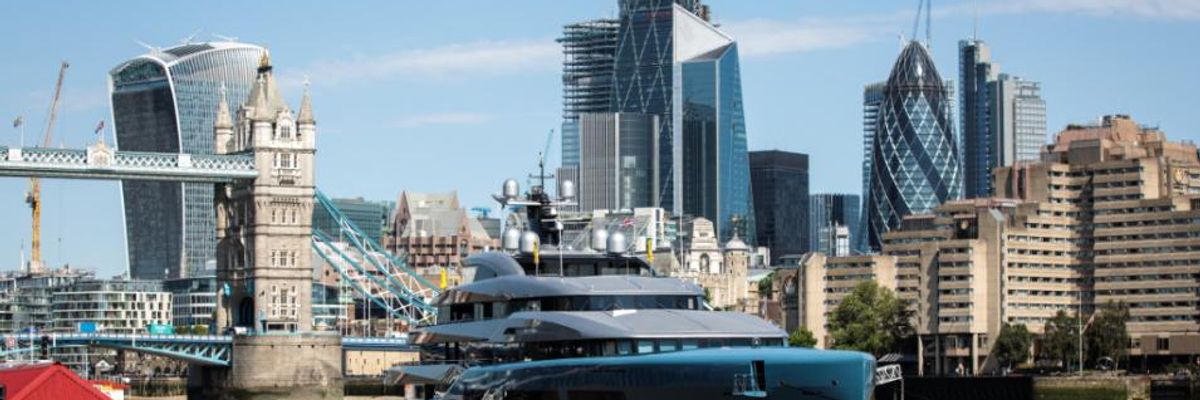
A yacht belonging to British billionaire Joe Lewis, pictured in Butler's Wharf on July 3, 2018 in London. (Photo: Jack Taylor/Getty Images)
Study of 50 Years of Tax Cuts For Rich Confirms 'Trickle Down' Theory Is an Absolute Sham
"Major tax cuts for the rich since the 1980s have increased income inequality, with all the problems that brings, without any offsetting gains in economic performance."
Neoliberal gospel says that cutting taxes on the wealthy will eventually benefit everyone by boosting economic growth and reducing unemployment, but a new analysis of fiscal policies in 18 countries over the last 50 years reveals that progressive critics of "trickle down" theory have been right all along: supply-side economics fuels inequality, and the real beneficiaries of the right-wing approach to taxation are the super-rich.
"Cutting taxes on the rich increases top income shares, but has little effect on economic performance."
--David Hope and Julian Limberg
The Economic Consequences of Major Tax Cuts for the Rich (pdf), a working paper published this month by the International Inequalities Institute at the London School of Economics and written by LSE's David Hope and Julian Limberg of King's College London, examines data from nearly 20 OECD countries, including the U.K. and the U.S., and finds that the past five decades have been characterized by "falling taxes on the rich in the advanced economies," with "major tax cuts... particularly clustered in the late 1980s."
But, according to Hope and Limberg, the vast majority of the populations in those countries have little to show for it, as the benefits of slashing taxes on the wealthy are concentrated among a handful of super-rich individuals--not widely shared across society in the form of improved job creation or prosperity, as "trickle down" theorists alleged would happen.
"Our research shows that the economic case for keeping taxes on the rich low is weak," Hope said Wednesday. "Major tax cuts for the rich since the 1980s have increased income inequality, with all the problems that brings, without any offsetting gains in economic performance."
In their study, the pair of political economists note that "economic performance, as measured by real GDP per capita and the unemployment rate, is not significantly affected by major tax cuts for the rich." However, they add, "major tax cuts for the rich increase the top 1% share of pre-tax national income in the years following the reform" by a magnitude of nearly 1%.
The researchers continue:
Our findings on the effects of growth and unemployment provide evidence against supply-side theories that suggest lower taxes on the rich will induce labour supply responses from high-income individuals (more hours of work, more effort etc.) that boost economic activity. They are, in fact, more in line with recent empirical research showing that income tax holidays and windfall gains do not lead individuals to significantly alter the amount they work.
Our results have important implications for current debates around the economic consequences of taxing the rich, as they provide causal evidence that supports the growing pool of evidence from correlational studies that cutting taxes on the rich increases top income shares, but has little effect on economic performance.
Limberg is hopeful that the research could bolster the case for increasing taxes on the wealthy to fund a just recovery from the coronavirus pandemic and ensuing economic fallout.
"Our results," he said Wednesday, "might be welcome news for governments as they seek to repair the public finances after the Covid-19 crisis, as they imply that they should not be unduly concerned about the economic consequences of higher taxes on the rich."
Progressives have argued that America's disastrous handling of the ongoing catastrophe is attributable to several decades of "free-market" ideology and associated policies that exacerbated vulnerabilities and undermined the government's capacity to respond effectively.
According to social justice advocates, taxing billionaires' surging wealth--akin to the "Millionaire's Tax" passed earlier this month in Argentina--could contribute to reversing the trend of intensifying inequality plaguing the nation.
We are at a crossroads
This country and this world are at a monumental crossroads. In a few short weeks, US voters will have an opportunity to beat back the forces of fascism and confront the billionaires who are rigging the economy, our media system, and our democracy, making it increasingly impossible for ordinary people to get by. We’re not just talking about the election. We’re talking about what must be done once these fascist elements are vanquished from power. We need a bolder set of solutions than what either major party has so far been willing to offer and a working-class movement ready to fight like hell for it. Trump didn't emerge from nowhere. The conditions that fueled MAGA authoritarianism were created by decades of radical neoliberal economic policies and a corrupt political system dominated by corporate interests. They slashed taxes on the super-rich, promising that the benefits would trickle down. They said giveaways to the corporate titans would make life more affordable for the rest of us. It was all bullshit. And when a bitter, betrayed populace searches for someone to blame, right-wing demagogues have little trouble finding scapegoats. People know when they're being lied to, but you won't hear any of this from the corporate media. Only independent journalism—powered and funded by people who believe in building a better world—can deliver truly trustworthy daily news. Our Fall Campaign is underway, and we need your help. To power our newsroom through the rest of the year, we need to raise $125,000 by midnight on October 31. So if you share our vision, please contribute whatever you can to sustain our work. |
Neoliberal gospel says that cutting taxes on the wealthy will eventually benefit everyone by boosting economic growth and reducing unemployment, but a new analysis of fiscal policies in 18 countries over the last 50 years reveals that progressive critics of "trickle down" theory have been right all along: supply-side economics fuels inequality, and the real beneficiaries of the right-wing approach to taxation are the super-rich.
"Cutting taxes on the rich increases top income shares, but has little effect on economic performance."
--David Hope and Julian Limberg
The Economic Consequences of Major Tax Cuts for the Rich (pdf), a working paper published this month by the International Inequalities Institute at the London School of Economics and written by LSE's David Hope and Julian Limberg of King's College London, examines data from nearly 20 OECD countries, including the U.K. and the U.S., and finds that the past five decades have been characterized by "falling taxes on the rich in the advanced economies," with "major tax cuts... particularly clustered in the late 1980s."
But, according to Hope and Limberg, the vast majority of the populations in those countries have little to show for it, as the benefits of slashing taxes on the wealthy are concentrated among a handful of super-rich individuals--not widely shared across society in the form of improved job creation or prosperity, as "trickle down" theorists alleged would happen.
"Our research shows that the economic case for keeping taxes on the rich low is weak," Hope said Wednesday. "Major tax cuts for the rich since the 1980s have increased income inequality, with all the problems that brings, without any offsetting gains in economic performance."
In their study, the pair of political economists note that "economic performance, as measured by real GDP per capita and the unemployment rate, is not significantly affected by major tax cuts for the rich." However, they add, "major tax cuts for the rich increase the top 1% share of pre-tax national income in the years following the reform" by a magnitude of nearly 1%.
The researchers continue:
Our findings on the effects of growth and unemployment provide evidence against supply-side theories that suggest lower taxes on the rich will induce labour supply responses from high-income individuals (more hours of work, more effort etc.) that boost economic activity. They are, in fact, more in line with recent empirical research showing that income tax holidays and windfall gains do not lead individuals to significantly alter the amount they work.
Our results have important implications for current debates around the economic consequences of taxing the rich, as they provide causal evidence that supports the growing pool of evidence from correlational studies that cutting taxes on the rich increases top income shares, but has little effect on economic performance.
Limberg is hopeful that the research could bolster the case for increasing taxes on the wealthy to fund a just recovery from the coronavirus pandemic and ensuing economic fallout.
"Our results," he said Wednesday, "might be welcome news for governments as they seek to repair the public finances after the Covid-19 crisis, as they imply that they should not be unduly concerned about the economic consequences of higher taxes on the rich."
Progressives have argued that America's disastrous handling of the ongoing catastrophe is attributable to several decades of "free-market" ideology and associated policies that exacerbated vulnerabilities and undermined the government's capacity to respond effectively.
According to social justice advocates, taxing billionaires' surging wealth--akin to the "Millionaire's Tax" passed earlier this month in Argentina--could contribute to reversing the trend of intensifying inequality plaguing the nation.