SUBSCRIBE TO OUR FREE NEWSLETTER
Daily news & progressive opinion—funded by the people, not the corporations—delivered straight to your inbox.
5
#000000
#FFFFFF
To donate by check, phone, or other method, see our More Ways to Give page.
Daily news & progressive opinion—funded by the people, not the corporations—delivered straight to your inbox.
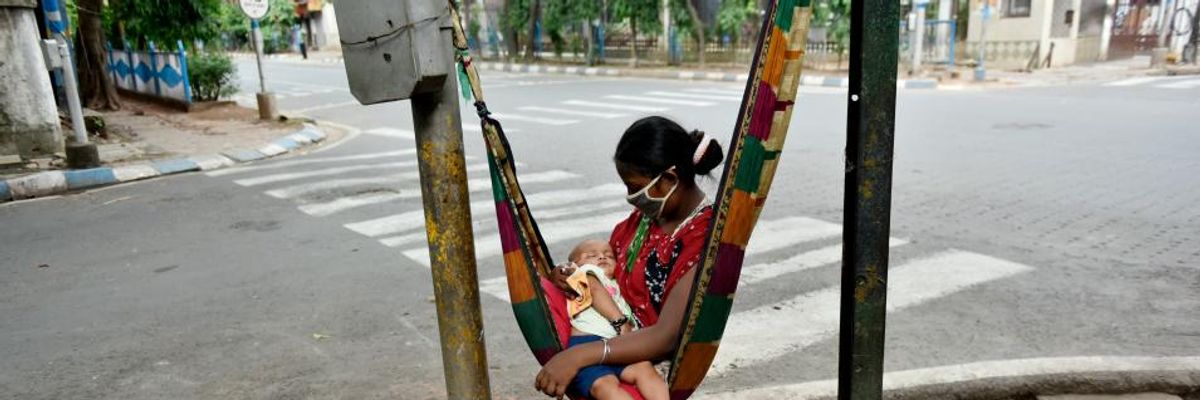
Momina, a 26 year-old homeless woman, carries her child on her lap while she swings on a makeshift cradle on the pavement during a government-imposed nationwide lockdown as a preventive measure against the Covid-19 pandemic in Kolkata, India on May 7, 2020. (Photo: Indranil Aditya/NurPhoto via Getty Images)
A harrowing study released by the United Nations early Thursday reveals that the global coronavirus pandemic is setting the stage for a massive surge in the number of people pushed into poverty worldwide over the next decade--a phenomenon that only immediate interventions in the form of ambitious investments in public health, social safety net programs, and a green transition can help avoid.
According to the findings of the new study by the United Nations Development Programme (UNDP), the "severe long-term effects" of the global pandemic could push an additional 207 million people into extreme poverty over the next decade. On top of the current pandemic trajectory, that would bring the total number of individuals living in extreme poverty to over 1 billion by 2030--this at a time of rampant and nearly unparalleled inequality as the fortunes of the world's richest individuals and families continue to soar.
While the UNDP makes clear the looming intensification of poverty is not a forgone conclusion, only with urgent action can such a scenario be avoided.
"As this new poverty research highlights, the Covid-19 pandemic is a tipping point, and the choices leaders take now could take the world in very different directions," said UNDP administrator Achim Steiner.
The analysis considers various recovery pathways and predicts how each one would affect the U.N.'s Sustainable Development Goals (SDGs).
Under the 'Baseline' scenario, based on current mortality rates and growth projections, 44 million more people will likely be pushed into extreme poverty by 2030 than would have been expected before the Covid-19 pandemic altered the world's development trajectory.
In a 'High Damage' scenario in which the recovery is protracted--meaning that 80 percent of economic productivity losses remain after 10 years--207 million additional people are projected to be living in poverty, bringing the total to 1 billion by the end of the decade.
"We have an opportunity to invest in a decade of action that not only helps people to recover from Covid-19, but that resets the development path of people and planet towards a more fair, resilient, and green future."
--Achim Steiner, UNDP
Worsening poverty is not inevitable, however. The UNDP also finds that a "focused set" of interventions to attain the SDGs, which the authors call the 'SDG Push' scenario, could lift 146 million people out of extreme poverty compared to the current pandemic-driven trends and reduce the gender poverty gap, too.
By making SDG investments over the next decade in social protection as well as digital and green economic development, "we can accelerate out of this crisis," the report says, and actually exceed pre-coronavirus expectations for human development in fragile states.
According to the UNDP, the benefits of a strong SDG push "are echoed across additional human development indicators, including nutrition and education."
With SDG interventions, the report states, "about 128 million adults and 16 million children are likely to escape malnutrition" by 2030, and "the proportion of children graduating from upper secondary school rises from the estimated 66 percent to 70 percent."
Additionally, the study warns the 'High Damage' scenario would see 37 million more people likely to become malnourished over the coming decade, including 4 million children under the age of five, and also that secondary school graduation rates could plummet to 64 percent worldwide if urgent actions are not taken.
"We have an opportunity," said Steiner, "to invest in a decade of action that not only helps people to recover from Covid-19, but that resets the development path of people and planet towards a more fair, resilient, and green future."
This country and this world are at a monumental crossroads. US voters have an opportunity to beat back the forces of fascism and confront the billionaires who are rigging the economy, our media system, and our democracy, making it increasingly impossible for ordinary people to get by. We’re not just talking about the election. We’re talking about what must be done once these fascist elements are vanquished from power. We need a bolder set of solutions than what either major party has so far been willing to offer and a working-class movement ready to fight like hell for it. Trump didn't emerge from nowhere. The conditions that fueled MAGA authoritarianism were created by decades of radical neoliberal economic policies and a corrupt political system dominated by corporate interests. They slashed taxes on the super-rich, promising that the benefits would trickle down. They said giveaways to the corporate titans would make life more affordable for the rest of us. It was all bullshit. And when a bitter, betrayed populace searches for someone to blame, right-wing demagogues have little trouble finding scapegoats. People know when they're being lied to, but you won't hear any of this from the corporate media. Only independent journalism—powered and funded by people who believe in building a better world—can deliver truly trustworthy daily news. If you share our vision, please contribute whatever you can to sustain our work. |
A harrowing study released by the United Nations early Thursday reveals that the global coronavirus pandemic is setting the stage for a massive surge in the number of people pushed into poverty worldwide over the next decade--a phenomenon that only immediate interventions in the form of ambitious investments in public health, social safety net programs, and a green transition can help avoid.
According to the findings of the new study by the United Nations Development Programme (UNDP), the "severe long-term effects" of the global pandemic could push an additional 207 million people into extreme poverty over the next decade. On top of the current pandemic trajectory, that would bring the total number of individuals living in extreme poverty to over 1 billion by 2030--this at a time of rampant and nearly unparalleled inequality as the fortunes of the world's richest individuals and families continue to soar.
While the UNDP makes clear the looming intensification of poverty is not a forgone conclusion, only with urgent action can such a scenario be avoided.
"As this new poverty research highlights, the Covid-19 pandemic is a tipping point, and the choices leaders take now could take the world in very different directions," said UNDP administrator Achim Steiner.
The analysis considers various recovery pathways and predicts how each one would affect the U.N.'s Sustainable Development Goals (SDGs).
Under the 'Baseline' scenario, based on current mortality rates and growth projections, 44 million more people will likely be pushed into extreme poverty by 2030 than would have been expected before the Covid-19 pandemic altered the world's development trajectory.
In a 'High Damage' scenario in which the recovery is protracted--meaning that 80 percent of economic productivity losses remain after 10 years--207 million additional people are projected to be living in poverty, bringing the total to 1 billion by the end of the decade.
"We have an opportunity to invest in a decade of action that not only helps people to recover from Covid-19, but that resets the development path of people and planet towards a more fair, resilient, and green future."
--Achim Steiner, UNDP
Worsening poverty is not inevitable, however. The UNDP also finds that a "focused set" of interventions to attain the SDGs, which the authors call the 'SDG Push' scenario, could lift 146 million people out of extreme poverty compared to the current pandemic-driven trends and reduce the gender poverty gap, too.
By making SDG investments over the next decade in social protection as well as digital and green economic development, "we can accelerate out of this crisis," the report says, and actually exceed pre-coronavirus expectations for human development in fragile states.
According to the UNDP, the benefits of a strong SDG push "are echoed across additional human development indicators, including nutrition and education."
With SDG interventions, the report states, "about 128 million adults and 16 million children are likely to escape malnutrition" by 2030, and "the proportion of children graduating from upper secondary school rises from the estimated 66 percent to 70 percent."
Additionally, the study warns the 'High Damage' scenario would see 37 million more people likely to become malnourished over the coming decade, including 4 million children under the age of five, and also that secondary school graduation rates could plummet to 64 percent worldwide if urgent actions are not taken.
"We have an opportunity," said Steiner, "to invest in a decade of action that not only helps people to recover from Covid-19, but that resets the development path of people and planet towards a more fair, resilient, and green future."