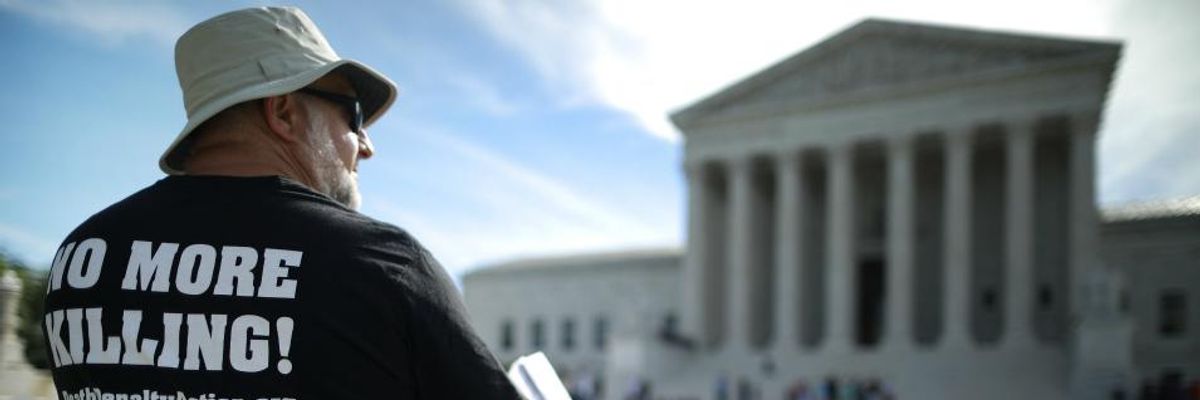
Abraham Bonowitz of Columbus, Ohio, joins fellow members of the Abolitionist Action Committee during an annual protest and hunger strike against the death penalty outside the U.S. Supreme Court July 1, 2019 in Washington, D.C. The committee has been organizing the "Starvin' for Justice: Fast and Vigil to Abolish the Death Penalty" protest for 26 years. (Photo: Chip Somodevilla/Getty Images)
Citing Likelihood of 'Extreme Pain and Needless Suffering,' US Judge Halts Resumption of Federal Executions
"We haven't had a federal execution in 17 years: There is absolutely no reason for the government to rush forward with such a reckless and dangerous plan."
This is a developing story... Please check back for possible updates...
A U.S. district judge on Monday temporarily blocked the Trump administration from resuming federal executions after a 17-year informal break--a decision that came mere hours before inmate Daniel Lewis Lee was set to be killed by lethal injection at the prison in Terre Haute, Indiana despite objections from victims' relatives and human rights advocates.
Judge Tanya Chutkan of Washington, D.C. issued a preliminary injunction preventing the execution of Lee and three other death row inmates while courts hear their respective challenges to the administration's controversial lethal injection protocol involving the sole drug pentobarbital, which replaced a three-drug cocktail that had supply issues.
Chutkan reportedly ruled that the protocol secretly developed early in President Donald Trump's first term and announced by U.S. Attorney General William Barr in July 2019 is "very likely to cause extreme pain and needless suffering," which would make it unconstitutional, as a violation the Eighth Amendment's ban on cruel and unusual punishment.
Lee was set to be killed at 4 pm local time on Monday. The federal government had also planned to execute two other inmates at the Indiana prison--Wesley Ira Purkey and Dustin Lee Honken--later this week, followed by Keith Dwayne Nelson on August 28.
As NPR reported Monday:
Chutkan said the last-minute ruling only hours before executions were set to resume for the first time in 17 years was "unfortunate," but she blamed the Justice Department for racing ahead before legal challenges had been fully aired.
...
The decision came amid a wave of litigation involving family members of victims and religious advisers to the men on federal death row.
Ultimately, the U.S. Supreme Court may have the final word.
Chutkan concluded in her opinion (pdf) that there are still legal issues to be resolved, writing that "the public is not served by short-circuiting legitimate judicial process, and is greatly served by attempting to ensure that the most serious punishment is imposed in a manner consistent with our Constitution," according to The Hill.
Shawn Nolan, one of the inmates' attorneys, welcomed Chutkan's decision in a statement also reported by The Hill.
"The government has been trying to plow forward with these executions despite many unanswered questions about the legality of its new execution protocol," Nolan said. "The district court's injunction ensures that the courts will have the opportunity to carefully address those issues."
"Given that these executions threaten to become Coivd-19 super-spreader events," Nolan added, "the injunction will also protect the lives and health of the correctional staff, victim family members, spiritual advisors, attorneys, and others who must witness the executions."
The news was also celebrated by anti-death penalty activists who gathered in Indiana Monday:
The Justice Department immediately appealed Chutkan's ruling to the U.S. Court of Appeals for the District of Columbia Circuit, according to the Associated Press.
We are at a crossroads
This country and this world are at a monumental crossroads. In a few short weeks, US voters will have an opportunity to beat back the forces of fascism and confront the billionaires who are rigging the economy, our media system, and our democracy, making it increasingly impossible for ordinary people to get by. We’re not just talking about the election. We’re talking about what must be done once these fascist elements are vanquished from power. We need a bolder set of solutions than what either major party has so far been willing to offer and a working-class movement ready to fight like hell for it. Trump didn't emerge from nowhere. The conditions that fueled MAGA authoritarianism were created by decades of radical neoliberal economic policies and a corrupt political system dominated by corporate interests. They slashed taxes on the super-rich, promising that the benefits would trickle down. They said giveaways to the corporate titans would make life more affordable for the rest of us. It was all bullshit. And when a bitter, betrayed populace searches for someone to blame, right-wing demagogues have little trouble finding scapegoats. People know when they're being lied to, but you won't hear any of this from the corporate media. Only independent journalism—powered and funded by people who believe in building a better world—can deliver truly trustworthy daily news. Our Fall Campaign is underway, and we need your help. To power our newsroom through the rest of the year, we need to raise $125,000 by midnight on October 31. So if you share our vision, please contribute whatever you can to sustain our work. |
This is a developing story... Please check back for possible updates...
A U.S. district judge on Monday temporarily blocked the Trump administration from resuming federal executions after a 17-year informal break--a decision that came mere hours before inmate Daniel Lewis Lee was set to be killed by lethal injection at the prison in Terre Haute, Indiana despite objections from victims' relatives and human rights advocates.
Judge Tanya Chutkan of Washington, D.C. issued a preliminary injunction preventing the execution of Lee and three other death row inmates while courts hear their respective challenges to the administration's controversial lethal injection protocol involving the sole drug pentobarbital, which replaced a three-drug cocktail that had supply issues.
Chutkan reportedly ruled that the protocol secretly developed early in President Donald Trump's first term and announced by U.S. Attorney General William Barr in July 2019 is "very likely to cause extreme pain and needless suffering," which would make it unconstitutional, as a violation the Eighth Amendment's ban on cruel and unusual punishment.
Lee was set to be killed at 4 pm local time on Monday. The federal government had also planned to execute two other inmates at the Indiana prison--Wesley Ira Purkey and Dustin Lee Honken--later this week, followed by Keith Dwayne Nelson on August 28.
As NPR reported Monday:
Chutkan said the last-minute ruling only hours before executions were set to resume for the first time in 17 years was "unfortunate," but she blamed the Justice Department for racing ahead before legal challenges had been fully aired.
...
The decision came amid a wave of litigation involving family members of victims and religious advisers to the men on federal death row.
Ultimately, the U.S. Supreme Court may have the final word.
Chutkan concluded in her opinion (pdf) that there are still legal issues to be resolved, writing that "the public is not served by short-circuiting legitimate judicial process, and is greatly served by attempting to ensure that the most serious punishment is imposed in a manner consistent with our Constitution," according to The Hill.
Shawn Nolan, one of the inmates' attorneys, welcomed Chutkan's decision in a statement also reported by The Hill.
"The government has been trying to plow forward with these executions despite many unanswered questions about the legality of its new execution protocol," Nolan said. "The district court's injunction ensures that the courts will have the opportunity to carefully address those issues."
"Given that these executions threaten to become Coivd-19 super-spreader events," Nolan added, "the injunction will also protect the lives and health of the correctional staff, victim family members, spiritual advisors, attorneys, and others who must witness the executions."
The news was also celebrated by anti-death penalty activists who gathered in Indiana Monday:
The Justice Department immediately appealed Chutkan's ruling to the U.S. Court of Appeals for the District of Columbia Circuit, according to the Associated Press.