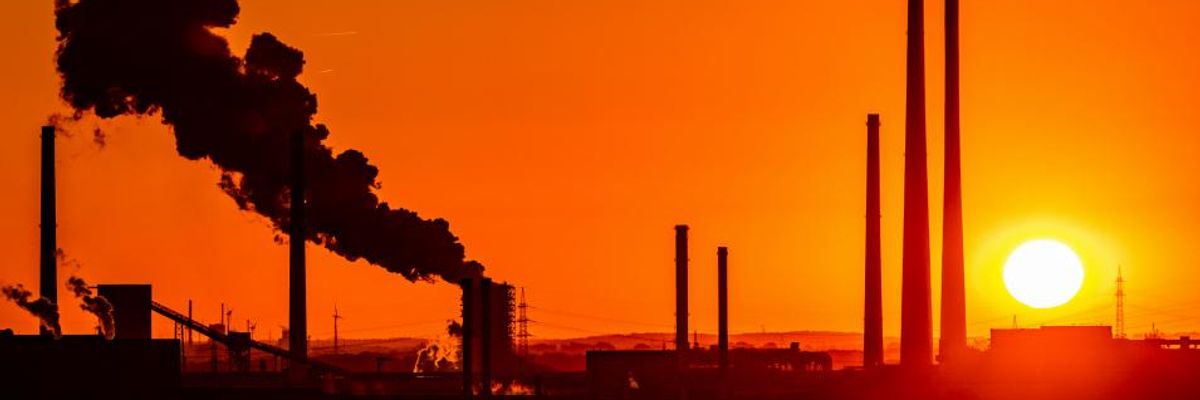
The sun goes down behind chimneys at a coal plant in Duisburg, Germany on June 28, 2019. (Photo: Marcel Kusch/dpa/picture alliance via Getty Images)
Humanity on Track to Soon Hit 1.5oC Paris Accord Limit as Atmospheric CO2 Nears Level Not Seen in 15 Million Years
"It's still not too late to avoid the worst effects of the #ClimateEmergency. But governments need to act NOW," tweeted Greenpeace.
As a United Nations agency released new climate projections showing that the world is on track in the next five years to hit or surpass a key limit of the Paris agreement, authors of a new study warned Thursday that increasing carbon dioxide in the atmosphere is nearing a level not seen in 15 million years.
For the study, published in the journal Scientific Reports, researchers at the University of Southampton in the United Kingdom examined CO2 levels during the Late Pliocene about three million years ago "to search for modern and near future-like climate states," co-author Thomas Chalk explained in a series of tweets.
"A striking result we've found is that the warmest part of the Pliocene had between 380 and 420 parts per million CO2 in the atmosphere," Chalk told the Guardian. "This is similar to today's value of around 415 parts per million, showing that we are already at levels that in the past were associated with temperature and sea-level significantly higher than today."
When CO2 levels peaked during the Pliocene, temperatures were 3oC to 4oC hotter and seas were 65 feet higher, the newspaper reported. Chalk said that "currently, our CO2 levels are rising at about 2.5 ppm per year, meaning that by 2025 we will have exceeded anything seen in the last 3.3 million years."
"We are burning through the Pliocene and heading towards a Miocene-like future," warned co-author Gavin Foster, referencing a period from about 23 to 5.3 million years ago. It was during the Miocene, around 15 million years ago, when "our ancestors are thought to have diverged from orangutans and become recognizably hominoid," the Guardian noted.
Reporting on the study elicited concern and calls for action from environmentalists and advocacy groups.
"Every kilo of CO2 we emit is one we have to sequester later, provided the food doesn't run out first," tweeted Extinction Rebellion Finland, urging the international community to #ActNow.
Nathaniel Stinnett, executive director of the U.S.-based Environmental Voter Project, also responded to the report on Twitter, saying, "Big Oil and Gas are killing us."
A new report released Thursday by the U.N.'s World Meteorological Organization (WMO) about global temperatures likely coming in the next five years provoked similar alarm and demands.
"It's still not too late to avoid the worst effects of the #ClimateEmergency. But governments need to act NOW," declared Greenpeace, pushing for a #GreenRecovery from the Covid-19 pandemic.
The WMO report projects that the annual global temperature is likely to be at least 1degC warmer than pre-industrial levels in each of the next five years. Although it is "extremely unlikely" the average temperature for 2020-2024 will be 1.5degC warmer than pre-industrial levels, WMO warned certain periods could hit that temperature.
Specifically, there is about a 70% chance that one or more months during those five years will be at least 1.5degC hotter than pre-industrial levels and about a 20% chance that one of the next five years will be at least that warm, according to WMO's Global Annual to Decadal Climate Update, led by the United Kingdom's Met Office.
In a statement Thursday, WMO Secretary-General Petteri Taalas also pointed to the coronavirus pandemic--which prompted global lockdowns that briefly caused planet-heating emissions to drop--as an opportunity to pursue bold recovery plans that incorporate policies that combat the climate crisis, such as rapidly transitioning to renewable energy worldwide.
"WMO has repeatedly stressed that the industrial and economic slowdown from Covid-19 is not a substitute for sustained and coordinated climate action," Taalas said. "Due to the very long lifetime of CO2 in the atmosphere, the impact of the drop in emissions this year is not expected to lead to a reduction of CO2 atmospheric concentrations which are driving global temperature increases."
"Whilst Covid-19 has caused a severe international health and economic crisis, failure to tackle climate change may threaten human well-being, ecosystems, and economies for centuries," he continued. "Governments should use the opportunity to embrace climate action as part of recovery program and ensure that we grow back better."
Taalas added that "this study shows--with a high level of scientific skill--the enormous challenge ahead in meeting the Paris agreement on climate change target of keeping a global temperature rise this century well below 2degC above pre-industrial levels and to pursue efforts to limit the temperature increase even further to 1.5degC."
While some scientists and activists have criticized the 2015 Paris climate agreement as not ambitious enough, it is backed by nearly all nations on Earth. U.S. President Donald Trump began the one-year withdrawal process in November 2019 but former Vice President Joe Biden, the presumed Democratic presidential nominee, has vowed to rejoin the accord if he wins this year's election.
We are at a crossroads
This country and this world are at a monumental crossroads. US voters have an opportunity to beat back the forces of fascism and confront the billionaires who are rigging the economy, our media system, and our democracy, making it increasingly impossible for ordinary people to get by. We’re not just talking about the election. We’re talking about what must be done once these fascist elements are vanquished from power. We need a bolder set of solutions than what either major party has so far been willing to offer and a working-class movement ready to fight like hell for it. Trump didn't emerge from nowhere. The conditions that fueled MAGA authoritarianism were created by decades of radical neoliberal economic policies and a corrupt political system dominated by corporate interests. They slashed taxes on the super-rich, promising that the benefits would trickle down. They said giveaways to the corporate titans would make life more affordable for the rest of us. It was all bullshit. And when a bitter, betrayed populace searches for someone to blame, right-wing demagogues have little trouble finding scapegoats. People know when they're being lied to, but you won't hear any of this from the corporate media. Only independent journalism—powered and funded by people who believe in building a better world—can deliver truly trustworthy daily news. Our Fall Campaign is underway, and we need your help. To power our newsroom through the rest of the year, we need to raise $125,000 by midnight on October 31. So if you share our vision, please contribute whatever you can to sustain our work. |
As a United Nations agency released new climate projections showing that the world is on track in the next five years to hit or surpass a key limit of the Paris agreement, authors of a new study warned Thursday that increasing carbon dioxide in the atmosphere is nearing a level not seen in 15 million years.
For the study, published in the journal Scientific Reports, researchers at the University of Southampton in the United Kingdom examined CO2 levels during the Late Pliocene about three million years ago "to search for modern and near future-like climate states," co-author Thomas Chalk explained in a series of tweets.
"A striking result we've found is that the warmest part of the Pliocene had between 380 and 420 parts per million CO2 in the atmosphere," Chalk told the Guardian. "This is similar to today's value of around 415 parts per million, showing that we are already at levels that in the past were associated with temperature and sea-level significantly higher than today."
When CO2 levels peaked during the Pliocene, temperatures were 3oC to 4oC hotter and seas were 65 feet higher, the newspaper reported. Chalk said that "currently, our CO2 levels are rising at about 2.5 ppm per year, meaning that by 2025 we will have exceeded anything seen in the last 3.3 million years."
"We are burning through the Pliocene and heading towards a Miocene-like future," warned co-author Gavin Foster, referencing a period from about 23 to 5.3 million years ago. It was during the Miocene, around 15 million years ago, when "our ancestors are thought to have diverged from orangutans and become recognizably hominoid," the Guardian noted.
Reporting on the study elicited concern and calls for action from environmentalists and advocacy groups.
"Every kilo of CO2 we emit is one we have to sequester later, provided the food doesn't run out first," tweeted Extinction Rebellion Finland, urging the international community to #ActNow.
Nathaniel Stinnett, executive director of the U.S.-based Environmental Voter Project, also responded to the report on Twitter, saying, "Big Oil and Gas are killing us."
A new report released Thursday by the U.N.'s World Meteorological Organization (WMO) about global temperatures likely coming in the next five years provoked similar alarm and demands.
"It's still not too late to avoid the worst effects of the #ClimateEmergency. But governments need to act NOW," declared Greenpeace, pushing for a #GreenRecovery from the Covid-19 pandemic.
The WMO report projects that the annual global temperature is likely to be at least 1degC warmer than pre-industrial levels in each of the next five years. Although it is "extremely unlikely" the average temperature for 2020-2024 will be 1.5degC warmer than pre-industrial levels, WMO warned certain periods could hit that temperature.
Specifically, there is about a 70% chance that one or more months during those five years will be at least 1.5degC hotter than pre-industrial levels and about a 20% chance that one of the next five years will be at least that warm, according to WMO's Global Annual to Decadal Climate Update, led by the United Kingdom's Met Office.
In a statement Thursday, WMO Secretary-General Petteri Taalas also pointed to the coronavirus pandemic--which prompted global lockdowns that briefly caused planet-heating emissions to drop--as an opportunity to pursue bold recovery plans that incorporate policies that combat the climate crisis, such as rapidly transitioning to renewable energy worldwide.
"WMO has repeatedly stressed that the industrial and economic slowdown from Covid-19 is not a substitute for sustained and coordinated climate action," Taalas said. "Due to the very long lifetime of CO2 in the atmosphere, the impact of the drop in emissions this year is not expected to lead to a reduction of CO2 atmospheric concentrations which are driving global temperature increases."
"Whilst Covid-19 has caused a severe international health and economic crisis, failure to tackle climate change may threaten human well-being, ecosystems, and economies for centuries," he continued. "Governments should use the opportunity to embrace climate action as part of recovery program and ensure that we grow back better."
Taalas added that "this study shows--with a high level of scientific skill--the enormous challenge ahead in meeting the Paris agreement on climate change target of keeping a global temperature rise this century well below 2degC above pre-industrial levels and to pursue efforts to limit the temperature increase even further to 1.5degC."
While some scientists and activists have criticized the 2015 Paris climate agreement as not ambitious enough, it is backed by nearly all nations on Earth. U.S. President Donald Trump began the one-year withdrawal process in November 2019 but former Vice President Joe Biden, the presumed Democratic presidential nominee, has vowed to rejoin the accord if he wins this year's election.