SUBSCRIBE TO OUR FREE NEWSLETTER
Daily news & progressive opinion—funded by the people, not the corporations—delivered straight to your inbox.
5
#000000
#FFFFFF
To donate by check, phone, or other method, see our More Ways to Give page.
Daily news & progressive opinion—funded by the people, not the corporations—delivered straight to your inbox.
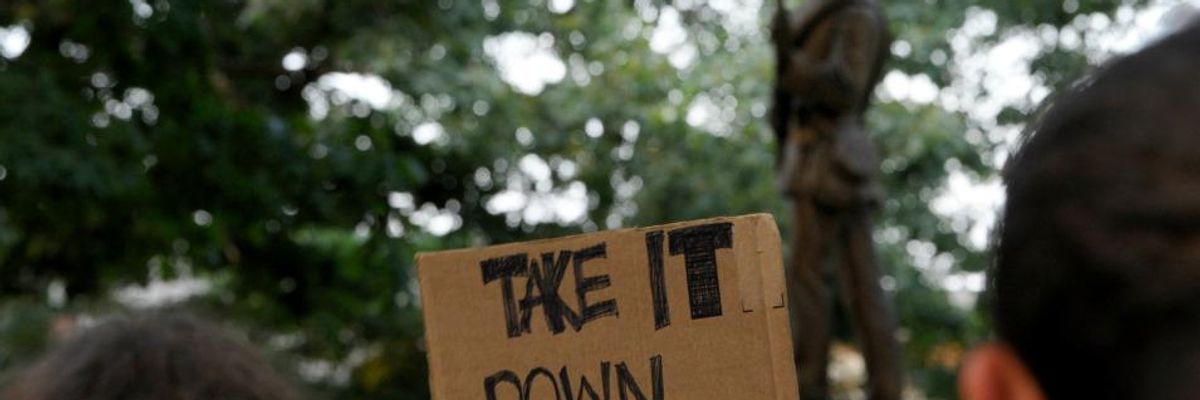
Demonstrators rally for the removal of a Confederate statue coined Silent Sam on the campus of the University of Chapel Hill on August 22, 2017 in Chapel Hill, N.C. Officials in Graham, N.C. last week said police would not be issuing protest permits for demonstrations at the Alamance County Courthouse, where a Confederate monument stands. (Photo: Sara D. Davis/Getty Images)
Civil rights groups on Friday filed a lawsuit against Alamance County and the city of Graham, North Carolina, after officials issued a new ordinance last week announcing the police department would not be issuing protest permits during the city's current state of emergency.
The Lawyers' Committee for Civil Rights Under Law, the ACLU, and a local law firm filed the lawsuit and a temporary restraining order on behalf of Alamance County NAACP and eight individuals who were planning to protest at the Alamance County Courthouse in the center of Graham.
The courthouse is the site of a Confederate monument, and like similar statues it has drawn demonstrations in recent weeks amid the ongoing nationwide uprising against racial injustice and police brutality.
"It is appalling that Alamance County officials would trample on the First Amendment rights of their own constituents for the sake of a monument to white supremacy."
--Kristi Graunke, ACLU of North Carolina
"This ordinance is a sweeping bar to the rights of people to freely assemble and protest in Graham. People have a constitutional right to gather and voice their concerns in public areas without fear of arrest, harassment, or intimidation from law enforcement," said Kristi Graunke with the ACLU of North Carolina. "It is appalling that Alamance County officials would trample on the First Amendment rights of their own constituents for the sake of a monument to white supremacy."
The groups argued in the lawsuit that the new restriction violates protesters' constitutional rights.
"The Ordinance is an unconstitutional prior restraint on First Amendment rights to free speech and assembly, violates the First Amendment's prohibition against unreasonable and content-based time, place and manner restrictions of speech in traditional public forums and violates due process because it is void for vagueness," reads the suit.
The ordinance was issued on June 26, a day after Graham Mayor Jerry Peterman issued an executive order to shut down protests at the courthouse.
The Alamance County Sheriff's office then announced that the Graham Police Department would no longer be issuing permits for demonstrations of two or more people, a move with the Lawyers' Committee said "effectively bans any protest."
The sheriff's office posted a notice about the new ordinance on Facebook last week, garnering more than 1,000 comments within a day--including many that accused the sheriff of trampling residents' basic rights.
"Pretty sure the right to peaceful assembly is granted by the constitution.. not [Sheriff] Terry Johnson," one critic wrote.
"First Amendment rights have been taken away," tweeted a protester the day after the ordinance was issued. "Is this America?"
Days later, several people gathered in Graham despite the order, holding signs reading "Black Lives Matter" as passing drivers honked in support.
"The Confederate monument in Graham's town square represents the racist past and present these protestors want to speak out against," said Elizabeth Haddix, managing attorney at the Lawyers' Committee for Civil Rights Under Law, in a statement Friday. "While the community is trying to reckon with its own racist history in the midst of police violence against Black citizens across the country and in Alamance County, the sheriff and police are restricting the people's basic rights to protest white supremacy."
Tenae Turner, a plaintiff who had planned to protest at the courthouse, said she had been denied the right to advocate "for equally representative government."
"I sought to gather with others to express support for Black lives," said Turner. "It sends a clear message that racist monuments are valued more highly than Black lives and our constitutional rights."
Dear Common Dreams reader, It’s been nearly 30 years since I co-founded Common Dreams with my late wife, Lina Newhouser. We had the radical notion that journalism should serve the public good, not corporate profits. It was clear to us from the outset what it would take to build such a project. No paid advertisements. No corporate sponsors. No millionaire publisher telling us what to think or do. Many people said we wouldn't last a year, but we proved those doubters wrong. Together with a tremendous team of journalists and dedicated staff, we built an independent media outlet free from the constraints of profits and corporate control. Our mission has always been simple: To inform. To inspire. To ignite change for the common good. Building Common Dreams was not easy. Our survival was never guaranteed. When you take on the most powerful forces—Wall Street greed, fossil fuel industry destruction, Big Tech lobbyists, and uber-rich oligarchs who have spent billions upon billions rigging the economy and democracy in their favor—the only bulwark you have is supporters who believe in your work. But here’s the urgent message from me today. It's never been this bad out there. And it's never been this hard to keep us going. At the very moment Common Dreams is most needed, the threats we face are intensifying. We need your support now more than ever. We don't accept corporate advertising and never will. We don't have a paywall because we don't think people should be blocked from critical news based on their ability to pay. Everything we do is funded by the donations of readers like you. When everyone does the little they can afford, we are strong. But if that support retreats or dries up, so do we. Will you donate now to make sure Common Dreams not only survives but thrives? —Craig Brown, Co-founder |
Civil rights groups on Friday filed a lawsuit against Alamance County and the city of Graham, North Carolina, after officials issued a new ordinance last week announcing the police department would not be issuing protest permits during the city's current state of emergency.
The Lawyers' Committee for Civil Rights Under Law, the ACLU, and a local law firm filed the lawsuit and a temporary restraining order on behalf of Alamance County NAACP and eight individuals who were planning to protest at the Alamance County Courthouse in the center of Graham.
The courthouse is the site of a Confederate monument, and like similar statues it has drawn demonstrations in recent weeks amid the ongoing nationwide uprising against racial injustice and police brutality.
"It is appalling that Alamance County officials would trample on the First Amendment rights of their own constituents for the sake of a monument to white supremacy."
--Kristi Graunke, ACLU of North Carolina
"This ordinance is a sweeping bar to the rights of people to freely assemble and protest in Graham. People have a constitutional right to gather and voice their concerns in public areas without fear of arrest, harassment, or intimidation from law enforcement," said Kristi Graunke with the ACLU of North Carolina. "It is appalling that Alamance County officials would trample on the First Amendment rights of their own constituents for the sake of a monument to white supremacy."
The groups argued in the lawsuit that the new restriction violates protesters' constitutional rights.
"The Ordinance is an unconstitutional prior restraint on First Amendment rights to free speech and assembly, violates the First Amendment's prohibition against unreasonable and content-based time, place and manner restrictions of speech in traditional public forums and violates due process because it is void for vagueness," reads the suit.
The ordinance was issued on June 26, a day after Graham Mayor Jerry Peterman issued an executive order to shut down protests at the courthouse.
The Alamance County Sheriff's office then announced that the Graham Police Department would no longer be issuing permits for demonstrations of two or more people, a move with the Lawyers' Committee said "effectively bans any protest."
The sheriff's office posted a notice about the new ordinance on Facebook last week, garnering more than 1,000 comments within a day--including many that accused the sheriff of trampling residents' basic rights.
"Pretty sure the right to peaceful assembly is granted by the constitution.. not [Sheriff] Terry Johnson," one critic wrote.
"First Amendment rights have been taken away," tweeted a protester the day after the ordinance was issued. "Is this America?"
Days later, several people gathered in Graham despite the order, holding signs reading "Black Lives Matter" as passing drivers honked in support.
"The Confederate monument in Graham's town square represents the racist past and present these protestors want to speak out against," said Elizabeth Haddix, managing attorney at the Lawyers' Committee for Civil Rights Under Law, in a statement Friday. "While the community is trying to reckon with its own racist history in the midst of police violence against Black citizens across the country and in Alamance County, the sheriff and police are restricting the people's basic rights to protest white supremacy."
Tenae Turner, a plaintiff who had planned to protest at the courthouse, said she had been denied the right to advocate "for equally representative government."
"I sought to gather with others to express support for Black lives," said Turner. "It sends a clear message that racist monuments are valued more highly than Black lives and our constitutional rights."
Civil rights groups on Friday filed a lawsuit against Alamance County and the city of Graham, North Carolina, after officials issued a new ordinance last week announcing the police department would not be issuing protest permits during the city's current state of emergency.
The Lawyers' Committee for Civil Rights Under Law, the ACLU, and a local law firm filed the lawsuit and a temporary restraining order on behalf of Alamance County NAACP and eight individuals who were planning to protest at the Alamance County Courthouse in the center of Graham.
The courthouse is the site of a Confederate monument, and like similar statues it has drawn demonstrations in recent weeks amid the ongoing nationwide uprising against racial injustice and police brutality.
"It is appalling that Alamance County officials would trample on the First Amendment rights of their own constituents for the sake of a monument to white supremacy."
--Kristi Graunke, ACLU of North Carolina
"This ordinance is a sweeping bar to the rights of people to freely assemble and protest in Graham. People have a constitutional right to gather and voice their concerns in public areas without fear of arrest, harassment, or intimidation from law enforcement," said Kristi Graunke with the ACLU of North Carolina. "It is appalling that Alamance County officials would trample on the First Amendment rights of their own constituents for the sake of a monument to white supremacy."
The groups argued in the lawsuit that the new restriction violates protesters' constitutional rights.
"The Ordinance is an unconstitutional prior restraint on First Amendment rights to free speech and assembly, violates the First Amendment's prohibition against unreasonable and content-based time, place and manner restrictions of speech in traditional public forums and violates due process because it is void for vagueness," reads the suit.
The ordinance was issued on June 26, a day after Graham Mayor Jerry Peterman issued an executive order to shut down protests at the courthouse.
The Alamance County Sheriff's office then announced that the Graham Police Department would no longer be issuing permits for demonstrations of two or more people, a move with the Lawyers' Committee said "effectively bans any protest."
The sheriff's office posted a notice about the new ordinance on Facebook last week, garnering more than 1,000 comments within a day--including many that accused the sheriff of trampling residents' basic rights.
"Pretty sure the right to peaceful assembly is granted by the constitution.. not [Sheriff] Terry Johnson," one critic wrote.
"First Amendment rights have been taken away," tweeted a protester the day after the ordinance was issued. "Is this America?"
Days later, several people gathered in Graham despite the order, holding signs reading "Black Lives Matter" as passing drivers honked in support.
"The Confederate monument in Graham's town square represents the racist past and present these protestors want to speak out against," said Elizabeth Haddix, managing attorney at the Lawyers' Committee for Civil Rights Under Law, in a statement Friday. "While the community is trying to reckon with its own racist history in the midst of police violence against Black citizens across the country and in Alamance County, the sheriff and police are restricting the people's basic rights to protest white supremacy."
Tenae Turner, a plaintiff who had planned to protest at the courthouse, said she had been denied the right to advocate "for equally representative government."
"I sought to gather with others to express support for Black lives," said Turner. "It sends a clear message that racist monuments are valued more highly than Black lives and our constitutional rights."