SUBSCRIBE TO OUR FREE NEWSLETTER
Daily news & progressive opinion—funded by the people, not the corporations—delivered straight to your inbox.
5
#000000
#FFFFFF
To donate by check, phone, or other method, see our More Ways to Give page.
Daily news & progressive opinion—funded by the people, not the corporations—delivered straight to your inbox.
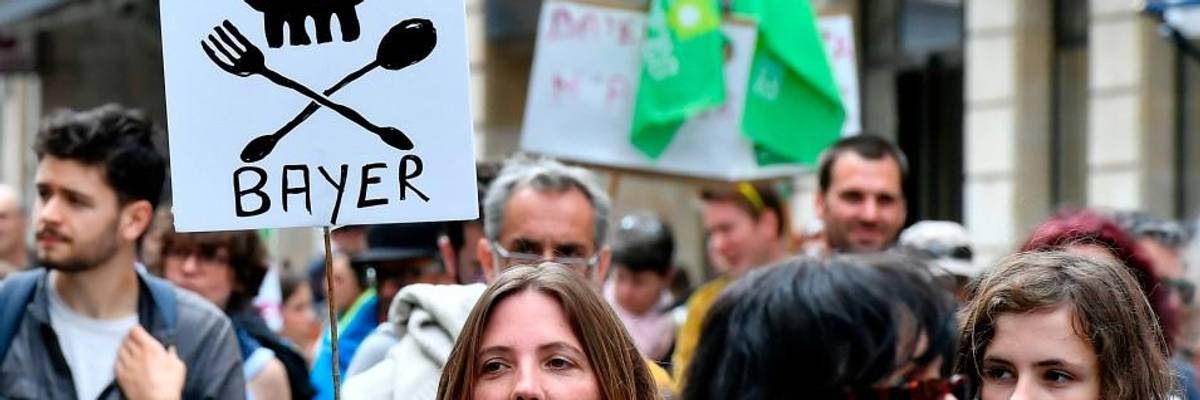
Demonstrators walk with placards during a march for agroecology and civil resistance against U.S. seed and pesticide maker Monsanto on May 20, 2017 in Bordeaux, southwestern France. (Photo: Georges Gobet/AFP/Getty Images)
Agribusiness giant Bayer announced Wednesday that it reached a more than $10 billion deal to settle thousands of lawsuits that claimed exposure to Monsanto's Roundup caused cancer.
A statement from Bayer, which acquired Monsanto in 2018--and thus inherited lawsuits targeting the widely used weedkiller--said the settlement affects "75% of the current Roundup litigation involving approximately 125,000 filed and unfiled claims overall."
Terms of the settlement include Bayer paying $8.8 billion to $9.6 billion to resolve the current lawsuits--"including an allowance expected to cover unresolved claims." The deal also includes $1.25 billion to cover potential future settlements, the company said.
According to Ken Cook, president of advocacy group Environmental Working Group, the settlement represents "vindication for all those who have fallen ill with cancer as a result of being exposed to this chemical."
"No amount of money can reverse the damage Bayer-Monsanto has inflicted on these victims and countless others, but because of their and their attorneys' tireless fight for justice, the company that exposed them is now paying a heavy price for its duplicitous deception," said Cook.
The main ingredient in Roundup is glyphosate, which EWG calls "the most widely used herbicide in the world." While the International Agency for Research on Cancer in 2015 classified glyphosate a "probable carcinogen" for humans, Bayer asserts that the weedkiller is safe to use and will not put cancer warning labels on the product.
Cook said that Roundup's widespread use means that public health in still at risk.
"Even as we celebrate and congratulate those who made this day possible, millions of people are being exposed to glyphosate through the food they eat, working as groundskeepers or farmworkers, or gardening at home," Cook said. As such, "Bayer-Monsanto must be held accountable beyond today's settlement, the Food and Drug Administration must immediately eliminate its use as a pre-harvest desiccant, and the Environmental Protection Agency must ban all home uses."
"That is the only way to assure future generations of Americans do not get sick or die from exposure to this cancer-causing chemical," said Cook.
Dear Common Dreams reader, It’s been nearly 30 years since I co-founded Common Dreams with my late wife, Lina Newhouser. We had the radical notion that journalism should serve the public good, not corporate profits. It was clear to us from the outset what it would take to build such a project. No paid advertisements. No corporate sponsors. No millionaire publisher telling us what to think or do. Many people said we wouldn't last a year, but we proved those doubters wrong. Together with a tremendous team of journalists and dedicated staff, we built an independent media outlet free from the constraints of profits and corporate control. Our mission has always been simple: To inform. To inspire. To ignite change for the common good. Building Common Dreams was not easy. Our survival was never guaranteed. When you take on the most powerful forces—Wall Street greed, fossil fuel industry destruction, Big Tech lobbyists, and uber-rich oligarchs who have spent billions upon billions rigging the economy and democracy in their favor—the only bulwark you have is supporters who believe in your work. But here’s the urgent message from me today. It's never been this bad out there. And it's never been this hard to keep us going. At the very moment Common Dreams is most needed, the threats we face are intensifying. We need your support now more than ever. We don't accept corporate advertising and never will. We don't have a paywall because we don't think people should be blocked from critical news based on their ability to pay. Everything we do is funded by the donations of readers like you. When everyone does the little they can afford, we are strong. But if that support retreats or dries up, so do we. Will you donate now to make sure Common Dreams not only survives but thrives? —Craig Brown, Co-founder |
Agribusiness giant Bayer announced Wednesday that it reached a more than $10 billion deal to settle thousands of lawsuits that claimed exposure to Monsanto's Roundup caused cancer.
A statement from Bayer, which acquired Monsanto in 2018--and thus inherited lawsuits targeting the widely used weedkiller--said the settlement affects "75% of the current Roundup litigation involving approximately 125,000 filed and unfiled claims overall."
Terms of the settlement include Bayer paying $8.8 billion to $9.6 billion to resolve the current lawsuits--"including an allowance expected to cover unresolved claims." The deal also includes $1.25 billion to cover potential future settlements, the company said.
According to Ken Cook, president of advocacy group Environmental Working Group, the settlement represents "vindication for all those who have fallen ill with cancer as a result of being exposed to this chemical."
"No amount of money can reverse the damage Bayer-Monsanto has inflicted on these victims and countless others, but because of their and their attorneys' tireless fight for justice, the company that exposed them is now paying a heavy price for its duplicitous deception," said Cook.
The main ingredient in Roundup is glyphosate, which EWG calls "the most widely used herbicide in the world." While the International Agency for Research on Cancer in 2015 classified glyphosate a "probable carcinogen" for humans, Bayer asserts that the weedkiller is safe to use and will not put cancer warning labels on the product.
Cook said that Roundup's widespread use means that public health in still at risk.
"Even as we celebrate and congratulate those who made this day possible, millions of people are being exposed to glyphosate through the food they eat, working as groundskeepers or farmworkers, or gardening at home," Cook said. As such, "Bayer-Monsanto must be held accountable beyond today's settlement, the Food and Drug Administration must immediately eliminate its use as a pre-harvest desiccant, and the Environmental Protection Agency must ban all home uses."
"That is the only way to assure future generations of Americans do not get sick or die from exposure to this cancer-causing chemical," said Cook.
Agribusiness giant Bayer announced Wednesday that it reached a more than $10 billion deal to settle thousands of lawsuits that claimed exposure to Monsanto's Roundup caused cancer.
A statement from Bayer, which acquired Monsanto in 2018--and thus inherited lawsuits targeting the widely used weedkiller--said the settlement affects "75% of the current Roundup litigation involving approximately 125,000 filed and unfiled claims overall."
Terms of the settlement include Bayer paying $8.8 billion to $9.6 billion to resolve the current lawsuits--"including an allowance expected to cover unresolved claims." The deal also includes $1.25 billion to cover potential future settlements, the company said.
According to Ken Cook, president of advocacy group Environmental Working Group, the settlement represents "vindication for all those who have fallen ill with cancer as a result of being exposed to this chemical."
"No amount of money can reverse the damage Bayer-Monsanto has inflicted on these victims and countless others, but because of their and their attorneys' tireless fight for justice, the company that exposed them is now paying a heavy price for its duplicitous deception," said Cook.
The main ingredient in Roundup is glyphosate, which EWG calls "the most widely used herbicide in the world." While the International Agency for Research on Cancer in 2015 classified glyphosate a "probable carcinogen" for humans, Bayer asserts that the weedkiller is safe to use and will not put cancer warning labels on the product.
Cook said that Roundup's widespread use means that public health in still at risk.
"Even as we celebrate and congratulate those who made this day possible, millions of people are being exposed to glyphosate through the food they eat, working as groundskeepers or farmworkers, or gardening at home," Cook said. As such, "Bayer-Monsanto must be held accountable beyond today's settlement, the Food and Drug Administration must immediately eliminate its use as a pre-harvest desiccant, and the Environmental Protection Agency must ban all home uses."
"That is the only way to assure future generations of Americans do not get sick or die from exposure to this cancer-causing chemical," said Cook.