SUBSCRIBE TO OUR FREE NEWSLETTER
Daily news & progressive opinion—funded by the people, not the corporations—delivered straight to your inbox.
5
#000000
#FFFFFF
To donate by check, phone, or other method, see our More Ways to Give page.
Daily news & progressive opinion—funded by the people, not the corporations—delivered straight to your inbox.
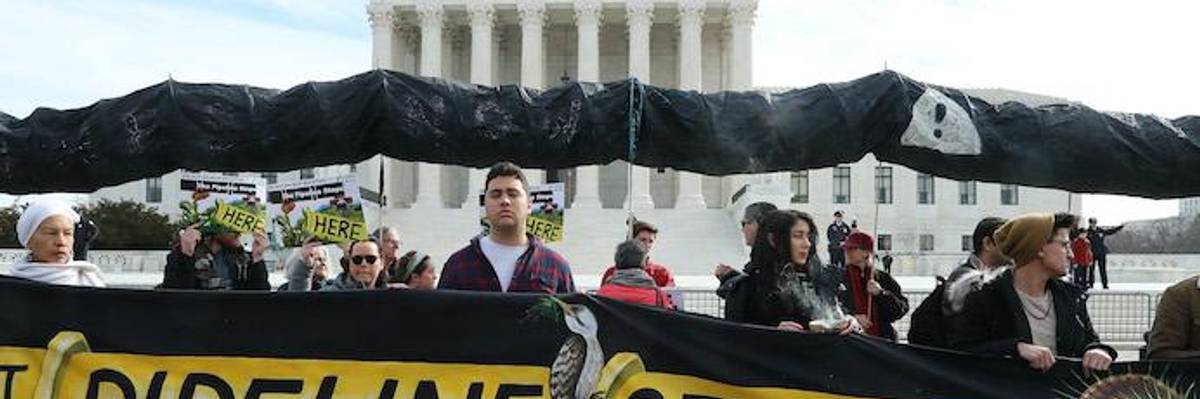
Climate activist groups protest in front of the U.S. Supreme Court as oral arguments are heard in U.S. Forest Service and Atlantic Coast Pipeline, LLC v. Cowpasture River Assn. case, on February 24, 2020 in Washington, D.C. The high court is hearing cases on Dominion Energy's proposed $7.5 billion Atlantic Coast Pipeline crossing the Appalachian Trail. (Photo: Mark Wilson/Getty Images)
Environmental campaigners on Monday reiterated their opposition to the Atlantic Coast Pipeline after a U.S. Supreme Court decision removing a hurdle for the "climate-wrecking" fracked gas infrastructure project.
The high court's Monday decision (pdf) was 7-2, with Justices Ruth Bader Ginsburg and Stephen Breyer joining the court's conservative majority. Justices Sonia Sotomayor and Elena Kagan dissented.
"At the heart of the case," NPR reported, "was a technical legal question about which federal agency, if any, had the authority to grant the permit for the pipeline."
The Fourth Circuit Court of Appeals ruled in 2018 that the U.S. Forest Service didn't have the authority to issue the permit for the behind schedule and over-budget Atlantic Coast Pipeline (ACP) pipeline, which is owned by Dominion Energy and Duke Energy and would cross the Appalachian Trail on federal land. The Appalachian Trail is administered by the National Park Service, an agency of the Interior Department.
The new ruling overturns that lower court's decision. From Reuters:
In Monday's ruling, the Supreme Court agreed with the Trump administration that the Forest Service retained the authority to approve rights of way across the trail.
The park service's authority over the trail "did not transform the land over which the trail passes into land within the National Park System," [conservative Justice Clarence] Thomas wrote.
"It's been six years since this pipeline was proposed, we didn't need it then and we certainly don't need it now," said Dick Brooks of the Cowpasture River Preservation, one of the local organizations fighting the pipeline. "Today's decision doesn't change the fact that Dominion chose a risky route through protected federal lands, steep mountains, and vulnerable communities," he added.
Kelly Martin, director of the Sierra Club's Beyond Dirty Fuels Campaign, said that the pipeline's future is still uncertain.
"With the ACP still lacking eight permits, this decision is just plugging just one hole on a sinking ship," said Martin. "Nothing in today's ruling changes the fact that the fracked gas Atlantic Coast Pipeline is a dirty, dangerous threat to our health, climate, and communities, and nothing about the ruling changes our intention to fight it."
The new ruling from the Supreme Court, said Donna Chavis, senior fossil fuel campaigner Friends of the Earth, goes beyond the ACP.
"It was about the integrity of our national forests and parks and how they are protected," said Chavis, claiming that "the court chose to ignore our communities and our environment in favor of the fossil fuel industry and this unnecessary and risky project that reeks of environmental racism."
"But our fight is not over, and we will push to ensure that this climate-wrecking project is never completed," she continued. "We will take it to the courts, to the halls of power, and to the streets. The court of public opinion will be heard, and that opinion differs from the U.S. Supreme Court."
Dear Common Dreams reader, It’s been nearly 30 years since I co-founded Common Dreams with my late wife, Lina Newhouser. We had the radical notion that journalism should serve the public good, not corporate profits. It was clear to us from the outset what it would take to build such a project. No paid advertisements. No corporate sponsors. No millionaire publisher telling us what to think or do. Many people said we wouldn't last a year, but we proved those doubters wrong. Together with a tremendous team of journalists and dedicated staff, we built an independent media outlet free from the constraints of profits and corporate control. Our mission has always been simple: To inform. To inspire. To ignite change for the common good. Building Common Dreams was not easy. Our survival was never guaranteed. When you take on the most powerful forces—Wall Street greed, fossil fuel industry destruction, Big Tech lobbyists, and uber-rich oligarchs who have spent billions upon billions rigging the economy and democracy in their favor—the only bulwark you have is supporters who believe in your work. But here’s the urgent message from me today. It's never been this bad out there. And it's never been this hard to keep us going. At the very moment Common Dreams is most needed, the threats we face are intensifying. We need your support now more than ever. We don't accept corporate advertising and never will. We don't have a paywall because we don't think people should be blocked from critical news based on their ability to pay. Everything we do is funded by the donations of readers like you. When everyone does the little they can afford, we are strong. But if that support retreats or dries up, so do we. Will you donate now to make sure Common Dreams not only survives but thrives? —Craig Brown, Co-founder |
Environmental campaigners on Monday reiterated their opposition to the Atlantic Coast Pipeline after a U.S. Supreme Court decision removing a hurdle for the "climate-wrecking" fracked gas infrastructure project.
The high court's Monday decision (pdf) was 7-2, with Justices Ruth Bader Ginsburg and Stephen Breyer joining the court's conservative majority. Justices Sonia Sotomayor and Elena Kagan dissented.
"At the heart of the case," NPR reported, "was a technical legal question about which federal agency, if any, had the authority to grant the permit for the pipeline."
The Fourth Circuit Court of Appeals ruled in 2018 that the U.S. Forest Service didn't have the authority to issue the permit for the behind schedule and over-budget Atlantic Coast Pipeline (ACP) pipeline, which is owned by Dominion Energy and Duke Energy and would cross the Appalachian Trail on federal land. The Appalachian Trail is administered by the National Park Service, an agency of the Interior Department.
The new ruling overturns that lower court's decision. From Reuters:
In Monday's ruling, the Supreme Court agreed with the Trump administration that the Forest Service retained the authority to approve rights of way across the trail.
The park service's authority over the trail "did not transform the land over which the trail passes into land within the National Park System," [conservative Justice Clarence] Thomas wrote.
"It's been six years since this pipeline was proposed, we didn't need it then and we certainly don't need it now," said Dick Brooks of the Cowpasture River Preservation, one of the local organizations fighting the pipeline. "Today's decision doesn't change the fact that Dominion chose a risky route through protected federal lands, steep mountains, and vulnerable communities," he added.
Kelly Martin, director of the Sierra Club's Beyond Dirty Fuels Campaign, said that the pipeline's future is still uncertain.
"With the ACP still lacking eight permits, this decision is just plugging just one hole on a sinking ship," said Martin. "Nothing in today's ruling changes the fact that the fracked gas Atlantic Coast Pipeline is a dirty, dangerous threat to our health, climate, and communities, and nothing about the ruling changes our intention to fight it."
The new ruling from the Supreme Court, said Donna Chavis, senior fossil fuel campaigner Friends of the Earth, goes beyond the ACP.
"It was about the integrity of our national forests and parks and how they are protected," said Chavis, claiming that "the court chose to ignore our communities and our environment in favor of the fossil fuel industry and this unnecessary and risky project that reeks of environmental racism."
"But our fight is not over, and we will push to ensure that this climate-wrecking project is never completed," she continued. "We will take it to the courts, to the halls of power, and to the streets. The court of public opinion will be heard, and that opinion differs from the U.S. Supreme Court."
Environmental campaigners on Monday reiterated their opposition to the Atlantic Coast Pipeline after a U.S. Supreme Court decision removing a hurdle for the "climate-wrecking" fracked gas infrastructure project.
The high court's Monday decision (pdf) was 7-2, with Justices Ruth Bader Ginsburg and Stephen Breyer joining the court's conservative majority. Justices Sonia Sotomayor and Elena Kagan dissented.
"At the heart of the case," NPR reported, "was a technical legal question about which federal agency, if any, had the authority to grant the permit for the pipeline."
The Fourth Circuit Court of Appeals ruled in 2018 that the U.S. Forest Service didn't have the authority to issue the permit for the behind schedule and over-budget Atlantic Coast Pipeline (ACP) pipeline, which is owned by Dominion Energy and Duke Energy and would cross the Appalachian Trail on federal land. The Appalachian Trail is administered by the National Park Service, an agency of the Interior Department.
The new ruling overturns that lower court's decision. From Reuters:
In Monday's ruling, the Supreme Court agreed with the Trump administration that the Forest Service retained the authority to approve rights of way across the trail.
The park service's authority over the trail "did not transform the land over which the trail passes into land within the National Park System," [conservative Justice Clarence] Thomas wrote.
"It's been six years since this pipeline was proposed, we didn't need it then and we certainly don't need it now," said Dick Brooks of the Cowpasture River Preservation, one of the local organizations fighting the pipeline. "Today's decision doesn't change the fact that Dominion chose a risky route through protected federal lands, steep mountains, and vulnerable communities," he added.
Kelly Martin, director of the Sierra Club's Beyond Dirty Fuels Campaign, said that the pipeline's future is still uncertain.
"With the ACP still lacking eight permits, this decision is just plugging just one hole on a sinking ship," said Martin. "Nothing in today's ruling changes the fact that the fracked gas Atlantic Coast Pipeline is a dirty, dangerous threat to our health, climate, and communities, and nothing about the ruling changes our intention to fight it."
The new ruling from the Supreme Court, said Donna Chavis, senior fossil fuel campaigner Friends of the Earth, goes beyond the ACP.
"It was about the integrity of our national forests and parks and how they are protected," said Chavis, claiming that "the court chose to ignore our communities and our environment in favor of the fossil fuel industry and this unnecessary and risky project that reeks of environmental racism."
"But our fight is not over, and we will push to ensure that this climate-wrecking project is never completed," she continued. "We will take it to the courts, to the halls of power, and to the streets. The court of public opinion will be heard, and that opinion differs from the U.S. Supreme Court."