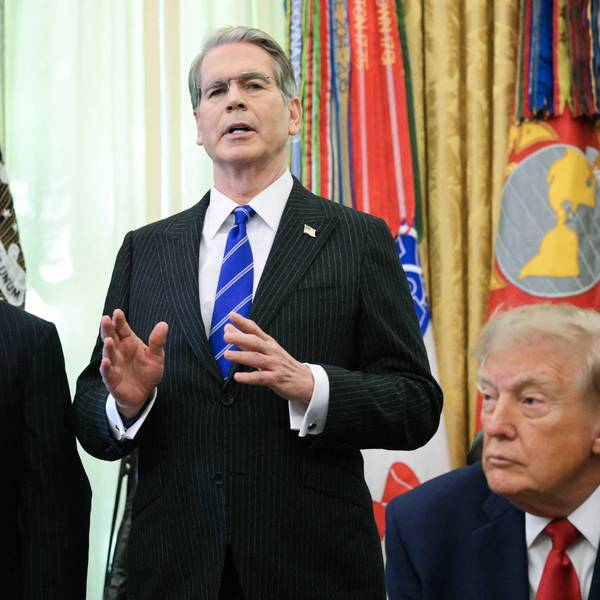


Labor Secretary Eugene Scalia speak during a roundtable discussion with President Donald Trump and industry executives in the State Dining Room of the White House in Washington, D.C. on May 29, 2020. (Photo: Mandel Ngan/AFP via Getty Images)
Labor Bureau Says 'Misclassification Error' Is Making Unemployment Rate Look Lower Than It Really Is
"Long story short, BLS is telling us that we're at 16 percent unemployment."
Buried at the bottom of the Bureau of Labor Statistics' May jobs report--which President Donald Trump and Republican lawmakers touted Friday as evidence that the U.S. economy is rebounding from the Covid-19 crisis at an extraordinary clip--is a note conceding that a "misclassification error" during the agency's data-collection process made the unemployment rate look significantly lower than it really is.
BLS, a Labor Department agency staffed with more than 2,000 career officials, admitted at the end of its report that "a large number of workers... were classified as employed but absent from work." Those workers, the agency explained, should have been classified as "unemployed on temporary layoff" by household survey interviewers but were not.
If those workers had been categorized correctly, the agency said, the "overall [May] unemployment rate would have been about 3 percentage points higher than reported."
"However, according to usual practice, the data from the household survey are accepted as recorded," the agency said, explaining its decision to report that the unemployment rate fell to 13.3% in May, down from 14.7% in April. "To maintain data integrity, no ad hoc actions are taken to reclassify survey responses."
Because the classification error also affected the March and April jobs reports--the actual unemployment rate in April, according to BLS, was likely 19.7% rather than the reported 14.7%--it remains the case that the U.S. unemployment rate likely fell in May, just not to 13.3%.
"Unemployment fell no matter how you cut it," tweeted economist Martha Gimbel, "but double-digit unemployment is unacceptable and should not be our standard for victory."
Many U.S. media outlets on Friday--including, regrettably, this website--reported the top-line BLS unemployment number for May without emphasizing the agency's "misclassification error." (Common Dreams' Friday article on the unemployment numbers has been adjusted to highlight the agency's error.)
Analysts quickly dismissed speculation that the BLS numbers were improperly tampered with by the Trump administration, a possibility that New York Times columnist Paul Krugman hinted at in a series of tweets Friday.
Late Friday, the Washington Post's Heather Long explained the process behind BLS' calculation of the unemployment rate:
The unemployment rate comes from a survey where Census workers ask about 60,000 households questions about whether they are working or looking for a job the week of May 10 to 16.
One of the first questions that gets asked is did the person do any work "for pay or profit?" There are then 45 pages of follow up questions that come after that. One of those questions asks if someone was "temporarily absent" from the job and why that absence occurred. One of the responses is "other."
The BLS instructed surveyors to try to figure out if someone was absent because of the pandemic and, if so, to classify them as on "temporary layoff," meaning they would count in the unemployment data. But some people continued to insist they were just "absent" from work during the pandemic, and the BLS has a policy of not changing people's answers once they are recorded. It's how the BLS protects again bias or data manipulation.
"Long story short, BLS is telling us that we're at 16 percent unemployment," David Dayen, executive editor at The American Prospect, wrote in a summary of the jobs report Friday. "And while that's better than the nearly 20 percent (if you include the misclassified) in the April jobs report, it means we've only brought a small sample of those workers back. The level of employment remains sharply reduced from the pre-pandemic months; we've maybe brought back a little over 10 percent of the jobs."
We are at a crossroads
This country and this world are at a monumental crossroads. US voters have an opportunity to beat back the forces of fascism and confront the billionaires who are rigging the economy, our media system, and our democracy, making it increasingly impossible for ordinary people to get by. We’re not just talking about the election. We’re talking about what must be done once these fascist elements are vanquished from power. We need a bolder set of solutions than what either major party has so far been willing to offer and a working-class movement ready to fight like hell for it. Trump didn't emerge from nowhere. The conditions that fueled MAGA authoritarianism were created by decades of radical neoliberal economic policies and a corrupt political system dominated by corporate interests. They slashed taxes on the super-rich, promising that the benefits would trickle down. They said giveaways to the corporate titans would make life more affordable for the rest of us. It was all bullshit. And when a bitter, betrayed populace searches for someone to blame, right-wing demagogues have little trouble finding scapegoats. People know when they're being lied to, but you won't hear any of this from the corporate media. Only independent journalism—powered and funded by people who believe in building a better world—can deliver truly trustworthy daily news. Our Fall Campaign is underway, and we need your help. To power our newsroom through the rest of the year, we need to raise $125,000 by midnight on October 31. So if you share our vision, please contribute whatever you can to sustain our work. |
Buried at the bottom of the Bureau of Labor Statistics' May jobs report--which President Donald Trump and Republican lawmakers touted Friday as evidence that the U.S. economy is rebounding from the Covid-19 crisis at an extraordinary clip--is a note conceding that a "misclassification error" during the agency's data-collection process made the unemployment rate look significantly lower than it really is.
BLS, a Labor Department agency staffed with more than 2,000 career officials, admitted at the end of its report that "a large number of workers... were classified as employed but absent from work." Those workers, the agency explained, should have been classified as "unemployed on temporary layoff" by household survey interviewers but were not.
If those workers had been categorized correctly, the agency said, the "overall [May] unemployment rate would have been about 3 percentage points higher than reported."
"However, according to usual practice, the data from the household survey are accepted as recorded," the agency said, explaining its decision to report that the unemployment rate fell to 13.3% in May, down from 14.7% in April. "To maintain data integrity, no ad hoc actions are taken to reclassify survey responses."
Because the classification error also affected the March and April jobs reports--the actual unemployment rate in April, according to BLS, was likely 19.7% rather than the reported 14.7%--it remains the case that the U.S. unemployment rate likely fell in May, just not to 13.3%.
"Unemployment fell no matter how you cut it," tweeted economist Martha Gimbel, "but double-digit unemployment is unacceptable and should not be our standard for victory."
Many U.S. media outlets on Friday--including, regrettably, this website--reported the top-line BLS unemployment number for May without emphasizing the agency's "misclassification error." (Common Dreams' Friday article on the unemployment numbers has been adjusted to highlight the agency's error.)
Analysts quickly dismissed speculation that the BLS numbers were improperly tampered with by the Trump administration, a possibility that New York Times columnist Paul Krugman hinted at in a series of tweets Friday.
Late Friday, the Washington Post's Heather Long explained the process behind BLS' calculation of the unemployment rate:
The unemployment rate comes from a survey where Census workers ask about 60,000 households questions about whether they are working or looking for a job the week of May 10 to 16.
One of the first questions that gets asked is did the person do any work "for pay or profit?" There are then 45 pages of follow up questions that come after that. One of those questions asks if someone was "temporarily absent" from the job and why that absence occurred. One of the responses is "other."
The BLS instructed surveyors to try to figure out if someone was absent because of the pandemic and, if so, to classify them as on "temporary layoff," meaning they would count in the unemployment data. But some people continued to insist they were just "absent" from work during the pandemic, and the BLS has a policy of not changing people's answers once they are recorded. It's how the BLS protects again bias or data manipulation.
"Long story short, BLS is telling us that we're at 16 percent unemployment," David Dayen, executive editor at The American Prospect, wrote in a summary of the jobs report Friday. "And while that's better than the nearly 20 percent (if you include the misclassified) in the April jobs report, it means we've only brought a small sample of those workers back. The level of employment remains sharply reduced from the pre-pandemic months; we've maybe brought back a little over 10 percent of the jobs."