
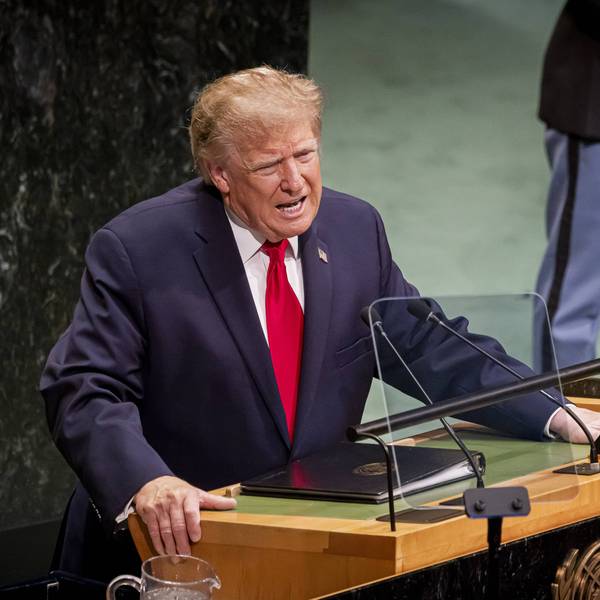

Sen. Richard Blumenthal (D-Conn.) is leading a bill to curb the president's power under the Insurrection Act of 1807. (Photo: Getty Images)
Dems Introduce Bill to Curb President's Insurrection Act Powers After Trump Threatens to Send Troops to Cities Across US
"We cannot allow President Trump to weaponize our military and use active duty troops to violate the constitutional rights of peaceful protesters working to bring about the change our nation desperately needs."
After President Donald Trump threatened to deploy the U.S. military in response to ongoing protests against police brutality and systemic racism in cities across the country, a group of Democratic senators on Thursday introduced legislation to curb the president's power to do so under the Insurrection Act of 1807.
"I'm proposing urgently necessary reforms to impose oversight and accountability to the president's broad, virtually unrestricted power."
--Sen. Richard Blumenthal
The Curtailing Insurrection Act Violations of Individuals' Liberties (CIVIL) Act, spearheaded by Sen. Richard Blumenthal (D-Conn.), would clarify that the Insurrection Act can only be used to protect civil rights and force the president to consult with Congress before invoking it, along with enacting other safeguards to prevent abuse.
"President Trump has threatened to use a slavery-era law to silence calls for justice from thousands of Americans protesting centuries of racist oppression," Blumenthal said in a statement. "I support demonstrators' demands for change and the constitutional rights of all Americans to seek it. President Trump's threats to 'dominate' protestors with military might are a clear and present danger to our most fundamental constitutional rights."
"I'm proposing urgently necessary reforms to impose oversight and accountability to the president's broad, virtually unrestricted power," added Blumenthal, who also shared a summary of the bill's provisions on Twitter. "If the president uses military force against Americans at home, Congress should demand at least the same checks that apply to his use of force against adversaries abroad."
Trump on Wednesday appeared to walk back his threat of deploying the military but still left the option on the table. The president told his former Press Secretary Sean Spicer in a Newsmax interview: "It depends. I don't think we'll have to. We have very strong powers to do it. The National Guard is customary, and we have a very powerful National Guard... and we can do pretty much whatever we want as far as that. But as far as going beyond that, sure, if it was necessary."
The CIVIL Act, which Blumenthal hopes to include in the upcoming National Defense Authorization Act (NDAA), is co-sponsored by Sens. Chris Van Hollen (D-Md.), Patrick Leahy (D-Vt.), Ed Markey (D-Mass.), and Tammy Baldwin (D-Wis.). Baldwin said she supports the bill "because we cannot allow President Trump to weaponize our military and use active duty troops to violate the constitutional rights of peaceful protesters working to bring about the change our nation desperately needs."
Baldwin also highlighted that she led a group of senators who sent a letter Wednesday to U.S. Defense Secretary Mark Esper and Gen. Mark Milley, chairman of the Joint Chiefs of Staff, "voicing grave concerns over President Trump's recent threat to invoke the Insurrection Act in response to Americans exercising their First Amendment rights, peacefully protesting in their communities, and calling for racial justice."
The president's comments this week about using the military against Americans have provoked fresh demands for Trump's removal from office, debates about the powers and limitations of the Insurrection Act, and calls for Congress to re-examine the centuries-old law, which has been amended multiple times since it was first enacted.
Hina Shamsi, director of the ACLU's National Security Project, warned in a Thursday blog post that "an even more militarized response to civilian dissent would escalate the tension, fear, and pain we're seeing and feeling across the country, especially in communities already traumatized by police violence. It would worsen the over-policing of black lives--the very reason why people around the country are protesting."
"An even more militarized response to civilian dissent would escalate the tension, fear, and pain we're seeing and feeling across the country, especially in communities already traumatized by police violence."
--Hina Shamsi, ACLU
In a Wednesday blog post for Lawfare, Scott R. Anderson, a fellow at the Brookings Institution and in the National Security Law Program at Columbia Law School, and Defense Department senior attorney Michel Paradis--who is also a Columbia Law School lecturer and Center on National Security fellow--urged Congress "to shed light on the deficiencies in the legal and policy grounds for Trump's threat to invoke the Insurrection Act."
Anderson and Paradis wrote that including reforms in the 2021 NDAA "will require support from congressional Republicans, especially in the Senate. Yet there have been enough negative reactions within the president's own party that this remains a possibility. That fact alone may deter Trump from pushing the outer limits of his own authorities. And if it does not, then Congress will have to reconsider whether it wants to delegate such broad authorities to the president in the future, even if it cannot stop this president from abusing them today."
The last time the Insurrection Act was invoked was in 1992: George H.W. Bush deployed troops to Los Angeles at the California governor's request over an uprising sparked by the acquittal of four police officers in the fatal beating Rodney King, a black man, the previous year. The current nationwide protests in response to the May 25 police killing of George Floyd, a black man in Minneapolis, have been met with violence from law enforcement.
Shortly before Trump's Monday speech in the Rose Garden, during which he threatened to deploy federal troops, law enforcement used tear gas and rubber bullets to break up a nearby peaceful protest so the president could walk to St. John's Episcopal Church for a photo op. A coalition of civil rights groups including the ACLU of the District of Columbia is suing Trump, Esper, Attorney General William Barr, and other federal officials over the incident.
We are at a crossroads
This country and this world are at a monumental crossroads. US voters have an opportunity to beat back the forces of fascism and confront the billionaires who are rigging the economy, our media system, and our democracy, making it increasingly impossible for ordinary people to get by. We’re not just talking about the election. We’re talking about what must be done once these fascist elements are vanquished from power. We need a bolder set of solutions than what either major party has so far been willing to offer and a working-class movement ready to fight like hell for it. Trump didn't emerge from nowhere. The conditions that fueled MAGA authoritarianism were created by decades of radical neoliberal economic policies and a corrupt political system dominated by corporate interests. They slashed taxes on the super-rich, promising that the benefits would trickle down. They said giveaways to the corporate titans would make life more affordable for the rest of us. It was all bullshit. And when a bitter, betrayed populace searches for someone to blame, right-wing demagogues have little trouble finding scapegoats. People know when they're being lied to, but you won't hear any of this from the corporate media. Only independent journalism—powered and funded by people who believe in building a better world—can deliver truly trustworthy daily news. Our Fall Campaign is underway, and we need your help. To power our newsroom through the rest of the year, we need to raise $125,000 by midnight on October 31. So if you share our vision, please contribute whatever you can to sustain our work. |
After President Donald Trump threatened to deploy the U.S. military in response to ongoing protests against police brutality and systemic racism in cities across the country, a group of Democratic senators on Thursday introduced legislation to curb the president's power to do so under the Insurrection Act of 1807.
"I'm proposing urgently necessary reforms to impose oversight and accountability to the president's broad, virtually unrestricted power."
--Sen. Richard Blumenthal
The Curtailing Insurrection Act Violations of Individuals' Liberties (CIVIL) Act, spearheaded by Sen. Richard Blumenthal (D-Conn.), would clarify that the Insurrection Act can only be used to protect civil rights and force the president to consult with Congress before invoking it, along with enacting other safeguards to prevent abuse.
"President Trump has threatened to use a slavery-era law to silence calls for justice from thousands of Americans protesting centuries of racist oppression," Blumenthal said in a statement. "I support demonstrators' demands for change and the constitutional rights of all Americans to seek it. President Trump's threats to 'dominate' protestors with military might are a clear and present danger to our most fundamental constitutional rights."
"I'm proposing urgently necessary reforms to impose oversight and accountability to the president's broad, virtually unrestricted power," added Blumenthal, who also shared a summary of the bill's provisions on Twitter. "If the president uses military force against Americans at home, Congress should demand at least the same checks that apply to his use of force against adversaries abroad."
Trump on Wednesday appeared to walk back his threat of deploying the military but still left the option on the table. The president told his former Press Secretary Sean Spicer in a Newsmax interview: "It depends. I don't think we'll have to. We have very strong powers to do it. The National Guard is customary, and we have a very powerful National Guard... and we can do pretty much whatever we want as far as that. But as far as going beyond that, sure, if it was necessary."
The CIVIL Act, which Blumenthal hopes to include in the upcoming National Defense Authorization Act (NDAA), is co-sponsored by Sens. Chris Van Hollen (D-Md.), Patrick Leahy (D-Vt.), Ed Markey (D-Mass.), and Tammy Baldwin (D-Wis.). Baldwin said she supports the bill "because we cannot allow President Trump to weaponize our military and use active duty troops to violate the constitutional rights of peaceful protesters working to bring about the change our nation desperately needs."
Baldwin also highlighted that she led a group of senators who sent a letter Wednesday to U.S. Defense Secretary Mark Esper and Gen. Mark Milley, chairman of the Joint Chiefs of Staff, "voicing grave concerns over President Trump's recent threat to invoke the Insurrection Act in response to Americans exercising their First Amendment rights, peacefully protesting in their communities, and calling for racial justice."
The president's comments this week about using the military against Americans have provoked fresh demands for Trump's removal from office, debates about the powers and limitations of the Insurrection Act, and calls for Congress to re-examine the centuries-old law, which has been amended multiple times since it was first enacted.
Hina Shamsi, director of the ACLU's National Security Project, warned in a Thursday blog post that "an even more militarized response to civilian dissent would escalate the tension, fear, and pain we're seeing and feeling across the country, especially in communities already traumatized by police violence. It would worsen the over-policing of black lives--the very reason why people around the country are protesting."
"An even more militarized response to civilian dissent would escalate the tension, fear, and pain we're seeing and feeling across the country, especially in communities already traumatized by police violence."
--Hina Shamsi, ACLU
In a Wednesday blog post for Lawfare, Scott R. Anderson, a fellow at the Brookings Institution and in the National Security Law Program at Columbia Law School, and Defense Department senior attorney Michel Paradis--who is also a Columbia Law School lecturer and Center on National Security fellow--urged Congress "to shed light on the deficiencies in the legal and policy grounds for Trump's threat to invoke the Insurrection Act."
Anderson and Paradis wrote that including reforms in the 2021 NDAA "will require support from congressional Republicans, especially in the Senate. Yet there have been enough negative reactions within the president's own party that this remains a possibility. That fact alone may deter Trump from pushing the outer limits of his own authorities. And if it does not, then Congress will have to reconsider whether it wants to delegate such broad authorities to the president in the future, even if it cannot stop this president from abusing them today."
The last time the Insurrection Act was invoked was in 1992: George H.W. Bush deployed troops to Los Angeles at the California governor's request over an uprising sparked by the acquittal of four police officers in the fatal beating Rodney King, a black man, the previous year. The current nationwide protests in response to the May 25 police killing of George Floyd, a black man in Minneapolis, have been met with violence from law enforcement.
Shortly before Trump's Monday speech in the Rose Garden, during which he threatened to deploy federal troops, law enforcement used tear gas and rubber bullets to break up a nearby peaceful protest so the president could walk to St. John's Episcopal Church for a photo op. A coalition of civil rights groups including the ACLU of the District of Columbia is suing Trump, Esper, Attorney General William Barr, and other federal officials over the incident.