

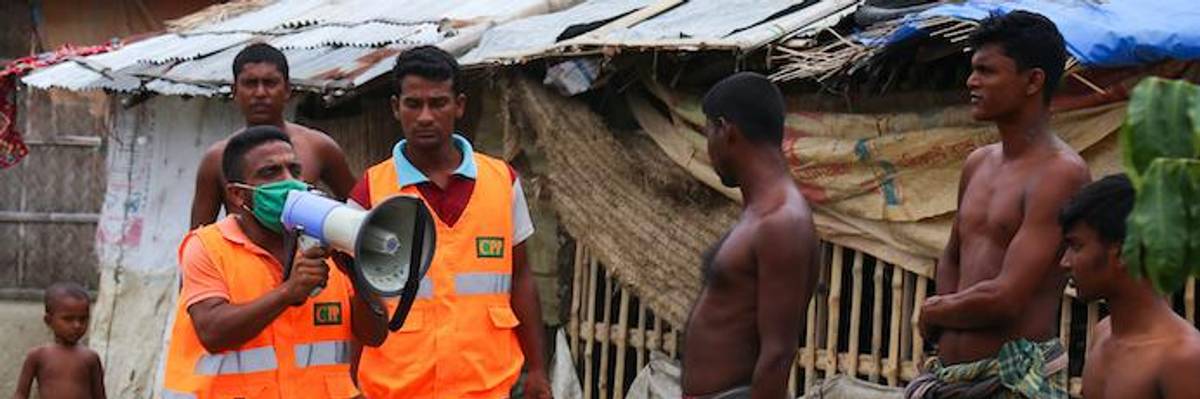
A Cyclone Preparedness Programme (CPP) volunteer uses a megaphone to urge residents to evacuate to shelters ahead of the expected landfall of Cyclone Amphan in Khulna on May 19, 2020. India and Bangladesh began evacuating more than two million people May 18 as a cyclone barrelled towards their coasts, with officials racing to ready extra shelters amid fears of coronavirus contagion in cramped refuges.
'Extremely Severe Cyclonic Storm' Amphan Barrels Towards India, Bangladesh
Meteorologists say there's "catastrophic storm surge potential."
India and Bangladesh are facing "catastrophic storm surge potential" from Cyclone Amphan as the major storm triggers mass evacuations a day before it's expected to make landfall on the Bengal coast.
The India Meteorological Department classified Amphan on Tuesday as an "extremely severe cyclonic storm" that would likely carry maximum sustained wind speeds of 155-165 kilometers per hour gusting to 185 kmp when the cyclone hits India's West Bengal state and Bangladesh.
The storm has weakened since Monday night when it was recorded as the Bay of Bengal's strongest ever storm, packing sustained winds of 270 kilometers per hour (165 miles per hours). Meteorologist Eric Holthaus warned Tuesday morning that Amphan could still bring major damage.
"This storm is deadly serious," Holthaus tweeted.
"Amphan will likely make landfall as a Category 2 equivalent, perhaps a Category 3," meteorologist Bob Henson wrote Tuesday. "Nevertheless, a major storm surge is almost certain given the storm's trajectory and the geography of the Bay of Bengal."
Henson explained further:
Although Amphan's high winds will wreak havoc, and its torrential rainfall will cause inland flooding--a major concern in itself, given the storm's vast envelope of moisture--the most serious threat posed by Amphan is potentially catastrophic storm surge. Even if Amphan's top winds weaken further, the storm surge threat will likely remain extreme. Amphan is a large cyclone that is already pushing a tremendous amount of water northward into the Bay of Bengal, which exerts a funneling effect on northward-moving cyclones. There is a great deal of momentum in the water pushed by large, powerful storms when their peak winds weaken but their overall wind fields expand, as evidenced by 2008's Hurricane Ike in Texas and 2012's Hurricane Sandy in New Jersey and New York.
Compounding the difficulties of keeping people safe during evacuations is the ongoing threat of Covid-19. From BBC News:
This time round there is the coronavirus pandemic to contend with too--social distancing protocols to curb the spread of infection mean more shelters are needed, and thousands of migrant workers displaced by lockdown restrictions in India are on the move, many heading by foot to coastal villages.
Preparations to shelter millions in Bangladesh are already underway, the Associated Press reports:
Authorities in Bangladesh warned that the cyclone could flood vast swaths of southwestern and southern areas. Junior Minister for Disaster Management and Relief Enamur Rahman said evacuations had begun in the southwest, where residents of Satkhira district, which was devastated by a 2009 cyclone, will be moved to shelters.
Rahman said he ordered local authorities to prepare thousands of shelters and makeshift structures to protect more than 5 million people before the cyclone crosses the region.
Amphan is the second ever recorded super cyclone to hit the Bay of Bengal. The other, the Odisha Cyclone, struck in 1999.
We are at a crossroads
This country and this world are at a monumental crossroads. US voters have an opportunity to beat back the forces of fascism and confront the billionaires who are rigging the economy, our media system, and our democracy, making it increasingly impossible for ordinary people to get by. We’re not just talking about the election. We’re talking about what must be done once these fascist elements are vanquished from power. We need a bolder set of solutions than what either major party has so far been willing to offer and a working-class movement ready to fight like hell for it. Trump didn't emerge from nowhere. The conditions that fueled MAGA authoritarianism were created by decades of radical neoliberal economic policies and a corrupt political system dominated by corporate interests. They slashed taxes on the super-rich, promising that the benefits would trickle down. They said giveaways to the corporate titans would make life more affordable for the rest of us. It was all bullshit. And when a bitter, betrayed populace searches for someone to blame, right-wing demagogues have little trouble finding scapegoats. People know when they're being lied to, but you won't hear any of this from the corporate media. Only independent journalism—powered and funded by people who believe in building a better world—can deliver truly trustworthy daily news. Our Fall Campaign is underway, and we need your help. To power our newsroom through the rest of the year, we need to raise $125,000 by midnight on October 31. So if you share our vision, please contribute whatever you can to sustain our work. |
India and Bangladesh are facing "catastrophic storm surge potential" from Cyclone Amphan as the major storm triggers mass evacuations a day before it's expected to make landfall on the Bengal coast.
The India Meteorological Department classified Amphan on Tuesday as an "extremely severe cyclonic storm" that would likely carry maximum sustained wind speeds of 155-165 kilometers per hour gusting to 185 kmp when the cyclone hits India's West Bengal state and Bangladesh.
The storm has weakened since Monday night when it was recorded as the Bay of Bengal's strongest ever storm, packing sustained winds of 270 kilometers per hour (165 miles per hours). Meteorologist Eric Holthaus warned Tuesday morning that Amphan could still bring major damage.
"This storm is deadly serious," Holthaus tweeted.
"Amphan will likely make landfall as a Category 2 equivalent, perhaps a Category 3," meteorologist Bob Henson wrote Tuesday. "Nevertheless, a major storm surge is almost certain given the storm's trajectory and the geography of the Bay of Bengal."
Henson explained further:
Although Amphan's high winds will wreak havoc, and its torrential rainfall will cause inland flooding--a major concern in itself, given the storm's vast envelope of moisture--the most serious threat posed by Amphan is potentially catastrophic storm surge. Even if Amphan's top winds weaken further, the storm surge threat will likely remain extreme. Amphan is a large cyclone that is already pushing a tremendous amount of water northward into the Bay of Bengal, which exerts a funneling effect on northward-moving cyclones. There is a great deal of momentum in the water pushed by large, powerful storms when their peak winds weaken but their overall wind fields expand, as evidenced by 2008's Hurricane Ike in Texas and 2012's Hurricane Sandy in New Jersey and New York.
Compounding the difficulties of keeping people safe during evacuations is the ongoing threat of Covid-19. From BBC News:
This time round there is the coronavirus pandemic to contend with too--social distancing protocols to curb the spread of infection mean more shelters are needed, and thousands of migrant workers displaced by lockdown restrictions in India are on the move, many heading by foot to coastal villages.
Preparations to shelter millions in Bangladesh are already underway, the Associated Press reports:
Authorities in Bangladesh warned that the cyclone could flood vast swaths of southwestern and southern areas. Junior Minister for Disaster Management and Relief Enamur Rahman said evacuations had begun in the southwest, where residents of Satkhira district, which was devastated by a 2009 cyclone, will be moved to shelters.
Rahman said he ordered local authorities to prepare thousands of shelters and makeshift structures to protect more than 5 million people before the cyclone crosses the region.
Amphan is the second ever recorded super cyclone to hit the Bay of Bengal. The other, the Odisha Cyclone, struck in 1999.