

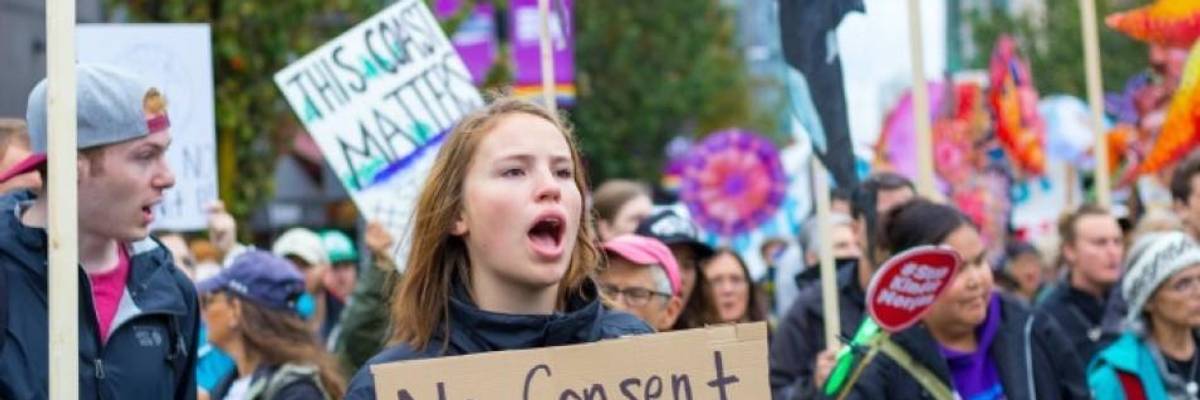
Protesters at a rally in Vancouver to show opposition to the Trans Mountain pipeline on September 9th, 2017.
Canada's Top Court Rejects BC Bid to Halt Trans Mountain Tar Sands Project
"We are at a pivotal moment in human history, and we can do better than banking on a future that continues to rely on fossil fuels."
Environmental groups fumed Thursday after Canada's Supreme Court rejected the province of British Columbia's appeal regarding the Trans Mountain tar sands pipeline expansion project.
The decision "is a loss for local governments who want to protect the land, water, and communities within their jurisdictions," said Sierra Club BC.
The high court's decision came quickly and unanimously. From The Globe and Mail:
After a one-day hearing, the bench deliberated for less than half an hour before Chief Justice Richard Wagner announced the decision, upholding a lower court ruling that what B.C. is proposing would be unconstitutional because only Ottawa has oversight of the federally owned and regulated Trans Mountain pipeline, or TMX.
Yet the ruling "does nothing to reduce the risk or damage of a diluted bitumen spill," said Vancouver-based West Coast Environmental Law.
The pipeline project, which would roughly double the existing pipeline's expansion, would carried bitumen from Alberta's tar sands to a terminal in Burnaby, British Columbia. The project has generated anger and calls for resistance from Indigenous and climate groups who say it threatens marine life and communities in its path.
As The Canadian Press reported, "B.C. argued it has jurisdiction to protect the environment within its borders and, since its land and people would bear the brunt of any damage from a spill if the pipeline ruptured, it should get a say in what can flow through it."
The Green Caucus in B.C. added to the chorus of condemnation.
"The decision to purchase and push through this expansion is a political decision," said B.C. Green MLA Sonia Furstenau for Cowichan Valley. "We are at a pivotal moment in human history, and we can do better than banking on a future that continues to rely on fossil fuels. Strong climate action is an economic driver that is already driving significant job growth in clean energy."
Canadian environmental law group Ecojustice, which intervened in the case argued that at stake was "so much more than a single project."
According to Kegan Pepper-Smith, a lawyer with the group, the "decision to block B.C. from amending its Environmental Management Act leaves communities and the environment vulnerable to toxic diluted bitumen spills. Ecojustice is also deeply concerned that the court refused to confirm that governments at all levels have both a right and a constitutional duty to protect the environment."
Though the fossil fuel industry and Alberta government cheered the development, not all obstacles have been removed; the expansion project still faces a legal challenge from Indigenous groups.
According to Torrance Coste, national campaign director with the Wilderness Committee, there's not place in the 21st Century for these types of fossil fuel projects.
"We need to get this through our heads," Coste tweeted, "if projects violate Indigenous rights, threaten ecosystems, and increase CO2 emissions, they don't belong in our economy in 2020, period."
We are at a crossroads
This country and this world are at a monumental crossroads. In a few short weeks, US voters will have an opportunity to beat back the forces of fascism and confront the billionaires who are rigging the economy, our media system, and our democracy, making it increasingly impossible for ordinary people to get by. We’re not just talking about the election. We’re talking about what must be done once these fascist elements are vanquished from power. We need a bolder set of solutions than what either major party has so far been willing to offer and a working-class movement ready to fight like hell for it. Trump didn't emerge from nowhere. The conditions that fueled MAGA authoritarianism were created by decades of radical neoliberal economic policies and a corrupt political system dominated by corporate interests. They slashed taxes on the super-rich, promising that the benefits would trickle down. They said giveaways to the corporate titans would make life more affordable for the rest of us. It was all bullshit. And when a bitter, betrayed populace searches for someone to blame, right-wing demagogues have little trouble finding scapegoats. People know when they're being lied to, but you won't hear any of this from the corporate media. Only independent journalism—powered and funded by people who believe in building a better world—can deliver truly trustworthy daily news. Our Fall Campaign is underway, and we need your help. To power our newsroom through the rest of the year, we need to raise $125,000 by midnight on October 31. So if you share our vision, please contribute whatever you can to sustain our work. |
Environmental groups fumed Thursday after Canada's Supreme Court rejected the province of British Columbia's appeal regarding the Trans Mountain tar sands pipeline expansion project.
The decision "is a loss for local governments who want to protect the land, water, and communities within their jurisdictions," said Sierra Club BC.
The high court's decision came quickly and unanimously. From The Globe and Mail:
After a one-day hearing, the bench deliberated for less than half an hour before Chief Justice Richard Wagner announced the decision, upholding a lower court ruling that what B.C. is proposing would be unconstitutional because only Ottawa has oversight of the federally owned and regulated Trans Mountain pipeline, or TMX.
Yet the ruling "does nothing to reduce the risk or damage of a diluted bitumen spill," said Vancouver-based West Coast Environmental Law.
The pipeline project, which would roughly double the existing pipeline's expansion, would carried bitumen from Alberta's tar sands to a terminal in Burnaby, British Columbia. The project has generated anger and calls for resistance from Indigenous and climate groups who say it threatens marine life and communities in its path.
As The Canadian Press reported, "B.C. argued it has jurisdiction to protect the environment within its borders and, since its land and people would bear the brunt of any damage from a spill if the pipeline ruptured, it should get a say in what can flow through it."
The Green Caucus in B.C. added to the chorus of condemnation.
"The decision to purchase and push through this expansion is a political decision," said B.C. Green MLA Sonia Furstenau for Cowichan Valley. "We are at a pivotal moment in human history, and we can do better than banking on a future that continues to rely on fossil fuels. Strong climate action is an economic driver that is already driving significant job growth in clean energy."
Canadian environmental law group Ecojustice, which intervened in the case argued that at stake was "so much more than a single project."
According to Kegan Pepper-Smith, a lawyer with the group, the "decision to block B.C. from amending its Environmental Management Act leaves communities and the environment vulnerable to toxic diluted bitumen spills. Ecojustice is also deeply concerned that the court refused to confirm that governments at all levels have both a right and a constitutional duty to protect the environment."
Though the fossil fuel industry and Alberta government cheered the development, not all obstacles have been removed; the expansion project still faces a legal challenge from Indigenous groups.
According to Torrance Coste, national campaign director with the Wilderness Committee, there's not place in the 21st Century for these types of fossil fuel projects.
"We need to get this through our heads," Coste tweeted, "if projects violate Indigenous rights, threaten ecosystems, and increase CO2 emissions, they don't belong in our economy in 2020, period."