

SUBSCRIBE TO OUR FREE NEWSLETTER
Daily news & progressive opinion—funded by the people, not the corporations—delivered straight to your inbox.
5
#000000
#FFFFFF
To donate by check, phone, or other method, see our More Ways to Give page.
Daily news & progressive opinion—funded by the people, not the corporations—delivered straight to your inbox.
The only real hope of avoiding climate disaster lies in dramatically ramping up the transition to clean energy by building new wind and solar farms at breakneck speed.
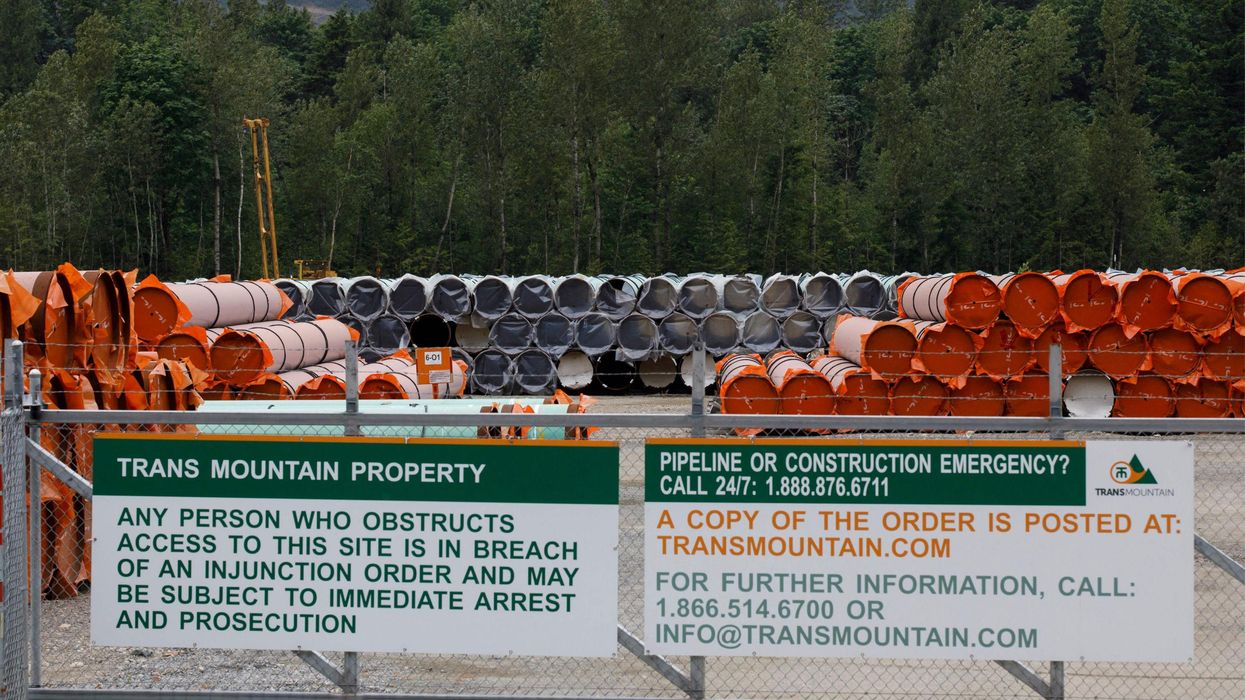
The opening of the Trans Mountain Pipeline expansion this month—widely celebrated in the media—reminds us that Canada is still very much in the grip of Big Oil.
That $34 billion expansion was financed by Ottawa, and it amounts to a massive public subsidy for the oil industry—at a time when we should urgently be financing renewable energy, not fossil fuels.
The renowned U.S. climatologist James Hansen famously said the oilsands were such a “dirty, carbon-intensive” oil that if they were to be fully exploited, it would be “game over” for the planet.
Over the past four years, Ottawa has provided $65 billion in financial support for oil and gas, but only a fraction as much for renewable energy.
Yet here we are, applauding the tripling of the pipeline’s capacity to carry oil from the oilsands, even as that moves us closer to “game over.”
A report this month revealed that the world’s top climate scientists believe the world is headed in a frightening direction—toward more than 2.5°C degrees of warming, charging past the international target of 1.5°C, beyond which fires, floods, and heatwaves become seriously unpredictable.
Today, we’re at just 1.2°C of warming, and look at the mess we’re in. Already this season, wildfires are burning out of control in B.C. and Alberta.
Climate scientists have been clear: The only real hope of avoiding climate disaster lies in dramatically ramping up the transition to clean energy by building new wind and solar farms at breakneck speed.
But this isn’t happening, even though the price of wind and solar power has become very competitive. That was supposed to be the trigger point at which the market would begin working in our favour, with renewables cheaper than fossil fuels, facilitating the transition to clean energy.
Renewables keep getting cheaper. The price of solar power has plunged by 90%, yet Big Oil remains dominant.
That’s because, with its long-established monopoly and extensive government support, Big Oil is far more profitable—and therefore more attractive—to major financial investors than the struggling, competitive firms that make up the budding renewable sector, notes Brett Christophers, a political economist at Uppsala University in Sweden.
Clearly, given the climate emergency, we can’t just leave the vital task of transitioning to renewables up to the whims of financial investors, whose only interest is maximizing their returns.
Governments must become a lot more involved, and they have to switch their loyalty from Big Oil to renewables.
The Biden administration has moved in this direction, with sweeping measures aimed at doubling renewable capacity in the U.S. over the next decade. Meanwhile, the Trudeau government is locked into serving the immensely powerful oil industry.
Over the past four years, Ottawa has provided $65 billion in financial support for oil and gas, but only a fraction as much for renewable energy. Its main program for subsidizing renewables provides less than $1 billion a year, says Julia Levin, an associate director with Environmental Defence.
The extent of Ottawa’s willingness to accommodate Big Oil became clear in 2018 when it took over the Trans Mountain Pipeline expansion, rather than let the project collapse after its original backers threatened to pull out amid intense environmental opposition.
Now Ottawa is planning to spend $10 billion, possibly much more, subsidizing Big Oil’s futile but costly efforts to reduce its carbon emissions through “carbon capture and storage”—despite ample evidence the technology is highly ineffective at reducing such emissions.
This enables Big Oil to pretend it’s serious about reducing emissions, lulling Canadians into believing we’re making progress on climate, when we’re really just spinning our wheels and wasting a lot of public money in the process.
For years, there was the comforting thought that, when the horrors of climate change truly became clear, humans would be smart enough to figure out a solution. That turned out to be true. It’s just that we haven’t figured out how to override the powerful so we can implement the solution.
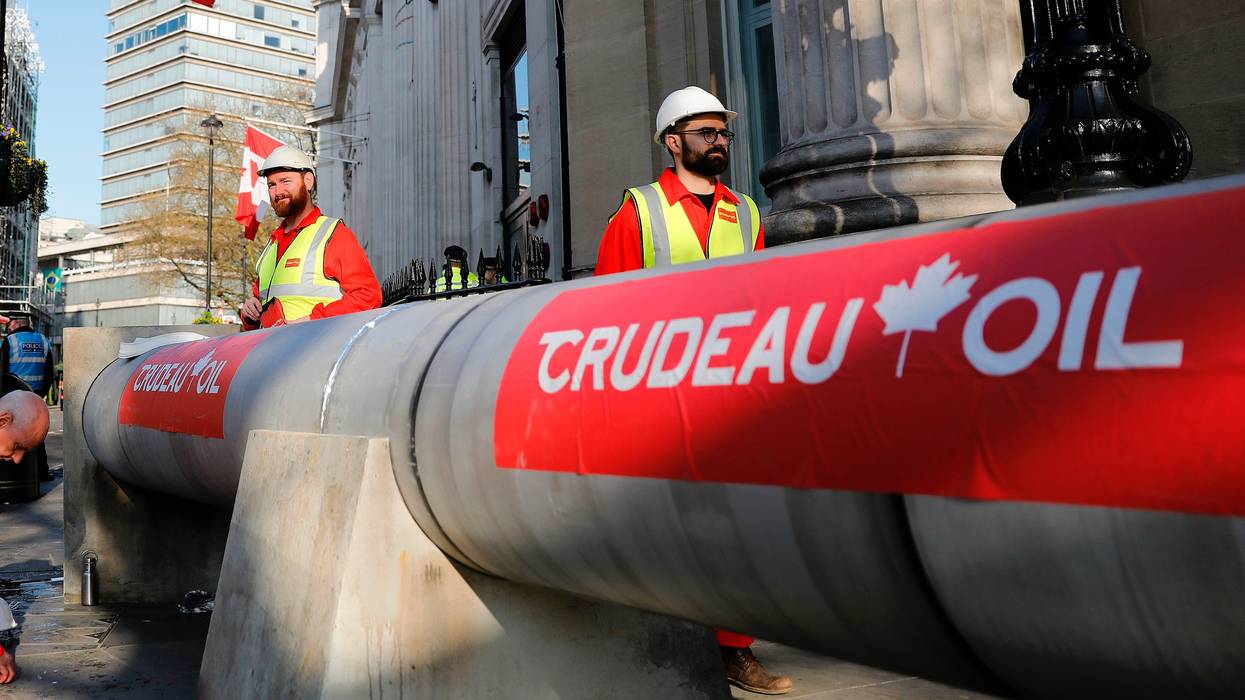
"Everybody warned Prime Minister Justin Trudeau if he bought this white elephant pipeline it would turn into a financial and political boondoggle," said one climate campaigner.
Climate, environmental, and Indigenous advocates in recent days condemned the skyrocketing cost of expanding the Canadian government-owned Trans Mountain oil pipeline, which is now expected to carry a CA$30.9 billion price tag—44% higher than last year's estimate and nearly a six-fold increase from the original appraisal.
Trans Mountain Corporation said Friday that the project—which will add more than 600 miles of new pipeline and will nearly triple existing capacity from 300,000 to 890,000 barrels per day—is currently close to 80% finished and should be completed by the end of the year. The company blamed the project's soaring cost on numerous factors, including floods in British Columbia, supply chain difficulties, inflation, and the discovery of major Indigenous archaeological sites along the pipeline route.
"Everybody warned Prime Minister Justin Trudeau if he bought this white elephant pipeline it would turn into a financial and political boondoggle," Peter McCartney, a climate campaigner at the Wilderness Committee, said in a statement Friday.
"I don't want to hear from any federal official that bold, transformative climate action is too expensive ever again."
In what critics called a betrayal of his purported commitment to tackling the climate emergency, Trudeau's government bought the pipeline from Houston-based Kinder Morgan in 2018 for $4.5 billion.
"Honestly, I really hate to say we told them so because there are far better things we should be doing with over $30 billion than exporting a polluting product the world has agreed to abandon as fast as possible," said McCartney.
"In the last year alone, the price tag for this pipeline—already the most expensive industrial project in Canadian history—has gone up almost $10 billion," McCartney added. "If the Liberal government doesn't abandon this pointless albatross now, how do we know taxpayers won't be looking at even more cost overruns and further delays a year from now?"
Keith Stewart, a senior energy strategist with Greenpeace Canada, told Reuters that the pipeline was "always a disaster from a climate change perspective."
"But this is now an economic crime that has stolen $30 billion of public funds from real climate solutions," he added.
According to the Wilderness Committee:
When Trans Mountain first proposed its expansion in 2012, American company Kinder Morgan estimated the construction costs at $5.4 billion. In 2018, when the federal government bought the pipeline it had a forecast price tag of $9.6 billion, on top of the $4.5 billion purchase. Last year, the company announced costs had risen to $21.4 billion, and now it predicts it will cost $30.9 billion in total to finish the project with about a year left to go. That means the price of this pipeline has ballooned almost six times.
"How deeply ironic it is for this fossil fuel company that climate disasters have led construction costs to spiral out of control," McCartney said. "I don't want to hear from any federal official that bold, transformative climate action is too expensive ever again."
According to the Union of British Columbia Indian Chiefs, at least 58 Indigenous sites—including former villages and burial grounds—were destroyed during the pipeline's construction in the early 1950s.
Completed in 1953, the Trans Mountain Pipeline carries crude tar sands oil, often called the world's dirtiest, over 700 miles from Alberta to the British Columbian coast. Activists have urged the Canadian government to cancel the expansion, arguing that it will further fuel the climate emergency, threaten the environment, and desecrate sacred Indigenous lands. Additionally, pipeline workers sometimes murder, rape, traffic, and perpetrate other crimes against First Nations women, girls, and two-spirit people.
On the same day Trans Mountain Corporation announced the revised estimate for the pipeline's cost, Calí Tzay, the United Nations special rapporteur on the rights of Indigenous peoples, ended a 10-day visit to Canada and published a report linking the project to human rights abuses.
"A large number of megaprojects in Indigenous territories proceed without good faith consultation and in the absence of obtaining Indigenous peoples' free, prior, and informed consent as, in the case of Trans Mountain Pipeline," Tzay wrote. "I am also concerned about the ongoing militarization of Indigenous lands and the criminalization of Indigenous human rights defenders resisting the Trans Mountain and Coastal GasLink pipelines in British Columbia."
"I urge the government of Canada to end these violations," Tzay added, "and to adopt adequate measures to guarantee Indigenous peoples' right to consultation and free, prior, and informed consent, and their rights to lands, territories, and resources."
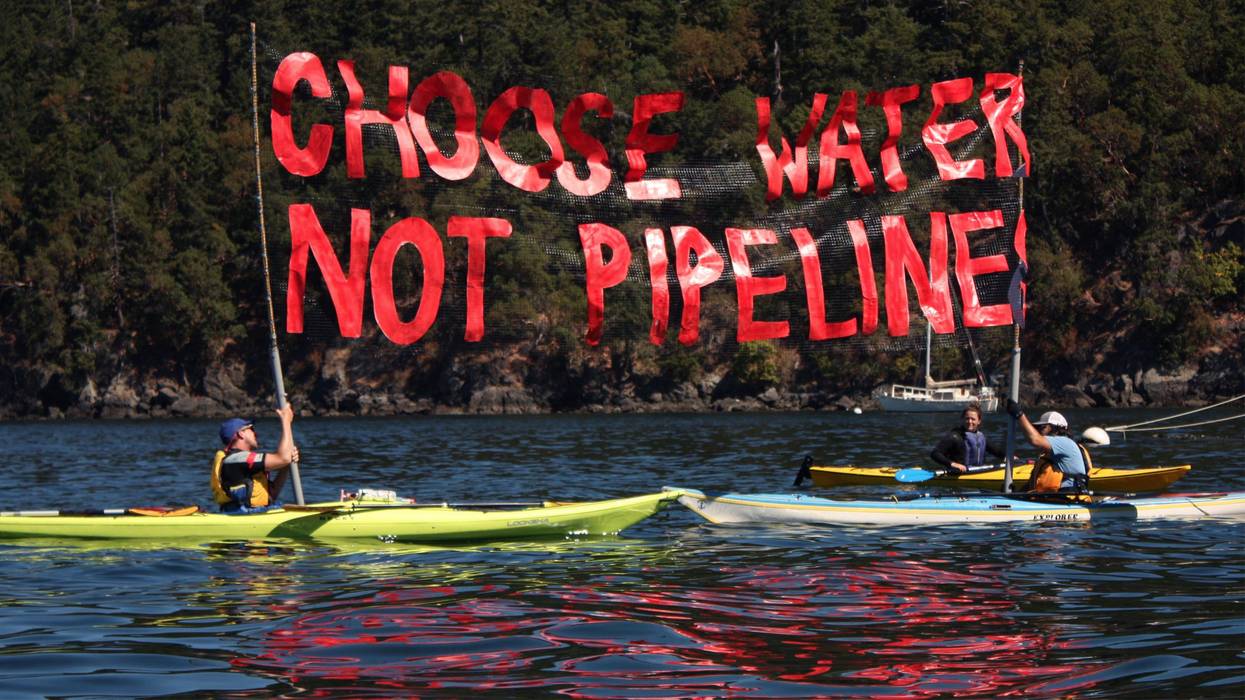
This weekend was my 31st birthday, and I had the joy of yelling and skinny dipping in bioluminescent waters, every motion of my body lighting up the waves around me, the salt on my lips. There is little as freeing and as humbling as jumping into cold water, the sea bringing out my inner child, shrieking and playing. I live on the West Coast of North America, on the Salish Sea.
Will Liberty leadership change the course? Or will the company keep choosing profit over people.
Yesterday, my partner and I processed local salmon to keep in our freezer. We are living near a community with local fishery management, where thousands of salmon return every year. The salmon return brings eagles and osprey, and further up the coast, bears.
We returned the blood, guts, bones, eggs, skin, all that we didn't use to the inlet the salmon came from, knowing the nitrogen feeds this entire ecosystem. Salmon are the lifeblood of this coast, their silvery scales tough as they determinedly return year after year. The animals that eat this salmon often bring their bones up unto the shores, where the nitrogen from their remains feed the forest, fertilizing the trees. Local Indigenous communities have been subsisting off of this salmon for thousands of years.
At Chief Seattle days in Suquamish, where I live--I was helping to hand out salmon to residents that have lived in this region since time immemorial, and the community thrives with the salmon. Salmon give their whole lives to this place, returning to their homes from thousands of miles away, and give the largest sacrifice one can make, returning their bodies to the river to provide for their young. This is the miracle of life and death, the splash and whirls of salmon dancing their way to demise, a smelly salty and powerful rhythm that defines the region.
Yet, I fear for the salmon's lives, and for the very backbone of this place, of this community. As industry has logged the region and development steals the trees that once shaded these narrow streams, and water warms from the changing climate, humans are surrounding these beautiful beings with everything from dams to overfishing. The local killer whale that lives from the salmon is endangered because the salmon counts are low, and the increase in vessel traffic means that the sound that they use to hunt together is preventing them from fishing.
A major pipeline expansion-- Trans Mountain --is being constructed as we speak, the roar of machines tearing up a swath across this earth, and this pipeline would bring a sevenfold increase in oil tanker traffic to the region. The oil that moves through the existing Trans Mountain pipeline and the related expansion is diluted bitumen which sinks in salt water and is impossible to recover, and the oil tankers that carry it are moving through one of the busiest channels in North America. Just last week there was a shipwreck that led to many gallons of diesel spilling in the region, demonstrating this ongoing risk of shipping accidents. The construction is ongoing in a wild salmon bearing river, in spawning grounds.
All of what I hold dear is at risk every day from corporate driven expansion, akin to death by a thousand paper cuts. Corporate power has people believing in the almighty dollar over the very essence of our humanity.
One of the major decision makers related to this life threatening industrial expansion is the insurance industry. The industry makes multi-million-dollar deals with pipeline companies lining the pockets of the wealthy, instead of prioritizing the health and well-being of communities.
Liberty Mutual still hasn't ruled out the Trans Mountain pipeline, and there's no mystery as to why: money talks. Some of the company's wealthiest board members have close ties with the oil and gas industry, with important folks in the company's upper echelons simultaneously profiting off of positions in tar sands companies.
This week Trans Mountain's insurance certificate expires on August 31st, and is being renewed behind closed doors- the company having filed to keep the insurance information secret. Despite this, people in Denver, Boston, Toronto, Vancouver and Seattle, are taking action at Liberty Mutual, and delivering a petition with thousands of their customers calling on them to drop Trans Mountain--a quarter of a million people signed on in total.
We are taking action because tar sands expansion poisons the water that fish rely on, resulting in deformations and poisoning, increasing cancer rates for communities at the sites of extraction, and driving the climate disasters we see every day from hurricanes to wells going dry.
Years from now, Liberty will look back on this decision with remorse if they continue to support the status quo of corporate power instead of listening to the communities who seek nothing but clean air, food to eat, clean water to drink, and a healthy climate. We deserve better. With billions invested in oil and gas, and insurance contracts for some of the largest expansions of oil and gas in the world, Liberty is currently materially supporting projects that put us all at risk.
The question is, will Liberty leadership change the course? Or will the company keep choosing profit over people. The ball is in your court, Liberty. We know this Salish Sea is worth defending, but do you?
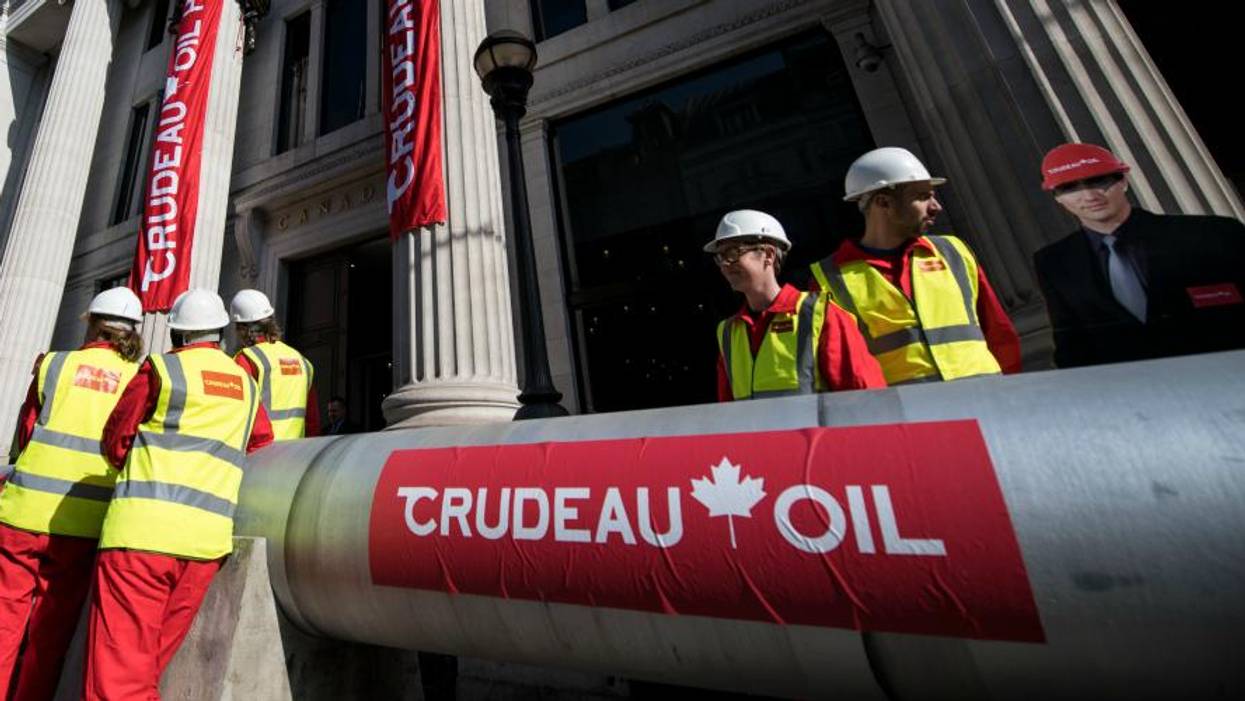
An analysis published Tuesday revealed that six of Canada's largest banks are financing the construction of the Trans Mountain tar sands pipeline expansion, partially fulfilling a promise by the center-left government of Prime Minister Justin Trudeau to secure private funding for the highly controversial project while calling into question the administration's pledge to cap oil and gas emissions.
"Our big fossil banks and the federal government have been working in tandem for a long time behind the scenes."
Based on data from Bloomberg Terminal, the grassroots advocacy group Stand.earth found that the banks--TD Securities, RBC Capital Markets, Canadian Imperial Bank of Commerce, BMO Capital Markets, Scotiabank, and National Bank of Canada--quietly agreed last month to lend CAD $10 billion (U.S. $7.9 billion) to Trans Mountain Corporation after the country's Department of Finance guaranteed taxpayers would foot the bill if anything went wrong.
The government then waited three weeks to inform the public of the deal and has refused to confirm who is behind the loan.
"Once again, we see that Canadian banks are leading the world in financing climate-destructive, Indigenous rights-violating projects like the Trans Mountain pipeline and tanker project," Stand.earth climate finance director Richard Brooks said in a statement. "It's time for them to choose sides--are you going to help us reach our national climate goals, or do everything possible to hold us back?"
The approximately 1,150-kilometer (715-mile) pipeline, which was completed in 1953, is owned by the Canadian government through its Trans Mountain Corporation and carries crude oil from the tar sands of Alberta to the British Columbian coast. Tar sands oil is often called the world's dirtiest.
The expansion will add 980 kilometers (609 miles) of new pipeline, nearly tripling its carrying capacity from 300,000 to 890,000 barrels per day, according to the crown corporation.
Climate activists have called on the Canadian government to cancel the expansion, arguing that in addition to exacerbating the climate emergency and threatening the environment, it desecrates sacred Indigenous lands, and workers housed in "man camps" sometimes murder, rape, traffic, and perpetrate other crimes against First Nations women, girls, and two-spirit people.
Campaigners note that Trudeau--who has often come under fire for his fossil fuel-friendly policies--pledged at last year's United Nations climate summit in Glasgow, Scotland to lower Canada's carbon footprint by committing to a cap on emissions from the country's oil and gas industry.
According to the federal agency Statistics Canada, oil and gas extraction contributes about 5% to the country's gross domestic product, and over 20% of the provincial economies of Alberta and Newfoundland and Labrador. Canada is the largest single source of U.S. imported petroleum and refined products.
All six of the banks named in the new report also claim they are committed to climate action. TD, for example, declares it is "continually working to embed responsible business practices," including "working toward achieving our target of net-zero greenhouse gas emissions associated with our operations and financing activities by 2050," while CIBC says it is "committed to collaborating with carbon-intensive sectors for a successful transition to net-zero" and Scotiabank proclaims it is "ensuring we are lowering our environmental footprint in our operations."
Canadian taxpayers have already contributed CAD $17 billion (U.S. $13.3 billion) toward the Trans Mountain pipeline, which the government purchased from Texas-based energy infrastructure giant Kinder Morgan in 2018. Earlier this year, Canadian Finance Minister and Deputy Prime Minister Chrystia Freeland promised not to spend any more public money building on the project.
In February, the government announced that the pipeline's price is expected to nearly double to over $21 billion. Other analyses suggest the cost could be even higher.
"Clearly our big fossil banks and the federal government have been working in tandem for a long time behind the scenes, with no oversight or scrutiny by any members of the public, despite all Canadians owning this pipeline," Brooks said Tuesday. "Why have they been so secretive? Should we not have transparency at Canadian crown corporations when we are all on the hook for this massive, climate regressive, Indigenous rights-violating investment?"
Climate activists on Wednesday reiterated calls to cancel Canada's expansion of the Trans Mountain oil pipeline after a new analysis found that a recent pledge to not put any public money into the project "is a promise that the government can't keep."
"The only solution is to cancel it."
"The only solution is to cancel it," tweeted Wilderness Committee campaigner Peter McCartney in response to new research by the Institute for Energy Economics and Financial Analysis (IEEFA).
Not long after an updated cost estimate for the Trans Mountain expansion (TMX) was unveiled last month, Deputy Prime Minister Chrystia Freeland said that rather than relying on more public money, the government would "secure the funding necessary to complete the project with third-party financing, either in the public debt markets or with financial institutions."
The government--which controversially bought the embattled pipeline from Kinder Morgan in 2018--"does not intend to be the long-term owner" and plans to "launch a divestment process" after completing the long-delayed expansion, added Freeland, who is also the finance minister.
"Freeland's assertion that Canada will invest no more public money in TMX is grossly misleading to the public. Any new money poured into the pipeline will be backed by the Canadian taxpayer," said Tom Sanzillo, IEEFA's director of financial analysis, in a statement. "Private money cannot be raised without a government guarantee."
As the institute's report explains:
IEEFA's analysis finds that the government, which owns the project, would not be able to generate an adequate profit for investors because the tolls it would charge for the completed project's use cannot be raised high enough to support new debt on the pipeline plus operational costs. To do so would raise the cost of exporting oil through TMX to a price that would not be competitive in international oil markets. To compete, the government would have to maintain toll rates so low that it would be operating TMX at a loss for its investors.
To attract private money to complete the TMX project, IEEFA concludes, the Canadian government will have to protect investors by guaranteeing the debt. The investors will be protected. The taxpayers will not.
Between the $4.7 billion purchase price and the reported $12.6 billion construction costs, Canadian taxpayers have already funded $17.3 billion on the project. These funds will never be recovered, and guaranteeing another $8.8 billion to complete the project will simply be throwing good money after bad, for a total taxpayer loss of $26.1 billion.
"Kinder Morgan quit the project because it was a bad bet for investors," said Sanzillo. "On its own, this project is not profitable. No amount of fiscal gimmickry can hide the fact that Canadian taxpayers must stand behind another estimated $8.8 billion. Investors won't finance it without a guarantee."
Omar Mawji, IEEFA's energy finance analyst for Canada, emphasized that "we have carefully reviewed the Trans Mountain project's balance sheet."
"The project is unbankable," he said. "To make a go of it, TMX would need to hike shipping tolls by 100%, raising the price of Canadian oil way beyond the level it needs to compete in the global market. Without substantial governmental support, the pipeline is unsustainable."
The IEEFA analysis comes after Canada's financial watchdog warned last week that the government is "very unlikely" to recoup its investment.
As Canada's Parliamentary Budget Officer Yves Giroux put it to Canada's National Observer: "Now that we're talking about over $20 billion in construction costs, it is clearly non-profitable."
While warning about the financial impacts of killing TMX now, he said that "it will probably mean losses for Canadian taxpayers whenever the government decides to sell the pipeline to a private-sector entity."
Noting the Observer's report, Torrance Coste of Wilderness Committee tweeted last week that "trampling Indigenous rights and making the climate crisis worse wouldn't be worth it if we got hundreds of billions of dollars in return."
"The fact we might get nothing," he added, "just underscores what a tacky, shameful mistake this is."

Climate activists on Friday renewed calls for canceling the expansion of the Trans Mountain oil pipeline after the Canadian government responded to the project's soaring cost by pledging not to put any more public money into it.
"Trans Mountain is an absolute dumpster fire and it's outrageous that it's been allowed to carry on on the public dime all this time."
"Trans Mountain never made any sense to build during a climate crisis," Emma Jackson, senior Canada organizing specialist with 350.org, said of the federally owned infrastructure. "Now, after a year where the pipeline was delayed by climate-fueled fires, heat, floods, and landslides, the government is pulling funding while the price tag has skyrocketed to $21.4 billion."
"This is the moment to cancel this project outright," she declared, "and put all of our energy and political will into a just transition that leaves fossil fuels in the ground and supports people, communities, and workers."
Climate campaigner Peter McCartney concurred in a statement from the Wilderness Committee.
"Everyone warned the federal government not to buy this cursed pipeline and anybody who has been tracking construction knows costs have spiraled out of control," McCartney said. "It's long past time for the federal government to put the shovels down, look at the evidence, and walk away from the project."
Trans Mountain Corporation (TMC) announced Friday that the price tag of the pipeline expansion has nearly doubled from an earlier estimate of $12.6 billion.
As Canada's Global News reports:
The company blamed the cost increases on the Covid-19 pandemic and the effects of the November 2021 flooding in British Columbia, as well as project enhancements, route changes to avoid culturally and environmentally sensitive areas, and scheduling pressures related to permitting processes and construction challenges in difficult terrain.
The company has also pushed back the projected completion date of the project to the third quarter of 2023. The pipeline expansion was originally expected to be complete sometime this year.
TMC is a subsidiary of a crown corporation--a federally owned organization structured like a private company--that controversially purchased the pipeline from Texas-based Kinder Morgan in 2018, earning Prime Minister Justin Trudeau widespread condemnation.
Shortly after the new cost estimate was revealed Friday, Deputy Prime Minister Chrystia Freeland said in a statement that the government "will spend no additional public money on the project" and TMC "will instead secure the funding necessary to complete the project with third-party financing, either in the public debt markets or with financial institutions."
"The government has engaged both BMO Capital Markets and TD Securities to provide advice on financial aspects of the project," she continued, claiming the analyses show public financing "is a feasible option" and the expansion "remains commercially viable."
Freeland added the Canadian government "does not intend to be the long-term owner" and "intends to launch a divestment process after the expansion project is further de-risked and after economic participation with Indigenous groups has progressed."
McCartney asked, "Who in their right minds would lend money to this company when construction costs have exploded to four times the original estimate of $5.4 billion to $21.4 billion today?"
"Trans Mountain is an absolute dumpster fire," he said, "and it's outrageous that it's been allowed to carry on on the public dime all this time."
"Investors have gotten far more climate savvy in recent years. I cannot see them lining up behind a project that's so obviously out of line with where the world is going," he added. "Could this finally be the end of the Trans Mountain pipeline?"

My name is Sof Petros and I am a youth climate organizer. Now, at 24, I have the words to describe the things I saw growing up but couldn't name--we live in a world where profit comes before people and the environment. That is why I've joined the growing movement of young people who are calling on big corporations and financial institutions to take accountability for their role in advancing the climate crisis.
By going after the banks that are financing fossil fuel extraction, we're cutting off the money pipeline that is the fossil fuel industry's only hope of survival in a world that is eager to transition to clean energy.
The pollution from coal, oil, and gas extraction is heating our planet and increasing the severity of natural disasters. Environmental racism and injustice means these impacts are felt first and worst by communities of color, indigenous peoples, and those living with disabilities. Fossil fuel executives and politicians have known this for decades. Yet the fossil fuel industry continues to expand: building and installing massive new oil pipelines like Line 3 and Trans Mountain and facilities like the Tacoma LNG project. In 'progressive Seattle', we continue to install new homes and buildings with fossil fuel heating, even when perfectly good alternatives are available and dozens of cities across the country have outlawed this practice.
People across the world have been experiencing the negative impacts of the climate crisis for years but this summer the climate crisis hit in new and real ways for people in the Northwest. A New York Times analysis suggests that there were an excess of at least 600 deaths in Washington and Oregon states as a result of the record breaking heat dome this past summer. More than a billion marine animals died across the Pacific coast, the state's glaciers melted at record pace, crops were destroyed, infrastructure buckled, wildfires sparked and raged for weeks. This devastating heat wave was made 150 times more likely by human-caused climate change.
Fossil fuel companies, like any other business, cannot operate without financial support. They need a bank account, insurance, loans, and investors. Without these resources, massive projects like oil pipelines and coal mines wouldn't have the cash to get off the ground. Fossil fuel companies are dependent on finance. The world's megabanks have lent the industry more than $3 trillion since 2016, when the Paris Climate Accord was signed. The top four U.S. banks alone--JP Morgan Chase, Citibank, Bank of America, and Wells Fargo--have loaned the oil and gas industry more than a quarter trillion dollars in the past five years.
Why are young people going after financial institutions? Because we know that if we can stop the flow of money, we can stop the flow of oil.
By going after the banks that are financing fossil fuel extraction, we're cutting off the money pipeline that is the fossil fuel industry's only hope of survival in a world that is eager to transition to clean energy. We've seen the results of purely moral and pragmatic appeals: Fires burn down homes, hurricanes destroy coastal communities, heatwaves kill our grandparents, tsunamis take human life. And yet, the money from banks keeps flowing and our government does little to intervene. At this stage, every penny to polluters is locking us into deadlier heat waves, hotter fires, and higher floodwaters and it's our communities that pay the price.
Our movement aims to create severe reputational, political, and economic costs to banks and insurers that continue to enable the fossil fuel industry. The executive director of the International Energy Agency, which recently authored a report on achieving net-zero by 2050, told the Guardian in May, "If governments are serious about the climate crisis, there can be no new investments in oil, gas, and coal, from now--from this year." There are no excuses.
That's why on October 29, we need you to join us in bringing our demands to these financial institutions and local politicians in Seattle. The money that fuels the fossil fuel industry ends here.
Youth are exposing finance executives for recklessly choosing to back dirty energy and human rights abuses when a liveable planet requires ending fossil fuel expansion this year. It doesn't have to be this way. Money can and must flow into communities to finance a transition to renewable energy and good jobs. We need to invest in people and the planet, not further destruction.
Banks and insurers have the money, but people have the power. Youth movements win change and define history, but we need a bold, loving, intergenerational and intersectional movement in order to win. We need people of all ages to come together to call for a Fossil Free Future!
If you're in Seattle, I hope you can join us on Friday October 29th at 11am at Pier 62.
We will march to JPMorgan Chase's PNW HQ where we will build a climate memorial, stage a die-in to commemorate all that has been lost to the climate crisis and demand that Chase stops funding fossil fuels.
At Liberty Mutual's regional HQ, we will take action to call out their insuring of Trans Mountain and other toxic fossil fuel projects.
At Seattle City Hall we will have art, music and speakers and we will demand that the City Council pass the Solidarity Budget, which is how the City Council can put climate justice into action, and immediately stops building new homes with fossil fuel heating.
Bring a friend or two and together we can begin to move closer to the world we all deserve.
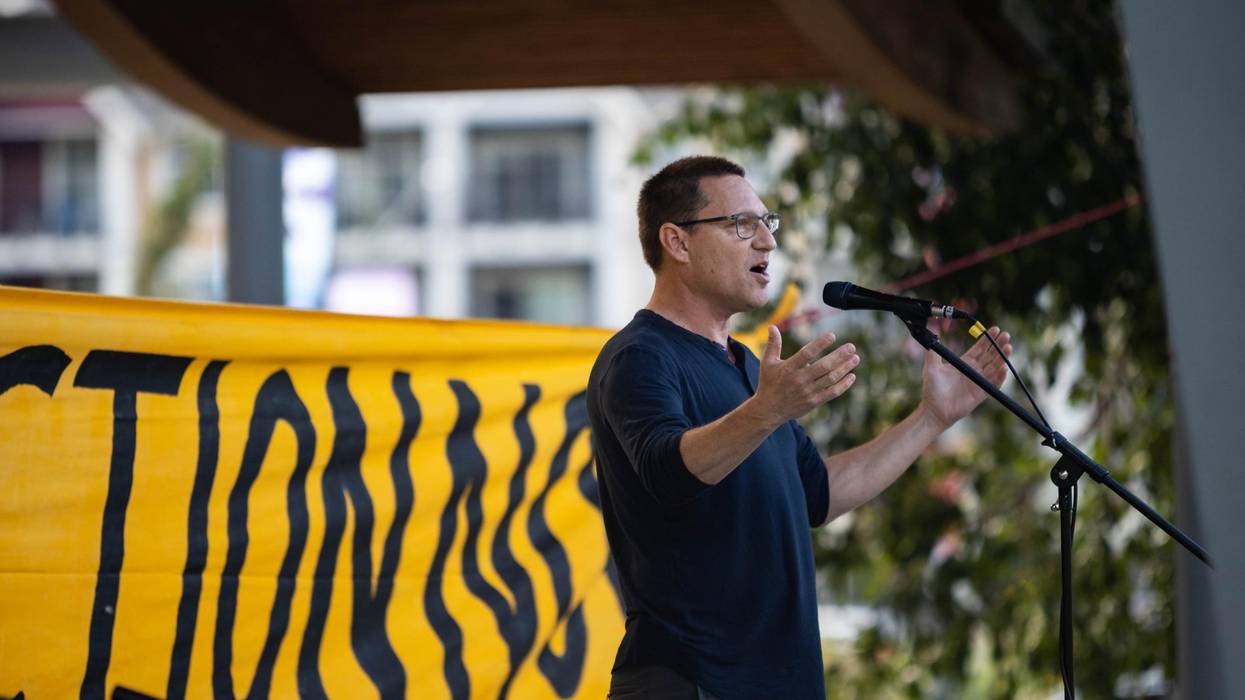
As Canadians head to the polls Monday on the final day of federal elections, a journalist, documentary filmmaker, and climate activist in British Columbia is hoping his plan to take aggressive action to combat the climate emergency will resonate with enough voters to score an upset victory.
"The entire political system is failing to confront the level of emergency that we have."
--Avi Lewis,
NDP candidate
Avi Lewis, the New Democratic Party's (NDP) candidate for the House of Commons for the West Vancouver-Sunshine Coast-Sea to Sky Country riding, knows his is a longshot campaign. The social democratic NDP--which finished a distant fourth place there in the 2019 election--has never held the seat in the riding, one of Canada's wealthiest, and a Liberal stronghold.
"We're in an uphill battle to pull off an upset of epic proportions," Lewis told CBC News Sunday.
However, Lewis--who is the third generation of his family to enter politics--believes he can flip the riding from the Liberals, the party of Prime Minister Justin Trudeau, by running on a Green New Deal platform that addresses the most pressing issues facing Canada today: the climate crisis and inequality.
"The entire political system is failing to confront the level of emergency that we have and embrace the level of opportunity in housing and health and transit and all the related systems that need changing," he added.
International climate campaigners including Canadian environmental activist David Suzuki and 350.org co-founder Bill McKibben have joined activists, artists, and intellectuals such as Jane Fonda, Alexandra Morton, Mike Douglas, Yan Martel, and Sara Quin in endorsing Lewis due to his strong stance on climate action.
In 2015, Lewis, along with his wife--the author, activist, and filmmaker Naomi Klein--and others published The Leap Manifesto, a bold call to action on climate and inequality spearheaded by a coalition of Indigenous leaders, labor unions, and environmentalists that was signed by more than 50,000 Canadians and whose principles were adopted by the NDP in 2016.
However, activists have criticized what they call the NDP's vague and inadequate climate policies, including the party's support for fossil fuel projects and its refusal to condemn fracking.
Unlike NDP leadership, Lewis has been unafraid to demand a halt to destructive projects, including the government-owned Trans Mountain Pipeline expansion. Both Trudeau's government and the Conservative Party opposition staunchly support the fossil fuel industry, which accounts for more than 5% of Canada's gross domestic product. Canada is the only G7 nation whose greenhouse gas emissions have increased since the Paris climate agreement was signed in 2015, mainly due to the extraction of tar sands oil, the world's dirtiest fuel.
Mike Simpson, the Green Party candidate running for the West Vancouver-Sunshine Coast-Sea to Sky Country parliamentary seat, has resisted pressure to step down and support Lewis. However, Lewis' stong stance on climate action has earned him the support of many Green Party members and voters.
"We need to send Avi to Ottawa," Suzuki asserted in an endorsement video featuring prominent British Columbian Greens, "to shake up the entire political establishment, including his own party, and tip the scales in favor of people and the planet."
Lewis' candidacy comes during a summer in which British Columbians suffered some of the world's hottest temperatures, as well as devastating wildfires. Provincial authorities said extreme heat claimed 569 lives between June 20 and July 29.
After the village of Lytton recorded a Canadian record temperature of 49.6degC (121.3degF) on June 30--surpassing all-time highs in desert cities including Las Vegas and Tucson, Arizona--it was destroyed by a massive wildfire.
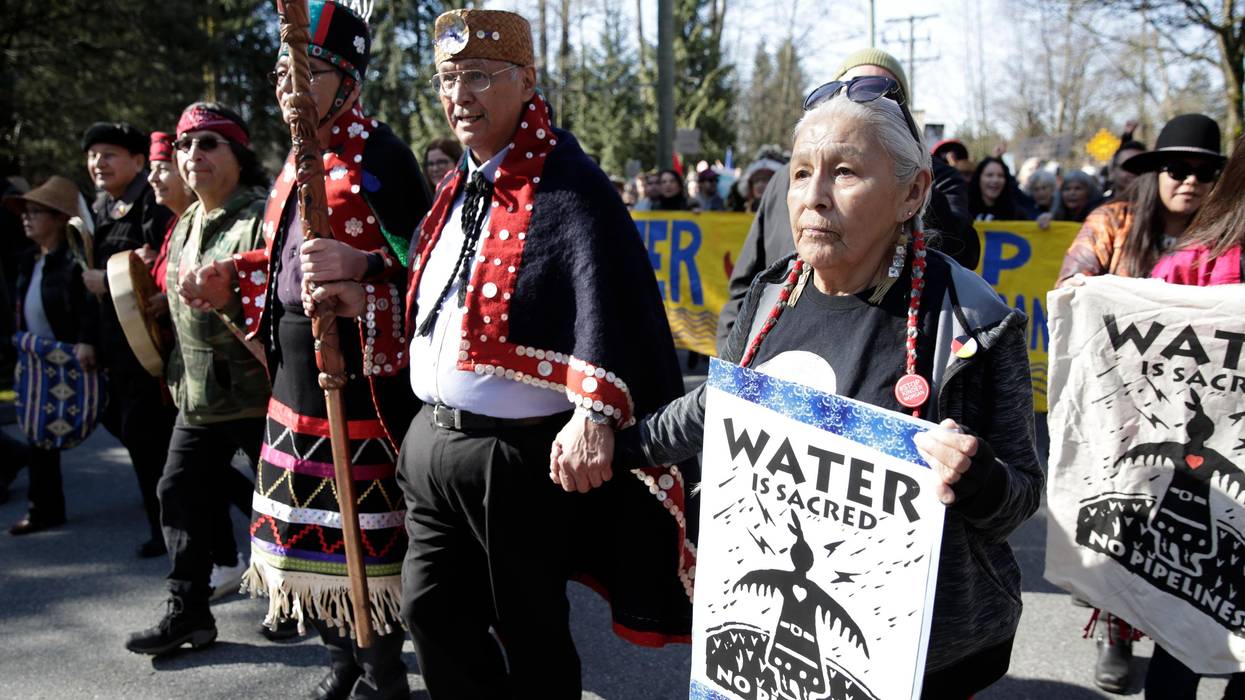
This week, Hurricane Ida left over a million people without power, and shocking flooding is rocking the Northeast of the United States. More than 80 million Americans were under a flood watch or advisory, with the majority associated with Ida's heavy rains. Simultaneously, 43,400 Californians have been forced to flee their homes because of the deadly wildfires tearing across the region. Earlier this summer in Madagascar 400,000 people were headed for famine from severe drought. The climate crisis is here, and it is devastating, though communities are doing everything they can to care for one another in this time of overlapping crisis.
The climate and Indigenous rights movements are fighting back through incredible direct action, divestment, and land defense, and shaking the tar sands oil industry to its core.
While we are feeling the life shattering impacts of climate chaos every day, the oil barons are continuing to drive us off of a cliff- trying to increase export of tar sands oil through major pipeline construction and keep lining their pockets.
To understand the scale of the insurance industry's fossil fuel investment, according to the S& P Global the U.S. insurance industry had $582 billion invested in some combination of oil, gas, coal, utilities and other fossil fuel related activities.
The climate and Indigenous rights movements are fighting back through incredible direct action, divestment, and land defense, and shaking the tar sands oil industry to its core. This year, we have been incredibly successful at removing pillars of corporate support that are backing up these massive tar sands projects. A recent report from Indigenous Environmental Network and Oil Change international demonstrated that Indigenous resistance to destructive projects has stopped or delayed greenhouse gas pollution equivalent to at least one-quarter of annual U.S. and Canadian emissions.
Through creative organizing and campaigning, we are moving multi million dollar deals away from the hands of these oil executives. This is no small feat, considering that our movements are rarely --if ever--allowed in the room where these deals are made, and the government is regularly providing police, surveillance equipment, and unlimited budgets to the oil and gas industry.
Over the past year, a coalition of environmental and Indigenous rights groups has been spotlighting the insurers backing the Trans Mountain tar sands pipeline project, and we are reaching major milestones together. To date, fifteen insurers have ruled out Trans Mountain and more than ten have adopted tar sands exclusion policies. One company noted the pipeline no longer fits the company's "risk appetite."
The insurance industry offers hundreds of millions in coverage to the Trans Mountain tar sands pipeline, and in the beginning of this year the Canadian government granted Trans Mountain's request to keep their names secret. The company stated when seeking confidentiality that "Trans Mountain has already observed increasing reluctance from insurance companies to offer insurance coverage for the Pipeline and to do so at a reasonable price."
This argument conveniently ignores the issue of risk of insuring fossil fuels in an era of climate change, the already leaking 68 year old pipeline, and the increasing uncertainty of oil sand production. Coming to this issue of price--the pipeline is significantly delayed and costs must have risen substantially, and yet they continue to build with no public recourse at the taxpayer's expense. Estimates of the pipeline cost is $16 billion, that cost swelled higher than Canada's 2019 fiscal federal deficit.
Although the current insurers names are now hidden, we know from the old certificates who has been providing coverage for the project, and if they haven't ruled them out, we aren't letting up.
Lloyd's, the biggest insurance market in the world, has responded to pressure, and set a market-wide policy to stop new insurance cover for coal, oil sands and Arctic energy projects by January 2022.
But the dozens of Lloyd's insurers may still be filling the insurance certificate on Trans Mountain insurers, and many have not responded to requests to meet, or have given non-committal responses in regards to Trans Mountain.
Lloyd's of London syndicate members that may be insuring the project through the Lloyd's marketplace are:
Our organizing has looked different every day. We have circulated petitions that reached over 150,000 signatures and coordinated a "Stop Insuring Trans Mountain" week of action with protests in 26 locations around the world, including countries across the ocean from Trans Mountain like Sierra Leone, Uganda, and Fiji. Grassroots communities have locked the office doors of these insurers closed, and held large ceremonies and resistance in their lobbies.
"Based on the coverages that you can get, I don't know if you'd see any more of these mega-projects go on in the oilsands anymore. I just don't see the ability to financially backstop some of the mega-projects that put the oil sands on the map," Joe Seeger, an advisor who has more than 25 years of experience advising oilpatch companies on insurance told CBC.
Today, over 20 Indigenous and Environmental organizations sent an open letter to the remaining insurers. "The insurance companies backing the Trans Mountain pipeline are intensifying the devastating impacts of the climate crisis and violating Indigenous Rights," said Grand Chief Stewart Phillip, President of the Union of British Columbia Indian Chiefs (UBCIC). "The Trans Mountain expansion and tanker project would enable a huge expansion of the world's dirtiest oil despite resistance from Indigenous Peoples along its route. The pipeline does not have the Free, Prior and Informed Consent of all Indigenous communities across whose lands this pipeline passes, and it will continue to face powerful resistance."
We will keep pushing this multi trillion dollar industry, and we need everyone to demand systemic change. The writing is on the wall for tar sands insurance, but we need a rapid unprecedented shift in this sector, and we can't do it without you.
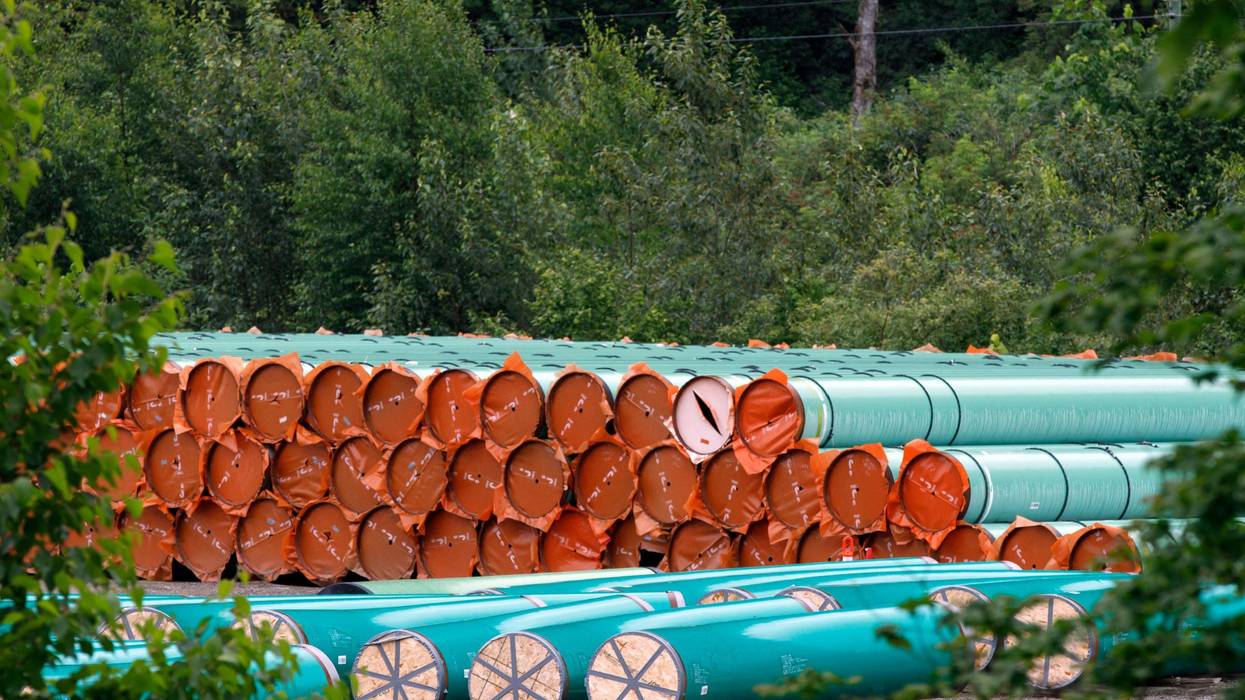
Canada's Minister of Environment and Climate Change Jonathan Wilkinson attracted fury and ridicule when he said Monday--just hours after the United Nations warned in no uncertain terms that continuing to burn fossil fuels will result in catastrophic consequences--that the country needs to secure more revenue from the Trans Mountain pipeline to achieve its long-term decarbonization goals.
"The IPCC was clear yesterday: we must accelerate our transition off fossil fuels. Millions of lives are at stake. Knowing this, and still sinking billions into expanding the Trans Mountain pipeline, is criminal."
--350 Canada
The Canadian government purchased the pipeline from Kinder Morgan in 2018 for $4.5 billion, and a planned expansion of the project would nearly triple the amount of oil moving through the pipeline.
According to Wilkinson, sending 890,000 barrels of crude per day from Alberta to British Columbia--where, earlier this summer, a heatwave killed hundreds of people and a wildfire incinerated the town of Lytton--would be a good thing because it would help finance Canada's clean energy transition.
"Canada needs to ensure that in the context of that transition, it's extracting full value for its resources and using that money to push forward in terms of reducing emissions," Wilkinson told guest host Katie Simpson during an interview on CBC's "Power & Politics."
The Trans Mountain pipeline expansion has "got to be part of the transition," Wilkinson said, because "part of the transition is being able to raise the revenues that enable you to actually make the investments that are required" to achieve net-zero emissions by mid-century.
Observers were quick to point out the absurdity of Wilkinson's comments--made just hours after he issued a statement in response to Monday's report from the Intergovernmental Panel on Climate Change, which stated unequivocally that failing to rapidly slash greenhouse gas emissions will endanger vulnerable populations and future generations.
One critic compared Wilkinson's defense of maximizing oil pipeline revenue to address the fossil fuel-driven climate emergency to something an official might say in one of the fictional dystopias described by Franz Kafka or George Orwell.
Environmental justice advocates from 350 Canada said Tuesday that "this is climate denial. From Canada's Environment Minister no less."
The group emphasized that the IPCC's report was clear about the need to "accelerate our transition off fossil fuels" to save millions of lives.
"Knowing this, and still sinking billions into expanding the Trans Mountain pipeline, is criminal," 350 Canada added.