
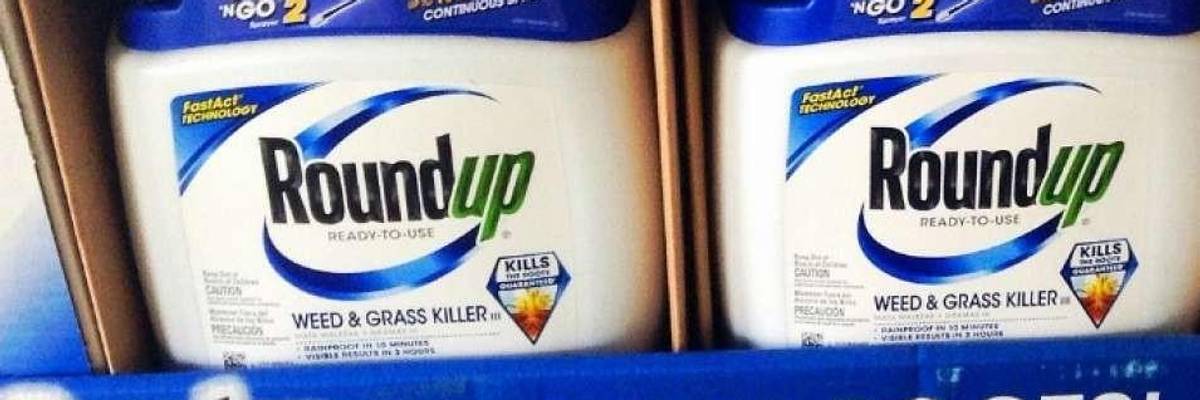
The active ingredient in RoundUp is glyphosate, which the World Health Organization classifies as a probable human carcinogen. (Photo: Mike Mozart/Flickr/cc)
Trump's EPA Goes to Bat for Bayer as Company Fights $25 Million Verdict in Roundup Cancer Case
The chemical company is asking a federal appeals court to reverse its ruling in favor of a California man suffering from non-Hodgkin's lymphoma.
President Donald Trump's Environmental Protection Agency--already accused of being "pesticide cheerleader"--threw its weight behind chemical company Bayer AG on Friday when the agency asked a federal appeals court to reverse a lower court's ruling in favor of a man who said the company's Roundup weedkiller was responsible for his cancer.
The case centers on Edwin Hardeman of California, who was diagnosed with non-Hodgkin's lymphoma in 2015 after using the glyphosate-based pesticide, made by Monsanto, for years on his property. Bayer acquired Monsanto last year.
A federal jury in July ordered the company to pay Hardeman roughly $25 million in damages, a lower amount than the $80 million a federal judge had ordered months earlier.
The EPA maintains--to the outrage of environmental and public health groups--that glyphosate is not a carcinogen. The federal decision notwithstanding, California in 2017 agreed with the World Health Organization's 2015 classification of glyphosate as a "probable carcinogen." Trump's EPA has pushed back on the state's finding and said that product labels informing users of that cancer risk would "misbranding" and announced in August of this year that the agency would not approve of labels carrying that warning.
In an amicus brief filed Friday with the U.S. Court of Appeals for the Ninth Circuit, attorneys with the EPA and Justice Department said,
EPA approved the label for the pesticide/herbicide at issue here, Roundup, through a registration process that did not require a cancer warning. In fact, EPA has never required a labeling warning of a cancer risk posed by Roundup, and such a warning would be inconsistent with the agency's scientific assessments of the carcinogenic potential of the product. Mr. Hardeman nevertheless sought damages under California common law, alleging that Monsanto had failed to adequately warn consumers of cancer risks posed by the active ingredient in Roundup. FIFRA therefore preempts Mr. Hardeman's claims to the extent that they are based on the lack of a warning on Roundup's labeling.
The filing from the federal government came the same week Bayer AG asked the appeals court to toss out the lower court's ruling and defended Roundup's safety.
Bayer is currently facing nearly 43,000 claims related to glyphosate-linked cancer in federal courts. An end to the company's legal woes is unlikely to happen soon, according to Bloomberg Environment.
"The only vehicle that remotely approaches [an end to litigation] might be bankruptcy," Loyola Law School professor Adam Zimmerman told the outlet last week. "Short of that, or some victories in court, I don't see what kind of arrangement would absolve them of future liability."
We are at a crossroads
This country and this world are at a monumental crossroads. In a few short weeks, US voters will have an opportunity to beat back the forces of fascism and confront the billionaires who are rigging the economy, our media system, and our democracy, making it increasingly impossible for ordinary people to get by. We’re not just talking about the election. We’re talking about what must be done once these fascist elements are vanquished from power. We need a bolder set of solutions than what either major party has so far been willing to offer and a working-class movement ready to fight like hell for it. Trump didn't emerge from nowhere. The conditions that fueled MAGA authoritarianism were created by decades of radical neoliberal economic policies and a corrupt political system dominated by corporate interests. They slashed taxes on the super-rich, promising that the benefits would trickle down. They said giveaways to the corporate titans would make life more affordable for the rest of us. It was all bullshit. And when a bitter, betrayed populace searches for someone to blame, right-wing demagogues have little trouble finding scapegoats. People know when they're being lied to, but you won't hear any of this from the corporate media. Only independent journalism—powered and funded by people who believe in building a better world—can deliver truly trustworthy daily news. Our Fall Campaign is underway, and we need your help. To power our newsroom through the rest of the year, we need to raise $125,000 by midnight on October 31. So if you share our vision, please contribute whatever you can to sustain our work. |
President Donald Trump's Environmental Protection Agency--already accused of being "pesticide cheerleader"--threw its weight behind chemical company Bayer AG on Friday when the agency asked a federal appeals court to reverse a lower court's ruling in favor of a man who said the company's Roundup weedkiller was responsible for his cancer.
The case centers on Edwin Hardeman of California, who was diagnosed with non-Hodgkin's lymphoma in 2015 after using the glyphosate-based pesticide, made by Monsanto, for years on his property. Bayer acquired Monsanto last year.
A federal jury in July ordered the company to pay Hardeman roughly $25 million in damages, a lower amount than the $80 million a federal judge had ordered months earlier.
The EPA maintains--to the outrage of environmental and public health groups--that glyphosate is not a carcinogen. The federal decision notwithstanding, California in 2017 agreed with the World Health Organization's 2015 classification of glyphosate as a "probable carcinogen." Trump's EPA has pushed back on the state's finding and said that product labels informing users of that cancer risk would "misbranding" and announced in August of this year that the agency would not approve of labels carrying that warning.
In an amicus brief filed Friday with the U.S. Court of Appeals for the Ninth Circuit, attorneys with the EPA and Justice Department said,
EPA approved the label for the pesticide/herbicide at issue here, Roundup, through a registration process that did not require a cancer warning. In fact, EPA has never required a labeling warning of a cancer risk posed by Roundup, and such a warning would be inconsistent with the agency's scientific assessments of the carcinogenic potential of the product. Mr. Hardeman nevertheless sought damages under California common law, alleging that Monsanto had failed to adequately warn consumers of cancer risks posed by the active ingredient in Roundup. FIFRA therefore preempts Mr. Hardeman's claims to the extent that they are based on the lack of a warning on Roundup's labeling.
The filing from the federal government came the same week Bayer AG asked the appeals court to toss out the lower court's ruling and defended Roundup's safety.
Bayer is currently facing nearly 43,000 claims related to glyphosate-linked cancer in federal courts. An end to the company's legal woes is unlikely to happen soon, according to Bloomberg Environment.
"The only vehicle that remotely approaches [an end to litigation] might be bankruptcy," Loyola Law School professor Adam Zimmerman told the outlet last week. "Short of that, or some victories in court, I don't see what kind of arrangement would absolve them of future liability."