SUBSCRIBE TO OUR FREE NEWSLETTER
Daily news & progressive opinion—funded by the people, not the corporations—delivered straight to your inbox.
5
#000000
#FFFFFF
To donate by check, phone, or other method, see our More Ways to Give page.
Daily news & progressive opinion—funded by the people, not the corporations—delivered straight to your inbox.
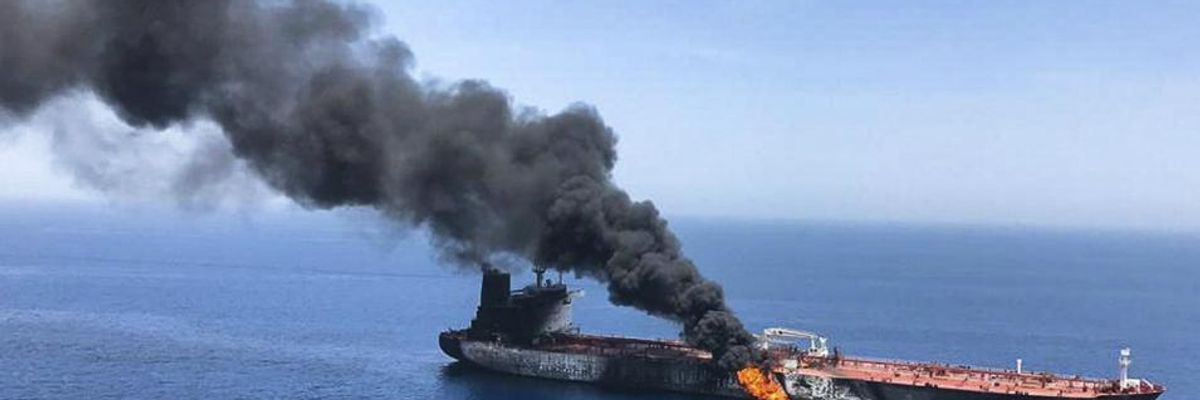
An oil tanker on fire in the sea of Oman after an alleged attack on Thursday June 13, 2019. (Photo: AP/ISNA)
As Trump administration officials rushed to blame Iran for the reported attacks on two oil tankers in the Gulf of Oman on Thursday, the timing and apparent target of the explosions immediately prompted warnings that they may have been part of a deliberate effort to provoke a war between the U.S. and Iran.
"The fact that the sabotage occurred amid Japanese Prime Minister Shinzo Abe's state visit to Iran underscores that the likely motive of the attackers is to prevent any easing of tensions."
--Jamal Abdi, National Iranian American Council
The alleged attacks, which set a Japanese-owned tanker ablaze, came as Japan's Prime Minister Shinzo Abe met with Iranian Supreme Leader Ayatollah Ali Khamenei in an attempt to reduce dangerous military tensions between the Iran and the U.S.
As Common Dreams reported last month, the recent escalation between Iran and the U.S. was sparked by the Trump administration's belligerent threats and naval activity in the Persian Gulf.
Jamal Abdi, president of the National Iranian American Council (NIAC), said in a statement that Thursday's attacks could have been carried out by "actors in the region and beyond who want to maneuver the U.S. into a war."
"With [national security adviser] John Bolton seeking to maneuver the U.S. into a war with Iran," said Abdi, "the sabotage of more oil tankers underscores the increasingly dangerous situation in the Middle East as the Trump administration pursues its maximum pressure approach toward Iran."
"The fact that the sabotage occurred amid Japanese Prime Minister Shinzo Abe's state visit to Iran--where he is believed to have communicated a message from Trump to Iran's Supreme Leader Ali Khamenei--underscores that the likely motive of the attackers is to prevent any easing of tensions," Abdi added. "For Congress, these attacks are yet another warning sign that Trump and his team are leaning into a disastrous war in the Middle East."
On Twitter, NIAC founder Trita Parsi echoed Abdi's concerns about the timing of the incident in the Gulf of Oman.
"Sounds like some are afraid Japan may succeed in starting diplomacy," Parsi said. "The message appears to be: Don't you dare stand in the way of my war plans."
While the Trump White House has not yet publicly assigned blame for the alleged attacks, one anonymous Defense Department official told CBS News--without citing any evidence--that it is "highly likely Iran caused these attacks."
According to the Washington Post, "U.S. military officials have assessed that the attacks were carried out by Iran or forces under its influence." The officials have not provided any proof to support their claim.
"Whoever is behind the attacks is no friend of Iran."
--Julian Lee, Bloomberg
The effort to blame Iran for the tanker attacks on Thursday is reminiscent of the unsubstantiated accusations in May from Bolton and the U.S. intelligence community that Iran was behind separate attacks on Saudi and UAE vessels in the Strait of Hormuz.
As the New York Times reported, it continues to be unclear who was behind last month's tanker attacks, despite Bolton's assertion at the time that Iran was "almost certainly" responsible.
Following Thursday's alleged attacks, Iranian Foreign Minister Javad Zarif said "suspicious doesn't begin to describe what likely transpired this morning" and expressed the urgent need for diplomacy.
Another Iranian official told BBC News that Iran "had nothing to do with today's apparent attacks" and said "someone is trying to destabilize relations between Iran and the [international] community."
According to Iran's Islamic Republic News Agency (IRNA), an Iranian rescue vessel picked up 44 sailors and brought them to safety following the tanker explosions.
It is unclear how much damage was done to the tankers or whether anyone was harmed by the reported attacks.
In a column on Thursday, Bloomberg oil strategist Julian Lee argued that while Iran would have "little to gain" from attacking tankers in the Gulf of Oman, it will likely "still get the blame--and suffer the fallout."
The "group that will benefit from the incident," Lee wrote, is "the people who want to see the U.S. step up its campaign against Iran and move from an economic war to a military one."
"There are plenty of those, both in the U.S. and among its allies in the Persian Gulf and wider Middle East regions," Lee added.
The alleged attacks, Lee concluded, are "absolutely understandable if you're someone whose ultimate goal is to derail any easing of tensions between the two nations, and to effect regime change in Tehran. Whoever is behind the attacks is no friend of Iran."
This country and this world are at a monumental crossroads. US voters have an opportunity to beat back the forces of fascism and confront the billionaires who are rigging the economy, our media system, and our democracy, making it increasingly impossible for ordinary people to get by. We’re not just talking about the election. We’re talking about what must be done once these fascist elements are vanquished from power. We need a bolder set of solutions than what either major party has so far been willing to offer and a working-class movement ready to fight like hell for it. Trump didn't emerge from nowhere. The conditions that fueled MAGA authoritarianism were created by decades of radical neoliberal economic policies and a corrupt political system dominated by corporate interests. They slashed taxes on the super-rich, promising that the benefits would trickle down. They said giveaways to the corporate titans would make life more affordable for the rest of us. It was all bullshit. And when a bitter, betrayed populace searches for someone to blame, right-wing demagogues have little trouble finding scapegoats. People know when they're being lied to, but you won't hear any of this from the corporate media. Only independent journalism—powered and funded by people who believe in building a better world—can deliver truly trustworthy daily news. If you share our vision, please contribute whatever you can to sustain our work. |
As Trump administration officials rushed to blame Iran for the reported attacks on two oil tankers in the Gulf of Oman on Thursday, the timing and apparent target of the explosions immediately prompted warnings that they may have been part of a deliberate effort to provoke a war between the U.S. and Iran.
"The fact that the sabotage occurred amid Japanese Prime Minister Shinzo Abe's state visit to Iran underscores that the likely motive of the attackers is to prevent any easing of tensions."
--Jamal Abdi, National Iranian American Council
The alleged attacks, which set a Japanese-owned tanker ablaze, came as Japan's Prime Minister Shinzo Abe met with Iranian Supreme Leader Ayatollah Ali Khamenei in an attempt to reduce dangerous military tensions between the Iran and the U.S.
As Common Dreams reported last month, the recent escalation between Iran and the U.S. was sparked by the Trump administration's belligerent threats and naval activity in the Persian Gulf.
Jamal Abdi, president of the National Iranian American Council (NIAC), said in a statement that Thursday's attacks could have been carried out by "actors in the region and beyond who want to maneuver the U.S. into a war."
"With [national security adviser] John Bolton seeking to maneuver the U.S. into a war with Iran," said Abdi, "the sabotage of more oil tankers underscores the increasingly dangerous situation in the Middle East as the Trump administration pursues its maximum pressure approach toward Iran."
"The fact that the sabotage occurred amid Japanese Prime Minister Shinzo Abe's state visit to Iran--where he is believed to have communicated a message from Trump to Iran's Supreme Leader Ali Khamenei--underscores that the likely motive of the attackers is to prevent any easing of tensions," Abdi added. "For Congress, these attacks are yet another warning sign that Trump and his team are leaning into a disastrous war in the Middle East."
On Twitter, NIAC founder Trita Parsi echoed Abdi's concerns about the timing of the incident in the Gulf of Oman.
"Sounds like some are afraid Japan may succeed in starting diplomacy," Parsi said. "The message appears to be: Don't you dare stand in the way of my war plans."
While the Trump White House has not yet publicly assigned blame for the alleged attacks, one anonymous Defense Department official told CBS News--without citing any evidence--that it is "highly likely Iran caused these attacks."
According to the Washington Post, "U.S. military officials have assessed that the attacks were carried out by Iran or forces under its influence." The officials have not provided any proof to support their claim.
"Whoever is behind the attacks is no friend of Iran."
--Julian Lee, Bloomberg
The effort to blame Iran for the tanker attacks on Thursday is reminiscent of the unsubstantiated accusations in May from Bolton and the U.S. intelligence community that Iran was behind separate attacks on Saudi and UAE vessels in the Strait of Hormuz.
As the New York Times reported, it continues to be unclear who was behind last month's tanker attacks, despite Bolton's assertion at the time that Iran was "almost certainly" responsible.
Following Thursday's alleged attacks, Iranian Foreign Minister Javad Zarif said "suspicious doesn't begin to describe what likely transpired this morning" and expressed the urgent need for diplomacy.
Another Iranian official told BBC News that Iran "had nothing to do with today's apparent attacks" and said "someone is trying to destabilize relations between Iran and the [international] community."
According to Iran's Islamic Republic News Agency (IRNA), an Iranian rescue vessel picked up 44 sailors and brought them to safety following the tanker explosions.
It is unclear how much damage was done to the tankers or whether anyone was harmed by the reported attacks.
In a column on Thursday, Bloomberg oil strategist Julian Lee argued that while Iran would have "little to gain" from attacking tankers in the Gulf of Oman, it will likely "still get the blame--and suffer the fallout."
The "group that will benefit from the incident," Lee wrote, is "the people who want to see the U.S. step up its campaign against Iran and move from an economic war to a military one."
"There are plenty of those, both in the U.S. and among its allies in the Persian Gulf and wider Middle East regions," Lee added.
The alleged attacks, Lee concluded, are "absolutely understandable if you're someone whose ultimate goal is to derail any easing of tensions between the two nations, and to effect regime change in Tehran. Whoever is behind the attacks is no friend of Iran."