
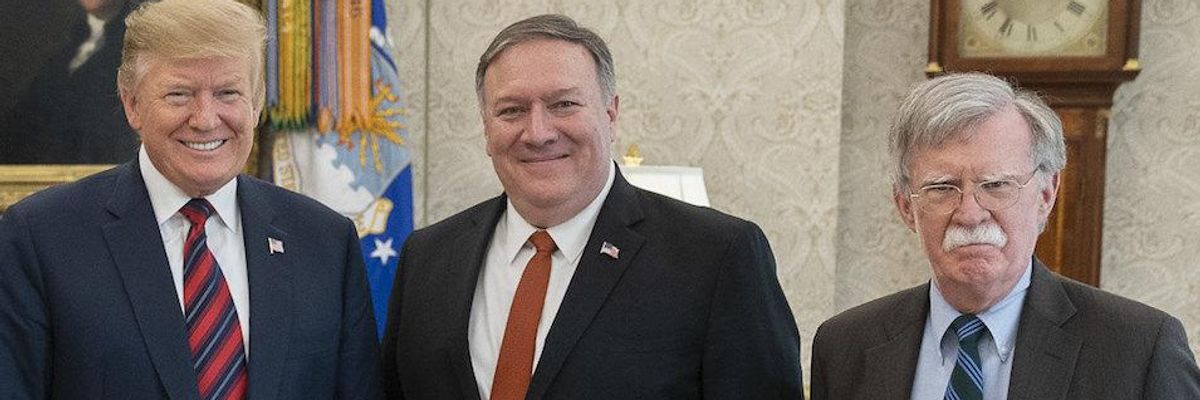
President Donald J. Trump, Secretary of State Mike Pompeo, and National Security Adviser Ambassador John Bolton, at the White House on Thursday, April 11, 2019. (Photo: Official White House/Shealah Craighead)
No War With Iran, Say 62 Groups in Letter to Congress
"Trump and his National Security Advisor John Bolton are taking this country to the brink of a completely avoidable military confrontation."
The White House is continuing its march to war with Iran, but resistance is growing--most recently by a group of 62 organizations that issued an open letter to Congress on Tuesday calling for the representative body to exercise its power and stop U.S. aggression.
"When a nuclear-armed country like the United States is involved, there is always a chance that conventional war could escalate into a nuclear war, with millions of deaths, nuclear winter, and mass starvation."
--Dr. Gwen DuBois
In the letter, the 62 groups call on Congress to "fulfill its constitutional duty and enact further constraints to unequivocally prevent the administration from launching an unauthorized war."
The push to war has been led mainly by President Donald Trump's National Security Advisor John Bolton and Secretary of State Mike Pompeo. Trump himself has been noncommittal, expressing support and hesitance in nearly equal measure depending on the day.
Nevertheless, a number of the letter's signatories said in a statement, the administration's actions require pushback from Congress.
"Trump and his National Security Advisor John Bolton are taking this country to the brink of a completely avoidable military confrontation," said Jamal Abdi, president of the National Iranian-American Council. "It's time for Congress to turn its words into action by passing legislation to stop Trump and Bolton from starting an illegal war."
Under the Constitution, only Congress has the ability to declare war. But that right has been eroded over the last seven decades as presidents have used language like "police actions" and other euphemisms to go around Congress and start wars at will. The 2001 Authorization for Use of Military Force (AUMF) in the wake of the 9/11 attacks has been used (pdf) over 37 times by Presidents George W. Bush, Barack Obama, and Trump in over 14 countries.
Still, there's a sense that Congress may finally be ready to take its duties seriously. The House has become progressively warmer in recent years to legislation by Rep. Barbara Lee (D-Calif.)--the lone vote against war in the wake of the 2001 attacks--to restrict the use of the AUMF.
In response to congressional cooling on war, the administration on Tuesday used a briefing from Acting Secretary of Defense Patrick M. Shanahan to continue to raise the specter of a vicious, calculating foe while telling members of Congress that the threat, for now, has abated.
"I'd say we're in a period where the threat remains high," Shanahan told reporters Tuesday. "And our job is to make sure that there is no miscalculation by the Iranians."
Erica Fein, the advocacy director for Win Without War, expressed her regret that the Trump White House has continually increased tensions with Iran--specifically by effectively tearing up the Iran nuclear agreement in May 2018.
"President Obama took us off the path to war, but now Trump and Bolton have put us back on it," said Fein. "It's time for Congress to put the brakes on a Trump-Bolton war with Iran."
In a statement, Jeff Carter, the executive director of letter signatory Physicians for Social Responsibility (PSR), said that diplomacy, not war, was the only path forward for peace.
"There is a clear, necessary path to preserve peace between our nations, one that has advanced and will continue to advance key progress," Carter said. "Both nations must continue to actively engage in dialogue, with open diplomatic communications channels and the mutual aim to prevent any further escalation of conflict."
Gwen DuBois, the president of the Chesapeake Bay chapter of PSR, made clear that the horror that could be seen in Iran was previewed in Iraq. In a war with Iran, DuBois said, "likely hundreds of thousands if not a million or more people would die, as in Iraq, from the indirect consequences of war--such as infections and the collapse of the healthcare system."
And the danger could be even greater than conventional war.
"When a nuclear-armed country like the United States is involved," DuBois said, "there is always a chance that conventional war could escalate into a nuclear war, with millions of deaths, nuclear winter, and mass starvation."
With that kind of desolation potentially on the horizon, the letter to Congress emphasizes that it's time for Congress to use its power as a co-equal branch of government to slow the march to war.
"Congress has the chance to stop a war before it starts," the letter says. "Please take action before it is too late."
An Urgent Message From Our Co-Founder
Dear Common Dreams reader, It’s been nearly 30 years since I co-founded Common Dreams with my late wife, Lina Newhouser. We had the radical notion that journalism should serve the public good, not corporate profits. It was clear to us from the outset what it would take to build such a project. No paid advertisements. No corporate sponsors. No millionaire publisher telling us what to think or do. Many people said we wouldn't last a year, but we proved those doubters wrong. Together with a tremendous team of journalists and dedicated staff, we built an independent media outlet free from the constraints of profits and corporate control. Our mission has always been simple: To inform. To inspire. To ignite change for the common good. Building Common Dreams was not easy. Our survival was never guaranteed. When you take on the most powerful forces—Wall Street greed, fossil fuel industry destruction, Big Tech lobbyists, and uber-rich oligarchs who have spent billions upon billions rigging the economy and democracy in their favor—the only bulwark you have is supporters who believe in your work. But here’s the urgent message from me today. It's never been this bad out there. And it's never been this hard to keep us going. At the very moment Common Dreams is most needed, the threats we face are intensifying. We need your support now more than ever. We don't accept corporate advertising and never will. We don't have a paywall because we don't think people should be blocked from critical news based on their ability to pay. Everything we do is funded by the donations of readers like you. When everyone does the little they can afford, we are strong. But if that support retreats or dries up, so do we. Will you donate now to make sure Common Dreams not only survives but thrives? —Craig Brown, Co-founder |
The White House is continuing its march to war with Iran, but resistance is growing--most recently by a group of 62 organizations that issued an open letter to Congress on Tuesday calling for the representative body to exercise its power and stop U.S. aggression.
"When a nuclear-armed country like the United States is involved, there is always a chance that conventional war could escalate into a nuclear war, with millions of deaths, nuclear winter, and mass starvation."
--Dr. Gwen DuBois
In the letter, the 62 groups call on Congress to "fulfill its constitutional duty and enact further constraints to unequivocally prevent the administration from launching an unauthorized war."
The push to war has been led mainly by President Donald Trump's National Security Advisor John Bolton and Secretary of State Mike Pompeo. Trump himself has been noncommittal, expressing support and hesitance in nearly equal measure depending on the day.
Nevertheless, a number of the letter's signatories said in a statement, the administration's actions require pushback from Congress.
"Trump and his National Security Advisor John Bolton are taking this country to the brink of a completely avoidable military confrontation," said Jamal Abdi, president of the National Iranian-American Council. "It's time for Congress to turn its words into action by passing legislation to stop Trump and Bolton from starting an illegal war."
Under the Constitution, only Congress has the ability to declare war. But that right has been eroded over the last seven decades as presidents have used language like "police actions" and other euphemisms to go around Congress and start wars at will. The 2001 Authorization for Use of Military Force (AUMF) in the wake of the 9/11 attacks has been used (pdf) over 37 times by Presidents George W. Bush, Barack Obama, and Trump in over 14 countries.
Still, there's a sense that Congress may finally be ready to take its duties seriously. The House has become progressively warmer in recent years to legislation by Rep. Barbara Lee (D-Calif.)--the lone vote against war in the wake of the 2001 attacks--to restrict the use of the AUMF.
In response to congressional cooling on war, the administration on Tuesday used a briefing from Acting Secretary of Defense Patrick M. Shanahan to continue to raise the specter of a vicious, calculating foe while telling members of Congress that the threat, for now, has abated.
"I'd say we're in a period where the threat remains high," Shanahan told reporters Tuesday. "And our job is to make sure that there is no miscalculation by the Iranians."
Erica Fein, the advocacy director for Win Without War, expressed her regret that the Trump White House has continually increased tensions with Iran--specifically by effectively tearing up the Iran nuclear agreement in May 2018.
"President Obama took us off the path to war, but now Trump and Bolton have put us back on it," said Fein. "It's time for Congress to put the brakes on a Trump-Bolton war with Iran."
In a statement, Jeff Carter, the executive director of letter signatory Physicians for Social Responsibility (PSR), said that diplomacy, not war, was the only path forward for peace.
"There is a clear, necessary path to preserve peace between our nations, one that has advanced and will continue to advance key progress," Carter said. "Both nations must continue to actively engage in dialogue, with open diplomatic communications channels and the mutual aim to prevent any further escalation of conflict."
Gwen DuBois, the president of the Chesapeake Bay chapter of PSR, made clear that the horror that could be seen in Iran was previewed in Iraq. In a war with Iran, DuBois said, "likely hundreds of thousands if not a million or more people would die, as in Iraq, from the indirect consequences of war--such as infections and the collapse of the healthcare system."
And the danger could be even greater than conventional war.
"When a nuclear-armed country like the United States is involved," DuBois said, "there is always a chance that conventional war could escalate into a nuclear war, with millions of deaths, nuclear winter, and mass starvation."
With that kind of desolation potentially on the horizon, the letter to Congress emphasizes that it's time for Congress to use its power as a co-equal branch of government to slow the march to war.
"Congress has the chance to stop a war before it starts," the letter says. "Please take action before it is too late."
The White House is continuing its march to war with Iran, but resistance is growing--most recently by a group of 62 organizations that issued an open letter to Congress on Tuesday calling for the representative body to exercise its power and stop U.S. aggression.
"When a nuclear-armed country like the United States is involved, there is always a chance that conventional war could escalate into a nuclear war, with millions of deaths, nuclear winter, and mass starvation."
--Dr. Gwen DuBois
In the letter, the 62 groups call on Congress to "fulfill its constitutional duty and enact further constraints to unequivocally prevent the administration from launching an unauthorized war."
The push to war has been led mainly by President Donald Trump's National Security Advisor John Bolton and Secretary of State Mike Pompeo. Trump himself has been noncommittal, expressing support and hesitance in nearly equal measure depending on the day.
Nevertheless, a number of the letter's signatories said in a statement, the administration's actions require pushback from Congress.
"Trump and his National Security Advisor John Bolton are taking this country to the brink of a completely avoidable military confrontation," said Jamal Abdi, president of the National Iranian-American Council. "It's time for Congress to turn its words into action by passing legislation to stop Trump and Bolton from starting an illegal war."
Under the Constitution, only Congress has the ability to declare war. But that right has been eroded over the last seven decades as presidents have used language like "police actions" and other euphemisms to go around Congress and start wars at will. The 2001 Authorization for Use of Military Force (AUMF) in the wake of the 9/11 attacks has been used (pdf) over 37 times by Presidents George W. Bush, Barack Obama, and Trump in over 14 countries.
Still, there's a sense that Congress may finally be ready to take its duties seriously. The House has become progressively warmer in recent years to legislation by Rep. Barbara Lee (D-Calif.)--the lone vote against war in the wake of the 2001 attacks--to restrict the use of the AUMF.
In response to congressional cooling on war, the administration on Tuesday used a briefing from Acting Secretary of Defense Patrick M. Shanahan to continue to raise the specter of a vicious, calculating foe while telling members of Congress that the threat, for now, has abated.
"I'd say we're in a period where the threat remains high," Shanahan told reporters Tuesday. "And our job is to make sure that there is no miscalculation by the Iranians."
Erica Fein, the advocacy director for Win Without War, expressed her regret that the Trump White House has continually increased tensions with Iran--specifically by effectively tearing up the Iran nuclear agreement in May 2018.
"President Obama took us off the path to war, but now Trump and Bolton have put us back on it," said Fein. "It's time for Congress to put the brakes on a Trump-Bolton war with Iran."
In a statement, Jeff Carter, the executive director of letter signatory Physicians for Social Responsibility (PSR), said that diplomacy, not war, was the only path forward for peace.
"There is a clear, necessary path to preserve peace between our nations, one that has advanced and will continue to advance key progress," Carter said. "Both nations must continue to actively engage in dialogue, with open diplomatic communications channels and the mutual aim to prevent any further escalation of conflict."
Gwen DuBois, the president of the Chesapeake Bay chapter of PSR, made clear that the horror that could be seen in Iran was previewed in Iraq. In a war with Iran, DuBois said, "likely hundreds of thousands if not a million or more people would die, as in Iraq, from the indirect consequences of war--such as infections and the collapse of the healthcare system."
And the danger could be even greater than conventional war.
"When a nuclear-armed country like the United States is involved," DuBois said, "there is always a chance that conventional war could escalate into a nuclear war, with millions of deaths, nuclear winter, and mass starvation."
With that kind of desolation potentially on the horizon, the letter to Congress emphasizes that it's time for Congress to use its power as a co-equal branch of government to slow the march to war.
"Congress has the chance to stop a war before it starts," the letter says. "Please take action before it is too late."