SUBSCRIBE TO OUR FREE NEWSLETTER
Daily news & progressive opinion—funded by the people, not the corporations—delivered straight to your inbox.
5
#000000
#FFFFFF
To donate by check, phone, or other method, see our More Ways to Give page.
Daily news & progressive opinion—funded by the people, not the corporations—delivered straight to your inbox.
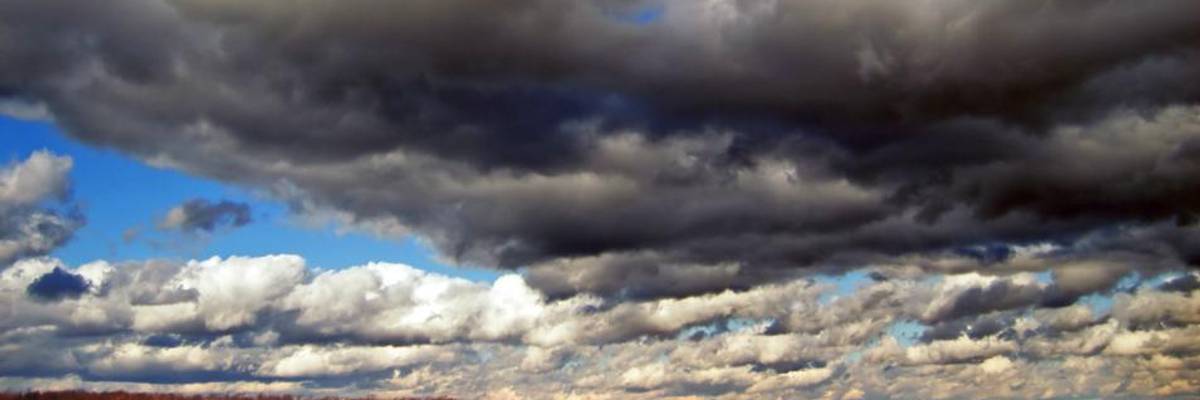
A new study warns that if the Earth's atmospheric carbon hits a certain level, stratocumulus clouds could completely vanish, causing the planet's temperatures to skyrocket even higher. (Photo: Nicholas A. Tonelli/Flickr/cc)
As people across the globe mobilize to demand bold action to combat the climate crisis and scientific findings about looming "environmental breakdown" pile up, a startling new study published Monday in the journal Nature Geoscience warns that human-caused global warming could cause stratocumulus clouds to totally disappear in as little as a century, triggering up to 8degC (14degF) of additional warming.
"To imagine 12 degrees of warming, think of crocodiles swimming in the Arctic and of the scorched, mostly lifeless equatorial regions during [prehistoric times]."
--Quanta Magazine
Stratocumulus clouds cover about two-thirds of the Earth and help keep it cool by reflecting solar radiation back to space. Recent research has suggested that planetary warming correlates with greater cloud loss, stoking fears about a feedback loop that could spell disaster.
For this study, researchers at the California Institute of Technology used a supercomputer simulation to explore what could lead these low-lying, lumpy clouds to vanish completely. As science journalist Natalie Wolchover laid out in a lengthy piece for Quanta Magazine titled "A World Without Clouds":
The simulation revealed a tipping point: a level of warming at which stratocumulus clouds break up altogether. The disappearance occurs when the concentration of CO2 in the simulated atmosphere reaches 1,200 parts per million [ppm]--a level that fossil fuel burning could push us past in about a century, under "business-as-usual" emissions scenarios. In the simulation, when the tipping point is breached, Earth's temperature soars 8 degrees Celsius, in addition to the 4 degrees of warming or more caused by the CO2 directly...
To imagine 12 degrees of warming, think of crocodiles swimming in the Arctic and of the scorched, mostly lifeless equatorial regions during the [Paleocene-Eocene Thermal Maximum or PETM]. If carbon emissions aren't curbed quickly enough and the tipping point is breached, "that would be truly devastating climate change," said Caltech's Tapio Schneider, who performed the new simulation with Colleen Kaul and Kyle Pressel.
Quanta Magazine also broke down the study's key findings in a short video shared on social media:
The study elicited alarm from climate campaigners along with calls for the "radical, disruptive changes" to society's energy and economic systems that scientists and experts have repeatedly said are necessary to prevent climate catastrophe:
The future is radical. We face a stark choice btw radical, disruptive changes to our physical world or radical, disruptive changes to our political and economic systems to avoid those outcomes. The status quo is not one of the options on the table - get it yet "centrists"? https://t.co/M6VCXgAbfv
-- Naomi Klein (@NaomiAKlein) February 25, 2019
Since the beginning of the Industrial Revolution, the amount of carbon dioxide in Earth's atmosphere has surged from about 280 ppm to more than 410 ppm today. Although concentrations will continue to rise as long as the international community maintains unsustainable activities that generate greenhouse gas emissions, some observers pointed out that atmospheric carbon hitting 1,200 ppm is far from a foregone conclusion.
And, as Penn State University climatologist Michael E. Mann noted, "if we let CO2 levels get anywhere near that high we're already in big trouble."
However, as Washington Post climate reporter Chris Mooney concluded in a series of tweets, "the point is not that this scary scenario is going to happen. Given the current trajectory of climate policy and renewables, it seems unlikely. Rather, the key point--and it's a big deal--is that there are many things we don't understand about the climate system and there could be key triggers out there, which set off processes that you can't easily stop."
In other words, as MIT professor Thomas Levenson put it: "The really terrifying aspect of this research is the reminder that we do not yet know all the ways catastrophic outcomes can emerge from this uncontrolled experiment on our only habitat."
This country and this world are at a monumental crossroads. US voters have an opportunity to beat back the forces of fascism and confront the billionaires who are rigging the economy, our media system, and our democracy, making it increasingly impossible for ordinary people to get by. We’re not just talking about the election. We’re talking about what must be done once these fascist elements are vanquished from power. We need a bolder set of solutions than what either major party has so far been willing to offer and a working-class movement ready to fight like hell for it. Trump didn't emerge from nowhere. The conditions that fueled MAGA authoritarianism were created by decades of radical neoliberal economic policies and a corrupt political system dominated by corporate interests. They slashed taxes on the super-rich, promising that the benefits would trickle down. They said giveaways to the corporate titans would make life more affordable for the rest of us. It was all bullshit. And when a bitter, betrayed populace searches for someone to blame, right-wing demagogues have little trouble finding scapegoats. People know when they're being lied to, but you won't hear any of this from the corporate media. Only independent journalism—powered and funded by people who believe in building a better world—can deliver truly trustworthy daily news. If you share our vision, please contribute whatever you can to sustain our work. |
As people across the globe mobilize to demand bold action to combat the climate crisis and scientific findings about looming "environmental breakdown" pile up, a startling new study published Monday in the journal Nature Geoscience warns that human-caused global warming could cause stratocumulus clouds to totally disappear in as little as a century, triggering up to 8degC (14degF) of additional warming.
"To imagine 12 degrees of warming, think of crocodiles swimming in the Arctic and of the scorched, mostly lifeless equatorial regions during [prehistoric times]."
--Quanta Magazine
Stratocumulus clouds cover about two-thirds of the Earth and help keep it cool by reflecting solar radiation back to space. Recent research has suggested that planetary warming correlates with greater cloud loss, stoking fears about a feedback loop that could spell disaster.
For this study, researchers at the California Institute of Technology used a supercomputer simulation to explore what could lead these low-lying, lumpy clouds to vanish completely. As science journalist Natalie Wolchover laid out in a lengthy piece for Quanta Magazine titled "A World Without Clouds":
The simulation revealed a tipping point: a level of warming at which stratocumulus clouds break up altogether. The disappearance occurs when the concentration of CO2 in the simulated atmosphere reaches 1,200 parts per million [ppm]--a level that fossil fuel burning could push us past in about a century, under "business-as-usual" emissions scenarios. In the simulation, when the tipping point is breached, Earth's temperature soars 8 degrees Celsius, in addition to the 4 degrees of warming or more caused by the CO2 directly...
To imagine 12 degrees of warming, think of crocodiles swimming in the Arctic and of the scorched, mostly lifeless equatorial regions during the [Paleocene-Eocene Thermal Maximum or PETM]. If carbon emissions aren't curbed quickly enough and the tipping point is breached, "that would be truly devastating climate change," said Caltech's Tapio Schneider, who performed the new simulation with Colleen Kaul and Kyle Pressel.
Quanta Magazine also broke down the study's key findings in a short video shared on social media:
The study elicited alarm from climate campaigners along with calls for the "radical, disruptive changes" to society's energy and economic systems that scientists and experts have repeatedly said are necessary to prevent climate catastrophe:
The future is radical. We face a stark choice btw radical, disruptive changes to our physical world or radical, disruptive changes to our political and economic systems to avoid those outcomes. The status quo is not one of the options on the table - get it yet "centrists"? https://t.co/M6VCXgAbfv
-- Naomi Klein (@NaomiAKlein) February 25, 2019
Since the beginning of the Industrial Revolution, the amount of carbon dioxide in Earth's atmosphere has surged from about 280 ppm to more than 410 ppm today. Although concentrations will continue to rise as long as the international community maintains unsustainable activities that generate greenhouse gas emissions, some observers pointed out that atmospheric carbon hitting 1,200 ppm is far from a foregone conclusion.
And, as Penn State University climatologist Michael E. Mann noted, "if we let CO2 levels get anywhere near that high we're already in big trouble."
However, as Washington Post climate reporter Chris Mooney concluded in a series of tweets, "the point is not that this scary scenario is going to happen. Given the current trajectory of climate policy and renewables, it seems unlikely. Rather, the key point--and it's a big deal--is that there are many things we don't understand about the climate system and there could be key triggers out there, which set off processes that you can't easily stop."
In other words, as MIT professor Thomas Levenson put it: "The really terrifying aspect of this research is the reminder that we do not yet know all the ways catastrophic outcomes can emerge from this uncontrolled experiment on our only habitat."