SUBSCRIBE TO OUR FREE NEWSLETTER
Daily news & progressive opinion—funded by the people, not the corporations—delivered straight to your inbox.
5
#000000
#FFFFFF
To donate by check, phone, or other method, see our More Ways to Give page.
Daily news & progressive opinion—funded by the people, not the corporations—delivered straight to your inbox.
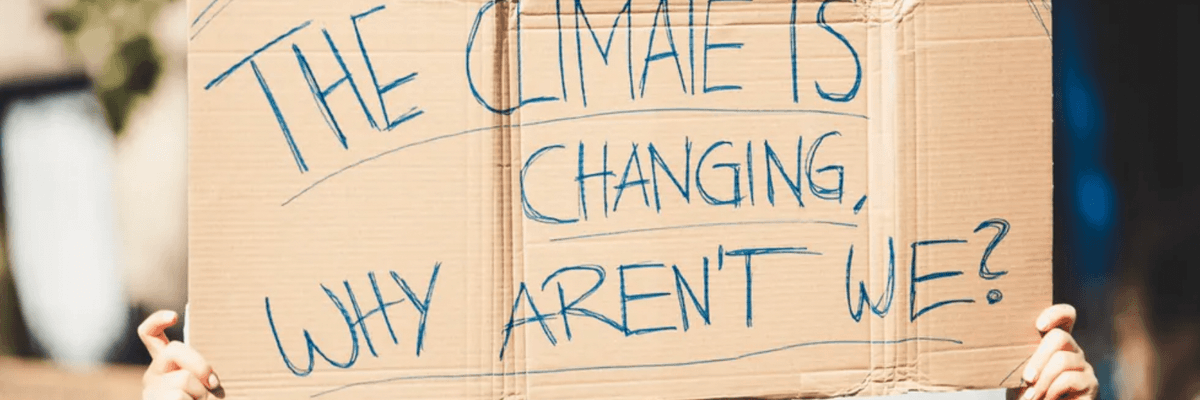
A sign at a protest reads, "The climate is changing, why aren't we?" on September 20, 2019.
"In order to be equipped for a warmer world, we have to anticipate changes, get the affected parties on board, and take advantage of local knowledge," said one researcher.
Scientists at the University of Hamburg in Germany argued Wednesday that meeting the 2015 Paris climate agreement's goal of limiting planetary heating to 1.5°C is "currently not plausible"—but warned that despairing over climate "tipping points" risks taking attention away from "the best hope for shaping a positive climate future... the ability of society to make fundamental changes."
The Hamburg Climate Futures Outlook assessed the planetary impacts of several "physical processes that are frequently discussed as tipping points." These include the melting of sea ice in the Arctic and glaciers at the North and South Poles; the weakening of the Atlantic Meridional Overturning Circulation (AMOC), the system of ocean currents that carries warm water upward into the North Atlantic; and "dieback" in the Amazon rainforest, in which rising temperatures would dry out trees and eventually change the forest landscape into a savanna, releasing billions of tons of stored carbon.
Those scenarios "are serious developments," said researchers at the university, but the melting of ice "will have very little influence on the global temperature until 2050." The weakening of AMOC and Amazon dieback will have a "moderately" greater influence on global temperatures.
"Human agency has a large potential to shape the way climate futures will evolve."
"By extrapolating current trends," reads the study, "permafrost thaw and Amazon Forest dieback are expected to release somewhat more than one year's worth of today's anthropogenic CO2 emissions between now and 2050. Thus, the contributions of these two processes to the remaining carbon budget are small. Since both will only moderately affect the global surface temperature, we deduce that they also only moderately inhibit the plausibility of attaining the Paris agreement temperature goals."
Such tipping points "could drastically change the conditions for life on Earth," but for experts, progressive politicians, and campaigners who share the goal of limiting planetary warming to 1.5°C—or as close to that as possible—"they're largely irrelevant," said Jochem Marotzke, a study co-author and professor at the university's Cluster of Excellence "Climate, Climatic Change, and Society" (CLICCS).
In other words, The Hill explained, "Keeping global warming below 1.5°C—the goal set in the Paris agreement—is implausible for social reasons, not technical ones."
The researchers also examined 10 "drivers of social change" including media, United Nations climate policies, transnational initiatives, climate regulations, climate litigation, knowledge production, consumption patterns, corporate responses, fossil fuel divestment, and climate and social movements like the global Fridays for Future movement and Extinction Rebellion.
With fossil fuel companies continuing to make long-term investments in oil and gas extraction even as they announce pledges to reach net-zero carbon emissions, and rampant consumption of carbon-intensive goods showing no sign of slowing down, the study says, corporate responses and consumption patterns "continue to undermine the pathways to decarbonization, let alone deep decarbonization."
A number of social drivers including social movements, climate regulations, and fossil fuel divestment were found to currently "support decarbonization, but not deep decarbonization by 2050," which is needed to attain the 1.5°C goal.
"There are promising reforms underway, especially at the E.U. level," reads the report, adding that "general and ongoing public interest in and focus on climate policies" is an "enabling condition" that could help strengthen global movements and ramp up pressure on policymakers.
The researchers' assessment of the 10 social drivers demonstrates "that human agency has a large potential to shape the way climate futures will evolve," tweeted CLICCS. "However, human agency is strongly shaped by injustices and social inequalities, which inhibit social dynamics toward deep decarbonization by 2050."
The study identified how human actions can help shift the current trajectory "toward deep decarbonization," including:
"In order to be equipped for a warmer world, we have to anticipate changes, get the affected parties on board, and take advantage of local knowledge," said Anita Engels of the Center for Earth System Research and Sustainability at University of Hamburg. "Instead of just reacting, we need to begin an active transformation here and now."
Dear Common Dreams reader, It’s been nearly 30 years since I co-founded Common Dreams with my late wife, Lina Newhouser. We had the radical notion that journalism should serve the public good, not corporate profits. It was clear to us from the outset what it would take to build such a project. No paid advertisements. No corporate sponsors. No millionaire publisher telling us what to think or do. Many people said we wouldn't last a year, but we proved those doubters wrong. Together with a tremendous team of journalists and dedicated staff, we built an independent media outlet free from the constraints of profits and corporate control. Our mission has always been simple: To inform. To inspire. To ignite change for the common good. Building Common Dreams was not easy. Our survival was never guaranteed. When you take on the most powerful forces—Wall Street greed, fossil fuel industry destruction, Big Tech lobbyists, and uber-rich oligarchs who have spent billions upon billions rigging the economy and democracy in their favor—the only bulwark you have is supporters who believe in your work. But here’s the urgent message from me today. It's never been this bad out there. And it's never been this hard to keep us going. At the very moment Common Dreams is most needed, the threats we face are intensifying. We need your support now more than ever. We don't accept corporate advertising and never will. We don't have a paywall because we don't think people should be blocked from critical news based on their ability to pay. Everything we do is funded by the donations of readers like you. When everyone does the little they can afford, we are strong. But if that support retreats or dries up, so do we. Will you donate now to make sure Common Dreams not only survives but thrives? —Craig Brown, Co-founder |
Scientists at the University of Hamburg in Germany argued Wednesday that meeting the 2015 Paris climate agreement's goal of limiting planetary heating to 1.5°C is "currently not plausible"—but warned that despairing over climate "tipping points" risks taking attention away from "the best hope for shaping a positive climate future... the ability of society to make fundamental changes."
The Hamburg Climate Futures Outlook assessed the planetary impacts of several "physical processes that are frequently discussed as tipping points." These include the melting of sea ice in the Arctic and glaciers at the North and South Poles; the weakening of the Atlantic Meridional Overturning Circulation (AMOC), the system of ocean currents that carries warm water upward into the North Atlantic; and "dieback" in the Amazon rainforest, in which rising temperatures would dry out trees and eventually change the forest landscape into a savanna, releasing billions of tons of stored carbon.
Those scenarios "are serious developments," said researchers at the university, but the melting of ice "will have very little influence on the global temperature until 2050." The weakening of AMOC and Amazon dieback will have a "moderately" greater influence on global temperatures.
"Human agency has a large potential to shape the way climate futures will evolve."
"By extrapolating current trends," reads the study, "permafrost thaw and Amazon Forest dieback are expected to release somewhat more than one year's worth of today's anthropogenic CO2 emissions between now and 2050. Thus, the contributions of these two processes to the remaining carbon budget are small. Since both will only moderately affect the global surface temperature, we deduce that they also only moderately inhibit the plausibility of attaining the Paris agreement temperature goals."
Such tipping points "could drastically change the conditions for life on Earth," but for experts, progressive politicians, and campaigners who share the goal of limiting planetary warming to 1.5°C—or as close to that as possible—"they're largely irrelevant," said Jochem Marotzke, a study co-author and professor at the university's Cluster of Excellence "Climate, Climatic Change, and Society" (CLICCS).
In other words, The Hill explained, "Keeping global warming below 1.5°C—the goal set in the Paris agreement—is implausible for social reasons, not technical ones."
The researchers also examined 10 "drivers of social change" including media, United Nations climate policies, transnational initiatives, climate regulations, climate litigation, knowledge production, consumption patterns, corporate responses, fossil fuel divestment, and climate and social movements like the global Fridays for Future movement and Extinction Rebellion.
With fossil fuel companies continuing to make long-term investments in oil and gas extraction even as they announce pledges to reach net-zero carbon emissions, and rampant consumption of carbon-intensive goods showing no sign of slowing down, the study says, corporate responses and consumption patterns "continue to undermine the pathways to decarbonization, let alone deep decarbonization."
A number of social drivers including social movements, climate regulations, and fossil fuel divestment were found to currently "support decarbonization, but not deep decarbonization by 2050," which is needed to attain the 1.5°C goal.
"There are promising reforms underway, especially at the E.U. level," reads the report, adding that "general and ongoing public interest in and focus on climate policies" is an "enabling condition" that could help strengthen global movements and ramp up pressure on policymakers.
The researchers' assessment of the 10 social drivers demonstrates "that human agency has a large potential to shape the way climate futures will evolve," tweeted CLICCS. "However, human agency is strongly shaped by injustices and social inequalities, which inhibit social dynamics toward deep decarbonization by 2050."
The study identified how human actions can help shift the current trajectory "toward deep decarbonization," including:
"In order to be equipped for a warmer world, we have to anticipate changes, get the affected parties on board, and take advantage of local knowledge," said Anita Engels of the Center for Earth System Research and Sustainability at University of Hamburg. "Instead of just reacting, we need to begin an active transformation here and now."
Scientists at the University of Hamburg in Germany argued Wednesday that meeting the 2015 Paris climate agreement's goal of limiting planetary heating to 1.5°C is "currently not plausible"—but warned that despairing over climate "tipping points" risks taking attention away from "the best hope for shaping a positive climate future... the ability of society to make fundamental changes."
The Hamburg Climate Futures Outlook assessed the planetary impacts of several "physical processes that are frequently discussed as tipping points." These include the melting of sea ice in the Arctic and glaciers at the North and South Poles; the weakening of the Atlantic Meridional Overturning Circulation (AMOC), the system of ocean currents that carries warm water upward into the North Atlantic; and "dieback" in the Amazon rainforest, in which rising temperatures would dry out trees and eventually change the forest landscape into a savanna, releasing billions of tons of stored carbon.
Those scenarios "are serious developments," said researchers at the university, but the melting of ice "will have very little influence on the global temperature until 2050." The weakening of AMOC and Amazon dieback will have a "moderately" greater influence on global temperatures.
"Human agency has a large potential to shape the way climate futures will evolve."
"By extrapolating current trends," reads the study, "permafrost thaw and Amazon Forest dieback are expected to release somewhat more than one year's worth of today's anthropogenic CO2 emissions between now and 2050. Thus, the contributions of these two processes to the remaining carbon budget are small. Since both will only moderately affect the global surface temperature, we deduce that they also only moderately inhibit the plausibility of attaining the Paris agreement temperature goals."
Such tipping points "could drastically change the conditions for life on Earth," but for experts, progressive politicians, and campaigners who share the goal of limiting planetary warming to 1.5°C—or as close to that as possible—"they're largely irrelevant," said Jochem Marotzke, a study co-author and professor at the university's Cluster of Excellence "Climate, Climatic Change, and Society" (CLICCS).
In other words, The Hill explained, "Keeping global warming below 1.5°C—the goal set in the Paris agreement—is implausible for social reasons, not technical ones."
The researchers also examined 10 "drivers of social change" including media, United Nations climate policies, transnational initiatives, climate regulations, climate litigation, knowledge production, consumption patterns, corporate responses, fossil fuel divestment, and climate and social movements like the global Fridays for Future movement and Extinction Rebellion.
With fossil fuel companies continuing to make long-term investments in oil and gas extraction even as they announce pledges to reach net-zero carbon emissions, and rampant consumption of carbon-intensive goods showing no sign of slowing down, the study says, corporate responses and consumption patterns "continue to undermine the pathways to decarbonization, let alone deep decarbonization."
A number of social drivers including social movements, climate regulations, and fossil fuel divestment were found to currently "support decarbonization, but not deep decarbonization by 2050," which is needed to attain the 1.5°C goal.
"There are promising reforms underway, especially at the E.U. level," reads the report, adding that "general and ongoing public interest in and focus on climate policies" is an "enabling condition" that could help strengthen global movements and ramp up pressure on policymakers.
The researchers' assessment of the 10 social drivers demonstrates "that human agency has a large potential to shape the way climate futures will evolve," tweeted CLICCS. "However, human agency is strongly shaped by injustices and social inequalities, which inhibit social dynamics toward deep decarbonization by 2050."
The study identified how human actions can help shift the current trajectory "toward deep decarbonization," including:
"In order to be equipped for a warmer world, we have to anticipate changes, get the affected parties on board, and take advantage of local knowledge," said Anita Engels of the Center for Earth System Research and Sustainability at University of Hamburg. "Instead of just reacting, we need to begin an active transformation here and now."