SUBSCRIBE TO OUR FREE NEWSLETTER
Daily news & progressive opinion—funded by the people, not the corporations—delivered straight to your inbox.
5
#000000
#FFFFFF
To donate by check, phone, or other method, see our More Ways to Give page.
Daily news & progressive opinion—funded by the people, not the corporations—delivered straight to your inbox.
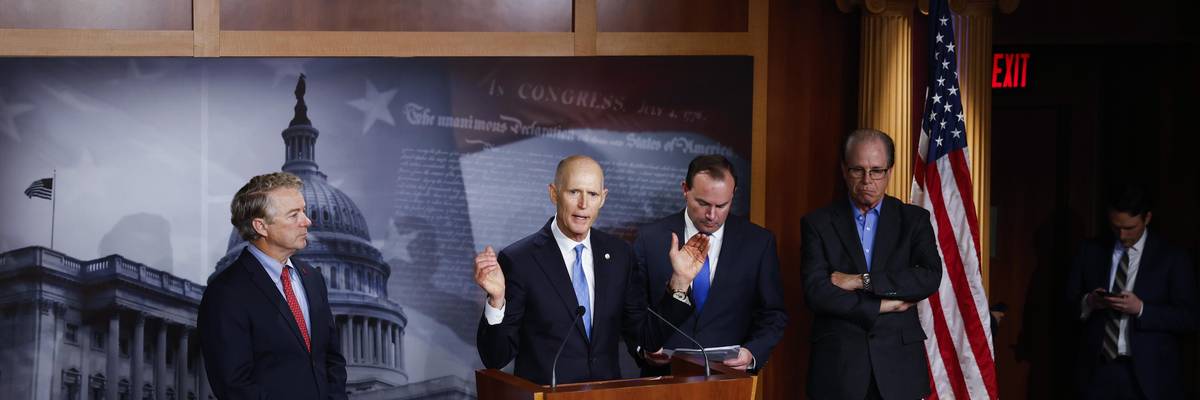
Sen. Rick Scott (R-FL) speaks at a news conference on government spending at the U.S. Capitol Building on December 07, 2022 in Washington, DC. GOP Senators held the news conference to discuss the National Defense Authorization Act (NDAA), and to call on the Senate to pass a short-term continuing resolution to fund the government until House Republicans take the gavel in January. (Photo by Anna Moneymaker/Getty Images)
It's the holiday season, which means parents are doing last-minute gift shopping while their kids eagerly await a host of presents from family. Ironically, Congress is engaging in a similar exercise in its final few work weeks of the year, and lawmakers are poised to pass a massive defense budget that is sure to make military brass and defense contractors giddy with glee ahead of Christmas day.
Finally, the legislative text of the Senate-House "compromise" version of the annual National Defense Authorization Act (NDAA) was dropped on Tuesday night, just two days before the House is scheduled to vote on the bill before the end of the day Thursday. The final, gift-wrapped package--including defense-related and non-defense related policy bills that may join the festivities as legislative stocking stuffers--has been negotiated in secret by just a handful of lawmakers, away from the prying eyes of other lawmakers, reporters, and the general public. It numbers 4,408 pages.
Unfortunately, this is a somewhat regular exercise for the U.S. Congress: procrastinating on necessary legislative items, waiting until the last minute for a resolution, and negotiating that resolution behind closed doors. It's evidence of a broken legislative process. It has also served to push the military budget to heights unimaginable just a few years ago.
This "compromise" version of NDAA will authorize 2023 defense spending at levels $45 billion higher than President Biden requested earlier this year and a whopping $80 billion higher than 2022 authorization levels. The total defense authorization amount is $858 billion, just $1 billion outside the range I predicted could come to pass in late October. As I wrote then, this hefty sum puts Congress on track to reach a $1 trillion defense budget much quicker (2027) than congressional budget experts currently project (2032).
And both lawmakers and the military continue to play budget games that only serve to hurt the American taxpayer. In November, Bloomberg reported that the Department of Defense sent Congress a highly unusual second unfunded priorities list (UPL) for the 2023 budget year, with total requests adding up to $25 billion. These UPLs, also called wish lists, have already helped Congress push the military budget higher in recent years. It's common practice (and, of late, required by law) for the military branches and combatant commands to send their wish lists to lawmakers early in the year when the Department as a whole submits its annual budget request. But this second, Department-wide effort appears to be both unprecedented and something of a shameless play at influencing the budget negotiations.
Sen. Elizabeth Warren (D-Mass.) had a similar takeaway. In a letter to Secretary of Defense Lloyd Austin in early December, Warren called the wish list "an end-of-year money grab, designed to short circuit the administration's budget and the congressional appropriations process."
An additional trend I'll be watching, one that won't matter so much in 2023 but could matter a lot in the future, is which NDAA amendments get approved for inclusion in the compromise product. Every year, lawmakers in both the House and the Senate file hundreds of amendments to the NDAA, in part because it's one of the few major pieces of legislation that Congress still reliably passes every year. Everyone wants their priority to hitch a ride on this must-pass bill.
Unfortunately, the amendments often serve to push future military budgets higher by authorizing all sorts of new programs and new spending. Congress doesn't always fund those new programs right away, but authorizing the new programs gives them the option to fund them in the future.
One prominent example I wrote about in October is the CHIPS (Creating Helpful Incentives to Produce Semiconductors and Science) Act of 2022. This multibillion-dollar legislation, enacted by Congress earlier this summer, provides subsidies to well-heeled American corporations to produce more semiconductors--a Congressional bid to steer semiconductor manufacturing away from China. The CHIPS Act was made possible in part by authorizations lawmakers previously made on a bipartisan basis in the 2021 NDAA.
Lawmakers introduced hundreds of amendments to the 2023 NDAA, dozens of which would authorize a collective $100 billion-plus on initiatives like military financing for Taiwan, defense cooperation with U.S. allies to counter China, and nuclear fuel. I'll be watching closely to see which of these initiatives are included in the thousands of pages of a compromise NDAA package. They may signal where Congress wants to increase the military budget in 2024, 2025, and beyond.
Congress is rushing to pass the NDAA over the next week or two, before they go home for the holidays. Lawmakers will all but certainly pass a massive increase to the defense budget approved by members of both parties in both chambers of the legislature--at least $80 billion in total above 2022 levels, and that doesn't include tens of billions of dollars the Pentagon has received to combat Russia's invasion of Ukraine.
If so, then Christmas will come early for the nation's military brass, who often get to spend without consequences from lawmakers who control their purse strings, and defense contractors, who benefit mightily from the taxpayer-funded largesse.
Dear Common Dreams reader, It’s been nearly 30 years since I co-founded Common Dreams with my late wife, Lina Newhouser. We had the radical notion that journalism should serve the public good, not corporate profits. It was clear to us from the outset what it would take to build such a project. No paid advertisements. No corporate sponsors. No millionaire publisher telling us what to think or do. Many people said we wouldn't last a year, but we proved those doubters wrong. Together with a tremendous team of journalists and dedicated staff, we built an independent media outlet free from the constraints of profits and corporate control. Our mission has always been simple: To inform. To inspire. To ignite change for the common good. Building Common Dreams was not easy. Our survival was never guaranteed. When you take on the most powerful forces—Wall Street greed, fossil fuel industry destruction, Big Tech lobbyists, and uber-rich oligarchs who have spent billions upon billions rigging the economy and democracy in their favor—the only bulwark you have is supporters who believe in your work. But here’s the urgent message from me today. It's never been this bad out there. And it's never been this hard to keep us going. At the very moment Common Dreams is most needed, the threats we face are intensifying. We need your support now more than ever. We don't accept corporate advertising and never will. We don't have a paywall because we don't think people should be blocked from critical news based on their ability to pay. Everything we do is funded by the donations of readers like you. When everyone does the little they can afford, we are strong. But if that support retreats or dries up, so do we. Will you donate now to make sure Common Dreams not only survives but thrives? —Craig Brown, Co-founder |
It's the holiday season, which means parents are doing last-minute gift shopping while their kids eagerly await a host of presents from family. Ironically, Congress is engaging in a similar exercise in its final few work weeks of the year, and lawmakers are poised to pass a massive defense budget that is sure to make military brass and defense contractors giddy with glee ahead of Christmas day.
Finally, the legislative text of the Senate-House "compromise" version of the annual National Defense Authorization Act (NDAA) was dropped on Tuesday night, just two days before the House is scheduled to vote on the bill before the end of the day Thursday. The final, gift-wrapped package--including defense-related and non-defense related policy bills that may join the festivities as legislative stocking stuffers--has been negotiated in secret by just a handful of lawmakers, away from the prying eyes of other lawmakers, reporters, and the general public. It numbers 4,408 pages.
Unfortunately, this is a somewhat regular exercise for the U.S. Congress: procrastinating on necessary legislative items, waiting until the last minute for a resolution, and negotiating that resolution behind closed doors. It's evidence of a broken legislative process. It has also served to push the military budget to heights unimaginable just a few years ago.
This "compromise" version of NDAA will authorize 2023 defense spending at levels $45 billion higher than President Biden requested earlier this year and a whopping $80 billion higher than 2022 authorization levels. The total defense authorization amount is $858 billion, just $1 billion outside the range I predicted could come to pass in late October. As I wrote then, this hefty sum puts Congress on track to reach a $1 trillion defense budget much quicker (2027) than congressional budget experts currently project (2032).
And both lawmakers and the military continue to play budget games that only serve to hurt the American taxpayer. In November, Bloomberg reported that the Department of Defense sent Congress a highly unusual second unfunded priorities list (UPL) for the 2023 budget year, with total requests adding up to $25 billion. These UPLs, also called wish lists, have already helped Congress push the military budget higher in recent years. It's common practice (and, of late, required by law) for the military branches and combatant commands to send their wish lists to lawmakers early in the year when the Department as a whole submits its annual budget request. But this second, Department-wide effort appears to be both unprecedented and something of a shameless play at influencing the budget negotiations.
Sen. Elizabeth Warren (D-Mass.) had a similar takeaway. In a letter to Secretary of Defense Lloyd Austin in early December, Warren called the wish list "an end-of-year money grab, designed to short circuit the administration's budget and the congressional appropriations process."
An additional trend I'll be watching, one that won't matter so much in 2023 but could matter a lot in the future, is which NDAA amendments get approved for inclusion in the compromise product. Every year, lawmakers in both the House and the Senate file hundreds of amendments to the NDAA, in part because it's one of the few major pieces of legislation that Congress still reliably passes every year. Everyone wants their priority to hitch a ride on this must-pass bill.
Unfortunately, the amendments often serve to push future military budgets higher by authorizing all sorts of new programs and new spending. Congress doesn't always fund those new programs right away, but authorizing the new programs gives them the option to fund them in the future.
One prominent example I wrote about in October is the CHIPS (Creating Helpful Incentives to Produce Semiconductors and Science) Act of 2022. This multibillion-dollar legislation, enacted by Congress earlier this summer, provides subsidies to well-heeled American corporations to produce more semiconductors--a Congressional bid to steer semiconductor manufacturing away from China. The CHIPS Act was made possible in part by authorizations lawmakers previously made on a bipartisan basis in the 2021 NDAA.
Lawmakers introduced hundreds of amendments to the 2023 NDAA, dozens of which would authorize a collective $100 billion-plus on initiatives like military financing for Taiwan, defense cooperation with U.S. allies to counter China, and nuclear fuel. I'll be watching closely to see which of these initiatives are included in the thousands of pages of a compromise NDAA package. They may signal where Congress wants to increase the military budget in 2024, 2025, and beyond.
Congress is rushing to pass the NDAA over the next week or two, before they go home for the holidays. Lawmakers will all but certainly pass a massive increase to the defense budget approved by members of both parties in both chambers of the legislature--at least $80 billion in total above 2022 levels, and that doesn't include tens of billions of dollars the Pentagon has received to combat Russia's invasion of Ukraine.
If so, then Christmas will come early for the nation's military brass, who often get to spend without consequences from lawmakers who control their purse strings, and defense contractors, who benefit mightily from the taxpayer-funded largesse.
It's the holiday season, which means parents are doing last-minute gift shopping while their kids eagerly await a host of presents from family. Ironically, Congress is engaging in a similar exercise in its final few work weeks of the year, and lawmakers are poised to pass a massive defense budget that is sure to make military brass and defense contractors giddy with glee ahead of Christmas day.
Finally, the legislative text of the Senate-House "compromise" version of the annual National Defense Authorization Act (NDAA) was dropped on Tuesday night, just two days before the House is scheduled to vote on the bill before the end of the day Thursday. The final, gift-wrapped package--including defense-related and non-defense related policy bills that may join the festivities as legislative stocking stuffers--has been negotiated in secret by just a handful of lawmakers, away from the prying eyes of other lawmakers, reporters, and the general public. It numbers 4,408 pages.
Unfortunately, this is a somewhat regular exercise for the U.S. Congress: procrastinating on necessary legislative items, waiting until the last minute for a resolution, and negotiating that resolution behind closed doors. It's evidence of a broken legislative process. It has also served to push the military budget to heights unimaginable just a few years ago.
This "compromise" version of NDAA will authorize 2023 defense spending at levels $45 billion higher than President Biden requested earlier this year and a whopping $80 billion higher than 2022 authorization levels. The total defense authorization amount is $858 billion, just $1 billion outside the range I predicted could come to pass in late October. As I wrote then, this hefty sum puts Congress on track to reach a $1 trillion defense budget much quicker (2027) than congressional budget experts currently project (2032).
And both lawmakers and the military continue to play budget games that only serve to hurt the American taxpayer. In November, Bloomberg reported that the Department of Defense sent Congress a highly unusual second unfunded priorities list (UPL) for the 2023 budget year, with total requests adding up to $25 billion. These UPLs, also called wish lists, have already helped Congress push the military budget higher in recent years. It's common practice (and, of late, required by law) for the military branches and combatant commands to send their wish lists to lawmakers early in the year when the Department as a whole submits its annual budget request. But this second, Department-wide effort appears to be both unprecedented and something of a shameless play at influencing the budget negotiations.
Sen. Elizabeth Warren (D-Mass.) had a similar takeaway. In a letter to Secretary of Defense Lloyd Austin in early December, Warren called the wish list "an end-of-year money grab, designed to short circuit the administration's budget and the congressional appropriations process."
An additional trend I'll be watching, one that won't matter so much in 2023 but could matter a lot in the future, is which NDAA amendments get approved for inclusion in the compromise product. Every year, lawmakers in both the House and the Senate file hundreds of amendments to the NDAA, in part because it's one of the few major pieces of legislation that Congress still reliably passes every year. Everyone wants their priority to hitch a ride on this must-pass bill.
Unfortunately, the amendments often serve to push future military budgets higher by authorizing all sorts of new programs and new spending. Congress doesn't always fund those new programs right away, but authorizing the new programs gives them the option to fund them in the future.
One prominent example I wrote about in October is the CHIPS (Creating Helpful Incentives to Produce Semiconductors and Science) Act of 2022. This multibillion-dollar legislation, enacted by Congress earlier this summer, provides subsidies to well-heeled American corporations to produce more semiconductors--a Congressional bid to steer semiconductor manufacturing away from China. The CHIPS Act was made possible in part by authorizations lawmakers previously made on a bipartisan basis in the 2021 NDAA.
Lawmakers introduced hundreds of amendments to the 2023 NDAA, dozens of which would authorize a collective $100 billion-plus on initiatives like military financing for Taiwan, defense cooperation with U.S. allies to counter China, and nuclear fuel. I'll be watching closely to see which of these initiatives are included in the thousands of pages of a compromise NDAA package. They may signal where Congress wants to increase the military budget in 2024, 2025, and beyond.
Congress is rushing to pass the NDAA over the next week or two, before they go home for the holidays. Lawmakers will all but certainly pass a massive increase to the defense budget approved by members of both parties in both chambers of the legislature--at least $80 billion in total above 2022 levels, and that doesn't include tens of billions of dollars the Pentagon has received to combat Russia's invasion of Ukraine.
If so, then Christmas will come early for the nation's military brass, who often get to spend without consequences from lawmakers who control their purse strings, and defense contractors, who benefit mightily from the taxpayer-funded largesse.