
Derrick Davis, a member of West Virginia New Jobs Coalition, hangs up signage during a community gathering and job fair on April 8, 2021 in Charleston, West Virginia. (Photo: Emilee Chinn/Getty Images for Green New Deal Network)
Why a Small Business-Centered Economy Is Critical Right Now
Covid pummeled small businesses already hamstrung by decades of neoliberal policy and a long history of structural racism.
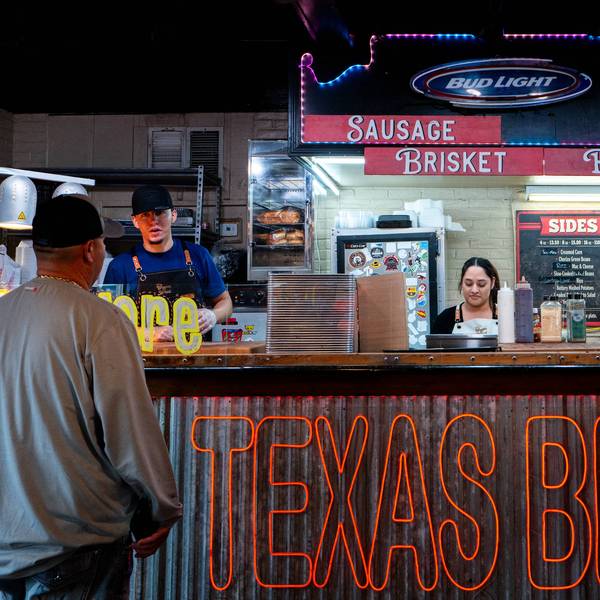
On Small Business Saturday, it's a day not only to shop small and local but also to reflect on how we can better support small businesses and our local economy for the long term.
For decades, influential corporate players have perpetrated a kind of identity theft against the country's small businesses. These players persuaded lawmakers, and much of the public, that businesses large and small shared common interests expressed through what they deemed a "business-friendly agenda."
Instead of community investment and entrepreneurial support, they pushed an agenda focused on tax breaks, deregulation, and privatization. Our relationship with small businesses here at Main Street Alliance shows that small businesses have distinct and unique needs. They thrive when their communities thrive, unlike big corporations who extract from communities.
"Only government can make the public investments at scale and set the market rules necessary to sustain a thriving small business economy."
Covid pummeled small businesses already hamstrung by decades of neoliberal policy and a long history of structural racism. Economic ideas gained steam throughout the 1970s and 1980s, with policy changes emphasizing growth over competition and attacks on labor unions and regulation. These principles have ultimately contributed to widespread inequality.
Many people believe that small business owners and entrepreneurs have a mythic quality: the go-getter, do-it-alone types who want to be their own bosses. Most small business owners know how interdependent we are and how much community support is needed to thrive. When businesses can't get that support, no amount of tenacity will save you.
Before the pandemic, the government needed to level the playing field for small businesses against ever consolidating corporations. During the pandemic, the immediate financial support only a government can provide at scale was evident. Overall, the PPP loan program reached over 75% of small businesses nationwide. As we try to move forward, the financial needs remain. Small businesses owners understand this. Government has a role in leveling the playing field.
Entrepreneurship is heralded as a path to opportunity. Prior to the pandemic, the fastest-growing segment of entrepreneurs were Black women. Yet, through government efforts to create an equal economy - with a specific commitment to dismantling systemic racism - entrepreneurship can contribute to generational wealth, financial security, and prosperous local economies. With 2.5 million women leaving the workforce during the pandemic, and women-owned businesses more heavily impacted than their male counterparts, decades of gains in economic power were erased overnight.
Only government can make the public investments at scale and set the market rules necessary to sustain a thriving small business economy. These investments cannot be solely left to philanthropy, which does not have the resources and policy tools to generalize benefits, nor to the private market as currently structured, which creates lopsided incentives for monopolization. Moreover, for effective delivery at the scale necessary, it must be done through an open, democratic process -- one only government can provide.
The investment proposed in the Build Back Better would create an environment that supports business growth -- supporting both entrepreneurs and their employees in the long run. At the state and national level, these investments would allow businesses to compete on their services, not their benefits. Benefits like health care, child care, paid leave, and more are benefits that the market does not make available and affordable to small business owners or our employees, making it harder to hire and retain staff. This will require more revenue to pay for this, and we should look to the wealthiest and largest corporations to pay their fair share so that all can benefit. It has been the wealthiest among us who have benefited from an inequitable economy and unfair market practices, so it is only fair that they participate in the fix.
Again, the Build Back Better Act brings many of these ideas together. It offers a reframing of how to support small businesses. With a rejection of neoliberalism, trickle-down economics, and corporate loopholes, a small business-centered economy looks like investment from the ground up. It provides a stable footing from which to launch and grow businesses. It reduces the risk for entrepreneurs to innovate with robust safety nets.
There is no more critical time for this investment, as our nation recovers from the pandemic and shifts the public perception of the economy and local businesses' role.
By dismantling the neoliberal ideologies of individualism, free-market capitalism, and small government, we can rewrite what it means to have healthy "Main Streets" in America. We are building community-focused, people-centered, small businesses for local economies. We can't let this moment pass.
We are at a crossroads
This country and this world are at a monumental crossroads. In a few short weeks, US voters will have an opportunity to beat back the forces of fascism and confront the billionaires who are rigging the economy, our media system, and our democracy, making it increasingly impossible for ordinary people to get by. We’re not just talking about the election. We’re talking about what must be done once these fascist elements are vanquished from power. We need a bolder set of solutions than what either major party has so far been willing to offer and a working-class movement ready to fight like hell for it. Trump didn't emerge from nowhere. The conditions that fueled MAGA authoritarianism were created by decades of radical neoliberal economic policies and a corrupt political system dominated by corporate interests. They slashed taxes on the super-rich, promising that the benefits would trickle down. They said giveaways to the corporate titans would make life more affordable for the rest of us. It was all bullshit. And when a bitter, betrayed populace searches for someone to blame, right-wing demagogues have little trouble finding scapegoats. People know when they're being lied to, but you won't hear any of this from the corporate media. Only independent journalism—powered and funded by people who believe in building a better world—can deliver truly trustworthy daily news. Our Fall Campaign is underway, and we need your help. To power our newsroom through the rest of the year, we need to raise $125,000 by midnight on October 31. So if you share our vision, please contribute whatever you can to sustain our work. |
On Small Business Saturday, it's a day not only to shop small and local but also to reflect on how we can better support small businesses and our local economy for the long term.
For decades, influential corporate players have perpetrated a kind of identity theft against the country's small businesses. These players persuaded lawmakers, and much of the public, that businesses large and small shared common interests expressed through what they deemed a "business-friendly agenda."
Instead of community investment and entrepreneurial support, they pushed an agenda focused on tax breaks, deregulation, and privatization. Our relationship with small businesses here at Main Street Alliance shows that small businesses have distinct and unique needs. They thrive when their communities thrive, unlike big corporations who extract from communities.
"Only government can make the public investments at scale and set the market rules necessary to sustain a thriving small business economy."
Covid pummeled small businesses already hamstrung by decades of neoliberal policy and a long history of structural racism. Economic ideas gained steam throughout the 1970s and 1980s, with policy changes emphasizing growth over competition and attacks on labor unions and regulation. These principles have ultimately contributed to widespread inequality.
Many people believe that small business owners and entrepreneurs have a mythic quality: the go-getter, do-it-alone types who want to be their own bosses. Most small business owners know how interdependent we are and how much community support is needed to thrive. When businesses can't get that support, no amount of tenacity will save you.
Before the pandemic, the government needed to level the playing field for small businesses against ever consolidating corporations. During the pandemic, the immediate financial support only a government can provide at scale was evident. Overall, the PPP loan program reached over 75% of small businesses nationwide. As we try to move forward, the financial needs remain. Small businesses owners understand this. Government has a role in leveling the playing field.
Entrepreneurship is heralded as a path to opportunity. Prior to the pandemic, the fastest-growing segment of entrepreneurs were Black women. Yet, through government efforts to create an equal economy - with a specific commitment to dismantling systemic racism - entrepreneurship can contribute to generational wealth, financial security, and prosperous local economies. With 2.5 million women leaving the workforce during the pandemic, and women-owned businesses more heavily impacted than their male counterparts, decades of gains in economic power were erased overnight.
Only government can make the public investments at scale and set the market rules necessary to sustain a thriving small business economy. These investments cannot be solely left to philanthropy, which does not have the resources and policy tools to generalize benefits, nor to the private market as currently structured, which creates lopsided incentives for monopolization. Moreover, for effective delivery at the scale necessary, it must be done through an open, democratic process -- one only government can provide.
The investment proposed in the Build Back Better would create an environment that supports business growth -- supporting both entrepreneurs and their employees in the long run. At the state and national level, these investments would allow businesses to compete on their services, not their benefits. Benefits like health care, child care, paid leave, and more are benefits that the market does not make available and affordable to small business owners or our employees, making it harder to hire and retain staff. This will require more revenue to pay for this, and we should look to the wealthiest and largest corporations to pay their fair share so that all can benefit. It has been the wealthiest among us who have benefited from an inequitable economy and unfair market practices, so it is only fair that they participate in the fix.
Again, the Build Back Better Act brings many of these ideas together. It offers a reframing of how to support small businesses. With a rejection of neoliberalism, trickle-down economics, and corporate loopholes, a small business-centered economy looks like investment from the ground up. It provides a stable footing from which to launch and grow businesses. It reduces the risk for entrepreneurs to innovate with robust safety nets.
There is no more critical time for this investment, as our nation recovers from the pandemic and shifts the public perception of the economy and local businesses' role.
By dismantling the neoliberal ideologies of individualism, free-market capitalism, and small government, we can rewrite what it means to have healthy "Main Streets" in America. We are building community-focused, people-centered, small businesses for local economies. We can't let this moment pass.