

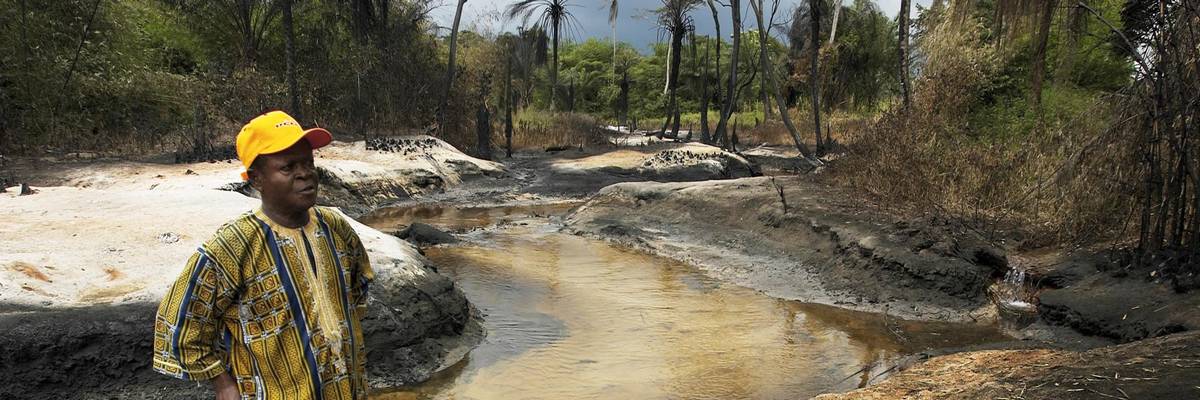
After more than six decades of oil exploitation in the Niger Delta, the region now ranks as one of the top ten most polluted places on earth. Water bodies, soils, and the air have all been stoked full of harmful pollutants, and life expectancy now stands at a dreary 41 years. (Photo: Jacob Silberberg via Getty Images)
Okavango, Oil Drilling, and the Tragedy of Africa
It is not too late for the governments of Namibia and Botswana to halt the race for an asset that is bound to get stranded as the world shifts away from fossil fuels.
The quest for profit in a predatory economic system has made it possible for humans to willfully ignore extractivist crimes unfolding in broad daylight. A clear case is the clawing into Namibia's Okavango Basin in search of hydrocarbon resources by ReconAfrica, a Canadian oil prospecting company. The company has been licensed to explore for hydrocarbons in an area of 13,600 square miles straddling Namibia and Botswana. ReconAfrica could end up fracking for oil and gas in this highly valuable region which is said to hold up to 31 billion barrels of crude oil.
"Exploitation of petroleum resources has routinely been accompanied by extreme ecological harms, and in some cases has also been the reason or pretext for violent conflicts and wars."
The Okavango Basin is touted as the "largest oil play of the decade." It is just as well that oil companies describe their finds as "plays" because what they do with these resources is a tragic play that routinely ends up devastating communities and basically irretrievably harming ecosystems. At a time when the world knows that not more than a third of known fossil reserves can still be extracted and burned without surpassing the already alarming 1.5degC temperature target of the Paris agreement, it is shameful that oil companies are still allowed to prospect for more oil, coal, and fossil gas.
Already, ReconAfrica's officials claim that they are playing according to rules set by the Namibian government as they go about their exploratory activities. We understand how such rules play out, who reaps the benefits of such rules, and who suffers the negative consequences. Experts have already noted that the Environmental Impact Assessment (EIA) report produced by ReconAfrica and accepted by the Namibian government would not pass serious scrutiny, and the process was not open to public participation. Public consultation is a critical requirement in any EIA process and where this is lacking the process is null and void. If the Minister of Agriculture of Namibia could say that his ministry was not consulted, why should we think that citizens were consulted?
It is concerning that governments keep on allowing oil companies to arm-twist them into accepting patently false promises of revenue booms and of capacity to avoid ecological harms and to trigger development in affected oil field communities. When the first commercially viable oil well spurted in 1956 in Nigeria's Niger Delta, there were wild celebrations of progress arriving in the area that had hitherto suffered hundreds of years of pillage of agricultural natural resources by imperialist and then colonial forces. The first oil exports commenced in 1958 and so far, more than 5,200 wells have been drilled in the region with over 603 being discovery wells. After more than six decades of hydrocarbons exploitation in the Niger Delta, the region now ranks as one of the top ten most polluted places on earth. Water bodies, soils, and the air have all been stoked full of harmful pollutants, and life expectancy now stands at a dreary 41 years.
You may say that Nigeria is an odd case. Consider the devastation that Texaco, now Chevron, wreaked in Ecuador where up to 18 billion U.S. gallons (68 billion liters) of toxic waste and 17 million gallons of crude oil were dumped on pristine rainforest soil in an area spanning 4,400 square kilometers or 1,700 square miles.
How about the ongoing massive pollutions in South Sudan and in Sudan? What about the tar sand fields of Canada, the home country of ReconAfrica? What of the burning coal caves in South Africa? In the words of Saul Landau in his collection of essays--A Bush & Botox World--"The quest for corporate profit invalidates concern for the environment." Besides, these companies also drag vulnerable nations into debt with the false promises of liquidity and hollow credit worthiness.
"The permission by the government of Namibia for the commencement of highly polluting and damaging activities in Okavango Basin is a willful denial of the real risk of permitting ecocide on its territory. It is a permit that promises glory but may end up offering genocide."
Namibia's Minister in charge of mining, Tom Alweendo, interestingly claimed that there was nothing to worry about oil and gas extraction in the Okavango Basin even though the area is a treasure to the people of Namibia and the world. According to the minister, "It's true the company has an oil and gas exploration license and obtained an environmental clearance certificate to do research drilling. They are not going to do hydraulic fracturing (fracking)--a more invasive method--but a conventional drilling method."
The truth is that exploitation of petroleum resources has routinely been accompanied by extreme ecological harms, and in some cases has also been the reason or pretext for violent conflicts and wars. Consider the invasion of Iraq and the destruction of Libya. Think of the unfolding violence in northeast Mozambique and the instability in the Lake Chad basin. The handling of wastewater and other toxic wastes from test drill pits already poses serious concerns.
The massive area earmarked for drilling by ReconAfrica reminds one of a time when Shell had the entire geographic space known as Nigeria as its concession. Okavango basin is home to over 200,000 Namibians and these Africans mostly rely on the Okavango River which brings supplies of fresh water from the forest regions of Angola all year round. Of course, ReconAfrica will pollute the natural potable water sources of the people and sink water bore holes for them. That is the epitome of so-called "Corporate Social Responsibility" (CSR) that has proven to be nothing other than crass irresponsibility elsewhere.
The Okavango Basin is an area of rich cultural heritage and boasts of several species that make living in this area a unique experience. The permission by the government of Namibia for the commencement of highly polluting and damaging activities in Okavango Basin is a willful denial of the real risk of permitting ecocide on its territory. It is a permit that promises glory but may end up offering genocide. It is a move that denies the existential challenge posed by climate change, the impacts of which Namibia is not a stranger to. It is digging for profit that ignores the fact that adding oil from there to the fossil fuel fires already raging in the world will compound the floods, droughts, desertification, population displacements, and other negative impacts of global warming.
Okavango is a highly treasured living community in Namibia and Botswana. Why should anyone allow the quest for petrodollars to turn this into an arena of death? It is not too late for the governments of Namibia and Botswana to halt this race for an asset that is bound to get stranded as the world shifts away from fossil fuels. Why permit actions that simply add to climate crimes? It is not too late to pull the plug on this gamble.
An Urgent Message From Our Co-Founder
Dear Common Dreams reader, It’s been nearly 30 years since I co-founded Common Dreams with my late wife, Lina Newhouser. We had the radical notion that journalism should serve the public good, not corporate profits. It was clear to us from the outset what it would take to build such a project. No paid advertisements. No corporate sponsors. No millionaire publisher telling us what to think or do. Many people said we wouldn't last a year, but we proved those doubters wrong. Together with a tremendous team of journalists and dedicated staff, we built an independent media outlet free from the constraints of profits and corporate control. Our mission has always been simple: To inform. To inspire. To ignite change for the common good. Building Common Dreams was not easy. Our survival was never guaranteed. When you take on the most powerful forces—Wall Street greed, fossil fuel industry destruction, Big Tech lobbyists, and uber-rich oligarchs who have spent billions upon billions rigging the economy and democracy in their favor—the only bulwark you have is supporters who believe in your work. But here’s the urgent message from me today. It's never been this bad out there. And it's never been this hard to keep us going. At the very moment Common Dreams is most needed, the threats we face are intensifying. We need your support now more than ever. We don't accept corporate advertising and never will. We don't have a paywall because we don't think people should be blocked from critical news based on their ability to pay. Everything we do is funded by the donations of readers like you. When everyone does the little they can afford, we are strong. But if that support retreats or dries up, so do we. Will you donate now to make sure Common Dreams not only survives but thrives? —Craig Brown, Co-founder |
The quest for profit in a predatory economic system has made it possible for humans to willfully ignore extractivist crimes unfolding in broad daylight. A clear case is the clawing into Namibia's Okavango Basin in search of hydrocarbon resources by ReconAfrica, a Canadian oil prospecting company. The company has been licensed to explore for hydrocarbons in an area of 13,600 square miles straddling Namibia and Botswana. ReconAfrica could end up fracking for oil and gas in this highly valuable region which is said to hold up to 31 billion barrels of crude oil.
"Exploitation of petroleum resources has routinely been accompanied by extreme ecological harms, and in some cases has also been the reason or pretext for violent conflicts and wars."
The Okavango Basin is touted as the "largest oil play of the decade." It is just as well that oil companies describe their finds as "plays" because what they do with these resources is a tragic play that routinely ends up devastating communities and basically irretrievably harming ecosystems. At a time when the world knows that not more than a third of known fossil reserves can still be extracted and burned without surpassing the already alarming 1.5degC temperature target of the Paris agreement, it is shameful that oil companies are still allowed to prospect for more oil, coal, and fossil gas.
Already, ReconAfrica's officials claim that they are playing according to rules set by the Namibian government as they go about their exploratory activities. We understand how such rules play out, who reaps the benefits of such rules, and who suffers the negative consequences. Experts have already noted that the Environmental Impact Assessment (EIA) report produced by ReconAfrica and accepted by the Namibian government would not pass serious scrutiny, and the process was not open to public participation. Public consultation is a critical requirement in any EIA process and where this is lacking the process is null and void. If the Minister of Agriculture of Namibia could say that his ministry was not consulted, why should we think that citizens were consulted?
It is concerning that governments keep on allowing oil companies to arm-twist them into accepting patently false promises of revenue booms and of capacity to avoid ecological harms and to trigger development in affected oil field communities. When the first commercially viable oil well spurted in 1956 in Nigeria's Niger Delta, there were wild celebrations of progress arriving in the area that had hitherto suffered hundreds of years of pillage of agricultural natural resources by imperialist and then colonial forces. The first oil exports commenced in 1958 and so far, more than 5,200 wells have been drilled in the region with over 603 being discovery wells. After more than six decades of hydrocarbons exploitation in the Niger Delta, the region now ranks as one of the top ten most polluted places on earth. Water bodies, soils, and the air have all been stoked full of harmful pollutants, and life expectancy now stands at a dreary 41 years.
You may say that Nigeria is an odd case. Consider the devastation that Texaco, now Chevron, wreaked in Ecuador where up to 18 billion U.S. gallons (68 billion liters) of toxic waste and 17 million gallons of crude oil were dumped on pristine rainforest soil in an area spanning 4,400 square kilometers or 1,700 square miles.
How about the ongoing massive pollutions in South Sudan and in Sudan? What about the tar sand fields of Canada, the home country of ReconAfrica? What of the burning coal caves in South Africa? In the words of Saul Landau in his collection of essays--A Bush & Botox World--"The quest for corporate profit invalidates concern for the environment." Besides, these companies also drag vulnerable nations into debt with the false promises of liquidity and hollow credit worthiness.
"The permission by the government of Namibia for the commencement of highly polluting and damaging activities in Okavango Basin is a willful denial of the real risk of permitting ecocide on its territory. It is a permit that promises glory but may end up offering genocide."
Namibia's Minister in charge of mining, Tom Alweendo, interestingly claimed that there was nothing to worry about oil and gas extraction in the Okavango Basin even though the area is a treasure to the people of Namibia and the world. According to the minister, "It's true the company has an oil and gas exploration license and obtained an environmental clearance certificate to do research drilling. They are not going to do hydraulic fracturing (fracking)--a more invasive method--but a conventional drilling method."
The truth is that exploitation of petroleum resources has routinely been accompanied by extreme ecological harms, and in some cases has also been the reason or pretext for violent conflicts and wars. Consider the invasion of Iraq and the destruction of Libya. Think of the unfolding violence in northeast Mozambique and the instability in the Lake Chad basin. The handling of wastewater and other toxic wastes from test drill pits already poses serious concerns.
The massive area earmarked for drilling by ReconAfrica reminds one of a time when Shell had the entire geographic space known as Nigeria as its concession. Okavango basin is home to over 200,000 Namibians and these Africans mostly rely on the Okavango River which brings supplies of fresh water from the forest regions of Angola all year round. Of course, ReconAfrica will pollute the natural potable water sources of the people and sink water bore holes for them. That is the epitome of so-called "Corporate Social Responsibility" (CSR) that has proven to be nothing other than crass irresponsibility elsewhere.
The Okavango Basin is an area of rich cultural heritage and boasts of several species that make living in this area a unique experience. The permission by the government of Namibia for the commencement of highly polluting and damaging activities in Okavango Basin is a willful denial of the real risk of permitting ecocide on its territory. It is a permit that promises glory but may end up offering genocide. It is a move that denies the existential challenge posed by climate change, the impacts of which Namibia is not a stranger to. It is digging for profit that ignores the fact that adding oil from there to the fossil fuel fires already raging in the world will compound the floods, droughts, desertification, population displacements, and other negative impacts of global warming.
Okavango is a highly treasured living community in Namibia and Botswana. Why should anyone allow the quest for petrodollars to turn this into an arena of death? It is not too late for the governments of Namibia and Botswana to halt this race for an asset that is bound to get stranded as the world shifts away from fossil fuels. Why permit actions that simply add to climate crimes? It is not too late to pull the plug on this gamble.
The quest for profit in a predatory economic system has made it possible for humans to willfully ignore extractivist crimes unfolding in broad daylight. A clear case is the clawing into Namibia's Okavango Basin in search of hydrocarbon resources by ReconAfrica, a Canadian oil prospecting company. The company has been licensed to explore for hydrocarbons in an area of 13,600 square miles straddling Namibia and Botswana. ReconAfrica could end up fracking for oil and gas in this highly valuable region which is said to hold up to 31 billion barrels of crude oil.
"Exploitation of petroleum resources has routinely been accompanied by extreme ecological harms, and in some cases has also been the reason or pretext for violent conflicts and wars."
The Okavango Basin is touted as the "largest oil play of the decade." It is just as well that oil companies describe their finds as "plays" because what they do with these resources is a tragic play that routinely ends up devastating communities and basically irretrievably harming ecosystems. At a time when the world knows that not more than a third of known fossil reserves can still be extracted and burned without surpassing the already alarming 1.5degC temperature target of the Paris agreement, it is shameful that oil companies are still allowed to prospect for more oil, coal, and fossil gas.
Already, ReconAfrica's officials claim that they are playing according to rules set by the Namibian government as they go about their exploratory activities. We understand how such rules play out, who reaps the benefits of such rules, and who suffers the negative consequences. Experts have already noted that the Environmental Impact Assessment (EIA) report produced by ReconAfrica and accepted by the Namibian government would not pass serious scrutiny, and the process was not open to public participation. Public consultation is a critical requirement in any EIA process and where this is lacking the process is null and void. If the Minister of Agriculture of Namibia could say that his ministry was not consulted, why should we think that citizens were consulted?
It is concerning that governments keep on allowing oil companies to arm-twist them into accepting patently false promises of revenue booms and of capacity to avoid ecological harms and to trigger development in affected oil field communities. When the first commercially viable oil well spurted in 1956 in Nigeria's Niger Delta, there were wild celebrations of progress arriving in the area that had hitherto suffered hundreds of years of pillage of agricultural natural resources by imperialist and then colonial forces. The first oil exports commenced in 1958 and so far, more than 5,200 wells have been drilled in the region with over 603 being discovery wells. After more than six decades of hydrocarbons exploitation in the Niger Delta, the region now ranks as one of the top ten most polluted places on earth. Water bodies, soils, and the air have all been stoked full of harmful pollutants, and life expectancy now stands at a dreary 41 years.
You may say that Nigeria is an odd case. Consider the devastation that Texaco, now Chevron, wreaked in Ecuador where up to 18 billion U.S. gallons (68 billion liters) of toxic waste and 17 million gallons of crude oil were dumped on pristine rainforest soil in an area spanning 4,400 square kilometers or 1,700 square miles.
How about the ongoing massive pollutions in South Sudan and in Sudan? What about the tar sand fields of Canada, the home country of ReconAfrica? What of the burning coal caves in South Africa? In the words of Saul Landau in his collection of essays--A Bush & Botox World--"The quest for corporate profit invalidates concern for the environment." Besides, these companies also drag vulnerable nations into debt with the false promises of liquidity and hollow credit worthiness.
"The permission by the government of Namibia for the commencement of highly polluting and damaging activities in Okavango Basin is a willful denial of the real risk of permitting ecocide on its territory. It is a permit that promises glory but may end up offering genocide."
Namibia's Minister in charge of mining, Tom Alweendo, interestingly claimed that there was nothing to worry about oil and gas extraction in the Okavango Basin even though the area is a treasure to the people of Namibia and the world. According to the minister, "It's true the company has an oil and gas exploration license and obtained an environmental clearance certificate to do research drilling. They are not going to do hydraulic fracturing (fracking)--a more invasive method--but a conventional drilling method."
The truth is that exploitation of petroleum resources has routinely been accompanied by extreme ecological harms, and in some cases has also been the reason or pretext for violent conflicts and wars. Consider the invasion of Iraq and the destruction of Libya. Think of the unfolding violence in northeast Mozambique and the instability in the Lake Chad basin. The handling of wastewater and other toxic wastes from test drill pits already poses serious concerns.
The massive area earmarked for drilling by ReconAfrica reminds one of a time when Shell had the entire geographic space known as Nigeria as its concession. Okavango basin is home to over 200,000 Namibians and these Africans mostly rely on the Okavango River which brings supplies of fresh water from the forest regions of Angola all year round. Of course, ReconAfrica will pollute the natural potable water sources of the people and sink water bore holes for them. That is the epitome of so-called "Corporate Social Responsibility" (CSR) that has proven to be nothing other than crass irresponsibility elsewhere.
The Okavango Basin is an area of rich cultural heritage and boasts of several species that make living in this area a unique experience. The permission by the government of Namibia for the commencement of highly polluting and damaging activities in Okavango Basin is a willful denial of the real risk of permitting ecocide on its territory. It is a permit that promises glory but may end up offering genocide. It is a move that denies the existential challenge posed by climate change, the impacts of which Namibia is not a stranger to. It is digging for profit that ignores the fact that adding oil from there to the fossil fuel fires already raging in the world will compound the floods, droughts, desertification, population displacements, and other negative impacts of global warming.
Okavango is a highly treasured living community in Namibia and Botswana. Why should anyone allow the quest for petrodollars to turn this into an arena of death? It is not too late for the governments of Namibia and Botswana to halt this race for an asset that is bound to get stranded as the world shifts away from fossil fuels. Why permit actions that simply add to climate crimes? It is not too late to pull the plug on this gamble.