SUBSCRIBE TO OUR FREE NEWSLETTER
Daily news & progressive opinion—funded by the people, not the corporations—delivered straight to your inbox.
5
#000000
#FFFFFF
To donate by check, phone, or other method, see our More Ways to Give page.
Daily news & progressive opinion—funded by the people, not the corporations—delivered straight to your inbox.

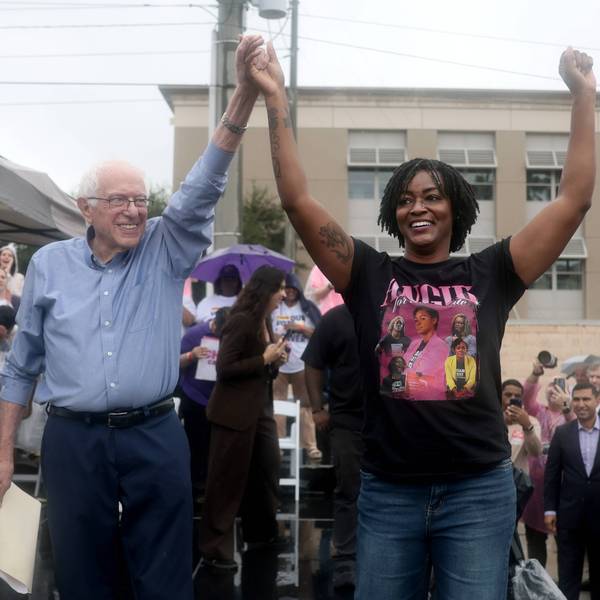
Nina Turner, national co-chair of the Bernie Sanders 2020 presidential campaign, rallies voters Feb. 26, 2020, in North Charleston, S.C. (Photo: Drew Angerer/Getty Images)
Former Ohio State Sen. Nina Turner calls into a virtual fundraiser February 24, hosted by Our Revolution, the grassroots political advocacy group that used to call Turner its president. The event is one of dozens as her run for Congress ramps up in Ohio's 11th Congressional District, around Cleveland and Akron.
Per usual, Turner includes a call for radical change. "This nation is going to be better because there are some 21st-century freedom fighters who are willing to put it on the line," Turner tells attendees.
"They want to know that their vote does really matter," Turner says. "That when they do vote for Democrats, that something materially is going to change in their lives."
Turner, who frequently cites famous Black politicians and activists, this time references former Rep. Barbara Jordan (D-Texas), who famously said in 1977: "What the people want is very simple. They want an America as good as its promise."
"Whether it's dealing with the damage that we're doing to Mother Earth, to ensuring that everybody in this nation has Medicare for All, to canceling student debt, to dealing with the injustices in the criminal justice system--you name it, baby, that is about creating an America that is as good as its promise, for everybody," Turner says.
Turner announced her run to replace Rep. Marcia Fudge in December 2020, shortly after President Joe Biden announced Fudge as his pick for secretary of the Department of Housing and Urban Development. Turner is one of seven Democratic candidates, but what sets Turner apart early is her national following.
Turner quickly won an endorsement from Sen. Bernie Sanders (I-Vt.), whom she campaigned for in the 2016 and 2020 Democratic presidential primaries. Reps. Cori Bush (D-Mo.) and Ro Khanna (D-Calif.) endorsed Turner the day she announced. The progressive political action committee Justice Democrats endorsed Turner in January, and Reps. Ilhan Omar (D-Minn.) and Rashida Tlaib (D-Mich.) followed suit in February. And in March, Rep. Alexandria Ocasio-Cortez (D-N.Y.) backed Turner as well.
"I'm looking to have her seated next to me, fighting this fight," Bush says at the February fundraiser. "We need somebody like Sen. Nina Turner who is unapologetic, who is unbossed, who is not ashamed and not afraid of her progressive values."
Inside the district, no polling data has been released and campaign finance reports have been slow. But in the first few weeks of the campaign, Turner--who has pledged on Twitter not to accept any lobbyist or corporate PAC money--had raised $646,744. The next highest fundraiser, Cuyahoga County Councilor (and local Democratic Party Chair) Shontel Brown, had around $40,000.
Liz Shirey, Turner's campaign manager, says they raised more than $1 million by early February in "tens of thousands of small-dollar donations from across the country."
The former state senator's local name recognition goes back more than a decade. Turner served on the Cleveland City Council from 2006 to 2008 before being appointed to the Ohio Senate. She won her seat in 2010 but chose not to run in 2014 to make a bid (unsuccessfully) for Ohio secretary of state.
Turner is joined in the race by Brown, former Cleveland Councilor and current state Sen. Jeff Johnson, former state Rep. John Barnes Jr., former state Sen. Shirley Smith, and lesser-known candidates Tariq Shabazz and Bryan Flannery. Based on fundraising and endorsements, Turner and Brown are considered the frontrunners.
In a state that went for former President Donald Trump in 2020, District 11 is a Democratic stronghold. Demographically, it is 53% Black with a strong working-class voting base and a median household income of $42,000.
Turner's platform includes a $15 minimum wage, recurring stimulus checks and free public college, which she believes her working-class constituents need.
"I'm running for big mama who needs some relief," Turner says. "I'm running for the babies in our community, some of whom don't have the hardware, the software, the internet connection they need to even be able to study and learn. I'm running for frontline workers."
Local endorsements in the race are slowly rolling in. The Amalgamated Transit Union (ATU), which represents around 1,800 workers in the Cleveland area, endorsed Turner in late February, as did the Bakery, Confectionery, Tobacco Workers and Grain Millers Union Local 19, and the Retail, Wholesale and Department Store Union.
ATU was one of the first unions to endorse Joe Biden in the 2020 primaries, so its vote of confidence in Turner hints at her ability to win over mainstream organizations, despite the more traditional Democratic candidates.
Still, Turner faces stiff competition to win the labor vote. Brown has the support of the local Bricklayers Union, the Pipefitters Union, the Cleveland Building & Construction Trades Council and the Black Contractors Group, among others. The steelworkers have yet to endorse.
Fudge's seat became officially vacant when her federal appointment was confirmed by the Senate on March 10 and she resigned from the House of Representatives, paving the way for Ohio Gov. Mike DeWine to call a special election. The primary will likely be in early May.
Turner has faith in her district and believes voters want real, systemic change.
"They want to know that their vote does really matter," Turner says. "That when they do vote for Democrats, that something materially is going to change in their lives."
This country and this world are at a monumental crossroads. US voters have an opportunity to beat back the forces of fascism and confront the billionaires who are rigging the economy, our media system, and our democracy, making it increasingly impossible for ordinary people to get by. We’re not just talking about the election. We’re talking about what must be done once these fascist elements are vanquished from power. We need a bolder set of solutions than what either major party has so far been willing to offer and a working-class movement ready to fight like hell for it. Trump didn't emerge from nowhere. The conditions that fueled MAGA authoritarianism were created by decades of radical neoliberal economic policies and a corrupt political system dominated by corporate interests. They slashed taxes on the super-rich, promising that the benefits would trickle down. They said giveaways to the corporate titans would make life more affordable for the rest of us. It was all bullshit. And when a bitter, betrayed populace searches for someone to blame, right-wing demagogues have little trouble finding scapegoats. People know when they're being lied to, but you won't hear any of this from the corporate media. Only independent journalism—powered and funded by people who believe in building a better world—can deliver truly trustworthy daily news. If you share our vision, please contribute whatever you can to sustain our work. |
Former Ohio State Sen. Nina Turner calls into a virtual fundraiser February 24, hosted by Our Revolution, the grassroots political advocacy group that used to call Turner its president. The event is one of dozens as her run for Congress ramps up in Ohio's 11th Congressional District, around Cleveland and Akron.
Per usual, Turner includes a call for radical change. "This nation is going to be better because there are some 21st-century freedom fighters who are willing to put it on the line," Turner tells attendees.
"They want to know that their vote does really matter," Turner says. "That when they do vote for Democrats, that something materially is going to change in their lives."
Turner, who frequently cites famous Black politicians and activists, this time references former Rep. Barbara Jordan (D-Texas), who famously said in 1977: "What the people want is very simple. They want an America as good as its promise."
"Whether it's dealing with the damage that we're doing to Mother Earth, to ensuring that everybody in this nation has Medicare for All, to canceling student debt, to dealing with the injustices in the criminal justice system--you name it, baby, that is about creating an America that is as good as its promise, for everybody," Turner says.
Turner announced her run to replace Rep. Marcia Fudge in December 2020, shortly after President Joe Biden announced Fudge as his pick for secretary of the Department of Housing and Urban Development. Turner is one of seven Democratic candidates, but what sets Turner apart early is her national following.
Turner quickly won an endorsement from Sen. Bernie Sanders (I-Vt.), whom she campaigned for in the 2016 and 2020 Democratic presidential primaries. Reps. Cori Bush (D-Mo.) and Ro Khanna (D-Calif.) endorsed Turner the day she announced. The progressive political action committee Justice Democrats endorsed Turner in January, and Reps. Ilhan Omar (D-Minn.) and Rashida Tlaib (D-Mich.) followed suit in February. And in March, Rep. Alexandria Ocasio-Cortez (D-N.Y.) backed Turner as well.
"I'm looking to have her seated next to me, fighting this fight," Bush says at the February fundraiser. "We need somebody like Sen. Nina Turner who is unapologetic, who is unbossed, who is not ashamed and not afraid of her progressive values."
Inside the district, no polling data has been released and campaign finance reports have been slow. But in the first few weeks of the campaign, Turner--who has pledged on Twitter not to accept any lobbyist or corporate PAC money--had raised $646,744. The next highest fundraiser, Cuyahoga County Councilor (and local Democratic Party Chair) Shontel Brown, had around $40,000.
Liz Shirey, Turner's campaign manager, says they raised more than $1 million by early February in "tens of thousands of small-dollar donations from across the country."
The former state senator's local name recognition goes back more than a decade. Turner served on the Cleveland City Council from 2006 to 2008 before being appointed to the Ohio Senate. She won her seat in 2010 but chose not to run in 2014 to make a bid (unsuccessfully) for Ohio secretary of state.
Turner is joined in the race by Brown, former Cleveland Councilor and current state Sen. Jeff Johnson, former state Rep. John Barnes Jr., former state Sen. Shirley Smith, and lesser-known candidates Tariq Shabazz and Bryan Flannery. Based on fundraising and endorsements, Turner and Brown are considered the frontrunners.
In a state that went for former President Donald Trump in 2020, District 11 is a Democratic stronghold. Demographically, it is 53% Black with a strong working-class voting base and a median household income of $42,000.
Turner's platform includes a $15 minimum wage, recurring stimulus checks and free public college, which she believes her working-class constituents need.
"I'm running for big mama who needs some relief," Turner says. "I'm running for the babies in our community, some of whom don't have the hardware, the software, the internet connection they need to even be able to study and learn. I'm running for frontline workers."
Local endorsements in the race are slowly rolling in. The Amalgamated Transit Union (ATU), which represents around 1,800 workers in the Cleveland area, endorsed Turner in late February, as did the Bakery, Confectionery, Tobacco Workers and Grain Millers Union Local 19, and the Retail, Wholesale and Department Store Union.
ATU was one of the first unions to endorse Joe Biden in the 2020 primaries, so its vote of confidence in Turner hints at her ability to win over mainstream organizations, despite the more traditional Democratic candidates.
Still, Turner faces stiff competition to win the labor vote. Brown has the support of the local Bricklayers Union, the Pipefitters Union, the Cleveland Building & Construction Trades Council and the Black Contractors Group, among others. The steelworkers have yet to endorse.
Fudge's seat became officially vacant when her federal appointment was confirmed by the Senate on March 10 and she resigned from the House of Representatives, paving the way for Ohio Gov. Mike DeWine to call a special election. The primary will likely be in early May.
Turner has faith in her district and believes voters want real, systemic change.
"They want to know that their vote does really matter," Turner says. "That when they do vote for Democrats, that something materially is going to change in their lives."