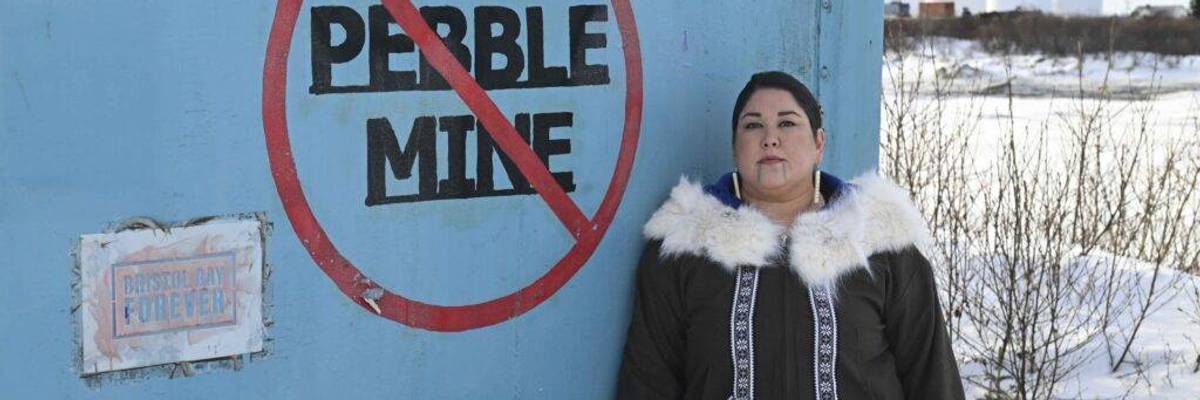
2026 Goldman Environmental Prize winner Alannah Acaq Hurley poses for a photo.
'This Is a Fight for Humanity': Meet the 2026 Winners of the Goldman Environmental Prize
“The 2026 prize winners are proof positive that courage, hard work, and hope go a long way toward creating meaningful progress," one foundation leader said.
The Goldman Environmental Foundation announced the six winners of the 2026 Goldman Environmental Prize on Monday, honoring an all-female slate of advocates who protected wildlife, took on extractive industries, and won important legal victories in the movement to halt the climate crisis.
The announcement comes as world leaders have failed to make progress in addressing environmental challenges, and President Donald Trump, leader of the world's largest historical climate polluter, has withdrawn the US from the Paris Agreement, rolled back climate and environmental regulations domestically, and made efforts to supercharge the extraction and use of fossil fuels.
“While we continue to fight uphill to protect the environment and implement lifesaving climate policies—in the US and globally—it is clear that true leaders can be found all around us,” John Goldman, vice president of the Goldman Environmental Foundation, said in a statement. “The 2026 prize winners are proof positive that courage, hard work, and hope go a long way toward creating meaningful progress."
The 2026 prize is notable because it marks the first time that all of the winners—Iroro Tanshi of Nigeria, Borim Kim of South Korea, Sarah Finch of the United Kingdom, Theonila Roka Matbob of Papau New Guinea, Alannah Acaq Hurley of the US, and Yuvelis Morales Blanco of Colombia—are women.
'There's lots of people doing really good things and, together, we are going to make the world a better place than it would otherwise have been."
"I am especially thrilled to honor our first-ever cohort of six women, as this is a powerful reflection of the absolutely central role that women play in the environmental community globally,” Goldman said.
The winners also exemplify the prize's 2026 theme "Change Starts Where You Stand," as each of them began with a fight to protect a local community or ecosystem that has global implications for the climate, biodiversity, and environmental justice.
As US-based winner Alannah Acaq Hurley said, "At the end of the day, this is a fight for humanity, and, honestly, our ability to continue as humans on this planet."
Here is how six remarkable women waged this fight and won.
Iroro Tanshi
Iroro Tanshi is a Nigerian conservation ecologist who has worked successfully with local communities to protect endangered bats and their rainforest habitat from wildfires.
Tanshi was elated in 2016 when she discovered the short-tailed roundleaf bat, previously believed to be extinct in the area, living in Nigeria's Afi Mountain Wildlife Sanctuary. However, two weeks later, a devastating wildfire ignited, forcing Tanshi to evacuate and ultimately impacting around half of the park.
Tanshi then turned her attention to preventing wildfires, which are sparked by traditional farming practices rubbing against the climate crisis.
"The way people manage these farms is they use fire to clean the farms every year, but climate change has completely toppled the pattern of rainfall and people can no longer predict when to burn safely," she explained in a video.
Tanshi and her team worked with local communities on a Zero Wildfire Campaign, which includes educating farmers on when it is safe to burn and forming a team of "forest guardians" to patrol and fight fires on high-risk days. Due to her efforts, these guardians put out 74 fires between 2022 and 2025, preventing any of them from becoming major blazes.
"My hope for the future is that people would take these small-scale projects as signals for what the future should look like," she said. "Let's stay nimble. Let's try to work in our small communities and solve those problems there on the ground."
Borim Kim
Borim Kim helped win Asia's first successful youth climate lawsuit, inspiring people across the region to demand government action on climate.
Kim was first motivated to take collective action when a heatwave baked Seoul in 2018, killing 48 people including a woman near her mother's age, who died in her home.
"I realized that even home wasn't safe from the climate crisis," she said in a video. "I started looking for what I could do."
Inspired by the international youth climate movement, she founded Youth 4 Climate Action (Y4CA) and helped organize school strikes and walkouts. After her activism led to meetings with policymakers, she realized that national leaders had no real plans to address the climate crisis. In 2020, she and Y4CA mobilized 19 young people to sue the South Korean government for violating the constitutional rights of future generations. Once the case was launched, she also continued to build a social movement for climate action.
In August 2024, the country's Constitutional Court ruled in favor of the young people, mandating that South Korea reduce its emissions in line with the scientific consensus, a decision the environmental minister accepted. The ruling is projected to prevent between 1.6-2.1 billion tons of carbon dioxide from reaching the atmosphere.
"Youth may be seen as having a lower position in society, but now this decision has affirmed our right to live safely and the state's duty to protect us," Kim said.
Sara Finch
On the other side of the world, Sarah Finch also secured a precedent-setting legal climate victory.
Finch lives in a part of southeastern England called the Weald. While it is currently a rural area, it hosts oil and gas reserves that were eyed for exploitation during the fracking boom of the 2010s. Finch helped form the Weald Action Group to push back against many potential wells, but they were not able to stop the Surrey County Council from approving the operation and expansion of a drilling site called Horse Hill in 2018.
In gearing up to challenge the decision, Finch discovered that the council's environmental impact statement had only considered emissions from direct drilling at the site, but not the emissions generated from the burning of the fuel once it was extracted, also known as Scope 3 emissions, which make up around 90% of oil and gas' contribution to the climate emergency.
"It became apparent that it was actually the norm that Scope 3 emissions were being emitted from these kinds of decisions, and we realized that actually it was happening everywhere and in much bigger developments than Horse Hill," Finch said in a video.
She and her team challenged the environmental impact statement over its failure to consider Scope 3 emissions, losing multiple times before finally securing a groundbreaking victory from the UK Supreme Court in 2024, which has come to be known as "the Finch ruling."
The UK government cited the "Finch ruling" when it revoked its backing of two North Sea oil developments. Overall, the projects canceled or delayed in 2024 due to the ruling would have generated enough Scope 3 emissions to equal the UK's domestic greenhouse gas emissions that year.
"It wasn't just a win on Horse Hill," Finch said. "It wasn't even just a win on a handful of sites. It was a win on the whole future of the UK oil and gas industry. And I feel like, there's lots of people doing really good things and, together, we are going to make the world a better place than it would otherwise have been."
Theonila Roka Matbob
Theonila Roka Matbob was born into an environmental disaster. Rio Tinto's Panguna Mine had devastated the ecosystem of Bougainville in Papua New Guinea’s (PNG) Autonomous Region of Bougainville (ARB), destabilized its society, and led to a civil war that killed 15,000-20,000 Bougainvilleans, including her father.
"Our environment was tortured, and then the land was tortured, and the third party that was tortured were my people," Roka Matbob said in a video.
Rio Tinto closed its copper, silver, and gold mine in 1989 due to the war, but had done nothing to clean up the 150,000 tons of tailings it had dumped into local rivers or take responsibility for the havoc the mine had caused. As an adult, Roka Matbob began to wonder why justice had not been done and to gather testimony from people impacted by the mine.
This led to a successful campaign that persuaded Rio Tinto first to fund an assessment of the mine's impacts and then to sign a memorandum of understanding in 2024 to act on the assessment's findings and develop a plan with local communities to remediate the area.
"It doesn't mean we will restore everything as it was, but at least the story that my grandchildren and my great-grandchildren can remember [is] that our grandparents fought," she said.
Alannah Acaq Hurley
As Theonila Roka Matbob secured justice for the impacts of one major mine, Alannah Acaq Hurley helped prevent another one from being dug in the first place.
Hurley grew up as a member of the Yup’ik Indigenous group in Alaska's Bristol Bay, a haven of biodiversity that also hosts the world's largest wild sockeye salmon run. But in 2001 a new danger emerged: Canadian company Northern Dynasty Minerals announced plans to construct the Pebble Mine, the largest open-pit mine in North America.
"The pit would be so big, you could literally see it from the moon," Hurley said in a video. "It didn't take long for us to understand the level of threat that this mine posed—acid mine drainage, toxic tailings left in perpetuity. It was not a matter of if something goes wrong, it was a matter of when."
Chosen to lead the United Tribes of Bristol Bay in 2013, Hurley built a coalition to oppose the mine, uniting tribes, commercial fishers, and environmentalists to make their cause to the US Environmental Protection Agency and push back against the company's multiple attempts to move forward with the copper-and-gold mining project. Finally, in 2023, the EPA canceled the project via its rarely used veto power.
"It's just really a testament to the power of the people," she said. "We just never stopped until we were heard."
Yuvelis Morales Blanco
Yuvelis Morales Blanco also defended her community from an extractive industry.
Blanco was born to subsistence fishers on Colombia's Magdalena River in the Afro-Colombian community of Puerto Wilches.
“We had nothing but the river—she was like a mother who took care of me," she said in a statement.
However, even as a child she saw the river was threatened by oil spills from Ecopetrol, Colombia's leading oil company headquartered nearby. The potential threat level was raised even further when she learned while attending college in 2019 that Ecopetrol planned to build two pilot fracking projects near Puerto Wilches.
"Man, I'm like, 'They're going to do that in Wilches?' No sir!'" she recalled in a video.
Blanco joined the Colombia Free from Fracking Alliance and began to raise awareness in her community about the plans. As the campaign's momentum grew, so did her reputation as a spokesperson. This ultimately led to threats of violence against her that forced her to seek asylum in France in 2022, yet she continued to mobilize against the fracking plans from abroad.
She and the alliance saw success in 2022, as a local court halted the permitting process, newly elected President Gustavo Petro pledged there would be no fracking during his administration, and Ecopetrol suspended its contracts. In 2024, the Colombian Constitutional Court further ruled that the fracking projects had violated the Afro-Colombian community of Puerto Wilches' right to free, prior, and informed consent.
Blanco continues to fight for a ban on fracking and for legal protections for environmental defenders—over 140 of whom were reported missing or killed in 2024, the most recent year for which Global Witness has a full tally. Colombia was also the most dangerous countries for defenders that year, with 48 deaths.
"I am very hopeful because I have a river that always accompanies me, and I know we're going to win," she said.
The Goldman Environmental Prize was founded in 1989 by Rhoda and Richard Goldman, and has since honored 239 winners in 37 years. The 2026 awards will be presented live in San Francisco on Monday evening at 8:30 pm ET. Watch it on YouTube here.
We are at a crossroads
This country and this world are at a monumental crossroads. In a few short weeks, US voters will have an opportunity to beat back the forces of fascism and confront the billionaires who are rigging the economy, our media system, and our democracy, making it increasingly impossible for ordinary people to get by. We’re not just talking about the election. We’re talking about what must be done once these fascist elements are vanquished from power. We need a bolder set of solutions than what either major party has so far been willing to offer and a working-class movement ready to fight like hell for it. Trump didn't emerge from nowhere. The conditions that fueled MAGA authoritarianism were created by decades of radical neoliberal economic policies and a corrupt political system dominated by corporate interests. They slashed taxes on the super-rich, promising that the benefits would trickle down. They said giveaways to the corporate titans would make life more affordable for the rest of us. It was all bullshit. And when a bitter, betrayed populace searches for someone to blame, right-wing demagogues have little trouble finding scapegoats. People know when they're being lied to, but you won't hear any of this from the corporate media. Only independent journalism—powered and funded by people who believe in building a better world—can deliver truly trustworthy daily news. Our Fall Campaign is underway, and we need your help. To power our newsroom through the rest of the year, we need to raise $125,000 by midnight on October 31. So if you share our vision, please contribute whatever you can to sustain our work. |
The Goldman Environmental Foundation announced the six winners of the 2026 Goldman Environmental Prize on Monday, honoring an all-female slate of advocates who protected wildlife, took on extractive industries, and won important legal victories in the movement to halt the climate crisis.
The announcement comes as world leaders have failed to make progress in addressing environmental challenges, and President Donald Trump, leader of the world's largest historical climate polluter, has withdrawn the US from the Paris Agreement, rolled back climate and environmental regulations domestically, and made efforts to supercharge the extraction and use of fossil fuels.
“While we continue to fight uphill to protect the environment and implement lifesaving climate policies—in the US and globally—it is clear that true leaders can be found all around us,” John Goldman, vice president of the Goldman Environmental Foundation, said in a statement. “The 2026 prize winners are proof positive that courage, hard work, and hope go a long way toward creating meaningful progress."
The 2026 prize is notable because it marks the first time that all of the winners—Iroro Tanshi of Nigeria, Borim Kim of South Korea, Sarah Finch of the United Kingdom, Theonila Roka Matbob of Papau New Guinea, Alannah Acaq Hurley of the US, and Yuvelis Morales Blanco of Colombia—are women.
'There's lots of people doing really good things and, together, we are going to make the world a better place than it would otherwise have been."
"I am especially thrilled to honor our first-ever cohort of six women, as this is a powerful reflection of the absolutely central role that women play in the environmental community globally,” Goldman said.
The winners also exemplify the prize's 2026 theme "Change Starts Where You Stand," as each of them began with a fight to protect a local community or ecosystem that has global implications for the climate, biodiversity, and environmental justice.
As US-based winner Alannah Acaq Hurley said, "At the end of the day, this is a fight for humanity, and, honestly, our ability to continue as humans on this planet."
Here is how six remarkable women waged this fight and won.
Iroro Tanshi
Iroro Tanshi is a Nigerian conservation ecologist who has worked successfully with local communities to protect endangered bats and their rainforest habitat from wildfires.
Tanshi was elated in 2016 when she discovered the short-tailed roundleaf bat, previously believed to be extinct in the area, living in Nigeria's Afi Mountain Wildlife Sanctuary. However, two weeks later, a devastating wildfire ignited, forcing Tanshi to evacuate and ultimately impacting around half of the park.
Tanshi then turned her attention to preventing wildfires, which are sparked by traditional farming practices rubbing against the climate crisis.
"The way people manage these farms is they use fire to clean the farms every year, but climate change has completely toppled the pattern of rainfall and people can no longer predict when to burn safely," she explained in a video.
Tanshi and her team worked with local communities on a Zero Wildfire Campaign, which includes educating farmers on when it is safe to burn and forming a team of "forest guardians" to patrol and fight fires on high-risk days. Due to her efforts, these guardians put out 74 fires between 2022 and 2025, preventing any of them from becoming major blazes.
"My hope for the future is that people would take these small-scale projects as signals for what the future should look like," she said. "Let's stay nimble. Let's try to work in our small communities and solve those problems there on the ground."
Borim Kim
Borim Kim helped win Asia's first successful youth climate lawsuit, inspiring people across the region to demand government action on climate.
Kim was first motivated to take collective action when a heatwave baked Seoul in 2018, killing 48 people including a woman near her mother's age, who died in her home.
"I realized that even home wasn't safe from the climate crisis," she said in a video. "I started looking for what I could do."
Inspired by the international youth climate movement, she founded Youth 4 Climate Action (Y4CA) and helped organize school strikes and walkouts. After her activism led to meetings with policymakers, she realized that national leaders had no real plans to address the climate crisis. In 2020, she and Y4CA mobilized 19 young people to sue the South Korean government for violating the constitutional rights of future generations. Once the case was launched, she also continued to build a social movement for climate action.
In August 2024, the country's Constitutional Court ruled in favor of the young people, mandating that South Korea reduce its emissions in line with the scientific consensus, a decision the environmental minister accepted. The ruling is projected to prevent between 1.6-2.1 billion tons of carbon dioxide from reaching the atmosphere.
"Youth may be seen as having a lower position in society, but now this decision has affirmed our right to live safely and the state's duty to protect us," Kim said.
Sara Finch
On the other side of the world, Sarah Finch also secured a precedent-setting legal climate victory.
Finch lives in a part of southeastern England called the Weald. While it is currently a rural area, it hosts oil and gas reserves that were eyed for exploitation during the fracking boom of the 2010s. Finch helped form the Weald Action Group to push back against many potential wells, but they were not able to stop the Surrey County Council from approving the operation and expansion of a drilling site called Horse Hill in 2018.
In gearing up to challenge the decision, Finch discovered that the council's environmental impact statement had only considered emissions from direct drilling at the site, but not the emissions generated from the burning of the fuel once it was extracted, also known as Scope 3 emissions, which make up around 90% of oil and gas' contribution to the climate emergency.
"It became apparent that it was actually the norm that Scope 3 emissions were being emitted from these kinds of decisions, and we realized that actually it was happening everywhere and in much bigger developments than Horse Hill," Finch said in a video.
She and her team challenged the environmental impact statement over its failure to consider Scope 3 emissions, losing multiple times before finally securing a groundbreaking victory from the UK Supreme Court in 2024, which has come to be known as "the Finch ruling."
The UK government cited the "Finch ruling" when it revoked its backing of two North Sea oil developments. Overall, the projects canceled or delayed in 2024 due to the ruling would have generated enough Scope 3 emissions to equal the UK's domestic greenhouse gas emissions that year.
"It wasn't just a win on Horse Hill," Finch said. "It wasn't even just a win on a handful of sites. It was a win on the whole future of the UK oil and gas industry. And I feel like, there's lots of people doing really good things and, together, we are going to make the world a better place than it would otherwise have been."
Theonila Roka Matbob
Theonila Roka Matbob was born into an environmental disaster. Rio Tinto's Panguna Mine had devastated the ecosystem of Bougainville in Papua New Guinea’s (PNG) Autonomous Region of Bougainville (ARB), destabilized its society, and led to a civil war that killed 15,000-20,000 Bougainvilleans, including her father.
"Our environment was tortured, and then the land was tortured, and the third party that was tortured were my people," Roka Matbob said in a video.
Rio Tinto closed its copper, silver, and gold mine in 1989 due to the war, but had done nothing to clean up the 150,000 tons of tailings it had dumped into local rivers or take responsibility for the havoc the mine had caused. As an adult, Roka Matbob began to wonder why justice had not been done and to gather testimony from people impacted by the mine.
This led to a successful campaign that persuaded Rio Tinto first to fund an assessment of the mine's impacts and then to sign a memorandum of understanding in 2024 to act on the assessment's findings and develop a plan with local communities to remediate the area.
"It doesn't mean we will restore everything as it was, but at least the story that my grandchildren and my great-grandchildren can remember [is] that our grandparents fought," she said.
Alannah Acaq Hurley
As Theonila Roka Matbob secured justice for the impacts of one major mine, Alannah Acaq Hurley helped prevent another one from being dug in the first place.
Hurley grew up as a member of the Yup’ik Indigenous group in Alaska's Bristol Bay, a haven of biodiversity that also hosts the world's largest wild sockeye salmon run. But in 2001 a new danger emerged: Canadian company Northern Dynasty Minerals announced plans to construct the Pebble Mine, the largest open-pit mine in North America.
"The pit would be so big, you could literally see it from the moon," Hurley said in a video. "It didn't take long for us to understand the level of threat that this mine posed—acid mine drainage, toxic tailings left in perpetuity. It was not a matter of if something goes wrong, it was a matter of when."
Chosen to lead the United Tribes of Bristol Bay in 2013, Hurley built a coalition to oppose the mine, uniting tribes, commercial fishers, and environmentalists to make their cause to the US Environmental Protection Agency and push back against the company's multiple attempts to move forward with the copper-and-gold mining project. Finally, in 2023, the EPA canceled the project via its rarely used veto power.
"It's just really a testament to the power of the people," she said. "We just never stopped until we were heard."
Yuvelis Morales Blanco
Yuvelis Morales Blanco also defended her community from an extractive industry.
Blanco was born to subsistence fishers on Colombia's Magdalena River in the Afro-Colombian community of Puerto Wilches.
“We had nothing but the river—she was like a mother who took care of me," she said in a statement.
However, even as a child she saw the river was threatened by oil spills from Ecopetrol, Colombia's leading oil company headquartered nearby. The potential threat level was raised even further when she learned while attending college in 2019 that Ecopetrol planned to build two pilot fracking projects near Puerto Wilches.
"Man, I'm like, 'They're going to do that in Wilches?' No sir!'" she recalled in a video.
Blanco joined the Colombia Free from Fracking Alliance and began to raise awareness in her community about the plans. As the campaign's momentum grew, so did her reputation as a spokesperson. This ultimately led to threats of violence against her that forced her to seek asylum in France in 2022, yet she continued to mobilize against the fracking plans from abroad.
She and the alliance saw success in 2022, as a local court halted the permitting process, newly elected President Gustavo Petro pledged there would be no fracking during his administration, and Ecopetrol suspended its contracts. In 2024, the Colombian Constitutional Court further ruled that the fracking projects had violated the Afro-Colombian community of Puerto Wilches' right to free, prior, and informed consent.
Blanco continues to fight for a ban on fracking and for legal protections for environmental defenders—over 140 of whom were reported missing or killed in 2024, the most recent year for which Global Witness has a full tally. Colombia was also the most dangerous countries for defenders that year, with 48 deaths.
"I am very hopeful because I have a river that always accompanies me, and I know we're going to win," she said.
The Goldman Environmental Prize was founded in 1989 by Rhoda and Richard Goldman, and has since honored 239 winners in 37 years. The 2026 awards will be presented live in San Francisco on Monday evening at 8:30 pm ET. Watch it on YouTube here.
- Goldman Prize Awarded to Activists Who Showed Nature's 'Amazing Capability to Regenerate' ›
- Frontline Foe of Formosa Plastics Plant in 'Cancer Alley' Among 2021 Winners of 'Green Nobels' ›
- Six Environmental Heroes Awarded This Year's Goldman Prize ›
- "Great Collection of #KeepItInTheGround Leaders" Awarded This Year's Goldman Prize ›
- Seven 'Incredible' Earth Defenders Honored With Goldman Environmental Prize ›
- 2025 Goldman Prize Winners 'Serve as Powerful Reminders of What Is Possible' ›
The Goldman Environmental Foundation announced the six winners of the 2026 Goldman Environmental Prize on Monday, honoring an all-female slate of advocates who protected wildlife, took on extractive industries, and won important legal victories in the movement to halt the climate crisis.
The announcement comes as world leaders have failed to make progress in addressing environmental challenges, and President Donald Trump, leader of the world's largest historical climate polluter, has withdrawn the US from the Paris Agreement, rolled back climate and environmental regulations domestically, and made efforts to supercharge the extraction and use of fossil fuels.
“While we continue to fight uphill to protect the environment and implement lifesaving climate policies—in the US and globally—it is clear that true leaders can be found all around us,” John Goldman, vice president of the Goldman Environmental Foundation, said in a statement. “The 2026 prize winners are proof positive that courage, hard work, and hope go a long way toward creating meaningful progress."
The 2026 prize is notable because it marks the first time that all of the winners—Iroro Tanshi of Nigeria, Borim Kim of South Korea, Sarah Finch of the United Kingdom, Theonila Roka Matbob of Papau New Guinea, Alannah Acaq Hurley of the US, and Yuvelis Morales Blanco of Colombia—are women.
'There's lots of people doing really good things and, together, we are going to make the world a better place than it would otherwise have been."
"I am especially thrilled to honor our first-ever cohort of six women, as this is a powerful reflection of the absolutely central role that women play in the environmental community globally,” Goldman said.
The winners also exemplify the prize's 2026 theme "Change Starts Where You Stand," as each of them began with a fight to protect a local community or ecosystem that has global implications for the climate, biodiversity, and environmental justice.
As US-based winner Alannah Acaq Hurley said, "At the end of the day, this is a fight for humanity, and, honestly, our ability to continue as humans on this planet."
Here is how six remarkable women waged this fight and won.
Iroro Tanshi
Iroro Tanshi is a Nigerian conservation ecologist who has worked successfully with local communities to protect endangered bats and their rainforest habitat from wildfires.
Tanshi was elated in 2016 when she discovered the short-tailed roundleaf bat, previously believed to be extinct in the area, living in Nigeria's Afi Mountain Wildlife Sanctuary. However, two weeks later, a devastating wildfire ignited, forcing Tanshi to evacuate and ultimately impacting around half of the park.
Tanshi then turned her attention to preventing wildfires, which are sparked by traditional farming practices rubbing against the climate crisis.
"The way people manage these farms is they use fire to clean the farms every year, but climate change has completely toppled the pattern of rainfall and people can no longer predict when to burn safely," she explained in a video.
Tanshi and her team worked with local communities on a Zero Wildfire Campaign, which includes educating farmers on when it is safe to burn and forming a team of "forest guardians" to patrol and fight fires on high-risk days. Due to her efforts, these guardians put out 74 fires between 2022 and 2025, preventing any of them from becoming major blazes.
"My hope for the future is that people would take these small-scale projects as signals for what the future should look like," she said. "Let's stay nimble. Let's try to work in our small communities and solve those problems there on the ground."
Borim Kim
Borim Kim helped win Asia's first successful youth climate lawsuit, inspiring people across the region to demand government action on climate.
Kim was first motivated to take collective action when a heatwave baked Seoul in 2018, killing 48 people including a woman near her mother's age, who died in her home.
"I realized that even home wasn't safe from the climate crisis," she said in a video. "I started looking for what I could do."
Inspired by the international youth climate movement, she founded Youth 4 Climate Action (Y4CA) and helped organize school strikes and walkouts. After her activism led to meetings with policymakers, she realized that national leaders had no real plans to address the climate crisis. In 2020, she and Y4CA mobilized 19 young people to sue the South Korean government for violating the constitutional rights of future generations. Once the case was launched, she also continued to build a social movement for climate action.
In August 2024, the country's Constitutional Court ruled in favor of the young people, mandating that South Korea reduce its emissions in line with the scientific consensus, a decision the environmental minister accepted. The ruling is projected to prevent between 1.6-2.1 billion tons of carbon dioxide from reaching the atmosphere.
"Youth may be seen as having a lower position in society, but now this decision has affirmed our right to live safely and the state's duty to protect us," Kim said.
Sara Finch
On the other side of the world, Sarah Finch also secured a precedent-setting legal climate victory.
Finch lives in a part of southeastern England called the Weald. While it is currently a rural area, it hosts oil and gas reserves that were eyed for exploitation during the fracking boom of the 2010s. Finch helped form the Weald Action Group to push back against many potential wells, but they were not able to stop the Surrey County Council from approving the operation and expansion of a drilling site called Horse Hill in 2018.
In gearing up to challenge the decision, Finch discovered that the council's environmental impact statement had only considered emissions from direct drilling at the site, but not the emissions generated from the burning of the fuel once it was extracted, also known as Scope 3 emissions, which make up around 90% of oil and gas' contribution to the climate emergency.
"It became apparent that it was actually the norm that Scope 3 emissions were being emitted from these kinds of decisions, and we realized that actually it was happening everywhere and in much bigger developments than Horse Hill," Finch said in a video.
She and her team challenged the environmental impact statement over its failure to consider Scope 3 emissions, losing multiple times before finally securing a groundbreaking victory from the UK Supreme Court in 2024, which has come to be known as "the Finch ruling."
The UK government cited the "Finch ruling" when it revoked its backing of two North Sea oil developments. Overall, the projects canceled or delayed in 2024 due to the ruling would have generated enough Scope 3 emissions to equal the UK's domestic greenhouse gas emissions that year.
"It wasn't just a win on Horse Hill," Finch said. "It wasn't even just a win on a handful of sites. It was a win on the whole future of the UK oil and gas industry. And I feel like, there's lots of people doing really good things and, together, we are going to make the world a better place than it would otherwise have been."
Theonila Roka Matbob
Theonila Roka Matbob was born into an environmental disaster. Rio Tinto's Panguna Mine had devastated the ecosystem of Bougainville in Papua New Guinea’s (PNG) Autonomous Region of Bougainville (ARB), destabilized its society, and led to a civil war that killed 15,000-20,000 Bougainvilleans, including her father.
"Our environment was tortured, and then the land was tortured, and the third party that was tortured were my people," Roka Matbob said in a video.
Rio Tinto closed its copper, silver, and gold mine in 1989 due to the war, but had done nothing to clean up the 150,000 tons of tailings it had dumped into local rivers or take responsibility for the havoc the mine had caused. As an adult, Roka Matbob began to wonder why justice had not been done and to gather testimony from people impacted by the mine.
This led to a successful campaign that persuaded Rio Tinto first to fund an assessment of the mine's impacts and then to sign a memorandum of understanding in 2024 to act on the assessment's findings and develop a plan with local communities to remediate the area.
"It doesn't mean we will restore everything as it was, but at least the story that my grandchildren and my great-grandchildren can remember [is] that our grandparents fought," she said.
Alannah Acaq Hurley
As Theonila Roka Matbob secured justice for the impacts of one major mine, Alannah Acaq Hurley helped prevent another one from being dug in the first place.
Hurley grew up as a member of the Yup’ik Indigenous group in Alaska's Bristol Bay, a haven of biodiversity that also hosts the world's largest wild sockeye salmon run. But in 2001 a new danger emerged: Canadian company Northern Dynasty Minerals announced plans to construct the Pebble Mine, the largest open-pit mine in North America.
"The pit would be so big, you could literally see it from the moon," Hurley said in a video. "It didn't take long for us to understand the level of threat that this mine posed—acid mine drainage, toxic tailings left in perpetuity. It was not a matter of if something goes wrong, it was a matter of when."
Chosen to lead the United Tribes of Bristol Bay in 2013, Hurley built a coalition to oppose the mine, uniting tribes, commercial fishers, and environmentalists to make their cause to the US Environmental Protection Agency and push back against the company's multiple attempts to move forward with the copper-and-gold mining project. Finally, in 2023, the EPA canceled the project via its rarely used veto power.
"It's just really a testament to the power of the people," she said. "We just never stopped until we were heard."
Yuvelis Morales Blanco
Yuvelis Morales Blanco also defended her community from an extractive industry.
Blanco was born to subsistence fishers on Colombia's Magdalena River in the Afro-Colombian community of Puerto Wilches.
“We had nothing but the river—she was like a mother who took care of me," she said in a statement.
However, even as a child she saw the river was threatened by oil spills from Ecopetrol, Colombia's leading oil company headquartered nearby. The potential threat level was raised even further when she learned while attending college in 2019 that Ecopetrol planned to build two pilot fracking projects near Puerto Wilches.
"Man, I'm like, 'They're going to do that in Wilches?' No sir!'" she recalled in a video.
Blanco joined the Colombia Free from Fracking Alliance and began to raise awareness in her community about the plans. As the campaign's momentum grew, so did her reputation as a spokesperson. This ultimately led to threats of violence against her that forced her to seek asylum in France in 2022, yet she continued to mobilize against the fracking plans from abroad.
She and the alliance saw success in 2022, as a local court halted the permitting process, newly elected President Gustavo Petro pledged there would be no fracking during his administration, and Ecopetrol suspended its contracts. In 2024, the Colombian Constitutional Court further ruled that the fracking projects had violated the Afro-Colombian community of Puerto Wilches' right to free, prior, and informed consent.
Blanco continues to fight for a ban on fracking and for legal protections for environmental defenders—over 140 of whom were reported missing or killed in 2024, the most recent year for which Global Witness has a full tally. Colombia was also the most dangerous countries for defenders that year, with 48 deaths.
"I am very hopeful because I have a river that always accompanies me, and I know we're going to win," she said.
The Goldman Environmental Prize was founded in 1989 by Rhoda and Richard Goldman, and has since honored 239 winners in 37 years. The 2026 awards will be presented live in San Francisco on Monday evening at 8:30 pm ET. Watch it on YouTube here.
- Goldman Prize Awarded to Activists Who Showed Nature's 'Amazing Capability to Regenerate' ›
- Frontline Foe of Formosa Plastics Plant in 'Cancer Alley' Among 2021 Winners of 'Green Nobels' ›
- Six Environmental Heroes Awarded This Year's Goldman Prize ›
- "Great Collection of #KeepItInTheGround Leaders" Awarded This Year's Goldman Prize ›
- Seven 'Incredible' Earth Defenders Honored With Goldman Environmental Prize ›
- 2025 Goldman Prize Winners 'Serve as Powerful Reminders of What Is Possible' ›