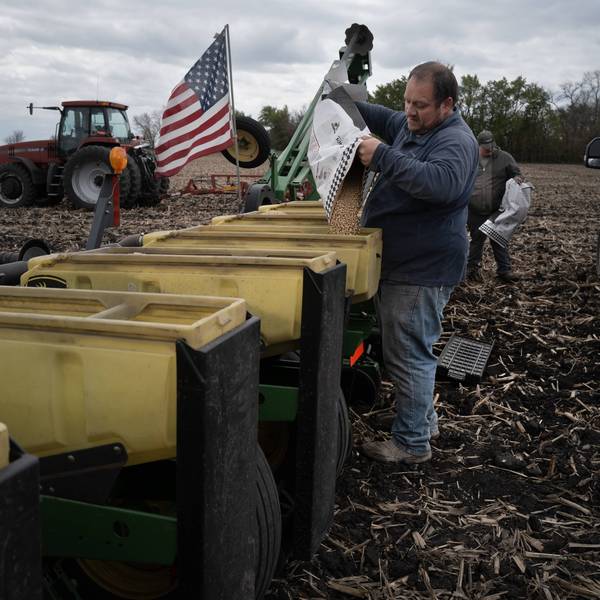


Passing large-scale relief measures now is an economic and racial justice imperative.(Photo: Getty/Stock Photo/Blake Callahan)
Jobs Report Shows Congress Must Pass Full $1.9 Trillion Relief Package Immediately
The $1.9 trillion relief and recovery bill being considered in Congress this week is exactly what workers and their families need right now.
Today, the Bureau of Labor Statistics (BLS) reported that 379,000 jobs were added in February. While that's a solid number, the U.S. economy is still down 9.5 million jobs from where we were a year ago. At this pace, it would take more than two years to even get back to pre-recession employment levels--but getting back to pre-recession levels would not come close to filling in the total jobs gap.
Thousands of jobs would've been added each month over the last year without the pandemic recession. If we count how many jobs may have been created if the recession hadn't hit--consider average job growth (202,000) over the 12 months before the recession--we are now short 11.9 million jobs since February. Make no mistake: The $1.9 trillion relief and recovery bill being considered in Congress this week is exactly what workers and their families need right now.
As we approach International Women's Day, it's important to remember that women have borne a heavier burden of job losses in the pandemic recession.
Low-wage workers continue to be the hardest hit in the recession. While leisure and hospitality--the lowest paid sector--saw significant improvements in February (+355,000 jobs), it remains 3.5 million jobs below where it was in February 2020. In addition, the labor market continued to hemorrhage public sector jobs last month, falling by 86,000 in February. The state and local government job shortfall stands at 1.4 million jobs, with 1.0 million of those losses in state and local education employment. Given that state and local governments face many new expenses in figuring out how to open schools safely, it is imperative that additional aid be provided to state and local governments so that new costs won't squeeze out necessary hiring. Policymakers must not shortchange aid to state and local governments, which is essential to a robust recovery.
As we approach International Women's Day, it's important to remember that women have borne a heavier burden of job losses in the pandemic recession. Women's disproportionate job losses are due in part to both occupational segregation (i.e., disproportionately more likely to hold lower-wage service sector jobs) and caretaking responsibilities (i.e., closed schools, daycare options, and caregiving responsibilities for other family members in general). In the United States, there's a clear gender story here, but in the aggregate, it's not about white women. Black and Hispanic women experienced the most significant and disproportionate job losses in the pandemic recession.
Black workers experienced an uptick in unemployment in February, back to 9.9%, just shy of the high-water mark in the Great Recession. Because of historic and current systemic racism, Black and Latinx workers have seen more job loss and more illness in this pandemic. Passing large-scale relief measures now is an economic and racial justice imperative.
The unemployment rate improved slightly, hitting 6.2% in February, but it would be a huge oversight to think that those officially unemployed workers are the only ones to experience economic pain in the pandemic recession.
In addition to the 10.0 million officially unemployed workers in February 2021, we must add four more groups of economically hurt workers.
- First, the 756,000 workers misclassified as "employed, not at work."
- Second, the 2.7 million undercount of unemployed workers, found even in normal times.
- Third, the 5.1 million workers now out of the labor force and not counted among the unemployed--measured by the differential between the size of the current labor force and what the labor force would be if the labor force participation rate hadn't dropped over the last year.
- Fourth, the 6.6 million workers who experienced a drop in hours and pay because of the pandemic. (More detailed methodology on each of these numbers can be found here.)
In total, this means that 25.1 million workers--or 14.7% of the workforce--have been directly harmed by the coronavirus downturn. On top of this, another 1.2 million people applied for unemployment insurance benefits last week. It is clear that policymakers need to step up right now to provide relief, and the $1.9 trillion relief and recovery bill is at the scale of the problem and is essential for a robust and equitable recovery.
We are at a crossroads
This country and this world are at a monumental crossroads. In a few short weeks, US voters will have an opportunity to beat back the forces of fascism and confront the billionaires who are rigging the economy, our media system, and our democracy, making it increasingly impossible for ordinary people to get by. We’re not just talking about the election. We’re talking about what must be done once these fascist elements are vanquished from power. We need a bolder set of solutions than what either major party has so far been willing to offer and a working-class movement ready to fight like hell for it. Trump didn't emerge from nowhere. The conditions that fueled MAGA authoritarianism were created by decades of radical neoliberal economic policies and a corrupt political system dominated by corporate interests. They slashed taxes on the super-rich, promising that the benefits would trickle down. They said giveaways to the corporate titans would make life more affordable for the rest of us. It was all bullshit. And when a bitter, betrayed populace searches for someone to blame, right-wing demagogues have little trouble finding scapegoats. People know when they're being lied to, but you won't hear any of this from the corporate media. Only independent journalism—powered and funded by people who believe in building a better world—can deliver truly trustworthy daily news. Our Fall Campaign is underway, and we need your help. To power our newsroom through the rest of the year, we need to raise $125,000 by midnight on October 31. So if you share our vision, please contribute whatever you can to sustain our work. |
Today, the Bureau of Labor Statistics (BLS) reported that 379,000 jobs were added in February. While that's a solid number, the U.S. economy is still down 9.5 million jobs from where we were a year ago. At this pace, it would take more than two years to even get back to pre-recession employment levels--but getting back to pre-recession levels would not come close to filling in the total jobs gap.
Thousands of jobs would've been added each month over the last year without the pandemic recession. If we count how many jobs may have been created if the recession hadn't hit--consider average job growth (202,000) over the 12 months before the recession--we are now short 11.9 million jobs since February. Make no mistake: The $1.9 trillion relief and recovery bill being considered in Congress this week is exactly what workers and their families need right now.
As we approach International Women's Day, it's important to remember that women have borne a heavier burden of job losses in the pandemic recession.
Low-wage workers continue to be the hardest hit in the recession. While leisure and hospitality--the lowest paid sector--saw significant improvements in February (+355,000 jobs), it remains 3.5 million jobs below where it was in February 2020. In addition, the labor market continued to hemorrhage public sector jobs last month, falling by 86,000 in February. The state and local government job shortfall stands at 1.4 million jobs, with 1.0 million of those losses in state and local education employment. Given that state and local governments face many new expenses in figuring out how to open schools safely, it is imperative that additional aid be provided to state and local governments so that new costs won't squeeze out necessary hiring. Policymakers must not shortchange aid to state and local governments, which is essential to a robust recovery.
As we approach International Women's Day, it's important to remember that women have borne a heavier burden of job losses in the pandemic recession. Women's disproportionate job losses are due in part to both occupational segregation (i.e., disproportionately more likely to hold lower-wage service sector jobs) and caretaking responsibilities (i.e., closed schools, daycare options, and caregiving responsibilities for other family members in general). In the United States, there's a clear gender story here, but in the aggregate, it's not about white women. Black and Hispanic women experienced the most significant and disproportionate job losses in the pandemic recession.
Black workers experienced an uptick in unemployment in February, back to 9.9%, just shy of the high-water mark in the Great Recession. Because of historic and current systemic racism, Black and Latinx workers have seen more job loss and more illness in this pandemic. Passing large-scale relief measures now is an economic and racial justice imperative.
The unemployment rate improved slightly, hitting 6.2% in February, but it would be a huge oversight to think that those officially unemployed workers are the only ones to experience economic pain in the pandemic recession.
In addition to the 10.0 million officially unemployed workers in February 2021, we must add four more groups of economically hurt workers.
- First, the 756,000 workers misclassified as "employed, not at work."
- Second, the 2.7 million undercount of unemployed workers, found even in normal times.
- Third, the 5.1 million workers now out of the labor force and not counted among the unemployed--measured by the differential between the size of the current labor force and what the labor force would be if the labor force participation rate hadn't dropped over the last year.
- Fourth, the 6.6 million workers who experienced a drop in hours and pay because of the pandemic. (More detailed methodology on each of these numbers can be found here.)
In total, this means that 25.1 million workers--or 14.7% of the workforce--have been directly harmed by the coronavirus downturn. On top of this, another 1.2 million people applied for unemployment insurance benefits last week. It is clear that policymakers need to step up right now to provide relief, and the $1.9 trillion relief and recovery bill is at the scale of the problem and is essential for a robust and equitable recovery.