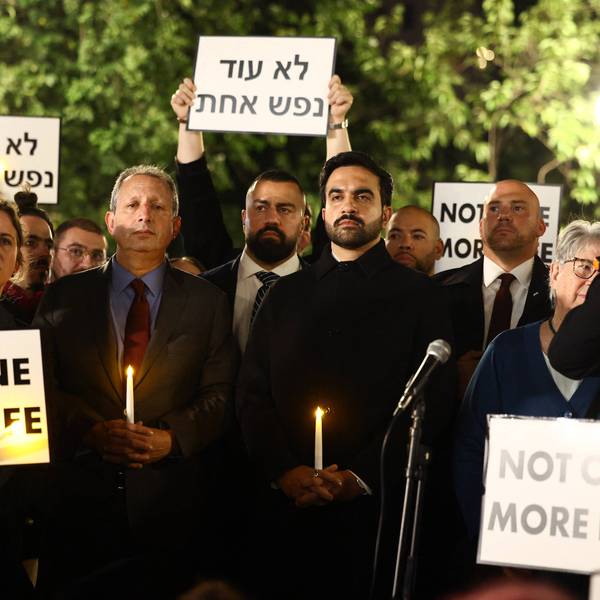
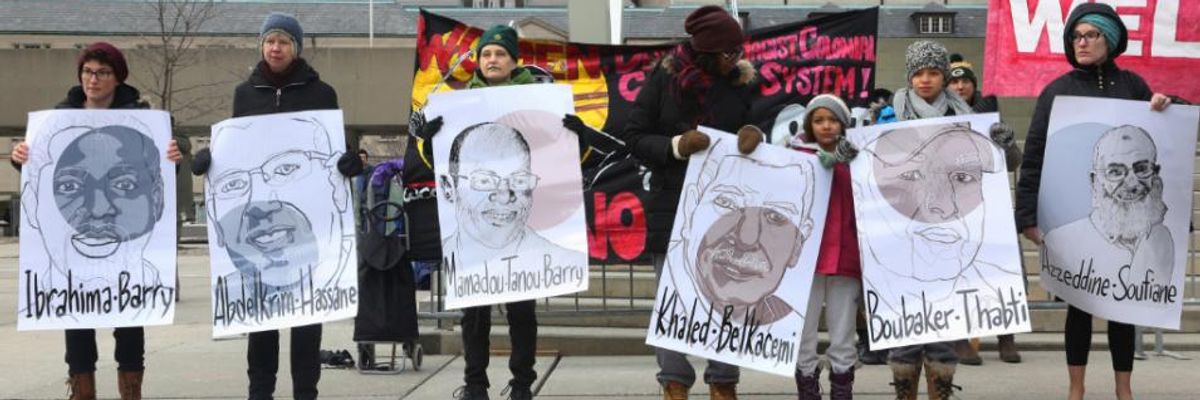
People hold portraits with the names of the six Muslim men killed in the Quebec City mosque shooting during a rally to condemn Islamophobia, hate, and racism held in Toronto on January 27, 2018. (Photo: Creative Touch Imaging Ltd./NurPhoto via Getty Images)
Remembering the Islamophobic Attack on Quebec City Mosque: Why Have So Many Canadians Forgotten?
The willful denial of anti-Muslim racism secures and maintains this national amnesia surrounding the 2017 Québec mosque massacre.
On January 29, 2017, six Muslim men were shot dead in a Quebec City mosque. An armed white nationalist terrorist went on a shooting rampage in the Islamic Cultural Centre in Laval, Quebec, just after evening prayers. It remains the worst mass murder in a house of worship in Canada's history.
A halal grocery store owner, a professor at Universite Laval, three civil servants and a pharmacy worker were slain by Alexandre Bissonnette. These men originally came from Morocco, Algeria and Guinea. The murder victims were: Ibrahima Barry, 39; Mamadou Tanou Barry, 42; Khaled Belkacemi, 60; Aboubaker Thabti, 44; Abdelkrim Hassane, 41; and Azzedine Soufiane; 57. Nineteen other worshippers were injured, including Aymen Derbali, who was paralyzed in an attempt to stop Bissonnette.
The federal government has now announced that January 29 will become a National Day of Remembrance for the victims of the mosque attack and that it will be used to promote action against Islamophobia.
This unprecedented act of violence has fallen prey to willful forgetting and national amnesia rather than being a part of our collective remembrance and commemoration as a nation.
Bissonnette had browsed websites linked to white nationalist ideologues. He also made more than 800 online searches of U.S. President Donald Trump. Bissonnette later confessed to police that he had been motivated by Prime Minister Justin Trudeau's message of welcome to refugees following Trump's travel ban on seven Muslim-majority countries.
Bissonnette was sentenced to 40 years with no parole. The sentence angered Quebec's Muslim community, which sought a harsher penalty. The Quebec Court of Appeal recently ruled that Bissonnette's sentence violated Canada's Charter of Rights and Freedoms and would subject him to "cruel and unusual" punishment. He will now be eligible for parole in 25 years.
The court's decision prioritized the rights of the perpetrator over justice for the victims, adding further insult to injury.
National amnesia
The documentary "The Mosque: A Community's Struggle" shares the stories of the survivors, victim's families and the local community. Some of those interviewed spoke of how they felt "forgotten," especially by the government and politicians, in the aftermath of this tragedy. This unprecedented act of violence has fallen prey to willful forgetting and national amnesia rather than being a part of our collective remembrance and commemoration as a nation.
Using the hashtag #IRememberJanuary29, the Canadian Muslim Forum (FMC-CMF) and Canadians for Peace and Justice in the Middle East (CJPME) launched a campaign for the federal government to recognize January 29 as a National Day of Remembrance and Action on Islamophobia and other forms of religious discrimination. In addition, more than 70 Muslim organizations and dozens of community partners called upon the federal government to commemorate the attack.
Quebec Premier Francois Legault rejected a proposal to have January 29 declared a Day of Action Against Islamophobia, saying there was "no Islamophobia in Quebec." He later backtracked by qualifying that discrimination exists but is not widespread. Statistics Canada found that hate crimes against Muslims in Quebec tripled to 117 in 2017 from 41 in 2016.
Montreal Imam Hassan Guillet characterized Legault's comments as "voluntary blindness." The willful denial of Islamophobia and anti-Muslim racism secures and maintains this national amnesia surrounding the Quebec mosque massacre.
Canada officially designated December 6 the National Day of Remembrance and Action on Violence Against Women to commemorate the murders of 14 young women at Polytechnique Montreal on Dec. 6, 1989. The day has become an important part of our collective memory as a nation.
Canadian Islamophobia
It took four years for the federal government to commemorate this tragedy and address the Islamophobia that led to it.
The lack of support for commemorating the mosque massacre was underscored by negative public attitudes toward Canadian Muslims. A 2017 poll revealed that 46 percent of Canadians held unfavourable views of Islam as compared to other faiths.
Commemorating the Quebec mosque massacre with a national day of remembrance ensures that we will not forget the lives that were lost and the communities that are affected by this violence.
A Radio-Canada poll that coincided with the mosque attack found 23 percent of Canadians favored a ban on Muslim immigration. The level of support rose to 32 percent in Quebec.
In the aftermath of the Quebec mosque attack, Liberal MP Iqra Khalid tabled Motion 103, calling on the government to address systemic racism and religious discrimination. This proposal was met with virulent Islamophobic rhetoric and hate. A parliamentary committee held hearings on the motion and wrote a report in response.
The report makes 30 recommendations, and only two of these reference Islamophobia. The report did recommend a national day of remembrance, yet it largely remains silent on specific action against anti-Muslim racism. A 2018 survey found that more than half of Canadians acknowledge that Islamophobia is "an increasingly disturbing problem in Canada." Sixty percent agreed that the government "must take action to combat Islamophobia" in Canada.
Last year, Quebec City inaugurated a memorial entitled "Vivre Ensemble" in honor of the victims of the mosque shooting. The monument, located near the Islamic Cultural Centre of Quebec in the city's Ste-Foy district, includes the names of the six murdered men and is adorned with intricately patterned aluminum leaves inspired by their countries of origin.
This poignant tribute is an important site for healing and reflection upon this tragedy and the Islamophobia that led to it.
Commemorating the Quebec mosque massacre with a national day of remembrance ensures that we will not forget the lives that were lost and the communities that are affected by this violence.
We are at a crossroads
This country and this world are at a monumental crossroads. In a few short weeks, US voters will have an opportunity to beat back the forces of fascism and confront the billionaires who are rigging the economy, our media system, and our democracy, making it increasingly impossible for ordinary people to get by. We’re not just talking about the election. We’re talking about what must be done once these fascist elements are vanquished from power. We need a bolder set of solutions than what either major party has so far been willing to offer and a working-class movement ready to fight like hell for it. Trump didn't emerge from nowhere. The conditions that fueled MAGA authoritarianism were created by decades of radical neoliberal economic policies and a corrupt political system dominated by corporate interests. They slashed taxes on the super-rich, promising that the benefits would trickle down. They said giveaways to the corporate titans would make life more affordable for the rest of us. It was all bullshit. And when a bitter, betrayed populace searches for someone to blame, right-wing demagogues have little trouble finding scapegoats. People know when they're being lied to, but you won't hear any of this from the corporate media. Only independent journalism—powered and funded by people who believe in building a better world—can deliver truly trustworthy daily news. Our Fall Campaign is underway, and we need your help. To power our newsroom through the rest of the year, we need to raise $125,000 by midnight on October 31. So if you share our vision, please contribute whatever you can to sustain our work. |
On January 29, 2017, six Muslim men were shot dead in a Quebec City mosque. An armed white nationalist terrorist went on a shooting rampage in the Islamic Cultural Centre in Laval, Quebec, just after evening prayers. It remains the worst mass murder in a house of worship in Canada's history.
A halal grocery store owner, a professor at Universite Laval, three civil servants and a pharmacy worker were slain by Alexandre Bissonnette. These men originally came from Morocco, Algeria and Guinea. The murder victims were: Ibrahima Barry, 39; Mamadou Tanou Barry, 42; Khaled Belkacemi, 60; Aboubaker Thabti, 44; Abdelkrim Hassane, 41; and Azzedine Soufiane; 57. Nineteen other worshippers were injured, including Aymen Derbali, who was paralyzed in an attempt to stop Bissonnette.
The federal government has now announced that January 29 will become a National Day of Remembrance for the victims of the mosque attack and that it will be used to promote action against Islamophobia.
This unprecedented act of violence has fallen prey to willful forgetting and national amnesia rather than being a part of our collective remembrance and commemoration as a nation.
Bissonnette had browsed websites linked to white nationalist ideologues. He also made more than 800 online searches of U.S. President Donald Trump. Bissonnette later confessed to police that he had been motivated by Prime Minister Justin Trudeau's message of welcome to refugees following Trump's travel ban on seven Muslim-majority countries.
Bissonnette was sentenced to 40 years with no parole. The sentence angered Quebec's Muslim community, which sought a harsher penalty. The Quebec Court of Appeal recently ruled that Bissonnette's sentence violated Canada's Charter of Rights and Freedoms and would subject him to "cruel and unusual" punishment. He will now be eligible for parole in 25 years.
The court's decision prioritized the rights of the perpetrator over justice for the victims, adding further insult to injury.
National amnesia
The documentary "The Mosque: A Community's Struggle" shares the stories of the survivors, victim's families and the local community. Some of those interviewed spoke of how they felt "forgotten," especially by the government and politicians, in the aftermath of this tragedy. This unprecedented act of violence has fallen prey to willful forgetting and national amnesia rather than being a part of our collective remembrance and commemoration as a nation.
Using the hashtag #IRememberJanuary29, the Canadian Muslim Forum (FMC-CMF) and Canadians for Peace and Justice in the Middle East (CJPME) launched a campaign for the federal government to recognize January 29 as a National Day of Remembrance and Action on Islamophobia and other forms of religious discrimination. In addition, more than 70 Muslim organizations and dozens of community partners called upon the federal government to commemorate the attack.
Quebec Premier Francois Legault rejected a proposal to have January 29 declared a Day of Action Against Islamophobia, saying there was "no Islamophobia in Quebec." He later backtracked by qualifying that discrimination exists but is not widespread. Statistics Canada found that hate crimes against Muslims in Quebec tripled to 117 in 2017 from 41 in 2016.
Montreal Imam Hassan Guillet characterized Legault's comments as "voluntary blindness." The willful denial of Islamophobia and anti-Muslim racism secures and maintains this national amnesia surrounding the Quebec mosque massacre.
Canada officially designated December 6 the National Day of Remembrance and Action on Violence Against Women to commemorate the murders of 14 young women at Polytechnique Montreal on Dec. 6, 1989. The day has become an important part of our collective memory as a nation.
Canadian Islamophobia
It took four years for the federal government to commemorate this tragedy and address the Islamophobia that led to it.
The lack of support for commemorating the mosque massacre was underscored by negative public attitudes toward Canadian Muslims. A 2017 poll revealed that 46 percent of Canadians held unfavourable views of Islam as compared to other faiths.
Commemorating the Quebec mosque massacre with a national day of remembrance ensures that we will not forget the lives that were lost and the communities that are affected by this violence.
A Radio-Canada poll that coincided with the mosque attack found 23 percent of Canadians favored a ban on Muslim immigration. The level of support rose to 32 percent in Quebec.
In the aftermath of the Quebec mosque attack, Liberal MP Iqra Khalid tabled Motion 103, calling on the government to address systemic racism and religious discrimination. This proposal was met with virulent Islamophobic rhetoric and hate. A parliamentary committee held hearings on the motion and wrote a report in response.
The report makes 30 recommendations, and only two of these reference Islamophobia. The report did recommend a national day of remembrance, yet it largely remains silent on specific action against anti-Muslim racism. A 2018 survey found that more than half of Canadians acknowledge that Islamophobia is "an increasingly disturbing problem in Canada." Sixty percent agreed that the government "must take action to combat Islamophobia" in Canada.
Last year, Quebec City inaugurated a memorial entitled "Vivre Ensemble" in honor of the victims of the mosque shooting. The monument, located near the Islamic Cultural Centre of Quebec in the city's Ste-Foy district, includes the names of the six murdered men and is adorned with intricately patterned aluminum leaves inspired by their countries of origin.
This poignant tribute is an important site for healing and reflection upon this tragedy and the Islamophobia that led to it.
Commemorating the Quebec mosque massacre with a national day of remembrance ensures that we will not forget the lives that were lost and the communities that are affected by this violence.