SUBSCRIBE TO OUR FREE NEWSLETTER
Daily news & progressive opinion—funded by the people, not the corporations—delivered straight to your inbox.
5
#000000
#FFFFFF
To donate by check, phone, or other method, see our More Ways to Give page.
Daily news & progressive opinion—funded by the people, not the corporations—delivered straight to your inbox.
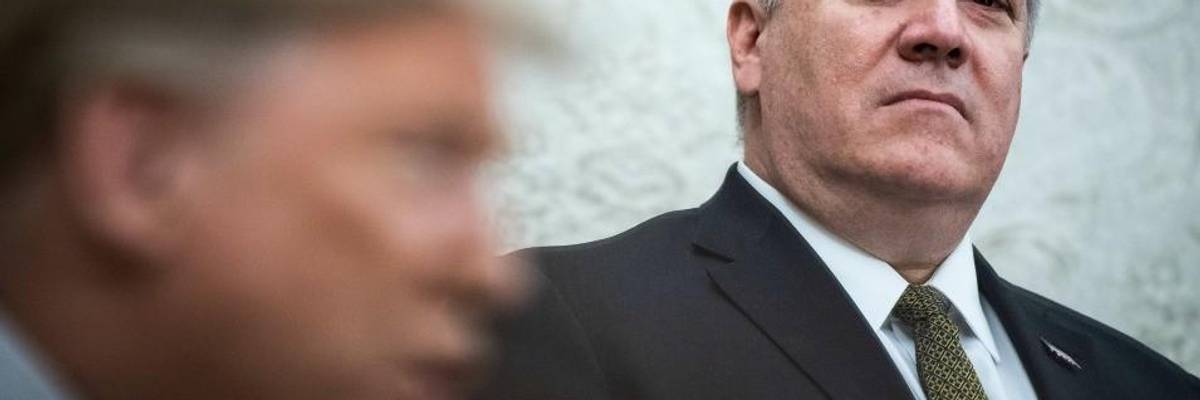
U.S. Secretary of State Mike Pompeo admitted on Wednesday that he was on the phone call between President Donald Trump and Ukrainian President Volodymyr Zelensy in July, in which Trump asked Zelensky to investigate 2020 Democratic presidential candidate Joe Biden's son. (Photo: Jabin Botsford/The Washington Post via Getty Images)
Many white Christian evangelicals in the United States have long believed that America has a God-given mission to save the world. Under the influence of this crusading mentality, US foreign policy has often swerved from diplomacy to war. It is in danger of doing so again.
Last month, Secretary of State Mike Pompeo launched yet another evangelical crusade, this time against China. His speech was extremist, simplistic, and dangerous - and may well put the US on a path to conflict with China.
According to Pompeo, Chinese President Xi Jinping and the Communist Party of China (CPC) harbor a "decades-long desire for global hegemony." This is ironic. Only one country - the US - has a defense strategy calling for it to be the "preeminent military power in the world," with "favorable regional balances of power in the Indo-Pacific, Europe, the Middle East, and the Western Hemisphere." China's defense white paper, by contrast, states that "China will never follow the beaten track of big powers in seeking hegemony," and that, "As economic globalization, the information society, and cultural diversification develop in an increasingly multi-polar world, peace, development, and win-win cooperation remain the irreversible trends of the times."
One is reminded of Jesus's own admonition: "Thou hypocrite, first cast out the beam out of thine own eye; and then shalt thou see clearly to cast out the mote out of thy brother's eye" (Matthew 7:5). US military spending totaled $732 billion in 2019, nearly three times the $261 billion China spent.
The US, moreover, has around 800 overseas military bases, while China has just one (a small naval base in Djibouti). The US has many military bases close to China, which has none anywhere near the US. The US has 5,800 nuclear warheads; China has roughly 320. The US has 11 aircraft carriers; China has one. The US has launched many overseas wars in the past 40 years; China has launched none (though it has been criticized for border skirmishes, most recently with India, that stop short of war).
The US has repeatedly rejected or withdrawn from United Nations treaties and UN organizations in recent years, including UNESCO, the Paris climate agreement, and, most recently, the World Health Organization, while China supports UN processes and agencies. US President Donald Trump recently threatened the staff of the International Criminal Court with sanctions. Pompeo rails against China's clampdown on its mainly Muslim Uighur population, but Trump's former national security adviser, John Bolton, claims that Trump privately gave China's actions a pass, or even encouraged them.
The world took relatively little notice of Pompeo's speech, which offered no evidence to back up his claims of China's hegemonic ambition. China's rejection of US hegemony does not mean that China itself seeks hegemony. Indeed, outside of the US, there is little belief that China aims for global dominance. China's explicitly stated national goals are to be a "moderately prosperous society" by 2021 (the centenary of the CPC), and a "fully developed country" by 2049 (the centennial of the People's Republic).
Moreover, at an estimated $10,098 in 2019, China's GDP per capita was less than one-sixth that of the US ($65,112) - hardly the basis for global supremacy. China still has a lot of catching up to do to achieve even its basic economic development goals.
Assuming that Trump loses in November's presidential election, Pompeo's speech will likely receive no further notice. The Democrats will surely criticize China, but without Pompeo's brazen exaggerations. Yet, if Trump wins, Pompeo's speech could be a harbinger of chaos. Pompeo's evangelism is real, and white evangelicals are the political base of today's Republican Party.
Pompeo's zealous excesses have deep roots in American history. As I recounted in my recent book A New Foreign Policy, English protestant settlers believed that they were founding a New Israel in the new promised land, with God's providential blessings. In 1845, John O'Sullivan coined the phrase "Manifest Destiny" to justify and celebrate America's violent annexation of North America. "All this will be our future history," he wrote in 1839, "to establish on earth the moral dignity and salvation of man - the immutable truth and beneficence of God. For this blessed mission to the nations of the world, which are shut out from the life-giving light of truth, has America been chosen..."
On the basis of such exalted views of its own beneficence, the US engaged in mass enslavement until the Civil War and mass apartheid thereafter; slaughtered Native Americans throughout the nineteenth century and subjugated them thereafter; and, with the closure of the Western frontier, extended Manifest Destiny overseas. Later, with the onset of the Cold War, anti-communist fervor led the US to fight disastrous wars in Southeast Asia (Vietnam, Laos, and Cambodia) in the 1960s and 1970s, and brutal wars in Central America in the 1980s.
After the September 11, 2001, terrorist attacks, the evangelical ardor was directed against "radical Islam" or "Islamic fascism," with four US wars of choice - in Afghanistan, Iraq, Syria, and Libya - all of which remain debacles to this day. Suddenly, the supposed existential threat of radical Islam has been forgotten, and the new crusade targets the CPC.
Pompeo himself is a biblical literalist who believes that the end time, the apocalyptic battle between good and evil, is imminent. Pompeo described his beliefs in a 2015 speech while a Congressman from Kansas: America is a Judeo-Christian nation, the greatest in history, whose task is to fight God's battles until the Rapture, when Christ's born-again followers, like Pompeo, will be swept to heaven at the Last Judgment.
White evangelicals represent only around 17% of the US adult population, but comprise around 26% of voters. They vote overwhelmingly Republican (an estimated 81% in 2016), making them the party's single most important voting bloc. That gives them powerful influence on Republican policy, and in particular on foreign policy when Republicans control the White House and Senate (with its treaty-ratifying powers). Fully 99% of Republican congressmen are Christian, of whom around 70% are Protestant, including a significant though unknown proportion of evangelicals.
Of course, the Democrats also harbor some politicians who proclaim American exceptionalism and launch crusading wars (for example, President Barack Obama's interventions in Syria and Libya). On the whole, however, the Democratic Party is less wedded to claims of US hegemony than is the Republican Party's evangelical base.
Pompeo's inflammatory anti-China rhetoric could become even more apocalyptic in the coming weeks, if only to fire up the Republican base ahead of the election. If Trump is defeated, as seems likely, the risk of a US confrontation with China will recede. But if he remains in power, whether by a true electoral victory, vote fraud, or even a coup (anything is possible), Pompeo's crusade would probably proceed, and could well bring the world to the brink of a war that he expects and perhaps even seeks.
Dear Common Dreams reader, It’s been nearly 30 years since I co-founded Common Dreams with my late wife, Lina Newhouser. We had the radical notion that journalism should serve the public good, not corporate profits. It was clear to us from the outset what it would take to build such a project. No paid advertisements. No corporate sponsors. No millionaire publisher telling us what to think or do. Many people said we wouldn't last a year, but we proved those doubters wrong. Together with a tremendous team of journalists and dedicated staff, we built an independent media outlet free from the constraints of profits and corporate control. Our mission has always been simple: To inform. To inspire. To ignite change for the common good. Building Common Dreams was not easy. Our survival was never guaranteed. When you take on the most powerful forces—Wall Street greed, fossil fuel industry destruction, Big Tech lobbyists, and uber-rich oligarchs who have spent billions upon billions rigging the economy and democracy in their favor—the only bulwark you have is supporters who believe in your work. But here’s the urgent message from me today. It's never been this bad out there. And it's never been this hard to keep us going. At the very moment Common Dreams is most needed, the threats we face are intensifying. We need your support now more than ever. We don't accept corporate advertising and never will. We don't have a paywall because we don't think people should be blocked from critical news based on their ability to pay. Everything we do is funded by the donations of readers like you. When everyone does the little they can afford, we are strong. But if that support retreats or dries up, so do we. Will you donate now to make sure Common Dreams not only survives but thrives? —Craig Brown, Co-founder |
Many white Christian evangelicals in the United States have long believed that America has a God-given mission to save the world. Under the influence of this crusading mentality, US foreign policy has often swerved from diplomacy to war. It is in danger of doing so again.
Last month, Secretary of State Mike Pompeo launched yet another evangelical crusade, this time against China. His speech was extremist, simplistic, and dangerous - and may well put the US on a path to conflict with China.
According to Pompeo, Chinese President Xi Jinping and the Communist Party of China (CPC) harbor a "decades-long desire for global hegemony." This is ironic. Only one country - the US - has a defense strategy calling for it to be the "preeminent military power in the world," with "favorable regional balances of power in the Indo-Pacific, Europe, the Middle East, and the Western Hemisphere." China's defense white paper, by contrast, states that "China will never follow the beaten track of big powers in seeking hegemony," and that, "As economic globalization, the information society, and cultural diversification develop in an increasingly multi-polar world, peace, development, and win-win cooperation remain the irreversible trends of the times."
One is reminded of Jesus's own admonition: "Thou hypocrite, first cast out the beam out of thine own eye; and then shalt thou see clearly to cast out the mote out of thy brother's eye" (Matthew 7:5). US military spending totaled $732 billion in 2019, nearly three times the $261 billion China spent.
The US, moreover, has around 800 overseas military bases, while China has just one (a small naval base in Djibouti). The US has many military bases close to China, which has none anywhere near the US. The US has 5,800 nuclear warheads; China has roughly 320. The US has 11 aircraft carriers; China has one. The US has launched many overseas wars in the past 40 years; China has launched none (though it has been criticized for border skirmishes, most recently with India, that stop short of war).
The US has repeatedly rejected or withdrawn from United Nations treaties and UN organizations in recent years, including UNESCO, the Paris climate agreement, and, most recently, the World Health Organization, while China supports UN processes and agencies. US President Donald Trump recently threatened the staff of the International Criminal Court with sanctions. Pompeo rails against China's clampdown on its mainly Muslim Uighur population, but Trump's former national security adviser, John Bolton, claims that Trump privately gave China's actions a pass, or even encouraged them.
The world took relatively little notice of Pompeo's speech, which offered no evidence to back up his claims of China's hegemonic ambition. China's rejection of US hegemony does not mean that China itself seeks hegemony. Indeed, outside of the US, there is little belief that China aims for global dominance. China's explicitly stated national goals are to be a "moderately prosperous society" by 2021 (the centenary of the CPC), and a "fully developed country" by 2049 (the centennial of the People's Republic).
Moreover, at an estimated $10,098 in 2019, China's GDP per capita was less than one-sixth that of the US ($65,112) - hardly the basis for global supremacy. China still has a lot of catching up to do to achieve even its basic economic development goals.
Assuming that Trump loses in November's presidential election, Pompeo's speech will likely receive no further notice. The Democrats will surely criticize China, but without Pompeo's brazen exaggerations. Yet, if Trump wins, Pompeo's speech could be a harbinger of chaos. Pompeo's evangelism is real, and white evangelicals are the political base of today's Republican Party.
Pompeo's zealous excesses have deep roots in American history. As I recounted in my recent book A New Foreign Policy, English protestant settlers believed that they were founding a New Israel in the new promised land, with God's providential blessings. In 1845, John O'Sullivan coined the phrase "Manifest Destiny" to justify and celebrate America's violent annexation of North America. "All this will be our future history," he wrote in 1839, "to establish on earth the moral dignity and salvation of man - the immutable truth and beneficence of God. For this blessed mission to the nations of the world, which are shut out from the life-giving light of truth, has America been chosen..."
On the basis of such exalted views of its own beneficence, the US engaged in mass enslavement until the Civil War and mass apartheid thereafter; slaughtered Native Americans throughout the nineteenth century and subjugated them thereafter; and, with the closure of the Western frontier, extended Manifest Destiny overseas. Later, with the onset of the Cold War, anti-communist fervor led the US to fight disastrous wars in Southeast Asia (Vietnam, Laos, and Cambodia) in the 1960s and 1970s, and brutal wars in Central America in the 1980s.
After the September 11, 2001, terrorist attacks, the evangelical ardor was directed against "radical Islam" or "Islamic fascism," with four US wars of choice - in Afghanistan, Iraq, Syria, and Libya - all of which remain debacles to this day. Suddenly, the supposed existential threat of radical Islam has been forgotten, and the new crusade targets the CPC.
Pompeo himself is a biblical literalist who believes that the end time, the apocalyptic battle between good and evil, is imminent. Pompeo described his beliefs in a 2015 speech while a Congressman from Kansas: America is a Judeo-Christian nation, the greatest in history, whose task is to fight God's battles until the Rapture, when Christ's born-again followers, like Pompeo, will be swept to heaven at the Last Judgment.
White evangelicals represent only around 17% of the US adult population, but comprise around 26% of voters. They vote overwhelmingly Republican (an estimated 81% in 2016), making them the party's single most important voting bloc. That gives them powerful influence on Republican policy, and in particular on foreign policy when Republicans control the White House and Senate (with its treaty-ratifying powers). Fully 99% of Republican congressmen are Christian, of whom around 70% are Protestant, including a significant though unknown proportion of evangelicals.
Of course, the Democrats also harbor some politicians who proclaim American exceptionalism and launch crusading wars (for example, President Barack Obama's interventions in Syria and Libya). On the whole, however, the Democratic Party is less wedded to claims of US hegemony than is the Republican Party's evangelical base.
Pompeo's inflammatory anti-China rhetoric could become even more apocalyptic in the coming weeks, if only to fire up the Republican base ahead of the election. If Trump is defeated, as seems likely, the risk of a US confrontation with China will recede. But if he remains in power, whether by a true electoral victory, vote fraud, or even a coup (anything is possible), Pompeo's crusade would probably proceed, and could well bring the world to the brink of a war that he expects and perhaps even seeks.
Many white Christian evangelicals in the United States have long believed that America has a God-given mission to save the world. Under the influence of this crusading mentality, US foreign policy has often swerved from diplomacy to war. It is in danger of doing so again.
Last month, Secretary of State Mike Pompeo launched yet another evangelical crusade, this time against China. His speech was extremist, simplistic, and dangerous - and may well put the US on a path to conflict with China.
According to Pompeo, Chinese President Xi Jinping and the Communist Party of China (CPC) harbor a "decades-long desire for global hegemony." This is ironic. Only one country - the US - has a defense strategy calling for it to be the "preeminent military power in the world," with "favorable regional balances of power in the Indo-Pacific, Europe, the Middle East, and the Western Hemisphere." China's defense white paper, by contrast, states that "China will never follow the beaten track of big powers in seeking hegemony," and that, "As economic globalization, the information society, and cultural diversification develop in an increasingly multi-polar world, peace, development, and win-win cooperation remain the irreversible trends of the times."
One is reminded of Jesus's own admonition: "Thou hypocrite, first cast out the beam out of thine own eye; and then shalt thou see clearly to cast out the mote out of thy brother's eye" (Matthew 7:5). US military spending totaled $732 billion in 2019, nearly three times the $261 billion China spent.
The US, moreover, has around 800 overseas military bases, while China has just one (a small naval base in Djibouti). The US has many military bases close to China, which has none anywhere near the US. The US has 5,800 nuclear warheads; China has roughly 320. The US has 11 aircraft carriers; China has one. The US has launched many overseas wars in the past 40 years; China has launched none (though it has been criticized for border skirmishes, most recently with India, that stop short of war).
The US has repeatedly rejected or withdrawn from United Nations treaties and UN organizations in recent years, including UNESCO, the Paris climate agreement, and, most recently, the World Health Organization, while China supports UN processes and agencies. US President Donald Trump recently threatened the staff of the International Criminal Court with sanctions. Pompeo rails against China's clampdown on its mainly Muslim Uighur population, but Trump's former national security adviser, John Bolton, claims that Trump privately gave China's actions a pass, or even encouraged them.
The world took relatively little notice of Pompeo's speech, which offered no evidence to back up his claims of China's hegemonic ambition. China's rejection of US hegemony does not mean that China itself seeks hegemony. Indeed, outside of the US, there is little belief that China aims for global dominance. China's explicitly stated national goals are to be a "moderately prosperous society" by 2021 (the centenary of the CPC), and a "fully developed country" by 2049 (the centennial of the People's Republic).
Moreover, at an estimated $10,098 in 2019, China's GDP per capita was less than one-sixth that of the US ($65,112) - hardly the basis for global supremacy. China still has a lot of catching up to do to achieve even its basic economic development goals.
Assuming that Trump loses in November's presidential election, Pompeo's speech will likely receive no further notice. The Democrats will surely criticize China, but without Pompeo's brazen exaggerations. Yet, if Trump wins, Pompeo's speech could be a harbinger of chaos. Pompeo's evangelism is real, and white evangelicals are the political base of today's Republican Party.
Pompeo's zealous excesses have deep roots in American history. As I recounted in my recent book A New Foreign Policy, English protestant settlers believed that they were founding a New Israel in the new promised land, with God's providential blessings. In 1845, John O'Sullivan coined the phrase "Manifest Destiny" to justify and celebrate America's violent annexation of North America. "All this will be our future history," he wrote in 1839, "to establish on earth the moral dignity and salvation of man - the immutable truth and beneficence of God. For this blessed mission to the nations of the world, which are shut out from the life-giving light of truth, has America been chosen..."
On the basis of such exalted views of its own beneficence, the US engaged in mass enslavement until the Civil War and mass apartheid thereafter; slaughtered Native Americans throughout the nineteenth century and subjugated them thereafter; and, with the closure of the Western frontier, extended Manifest Destiny overseas. Later, with the onset of the Cold War, anti-communist fervor led the US to fight disastrous wars in Southeast Asia (Vietnam, Laos, and Cambodia) in the 1960s and 1970s, and brutal wars in Central America in the 1980s.
After the September 11, 2001, terrorist attacks, the evangelical ardor was directed against "radical Islam" or "Islamic fascism," with four US wars of choice - in Afghanistan, Iraq, Syria, and Libya - all of which remain debacles to this day. Suddenly, the supposed existential threat of radical Islam has been forgotten, and the new crusade targets the CPC.
Pompeo himself is a biblical literalist who believes that the end time, the apocalyptic battle between good and evil, is imminent. Pompeo described his beliefs in a 2015 speech while a Congressman from Kansas: America is a Judeo-Christian nation, the greatest in history, whose task is to fight God's battles until the Rapture, when Christ's born-again followers, like Pompeo, will be swept to heaven at the Last Judgment.
White evangelicals represent only around 17% of the US adult population, but comprise around 26% of voters. They vote overwhelmingly Republican (an estimated 81% in 2016), making them the party's single most important voting bloc. That gives them powerful influence on Republican policy, and in particular on foreign policy when Republicans control the White House and Senate (with its treaty-ratifying powers). Fully 99% of Republican congressmen are Christian, of whom around 70% are Protestant, including a significant though unknown proportion of evangelicals.
Of course, the Democrats also harbor some politicians who proclaim American exceptionalism and launch crusading wars (for example, President Barack Obama's interventions in Syria and Libya). On the whole, however, the Democratic Party is less wedded to claims of US hegemony than is the Republican Party's evangelical base.
Pompeo's inflammatory anti-China rhetoric could become even more apocalyptic in the coming weeks, if only to fire up the Republican base ahead of the election. If Trump is defeated, as seems likely, the risk of a US confrontation with China will recede. But if he remains in power, whether by a true electoral victory, vote fraud, or even a coup (anything is possible), Pompeo's crusade would probably proceed, and could well bring the world to the brink of a war that he expects and perhaps even seeks.