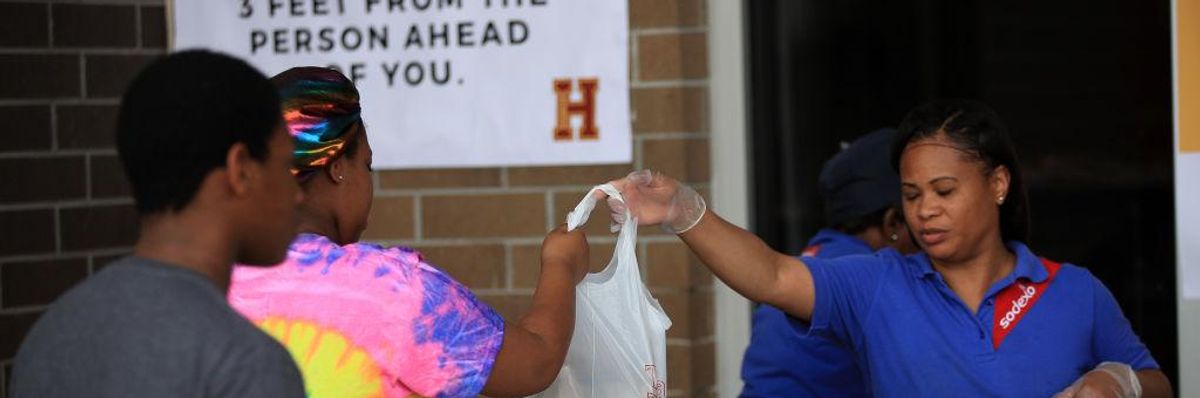
In Louisiana, and across the U.S., we are seeing a disproportionate number of Black people die from this virus. (Photo: Chris Graythen/Getty Images)
The Coronavirus Is Devastating Already Devastated Communities
The people and equity-centered recovery approach we are putting forward is intended to address immediate needs, but it’s also a guide for long-term change.
In the midst of this pandemic, we've all been forced to ask ourselves some important questions, regardless of our religious affiliation (or lack thereof). They are questions we've probably considered before--What is being asked of us during this crisis? Will I take action to help others? How can I be the best version of myself when life is at its most difficult?
This pandemic has revealed so much about the deep structural and systemic problems that have existed for generations. Foremost among those are racism and poverty. At the Power Coalition for Equity and Justice, where I serve as executive director, we are responding by rallying our partner organizations, including Voice of the Experienced (VOTE), the New Orleans Workers' Center for Racial Justice, Families and Friends of Louisiana's Incarcerated Children (FFLIC), and a host of other advocacy groups and community leaders, to lay out a roadmap for an equitable COVID-19 response and recovery effort.
In Louisiana, and across the U.S., we are seeing a disproportionate number of Black people die from this virus. According to The Advocate, "roughly 70% of the people who have died from coronavirus in Louisiana are black, a striking disparity for a state where African-Americans make up only 32% of the population." The situation is the same in other hard-hit areas like New York City, Chicago, and Milwaukee.
It's not a surprise for Black and Brown communities who, for generations, have borne the biggest brunt of most disasters, experienced the greatest health disparities, and most viscerally felt the pain of poverty driven by low-wage jobs. That's not a surprise for those of us who have worked in disaster recovery or public policy. It's not a surprise for Black and Brown communities who, for generations, have borne the biggest brunt of most disasters, experienced the greatest health disparities, and most viscerally felt the pain of poverty driven by low-wage jobs.
We know pre-existing racial and economic inequities are driving these outcomes. We know the structures and systems in Louisiana, in the South, and in our country, including criminalization starting from an early age, redlining and lack of affordable housing, and putting corporations before people have led us to these outcomes.
My friend Gina Womack, FFLIC's Executive Director, puts it plainly: "By criminalizing our youth, especially our Black children, we are establishing systems that set our communities up to fail as a whole. In our response to this crisis, we have to re-evaluate every aspect of how we've traditionally operated."
Louisiana's "Cancer Alley" - an 85-mile stretch of communities along the Mississippi River between New Orleans and Baton Rouge - is one of the clearest examples of how racist structures and systems are directly leading to the racially disparate health outcomes we're seeing during this pandemic. Cancer Alley earned its nickname because it has some of the highest cancer rates in the U.S., primarily due to pollution from the approximately 150 oil, gas, and petrochemical plants in the area.
Many of the plants in Cancer Alley are in predominantly Black communities. Consequently, those communities have suffered disproportionately from their pollution, with higher rates of cancer and other pollution-related maladies, like asthma, than their white neighbors (although, their white neighbors also suffer from higher rates of illness than most communities in the country). Not surprisingly, these communities are also suffering from the highest coronavirus mortality rates in the U.S. As of early April, St. John the Baptist Parish, which lies in the heart of Cancer Alley, had the highest death rate per capita of any county in the United States. Its neighbor, St. James Parish, had the fourth highest rate in the country.
Yet, despite clear research showing that higher air pollution increases COVID-19 mortality rates, the U.S. Environmental Protection Agency (EPA) relaxed its pollution standards last month.
That is exactly the kind of policy and decision-making that created these disparities in the first place, and that has allowed them to persist. It's a similar story in many other predominantly Black neighborhoods in Louisiana.
"Life in this neighborhood is an underlying condition: hard jobs, long hours, bad pay, no health insurance, no money, bad diet," said Burnell Cotlon, a grocery store owner in the Lower Ninth Ward of New Orleans wrote in a recent Washington Post piece. "Before I opened, this part of the city was a food desert... We were made more vulnerable to this virus down here because of what we've had to deal with. Wearing a mask won't protect us from our history."
One of the few silver linings of this tragedy is that it does offer us the opportunity to take stock of ourselves, our communities, our state, and our country. In the advocacy community, it's forcing us to drill deeper into how we can help build a more equitable and just society through our response to this pandemic.
A major part of that effort is the list of policy demands and ideas that we have put forward. We hope this document gives our local, state, and federal leaders and decision-makers a clear roadmap to a people-centered recovery, instead of one that primarily benefits corporations, with the hope that it magically trickles down to everyone else. Recovering from the large scale of this disaster will not be accomplished with old ideas.
The people- and equity-centered recovery approach we are putting forward is intended to address immediate needs, but it's also a guide for long-term change. It would help us avoid a housing crisis by, among other things, providing assistance to renters, landlords, and the unhoused. It would protect health and safety in jails, prisons, juvenile facilities, and immigration detention centers through compassionate releases and avoiding imprisonment for minor offenses. It would protect workers, families, and children with both immediate and long-term policy solutions. And it would put us in position to ensure our state budget and our state's democratic system continue to function in these challenging times.
In the face of this crisis, I feel inspired by the fact that so many leaders have come together to develop these policy demands and ideas. I feel inspired because everyone has gotten to see how people who are often referred to as "low-skilled workers" are actually essential workers, and that they deserve living wages, healthcare, and paid sick leave. I feel inspired because people are rallying around our shared humanity as we reduce Louisiana's highest-in-the-world incarceration rate. I feel inspired because we're all seeing how fragile our existing systems were, which will give us all the inspiration we need to not just rebuild them, but reimagine them in ways that work for everyone.
We are at a crossroads
This country and this world are at a monumental crossroads. US voters have an opportunity to beat back the forces of fascism and confront the billionaires who are rigging the economy, our media system, and our democracy, making it increasingly impossible for ordinary people to get by. We’re not just talking about the election. We’re talking about what must be done once these fascist elements are vanquished from power. We need a bolder set of solutions than what either major party has so far been willing to offer and a working-class movement ready to fight like hell for it. Trump didn't emerge from nowhere. The conditions that fueled MAGA authoritarianism were created by decades of radical neoliberal economic policies and a corrupt political system dominated by corporate interests. They slashed taxes on the super-rich, promising that the benefits would trickle down. They said giveaways to the corporate titans would make life more affordable for the rest of us. It was all bullshit. And when a bitter, betrayed populace searches for someone to blame, right-wing demagogues have little trouble finding scapegoats. People know when they're being lied to, but you won't hear any of this from the corporate media. Only independent journalism—powered and funded by people who believe in building a better world—can deliver truly trustworthy daily news. Our Fall Campaign is underway, and we need your help. To power our newsroom through the rest of the year, we need to raise $125,000 by midnight on October 31. So if you share our vision, please contribute whatever you can to sustain our work. |
In the midst of this pandemic, we've all been forced to ask ourselves some important questions, regardless of our religious affiliation (or lack thereof). They are questions we've probably considered before--What is being asked of us during this crisis? Will I take action to help others? How can I be the best version of myself when life is at its most difficult?
This pandemic has revealed so much about the deep structural and systemic problems that have existed for generations. Foremost among those are racism and poverty. At the Power Coalition for Equity and Justice, where I serve as executive director, we are responding by rallying our partner organizations, including Voice of the Experienced (VOTE), the New Orleans Workers' Center for Racial Justice, Families and Friends of Louisiana's Incarcerated Children (FFLIC), and a host of other advocacy groups and community leaders, to lay out a roadmap for an equitable COVID-19 response and recovery effort.
In Louisiana, and across the U.S., we are seeing a disproportionate number of Black people die from this virus. According to The Advocate, "roughly 70% of the people who have died from coronavirus in Louisiana are black, a striking disparity for a state where African-Americans make up only 32% of the population." The situation is the same in other hard-hit areas like New York City, Chicago, and Milwaukee.
It's not a surprise for Black and Brown communities who, for generations, have borne the biggest brunt of most disasters, experienced the greatest health disparities, and most viscerally felt the pain of poverty driven by low-wage jobs. That's not a surprise for those of us who have worked in disaster recovery or public policy. It's not a surprise for Black and Brown communities who, for generations, have borne the biggest brunt of most disasters, experienced the greatest health disparities, and most viscerally felt the pain of poverty driven by low-wage jobs.
We know pre-existing racial and economic inequities are driving these outcomes. We know the structures and systems in Louisiana, in the South, and in our country, including criminalization starting from an early age, redlining and lack of affordable housing, and putting corporations before people have led us to these outcomes.
My friend Gina Womack, FFLIC's Executive Director, puts it plainly: "By criminalizing our youth, especially our Black children, we are establishing systems that set our communities up to fail as a whole. In our response to this crisis, we have to re-evaluate every aspect of how we've traditionally operated."
Louisiana's "Cancer Alley" - an 85-mile stretch of communities along the Mississippi River between New Orleans and Baton Rouge - is one of the clearest examples of how racist structures and systems are directly leading to the racially disparate health outcomes we're seeing during this pandemic. Cancer Alley earned its nickname because it has some of the highest cancer rates in the U.S., primarily due to pollution from the approximately 150 oil, gas, and petrochemical plants in the area.
Many of the plants in Cancer Alley are in predominantly Black communities. Consequently, those communities have suffered disproportionately from their pollution, with higher rates of cancer and other pollution-related maladies, like asthma, than their white neighbors (although, their white neighbors also suffer from higher rates of illness than most communities in the country). Not surprisingly, these communities are also suffering from the highest coronavirus mortality rates in the U.S. As of early April, St. John the Baptist Parish, which lies in the heart of Cancer Alley, had the highest death rate per capita of any county in the United States. Its neighbor, St. James Parish, had the fourth highest rate in the country.
Yet, despite clear research showing that higher air pollution increases COVID-19 mortality rates, the U.S. Environmental Protection Agency (EPA) relaxed its pollution standards last month.
That is exactly the kind of policy and decision-making that created these disparities in the first place, and that has allowed them to persist. It's a similar story in many other predominantly Black neighborhoods in Louisiana.
"Life in this neighborhood is an underlying condition: hard jobs, long hours, bad pay, no health insurance, no money, bad diet," said Burnell Cotlon, a grocery store owner in the Lower Ninth Ward of New Orleans wrote in a recent Washington Post piece. "Before I opened, this part of the city was a food desert... We were made more vulnerable to this virus down here because of what we've had to deal with. Wearing a mask won't protect us from our history."
One of the few silver linings of this tragedy is that it does offer us the opportunity to take stock of ourselves, our communities, our state, and our country. In the advocacy community, it's forcing us to drill deeper into how we can help build a more equitable and just society through our response to this pandemic.
A major part of that effort is the list of policy demands and ideas that we have put forward. We hope this document gives our local, state, and federal leaders and decision-makers a clear roadmap to a people-centered recovery, instead of one that primarily benefits corporations, with the hope that it magically trickles down to everyone else. Recovering from the large scale of this disaster will not be accomplished with old ideas.
The people- and equity-centered recovery approach we are putting forward is intended to address immediate needs, but it's also a guide for long-term change. It would help us avoid a housing crisis by, among other things, providing assistance to renters, landlords, and the unhoused. It would protect health and safety in jails, prisons, juvenile facilities, and immigration detention centers through compassionate releases and avoiding imprisonment for minor offenses. It would protect workers, families, and children with both immediate and long-term policy solutions. And it would put us in position to ensure our state budget and our state's democratic system continue to function in these challenging times.
In the face of this crisis, I feel inspired by the fact that so many leaders have come together to develop these policy demands and ideas. I feel inspired because everyone has gotten to see how people who are often referred to as "low-skilled workers" are actually essential workers, and that they deserve living wages, healthcare, and paid sick leave. I feel inspired because people are rallying around our shared humanity as we reduce Louisiana's highest-in-the-world incarceration rate. I feel inspired because we're all seeing how fragile our existing systems were, which will give us all the inspiration we need to not just rebuild them, but reimagine them in ways that work for everyone.