SUBSCRIBE TO OUR FREE NEWSLETTER
Daily news & progressive opinion—funded by the people, not the corporations—delivered straight to your inbox.
5
#000000
#FFFFFF
To donate by check, phone, or other method, see our More Ways to Give page.
Daily news & progressive opinion—funded by the people, not the corporations—delivered straight to your inbox.
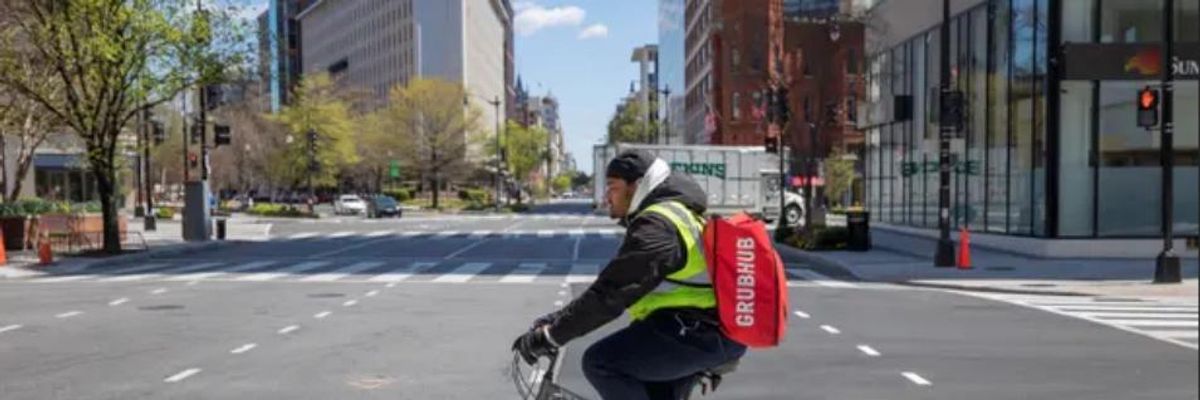
A Grubhub delivery person makes bicycle deliveries on the empty streets of Washington DC. (Photograph: Erik S Lesser/EPA)
The pandemic is putting America's deepening class divide into stark relief. Four classes are emerging.
The Remotes. These are professional, managerial, and technical workers - an estimated 35 percent of the workforce - who are putting in long hours at their laptops, Zooming into conferences, scanning electronic documents, and collecting about the same pay as before the crisis.
Many are bored or anxious, but they're well off compared to the three other classes.
The Essentials. They're about 30 percent of workers, including nurses, homecare and childcare workers, group home workers, farm workers, food processors, truck drivers, warehouse and transit workers, drug store employees, sanitation workers, police officers, fire fighters, and the military.
Too many essentials lack adequate protective gear, paid sick leave, health insurance, and childcare, which is especially important now that schools are shuttered. They also deserve hazard pay.
Their vulnerability is generating a wave of worker activism at businesses such as Instacart, Amazon, Walmart, and Whole Foods. Mass-transit workers are organizing work stoppages.
Trump's Occupational Safety and Health Administration has the legal authority to require private employers provide essential workers with protective gear. Don't hold your breath.
The Unpaid. They're an even larger group that the unemployed - whose ranks could soon reach 25 percent, the same as in the Great Depression. Some of the unpaid are furloughed or have used up their paid leave. So far in this crisis, 43 percent of adults report they or someone in their household has lost jobs or pay, according to the Pew Research Center.
An estimated 9.2 million have lost their employer-provided health insurance.
Many of these jobs had been in personal services that can't be done remotely, such as retail, restaurant, and hospitality work. But as consumers rein in spending, layoffs are spreading to news organizations, tech companies, consumer-goods manufacturers.
The unpaid most need cash to feed their families and pay the rent. Fewer than half say they have enough emergency funds to cover three months of expenses, according to a survey conducted this month Pew.
So far, government has failed them, too. Checks mailed out by the Treasury last week are a pittance. Extra benefits could help, but unemployment offices are so overwhelmed with claims that they can't get money out the door. Loans to small businesses have gone largely to big, well-connected businesses, with banks collecting fat fees.
On Wednesday, Republican Senate majority leader Mitch McConnell said he opposed to any further federal aid to state and local governments, suggesting states declare bankruptcy instead. Which means even less money for unemployment insurance, Medicaid, and everything else the unpaid need.
The resulting desperation is fueling demands to "reopen the economy" long before it's safe. If it comes down to a choice between risking one's health and putting food on the table, many will take latter.
The Forgotten. This group includes everyone for whom social distancing is nearly impossible because they're packed tightly into places most Americans don't see - prisons, jails for undocumented immigrants, group homes for the severely disabled, camps for migrant farmworkers, Native American reservations, homeless shelters, and nursing homes.
While much of New York City is sheltering at home, for example, more than 17,000 men and women, many already in poor health, are sleeping in roughly 100 shelters for single adults.
All such places are becoming hot spots for the virus. These people need safe spaces with proper medical care, adequate social distancing, testing for the virus and isolation of those who have contracted it. Few are getting any of this.
Not surprisingly, the Essentials, the Unpaid, and the Forgotten are disproportionately poor, black, and Latino. And they are disproportionately becoming infected.
An Associated Press breakdown of available state and local data showed close to 33 percent of coronavirus deaths so far are African-American, despite representing only 14 percent of the total population in areas surveyed. The Navajo Nation already has lost more to coronavirus than have 13 states. Four of the 10 largest-known sources of infection in the United States have been correctional facilities.
These three groups aren't getting what they need to survive this crisis because they don't have lobbyists and political action committees to do their bidding in Washington or state capitals.
The Remotes among us should be concerned, and not just because of the unfairness of the Covid-19 class divide. If the Essentials aren't sufficiently protected, the Unpaid are forced back to work earlier than is safe, and the Forgotten remain forgotten, no one can be secure. Covid-19 will continue to spread sickness and death for months, if not years to come.
Dear Common Dreams reader, It’s been nearly 30 years since I co-founded Common Dreams with my late wife, Lina Newhouser. We had the radical notion that journalism should serve the public good, not corporate profits. It was clear to us from the outset what it would take to build such a project. No paid advertisements. No corporate sponsors. No millionaire publisher telling us what to think or do. Many people said we wouldn't last a year, but we proved those doubters wrong. Together with a tremendous team of journalists and dedicated staff, we built an independent media outlet free from the constraints of profits and corporate control. Our mission has always been simple: To inform. To inspire. To ignite change for the common good. Building Common Dreams was not easy. Our survival was never guaranteed. When you take on the most powerful forces—Wall Street greed, fossil fuel industry destruction, Big Tech lobbyists, and uber-rich oligarchs who have spent billions upon billions rigging the economy and democracy in their favor—the only bulwark you have is supporters who believe in your work. But here’s the urgent message from me today. It's never been this bad out there. And it's never been this hard to keep us going. At the very moment Common Dreams is most needed, the threats we face are intensifying. We need your support now more than ever. We don't accept corporate advertising and never will. We don't have a paywall because we don't think people should be blocked from critical news based on their ability to pay. Everything we do is funded by the donations of readers like you. When everyone does the little they can afford, we are strong. But if that support retreats or dries up, so do we. Will you donate now to make sure Common Dreams not only survives but thrives? —Craig Brown, Co-founder |
The pandemic is putting America's deepening class divide into stark relief. Four classes are emerging.
The Remotes. These are professional, managerial, and technical workers - an estimated 35 percent of the workforce - who are putting in long hours at their laptops, Zooming into conferences, scanning electronic documents, and collecting about the same pay as before the crisis.
Many are bored or anxious, but they're well off compared to the three other classes.
The Essentials. They're about 30 percent of workers, including nurses, homecare and childcare workers, group home workers, farm workers, food processors, truck drivers, warehouse and transit workers, drug store employees, sanitation workers, police officers, fire fighters, and the military.
Too many essentials lack adequate protective gear, paid sick leave, health insurance, and childcare, which is especially important now that schools are shuttered. They also deserve hazard pay.
Their vulnerability is generating a wave of worker activism at businesses such as Instacart, Amazon, Walmart, and Whole Foods. Mass-transit workers are organizing work stoppages.
Trump's Occupational Safety and Health Administration has the legal authority to require private employers provide essential workers with protective gear. Don't hold your breath.
The Unpaid. They're an even larger group that the unemployed - whose ranks could soon reach 25 percent, the same as in the Great Depression. Some of the unpaid are furloughed or have used up their paid leave. So far in this crisis, 43 percent of adults report they or someone in their household has lost jobs or pay, according to the Pew Research Center.
An estimated 9.2 million have lost their employer-provided health insurance.
Many of these jobs had been in personal services that can't be done remotely, such as retail, restaurant, and hospitality work. But as consumers rein in spending, layoffs are spreading to news organizations, tech companies, consumer-goods manufacturers.
The unpaid most need cash to feed their families and pay the rent. Fewer than half say they have enough emergency funds to cover three months of expenses, according to a survey conducted this month Pew.
So far, government has failed them, too. Checks mailed out by the Treasury last week are a pittance. Extra benefits could help, but unemployment offices are so overwhelmed with claims that they can't get money out the door. Loans to small businesses have gone largely to big, well-connected businesses, with banks collecting fat fees.
On Wednesday, Republican Senate majority leader Mitch McConnell said he opposed to any further federal aid to state and local governments, suggesting states declare bankruptcy instead. Which means even less money for unemployment insurance, Medicaid, and everything else the unpaid need.
The resulting desperation is fueling demands to "reopen the economy" long before it's safe. If it comes down to a choice between risking one's health and putting food on the table, many will take latter.
The Forgotten. This group includes everyone for whom social distancing is nearly impossible because they're packed tightly into places most Americans don't see - prisons, jails for undocumented immigrants, group homes for the severely disabled, camps for migrant farmworkers, Native American reservations, homeless shelters, and nursing homes.
While much of New York City is sheltering at home, for example, more than 17,000 men and women, many already in poor health, are sleeping in roughly 100 shelters for single adults.
All such places are becoming hot spots for the virus. These people need safe spaces with proper medical care, adequate social distancing, testing for the virus and isolation of those who have contracted it. Few are getting any of this.
Not surprisingly, the Essentials, the Unpaid, and the Forgotten are disproportionately poor, black, and Latino. And they are disproportionately becoming infected.
An Associated Press breakdown of available state and local data showed close to 33 percent of coronavirus deaths so far are African-American, despite representing only 14 percent of the total population in areas surveyed. The Navajo Nation already has lost more to coronavirus than have 13 states. Four of the 10 largest-known sources of infection in the United States have been correctional facilities.
These three groups aren't getting what they need to survive this crisis because they don't have lobbyists and political action committees to do their bidding in Washington or state capitals.
The Remotes among us should be concerned, and not just because of the unfairness of the Covid-19 class divide. If the Essentials aren't sufficiently protected, the Unpaid are forced back to work earlier than is safe, and the Forgotten remain forgotten, no one can be secure. Covid-19 will continue to spread sickness and death for months, if not years to come.
The pandemic is putting America's deepening class divide into stark relief. Four classes are emerging.
The Remotes. These are professional, managerial, and technical workers - an estimated 35 percent of the workforce - who are putting in long hours at their laptops, Zooming into conferences, scanning electronic documents, and collecting about the same pay as before the crisis.
Many are bored or anxious, but they're well off compared to the three other classes.
The Essentials. They're about 30 percent of workers, including nurses, homecare and childcare workers, group home workers, farm workers, food processors, truck drivers, warehouse and transit workers, drug store employees, sanitation workers, police officers, fire fighters, and the military.
Too many essentials lack adequate protective gear, paid sick leave, health insurance, and childcare, which is especially important now that schools are shuttered. They also deserve hazard pay.
Their vulnerability is generating a wave of worker activism at businesses such as Instacart, Amazon, Walmart, and Whole Foods. Mass-transit workers are organizing work stoppages.
Trump's Occupational Safety and Health Administration has the legal authority to require private employers provide essential workers with protective gear. Don't hold your breath.
The Unpaid. They're an even larger group that the unemployed - whose ranks could soon reach 25 percent, the same as in the Great Depression. Some of the unpaid are furloughed or have used up their paid leave. So far in this crisis, 43 percent of adults report they or someone in their household has lost jobs or pay, according to the Pew Research Center.
An estimated 9.2 million have lost their employer-provided health insurance.
Many of these jobs had been in personal services that can't be done remotely, such as retail, restaurant, and hospitality work. But as consumers rein in spending, layoffs are spreading to news organizations, tech companies, consumer-goods manufacturers.
The unpaid most need cash to feed their families and pay the rent. Fewer than half say they have enough emergency funds to cover three months of expenses, according to a survey conducted this month Pew.
So far, government has failed them, too. Checks mailed out by the Treasury last week are a pittance. Extra benefits could help, but unemployment offices are so overwhelmed with claims that they can't get money out the door. Loans to small businesses have gone largely to big, well-connected businesses, with banks collecting fat fees.
On Wednesday, Republican Senate majority leader Mitch McConnell said he opposed to any further federal aid to state and local governments, suggesting states declare bankruptcy instead. Which means even less money for unemployment insurance, Medicaid, and everything else the unpaid need.
The resulting desperation is fueling demands to "reopen the economy" long before it's safe. If it comes down to a choice between risking one's health and putting food on the table, many will take latter.
The Forgotten. This group includes everyone for whom social distancing is nearly impossible because they're packed tightly into places most Americans don't see - prisons, jails for undocumented immigrants, group homes for the severely disabled, camps for migrant farmworkers, Native American reservations, homeless shelters, and nursing homes.
While much of New York City is sheltering at home, for example, more than 17,000 men and women, many already in poor health, are sleeping in roughly 100 shelters for single adults.
All such places are becoming hot spots for the virus. These people need safe spaces with proper medical care, adequate social distancing, testing for the virus and isolation of those who have contracted it. Few are getting any of this.
Not surprisingly, the Essentials, the Unpaid, and the Forgotten are disproportionately poor, black, and Latino. And they are disproportionately becoming infected.
An Associated Press breakdown of available state and local data showed close to 33 percent of coronavirus deaths so far are African-American, despite representing only 14 percent of the total population in areas surveyed. The Navajo Nation already has lost more to coronavirus than have 13 states. Four of the 10 largest-known sources of infection in the United States have been correctional facilities.
These three groups aren't getting what they need to survive this crisis because they don't have lobbyists and political action committees to do their bidding in Washington or state capitals.
The Remotes among us should be concerned, and not just because of the unfairness of the Covid-19 class divide. If the Essentials aren't sufficiently protected, the Unpaid are forced back to work earlier than is safe, and the Forgotten remain forgotten, no one can be secure. Covid-19 will continue to spread sickness and death for months, if not years to come.