

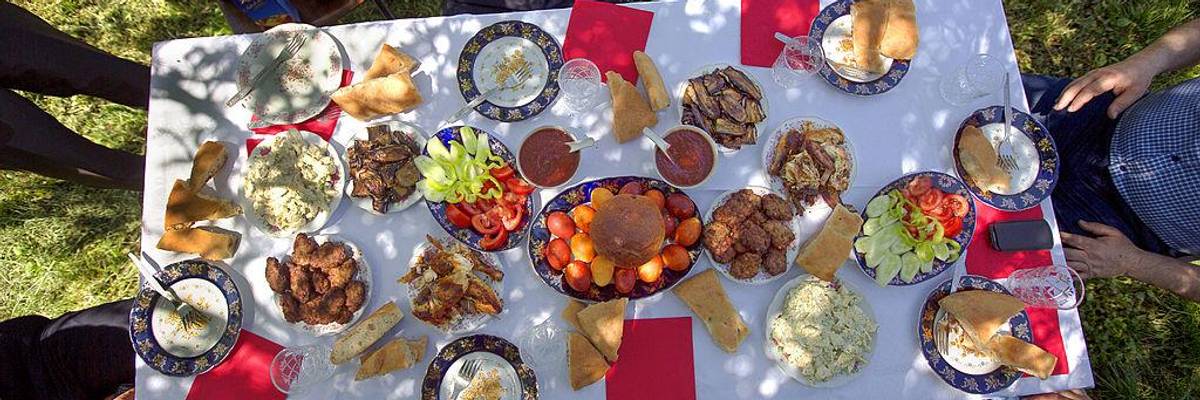
Today's nutritionists have pronounced this Mediterranean diet to be just about the healthiest diet in the world. (Photo by Reza/Getty Images)
The Uplifting Magic of Mother's Day in These Perilous Days
For my Mother, the family table was a mosaic of sights, scents, and tastes, of talking, teaching, and teasing, of health, culture, stimulation, and delight.
As Mother's Day approaches, the celebration of our Mothers is overshadowed by the mounting Covid-19 casualties. Donald Trump is incapable and unwilling to provide the leadership needed to deal with the deadly pandemic attacking our communities. While we cannot afford to slow efforts to challenge the President and our Members of Congress, it is important to take a bit of time and reflect on what our parents, and in particular our mothers, have done and continue to do for their families.
I describe this sentiment in the Ralph Nader and Family Cookbook about nutritious food and its relation to our upbringings.
My mother and father and their four children--two girls and two boys--all ate the same food. There was peace and time for family discussions at the dinner table. To my mother, meals provided a daily occasion for education, for finding out what was on our minds, for recounting the traditions of food, culture, and kinship in Lebanon, where she and my father were born. At the dinner table, my mother would ask us what we had learned from our teachers each day at school. Small talk and gossip were not high on her agenda, though she knew those had their place, too.
Our mother cooked her nutritious and delicious recipes from scratch. There were no processed foods on our table. We were expected to eat everything on our plates.
She believed keeping it simple and everything in moderation were two good guiding principles for our dinner table. It allowed her to efficiently prepare food. Holidays and birthdays featured more elaborate entrees from Mother's busy kitchen. One family favorite is called sheikh al-mahshi (the 'king' of stuffed food), a baked eggplant stuffed with minced lamb, pine nuts, and onions, garnished with tomatoes and served on long-grain rice with a tossed salad. Every Friday we had baked fish with tarator sauce, reflective of a Christian tradition in Lebanon.
Mother did not believe in regular snacks between meals, but occasionally, she liked to surprise us with some labneh with olive oil, tucked inside whole wheat pita bread, to take to school.
Diet is viewed by both consumers and physicians as more and more significant in an individual's weight, energy level, and overall health.
Sometime in the 1970s, having seemingly run out of criticism of my consumer protection work, the Wall Street Journal astonishingly devoted an entire editorial to how puritanical my mother was, forcing chickpea snacks on us instead of, presumably, candy. The Journal was particularly incensed at my mother quietly scraping the sugary frosting off birthday cakes once we had blown out the candles - a practice that had become a family joke. Mother reacted with amusement. Cakes had plenty of sweetness, she would say, without loading up on frosting that was pure sugar.
She knew that meals were about much more than food. For Mother, the family table was a mosaic of sights, scents, and tastes, of talking, teaching, and teasing, of health, culture, stimulation, and delight. For Dad, it was a time to ask us challenging questions to sharpen our minds and our independent thinking. Such as: Do the great leaders make the changes in history or do they reflect the rising pressures from people at any given time? Is it better to buy from a local family-owned business than from a large chain store? When can a revolution be called a success? What were you taught in school that you found out not to be true?
A major inspiration for The Ralph Nader and Family Cookbook is to celebrate my parents. Another stems from people always asking me what I eat, prompted in part by my work on food safety laws. Also, the growing popularity of Arab cuisine, backed by the scientific research into its exceptional nutrition, has broadened the audience and market for what was once seen as an exotic menu.
Diet is viewed by both consumers and physicians as more and more significant in an individual's weight, energy level, and overall health. Medical schools, which traditionally haven't featured nutrition very prominently in their curricula, are now more systematically focusing on diet.
As is reflected in the recipes chosen for this book, we were mostly raised on Arab cuisine - more specifically the food of the people who lived in the mountains of Lebanon. Today's nutritionists have pronounced this Mediterranean diet to be just about the healthiest diet in the world. It is heavy with varieties of vegetables, fruits, grains, nuts, spices, and lean (but not too much red) meat, mostly lamb.
The recipes are healthy and are reasonably low in fat, salt, and sugar (the latter given leeway in the desserts). The dishes are easy to prepare, with a few exceptions and their ingredients are relatively inexpensive. For sure, much of our upbringing happened in our comfortable kitchen - tucked between two pantries at our family table. That is why the recipes in this book evoke memories of their broader contexts and celebrate our good fortune in having such wonderful parents.
A selection of our family recipes are available for you to review and sample at: Nader.Org/Recipes.
An Urgent Message From Our Co-Founder
Dear Common Dreams reader, It’s been nearly 30 years since I co-founded Common Dreams with my late wife, Lina Newhouser. We had the radical notion that journalism should serve the public good, not corporate profits. It was clear to us from the outset what it would take to build such a project. No paid advertisements. No corporate sponsors. No millionaire publisher telling us what to think or do. Many people said we wouldn't last a year, but we proved those doubters wrong. Together with a tremendous team of journalists and dedicated staff, we built an independent media outlet free from the constraints of profits and corporate control. Our mission has always been simple: To inform. To inspire. To ignite change for the common good. Building Common Dreams was not easy. Our survival was never guaranteed. When you take on the most powerful forces—Wall Street greed, fossil fuel industry destruction, Big Tech lobbyists, and uber-rich oligarchs who have spent billions upon billions rigging the economy and democracy in their favor—the only bulwark you have is supporters who believe in your work. But here’s the urgent message from me today. It's never been this bad out there. And it's never been this hard to keep us going. At the very moment Common Dreams is most needed, the threats we face are intensifying. We need your support now more than ever. We don't accept corporate advertising and never will. We don't have a paywall because we don't think people should be blocked from critical news based on their ability to pay. Everything we do is funded by the donations of readers like you. When everyone does the little they can afford, we are strong. But if that support retreats or dries up, so do we. Will you donate now to make sure Common Dreams not only survives but thrives? —Craig Brown, Co-founder |
As Mother's Day approaches, the celebration of our Mothers is overshadowed by the mounting Covid-19 casualties. Donald Trump is incapable and unwilling to provide the leadership needed to deal with the deadly pandemic attacking our communities. While we cannot afford to slow efforts to challenge the President and our Members of Congress, it is important to take a bit of time and reflect on what our parents, and in particular our mothers, have done and continue to do for their families.
I describe this sentiment in the Ralph Nader and Family Cookbook about nutritious food and its relation to our upbringings.
My mother and father and their four children--two girls and two boys--all ate the same food. There was peace and time for family discussions at the dinner table. To my mother, meals provided a daily occasion for education, for finding out what was on our minds, for recounting the traditions of food, culture, and kinship in Lebanon, where she and my father were born. At the dinner table, my mother would ask us what we had learned from our teachers each day at school. Small talk and gossip were not high on her agenda, though she knew those had their place, too.
Our mother cooked her nutritious and delicious recipes from scratch. There were no processed foods on our table. We were expected to eat everything on our plates.
She believed keeping it simple and everything in moderation were two good guiding principles for our dinner table. It allowed her to efficiently prepare food. Holidays and birthdays featured more elaborate entrees from Mother's busy kitchen. One family favorite is called sheikh al-mahshi (the 'king' of stuffed food), a baked eggplant stuffed with minced lamb, pine nuts, and onions, garnished with tomatoes and served on long-grain rice with a tossed salad. Every Friday we had baked fish with tarator sauce, reflective of a Christian tradition in Lebanon.
Mother did not believe in regular snacks between meals, but occasionally, she liked to surprise us with some labneh with olive oil, tucked inside whole wheat pita bread, to take to school.
Diet is viewed by both consumers and physicians as more and more significant in an individual's weight, energy level, and overall health.
Sometime in the 1970s, having seemingly run out of criticism of my consumer protection work, the Wall Street Journal astonishingly devoted an entire editorial to how puritanical my mother was, forcing chickpea snacks on us instead of, presumably, candy. The Journal was particularly incensed at my mother quietly scraping the sugary frosting off birthday cakes once we had blown out the candles - a practice that had become a family joke. Mother reacted with amusement. Cakes had plenty of sweetness, she would say, without loading up on frosting that was pure sugar.
She knew that meals were about much more than food. For Mother, the family table was a mosaic of sights, scents, and tastes, of talking, teaching, and teasing, of health, culture, stimulation, and delight. For Dad, it was a time to ask us challenging questions to sharpen our minds and our independent thinking. Such as: Do the great leaders make the changes in history or do they reflect the rising pressures from people at any given time? Is it better to buy from a local family-owned business than from a large chain store? When can a revolution be called a success? What were you taught in school that you found out not to be true?
A major inspiration for The Ralph Nader and Family Cookbook is to celebrate my parents. Another stems from people always asking me what I eat, prompted in part by my work on food safety laws. Also, the growing popularity of Arab cuisine, backed by the scientific research into its exceptional nutrition, has broadened the audience and market for what was once seen as an exotic menu.
Diet is viewed by both consumers and physicians as more and more significant in an individual's weight, energy level, and overall health. Medical schools, which traditionally haven't featured nutrition very prominently in their curricula, are now more systematically focusing on diet.
As is reflected in the recipes chosen for this book, we were mostly raised on Arab cuisine - more specifically the food of the people who lived in the mountains of Lebanon. Today's nutritionists have pronounced this Mediterranean diet to be just about the healthiest diet in the world. It is heavy with varieties of vegetables, fruits, grains, nuts, spices, and lean (but not too much red) meat, mostly lamb.
The recipes are healthy and are reasonably low in fat, salt, and sugar (the latter given leeway in the desserts). The dishes are easy to prepare, with a few exceptions and their ingredients are relatively inexpensive. For sure, much of our upbringing happened in our comfortable kitchen - tucked between two pantries at our family table. That is why the recipes in this book evoke memories of their broader contexts and celebrate our good fortune in having such wonderful parents.
A selection of our family recipes are available for you to review and sample at: Nader.Org/Recipes.
As Mother's Day approaches, the celebration of our Mothers is overshadowed by the mounting Covid-19 casualties. Donald Trump is incapable and unwilling to provide the leadership needed to deal with the deadly pandemic attacking our communities. While we cannot afford to slow efforts to challenge the President and our Members of Congress, it is important to take a bit of time and reflect on what our parents, and in particular our mothers, have done and continue to do for their families.
I describe this sentiment in the Ralph Nader and Family Cookbook about nutritious food and its relation to our upbringings.
My mother and father and their four children--two girls and two boys--all ate the same food. There was peace and time for family discussions at the dinner table. To my mother, meals provided a daily occasion for education, for finding out what was on our minds, for recounting the traditions of food, culture, and kinship in Lebanon, where she and my father were born. At the dinner table, my mother would ask us what we had learned from our teachers each day at school. Small talk and gossip were not high on her agenda, though she knew those had their place, too.
Our mother cooked her nutritious and delicious recipes from scratch. There were no processed foods on our table. We were expected to eat everything on our plates.
She believed keeping it simple and everything in moderation were two good guiding principles for our dinner table. It allowed her to efficiently prepare food. Holidays and birthdays featured more elaborate entrees from Mother's busy kitchen. One family favorite is called sheikh al-mahshi (the 'king' of stuffed food), a baked eggplant stuffed with minced lamb, pine nuts, and onions, garnished with tomatoes and served on long-grain rice with a tossed salad. Every Friday we had baked fish with tarator sauce, reflective of a Christian tradition in Lebanon.
Mother did not believe in regular snacks between meals, but occasionally, she liked to surprise us with some labneh with olive oil, tucked inside whole wheat pita bread, to take to school.
Diet is viewed by both consumers and physicians as more and more significant in an individual's weight, energy level, and overall health.
Sometime in the 1970s, having seemingly run out of criticism of my consumer protection work, the Wall Street Journal astonishingly devoted an entire editorial to how puritanical my mother was, forcing chickpea snacks on us instead of, presumably, candy. The Journal was particularly incensed at my mother quietly scraping the sugary frosting off birthday cakes once we had blown out the candles - a practice that had become a family joke. Mother reacted with amusement. Cakes had plenty of sweetness, she would say, without loading up on frosting that was pure sugar.
She knew that meals were about much more than food. For Mother, the family table was a mosaic of sights, scents, and tastes, of talking, teaching, and teasing, of health, culture, stimulation, and delight. For Dad, it was a time to ask us challenging questions to sharpen our minds and our independent thinking. Such as: Do the great leaders make the changes in history or do they reflect the rising pressures from people at any given time? Is it better to buy from a local family-owned business than from a large chain store? When can a revolution be called a success? What were you taught in school that you found out not to be true?
A major inspiration for The Ralph Nader and Family Cookbook is to celebrate my parents. Another stems from people always asking me what I eat, prompted in part by my work on food safety laws. Also, the growing popularity of Arab cuisine, backed by the scientific research into its exceptional nutrition, has broadened the audience and market for what was once seen as an exotic menu.
Diet is viewed by both consumers and physicians as more and more significant in an individual's weight, energy level, and overall health. Medical schools, which traditionally haven't featured nutrition very prominently in their curricula, are now more systematically focusing on diet.
As is reflected in the recipes chosen for this book, we were mostly raised on Arab cuisine - more specifically the food of the people who lived in the mountains of Lebanon. Today's nutritionists have pronounced this Mediterranean diet to be just about the healthiest diet in the world. It is heavy with varieties of vegetables, fruits, grains, nuts, spices, and lean (but not too much red) meat, mostly lamb.
The recipes are healthy and are reasonably low in fat, salt, and sugar (the latter given leeway in the desserts). The dishes are easy to prepare, with a few exceptions and their ingredients are relatively inexpensive. For sure, much of our upbringing happened in our comfortable kitchen - tucked between two pantries at our family table. That is why the recipes in this book evoke memories of their broader contexts and celebrate our good fortune in having such wonderful parents.
A selection of our family recipes are available for you to review and sample at: Nader.Org/Recipes.