SUBSCRIBE TO OUR FREE NEWSLETTER
Daily news & progressive opinion—funded by the people, not the corporations—delivered straight to your inbox.
5
#000000
#FFFFFF
To donate by check, phone, or other method, see our More Ways to Give page.
Daily news & progressive opinion—funded by the people, not the corporations—delivered straight to your inbox.
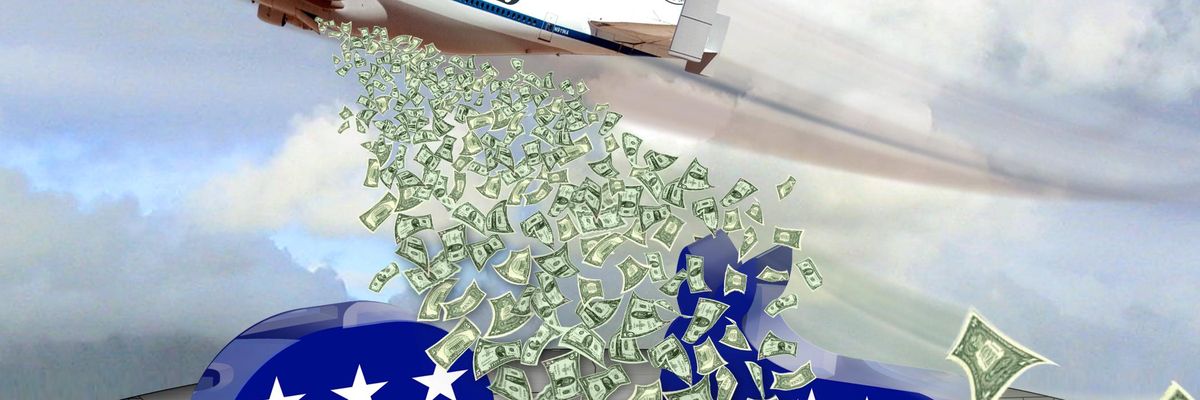
With so many politicians in the pockets of their big donors, it's been even harder to make progress on issues like gun safety, health care costs, or climate change. (Photo: DonkeyHotey/Flickr)
Ten years ago, in January 2010, the Supreme Court released its disastrous Citizens United decision. The court, either through remarkable naivety or sheer malevolence, essentially married the terrible idea that "money is speech" to the terrible idea that "corporations are people."
The ruling put a for sale sign on our democracy, opening up a flood of corporate, special interest, and even foreign money into our politics.
Through Citizens United and related decisions, the Court made a bad situation worse. We saw the proliferation of super PACs, which can accept and spend unlimited amounts of money to influence elections, and the rise of dark money, which is undisclosed political spending that can come from any special interest, including foreign countries.
One-fifth of all super PAC donations in the past 10 years have come from just 11 people.
In the 10 years since the decision, there's been $4.5 billion in political spending by outside interest groups, compared to $750 million spent in the 20 years prior to the case.
From 2000-2008, there were only 15 federal races where outside spending exceeded candidate spending. In the same amount of time following Citizens United, this occurred in 126 races. Now, almost half of all outside spending is dark money that has no or limited disclosure of its donors.
That money isn't coming from the farmers suffering through Donald Trump's trade war or the fast-food workers fighting for a living wage. It's coming from the wealthiest donors, people often with very different priorities than the majority of Americans. In fact, a full one-fifth of all super PAC donations in the past 10 years have come from just 11 people.
This has led to an unresponsive and dysfunctional government. With so many politicians in the pockets of their big donors, it's been even harder to make progress on issues like gun safety, health care costs, or climate change.
Not to mention, we're left with the most corrupt president in American history, who's embroiled in a series of scandals that threaten our prosperity, safety, and security.
To name just a few of these scandals: Trump urged a foreign country to investigate his political opponents. His lawyer's "associates" funneled money into Trump's super PAC through a sham corporation. The National Rifle Association spent tens of millions of dollars in unreported "dark" money to elect him while allegedly serving as a Russian asset.
Trump and his accomplices should be held accountable, through congressional impeachment, the judicial process, or both. But we also need meaningful anti-corruption reforms.
Thanks to a class of reformers elected in 2018, we've already begun that process. Last year, the House of Representatives passed the For the People Act (H.R. 1).
H.R. 1 would strengthen ethics rules and enforcement; reduce the influence of big money while empowering individual, small-dollar donors; and, along with a bill to restore the Voting Rights Act, protect every American's right to vote. It also calls for a constitutional amendment to overturn Citizens United.
Sadly, this bill is being blocked by Mitch McConnell in the Senate.
These reforms are all popular with the American people. We can unrig the system and restore that faith by fighting for these priorities, and by pressuring elected officials to act. Join groups like End Citizens United or Let America Vote to push back against our rigged system and put people ahead of corporate special interests.
Together, we can restore trust in government, prevent corruption, strengthen our national security, and ensure Washington truly works for the people.
Dear Common Dreams reader, It’s been nearly 30 years since I co-founded Common Dreams with my late wife, Lina Newhouser. We had the radical notion that journalism should serve the public good, not corporate profits. It was clear to us from the outset what it would take to build such a project. No paid advertisements. No corporate sponsors. No millionaire publisher telling us what to think or do. Many people said we wouldn't last a year, but we proved those doubters wrong. Together with a tremendous team of journalists and dedicated staff, we built an independent media outlet free from the constraints of profits and corporate control. Our mission has always been simple: To inform. To inspire. To ignite change for the common good. Building Common Dreams was not easy. Our survival was never guaranteed. When you take on the most powerful forces—Wall Street greed, fossil fuel industry destruction, Big Tech lobbyists, and uber-rich oligarchs who have spent billions upon billions rigging the economy and democracy in their favor—the only bulwark you have is supporters who believe in your work. But here’s the urgent message from me today. It's never been this bad out there. And it's never been this hard to keep us going. At the very moment Common Dreams is most needed, the threats we face are intensifying. We need your support now more than ever. We don't accept corporate advertising and never will. We don't have a paywall because we don't think people should be blocked from critical news based on their ability to pay. Everything we do is funded by the donations of readers like you. When everyone does the little they can afford, we are strong. But if that support retreats or dries up, so do we. Will you donate now to make sure Common Dreams not only survives but thrives? —Craig Brown, Co-founder |
Ten years ago, in January 2010, the Supreme Court released its disastrous Citizens United decision. The court, either through remarkable naivety or sheer malevolence, essentially married the terrible idea that "money is speech" to the terrible idea that "corporations are people."
The ruling put a for sale sign on our democracy, opening up a flood of corporate, special interest, and even foreign money into our politics.
Through Citizens United and related decisions, the Court made a bad situation worse. We saw the proliferation of super PACs, which can accept and spend unlimited amounts of money to influence elections, and the rise of dark money, which is undisclosed political spending that can come from any special interest, including foreign countries.
One-fifth of all super PAC donations in the past 10 years have come from just 11 people.
In the 10 years since the decision, there's been $4.5 billion in political spending by outside interest groups, compared to $750 million spent in the 20 years prior to the case.
From 2000-2008, there were only 15 federal races where outside spending exceeded candidate spending. In the same amount of time following Citizens United, this occurred in 126 races. Now, almost half of all outside spending is dark money that has no or limited disclosure of its donors.
That money isn't coming from the farmers suffering through Donald Trump's trade war or the fast-food workers fighting for a living wage. It's coming from the wealthiest donors, people often with very different priorities than the majority of Americans. In fact, a full one-fifth of all super PAC donations in the past 10 years have come from just 11 people.
This has led to an unresponsive and dysfunctional government. With so many politicians in the pockets of their big donors, it's been even harder to make progress on issues like gun safety, health care costs, or climate change.
Not to mention, we're left with the most corrupt president in American history, who's embroiled in a series of scandals that threaten our prosperity, safety, and security.
To name just a few of these scandals: Trump urged a foreign country to investigate his political opponents. His lawyer's "associates" funneled money into Trump's super PAC through a sham corporation. The National Rifle Association spent tens of millions of dollars in unreported "dark" money to elect him while allegedly serving as a Russian asset.
Trump and his accomplices should be held accountable, through congressional impeachment, the judicial process, or both. But we also need meaningful anti-corruption reforms.
Thanks to a class of reformers elected in 2018, we've already begun that process. Last year, the House of Representatives passed the For the People Act (H.R. 1).
H.R. 1 would strengthen ethics rules and enforcement; reduce the influence of big money while empowering individual, small-dollar donors; and, along with a bill to restore the Voting Rights Act, protect every American's right to vote. It also calls for a constitutional amendment to overturn Citizens United.
Sadly, this bill is being blocked by Mitch McConnell in the Senate.
These reforms are all popular with the American people. We can unrig the system and restore that faith by fighting for these priorities, and by pressuring elected officials to act. Join groups like End Citizens United or Let America Vote to push back against our rigged system and put people ahead of corporate special interests.
Together, we can restore trust in government, prevent corruption, strengthen our national security, and ensure Washington truly works for the people.
Ten years ago, in January 2010, the Supreme Court released its disastrous Citizens United decision. The court, either through remarkable naivety or sheer malevolence, essentially married the terrible idea that "money is speech" to the terrible idea that "corporations are people."
The ruling put a for sale sign on our democracy, opening up a flood of corporate, special interest, and even foreign money into our politics.
Through Citizens United and related decisions, the Court made a bad situation worse. We saw the proliferation of super PACs, which can accept and spend unlimited amounts of money to influence elections, and the rise of dark money, which is undisclosed political spending that can come from any special interest, including foreign countries.
One-fifth of all super PAC donations in the past 10 years have come from just 11 people.
In the 10 years since the decision, there's been $4.5 billion in political spending by outside interest groups, compared to $750 million spent in the 20 years prior to the case.
From 2000-2008, there were only 15 federal races where outside spending exceeded candidate spending. In the same amount of time following Citizens United, this occurred in 126 races. Now, almost half of all outside spending is dark money that has no or limited disclosure of its donors.
That money isn't coming from the farmers suffering through Donald Trump's trade war or the fast-food workers fighting for a living wage. It's coming from the wealthiest donors, people often with very different priorities than the majority of Americans. In fact, a full one-fifth of all super PAC donations in the past 10 years have come from just 11 people.
This has led to an unresponsive and dysfunctional government. With so many politicians in the pockets of their big donors, it's been even harder to make progress on issues like gun safety, health care costs, or climate change.
Not to mention, we're left with the most corrupt president in American history, who's embroiled in a series of scandals that threaten our prosperity, safety, and security.
To name just a few of these scandals: Trump urged a foreign country to investigate his political opponents. His lawyer's "associates" funneled money into Trump's super PAC through a sham corporation. The National Rifle Association spent tens of millions of dollars in unreported "dark" money to elect him while allegedly serving as a Russian asset.
Trump and his accomplices should be held accountable, through congressional impeachment, the judicial process, or both. But we also need meaningful anti-corruption reforms.
Thanks to a class of reformers elected in 2018, we've already begun that process. Last year, the House of Representatives passed the For the People Act (H.R. 1).
H.R. 1 would strengthen ethics rules and enforcement; reduce the influence of big money while empowering individual, small-dollar donors; and, along with a bill to restore the Voting Rights Act, protect every American's right to vote. It also calls for a constitutional amendment to overturn Citizens United.
Sadly, this bill is being blocked by Mitch McConnell in the Senate.
These reforms are all popular with the American people. We can unrig the system and restore that faith by fighting for these priorities, and by pressuring elected officials to act. Join groups like End Citizens United or Let America Vote to push back against our rigged system and put people ahead of corporate special interests.
Together, we can restore trust in government, prevent corruption, strengthen our national security, and ensure Washington truly works for the people.