SUBSCRIBE TO OUR FREE NEWSLETTER
Daily news & progressive opinion—funded by the people, not the corporations—delivered straight to your inbox.
5
#000000
#FFFFFF
To donate by check, phone, or other method, see our More Ways to Give page.
Daily news & progressive opinion—funded by the people, not the corporations—delivered straight to your inbox.
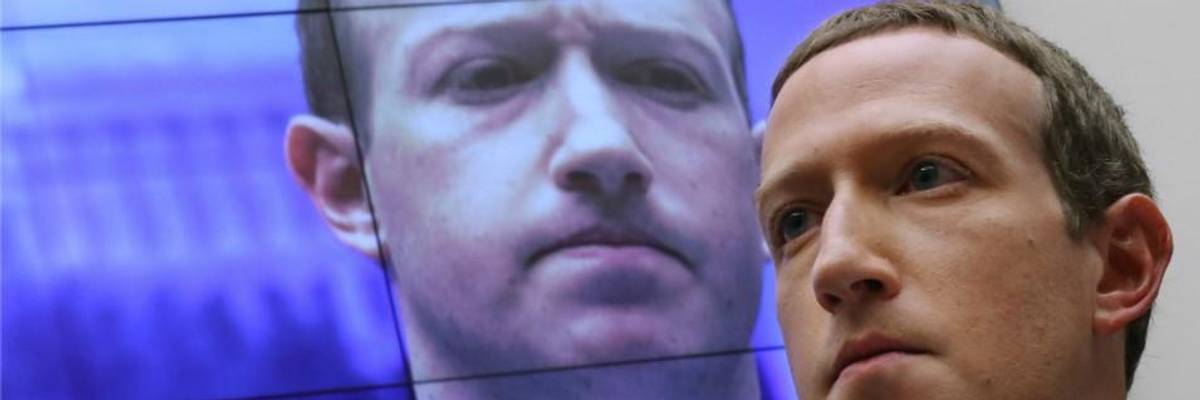
Instead of taking a serious look at its responsibility as a curator and disseminator of vast amounts of information in a highly charged political atmosphere, Facebook has shunted the responsibility on to its consumers. (Photo: Chip Somodevilla/Getty Images)
What has Facebook done to solve the problem of fake news, of foreign interference in elections, or data privacy -- all the issues, in other words, that have plagued the company and tarnished its reputation since the 2016 presidential election? To judge by its new policy on political advertising, the answer is: Next to nothing.
On Thursday Facebook rolled out "expanded transparency" rules giving its users some control over the kinds of political ads that pop up in their feed. We can now adjust the frequency of the ads we see and restrict ones from sources we'd rather not hear from. What the new rules clamorously do not do, however, is regulate the ads themselves.
Politicians, political consultants and their allies are still at liberty to lie, dissemble and subvert plain language to manipulate and confuse the electorate, just as they were able to four years ago. They can still fill voters' heads with false outrage, create non-existent scandals to make opposing candidates seem toxic, or otherwise poison our political discourse to turn off voters they'd prefer to keep away from the polls.
It's time for Congress to take Zuckerberg at his word and reclassify Facebook and the other social media giants not as gateways but as publishers.
And all Facebook is willing to say in response is: if you have a problem with that, it's not on us, or even on our advertisers. It's on you.
Let's be honest: Few if any marginally engaged voters--the ones most prone to manipulation, but also the ones likely to sway the outcome in a close race--are ever going to navigate through the bowels of Facebook's settings and explore their advertising opt-out options. Transparency certainly sounds like a good thing, but if this is all Facebook means by it then it is a manipulation of language all of its own in the service of a publicity stunt we shouldn't fall for.
Instead of taking a serious look at its responsibility as a curator and disseminator of vast amounts of information in a highly charged political atmosphere, Facebook has shunted the responsibility on to its consumers. Somehow, they are expected to know and understand what type of media they might want to see before they have even seen it.
How is the average consumer going to know which advertisers to block? Will Russian trolls list themselves as fake news advertisers to make this easy? Of course not. Even the best-informed voters struggle to wrap their minds around the intricacies of candidates, super PACs and the rules around transparency and accuracy in political advertising. A swing voter with a family to feed and two jobs to make ends meet doesn't stand a chance.
Facebook is trying to have it both ways here. By invoking transparency, the company wants at least to go through the motions of sounding like a champion for the First Amendment. At the same time, it wants to rake in the maximum number of advertising dollars with a minimum of either governmental or internal oversight. The contradiction is bad for our democratic health, and we shouldn't stand for it.
One glimmer of hope is that Facebook's own CEO, Mark Zuckerberg, has indicated he's not sure we should stand for it either. "There are a number of areas where I believe governments establishing clearer rules would be helpful, including around elections, harmful content, privacy, and data portability," Zuckerberg said in a Facebook post accompanying the announcement on political ads. "I've called for new regulation in these areas and over the next decade I hope we get clearer rules for the internet."
He's right. Facebook should be subject to the same rules and responsibilities as any other publisher; it's not enough to call itself a gateway to other people's content and wash its hands of the consequences. Facebook is not neutral about the distribution of information on its site, just as a traditional newspaper or magazine publisher is not neutral. The algorithms it uses to select who sees what content are a form of editorial control and as such demand the imposition of basic editorial standards. Facebook should not be allowed to play host to malicious falsehoods or other forms of political skullduggery any more than CNN or the New York Times is allowed to.
As it is, Facebook and other social media sites enjoy protection under a law passed before any of them existed. The 1996 Communications Decency Act was designed to shield the first online service providers like Prodigy and AOL from the behavior of their users. Nobody, back then, could envisage the earth-shaking impact of online information networks; nobody, back then, even knew the term "social media".
Section 230 of the act is essentially a fig leaf behind which Facebook, Google and other online giants continue to hide long after they should have been called out into the open. Their lobbyists even managed to sneak Section 230 protections into the recent U.S.-Mexico-Canada Free Trade Agreement over the objections of some of Congress's heaviest hitters. "I lost," a rueful Nancy Pelosi was quoted as saying after the deal was done. "It's a real gift to big tech."
Facebook is not a free bulletin board or public square that allows everyone a voice. It is a private company that privileges its own corporate interests over the safety of its users. Giving a green light to false and misleading advertisements that it could easily stop is just one instance of this. It's time for Congress to take Zuckerberg at his word and reclassify Facebook and the other social media giants not as gateways but as publishers.
Dear Common Dreams reader, It’s been nearly 30 years since I co-founded Common Dreams with my late wife, Lina Newhouser. We had the radical notion that journalism should serve the public good, not corporate profits. It was clear to us from the outset what it would take to build such a project. No paid advertisements. No corporate sponsors. No millionaire publisher telling us what to think or do. Many people said we wouldn't last a year, but we proved those doubters wrong. Together with a tremendous team of journalists and dedicated staff, we built an independent media outlet free from the constraints of profits and corporate control. Our mission has always been simple: To inform. To inspire. To ignite change for the common good. Building Common Dreams was not easy. Our survival was never guaranteed. When you take on the most powerful forces—Wall Street greed, fossil fuel industry destruction, Big Tech lobbyists, and uber-rich oligarchs who have spent billions upon billions rigging the economy and democracy in their favor—the only bulwark you have is supporters who believe in your work. But here’s the urgent message from me today. It's never been this bad out there. And it's never been this hard to keep us going. At the very moment Common Dreams is most needed, the threats we face are intensifying. We need your support now more than ever. We don't accept corporate advertising and never will. We don't have a paywall because we don't think people should be blocked from critical news based on their ability to pay. Everything we do is funded by the donations of readers like you. When everyone does the little they can afford, we are strong. But if that support retreats or dries up, so do we. Will you donate now to make sure Common Dreams not only survives but thrives? —Craig Brown, Co-founder |
What has Facebook done to solve the problem of fake news, of foreign interference in elections, or data privacy -- all the issues, in other words, that have plagued the company and tarnished its reputation since the 2016 presidential election? To judge by its new policy on political advertising, the answer is: Next to nothing.
On Thursday Facebook rolled out "expanded transparency" rules giving its users some control over the kinds of political ads that pop up in their feed. We can now adjust the frequency of the ads we see and restrict ones from sources we'd rather not hear from. What the new rules clamorously do not do, however, is regulate the ads themselves.
Politicians, political consultants and their allies are still at liberty to lie, dissemble and subvert plain language to manipulate and confuse the electorate, just as they were able to four years ago. They can still fill voters' heads with false outrage, create non-existent scandals to make opposing candidates seem toxic, or otherwise poison our political discourse to turn off voters they'd prefer to keep away from the polls.
It's time for Congress to take Zuckerberg at his word and reclassify Facebook and the other social media giants not as gateways but as publishers.
And all Facebook is willing to say in response is: if you have a problem with that, it's not on us, or even on our advertisers. It's on you.
Let's be honest: Few if any marginally engaged voters--the ones most prone to manipulation, but also the ones likely to sway the outcome in a close race--are ever going to navigate through the bowels of Facebook's settings and explore their advertising opt-out options. Transparency certainly sounds like a good thing, but if this is all Facebook means by it then it is a manipulation of language all of its own in the service of a publicity stunt we shouldn't fall for.
Instead of taking a serious look at its responsibility as a curator and disseminator of vast amounts of information in a highly charged political atmosphere, Facebook has shunted the responsibility on to its consumers. Somehow, they are expected to know and understand what type of media they might want to see before they have even seen it.
How is the average consumer going to know which advertisers to block? Will Russian trolls list themselves as fake news advertisers to make this easy? Of course not. Even the best-informed voters struggle to wrap their minds around the intricacies of candidates, super PACs and the rules around transparency and accuracy in political advertising. A swing voter with a family to feed and two jobs to make ends meet doesn't stand a chance.
Facebook is trying to have it both ways here. By invoking transparency, the company wants at least to go through the motions of sounding like a champion for the First Amendment. At the same time, it wants to rake in the maximum number of advertising dollars with a minimum of either governmental or internal oversight. The contradiction is bad for our democratic health, and we shouldn't stand for it.
One glimmer of hope is that Facebook's own CEO, Mark Zuckerberg, has indicated he's not sure we should stand for it either. "There are a number of areas where I believe governments establishing clearer rules would be helpful, including around elections, harmful content, privacy, and data portability," Zuckerberg said in a Facebook post accompanying the announcement on political ads. "I've called for new regulation in these areas and over the next decade I hope we get clearer rules for the internet."
He's right. Facebook should be subject to the same rules and responsibilities as any other publisher; it's not enough to call itself a gateway to other people's content and wash its hands of the consequences. Facebook is not neutral about the distribution of information on its site, just as a traditional newspaper or magazine publisher is not neutral. The algorithms it uses to select who sees what content are a form of editorial control and as such demand the imposition of basic editorial standards. Facebook should not be allowed to play host to malicious falsehoods or other forms of political skullduggery any more than CNN or the New York Times is allowed to.
As it is, Facebook and other social media sites enjoy protection under a law passed before any of them existed. The 1996 Communications Decency Act was designed to shield the first online service providers like Prodigy and AOL from the behavior of their users. Nobody, back then, could envisage the earth-shaking impact of online information networks; nobody, back then, even knew the term "social media".
Section 230 of the act is essentially a fig leaf behind which Facebook, Google and other online giants continue to hide long after they should have been called out into the open. Their lobbyists even managed to sneak Section 230 protections into the recent U.S.-Mexico-Canada Free Trade Agreement over the objections of some of Congress's heaviest hitters. "I lost," a rueful Nancy Pelosi was quoted as saying after the deal was done. "It's a real gift to big tech."
Facebook is not a free bulletin board or public square that allows everyone a voice. It is a private company that privileges its own corporate interests over the safety of its users. Giving a green light to false and misleading advertisements that it could easily stop is just one instance of this. It's time for Congress to take Zuckerberg at his word and reclassify Facebook and the other social media giants not as gateways but as publishers.
What has Facebook done to solve the problem of fake news, of foreign interference in elections, or data privacy -- all the issues, in other words, that have plagued the company and tarnished its reputation since the 2016 presidential election? To judge by its new policy on political advertising, the answer is: Next to nothing.
On Thursday Facebook rolled out "expanded transparency" rules giving its users some control over the kinds of political ads that pop up in their feed. We can now adjust the frequency of the ads we see and restrict ones from sources we'd rather not hear from. What the new rules clamorously do not do, however, is regulate the ads themselves.
Politicians, political consultants and their allies are still at liberty to lie, dissemble and subvert plain language to manipulate and confuse the electorate, just as they were able to four years ago. They can still fill voters' heads with false outrage, create non-existent scandals to make opposing candidates seem toxic, or otherwise poison our political discourse to turn off voters they'd prefer to keep away from the polls.
It's time for Congress to take Zuckerberg at his word and reclassify Facebook and the other social media giants not as gateways but as publishers.
And all Facebook is willing to say in response is: if you have a problem with that, it's not on us, or even on our advertisers. It's on you.
Let's be honest: Few if any marginally engaged voters--the ones most prone to manipulation, but also the ones likely to sway the outcome in a close race--are ever going to navigate through the bowels of Facebook's settings and explore their advertising opt-out options. Transparency certainly sounds like a good thing, but if this is all Facebook means by it then it is a manipulation of language all of its own in the service of a publicity stunt we shouldn't fall for.
Instead of taking a serious look at its responsibility as a curator and disseminator of vast amounts of information in a highly charged political atmosphere, Facebook has shunted the responsibility on to its consumers. Somehow, they are expected to know and understand what type of media they might want to see before they have even seen it.
How is the average consumer going to know which advertisers to block? Will Russian trolls list themselves as fake news advertisers to make this easy? Of course not. Even the best-informed voters struggle to wrap their minds around the intricacies of candidates, super PACs and the rules around transparency and accuracy in political advertising. A swing voter with a family to feed and two jobs to make ends meet doesn't stand a chance.
Facebook is trying to have it both ways here. By invoking transparency, the company wants at least to go through the motions of sounding like a champion for the First Amendment. At the same time, it wants to rake in the maximum number of advertising dollars with a minimum of either governmental or internal oversight. The contradiction is bad for our democratic health, and we shouldn't stand for it.
One glimmer of hope is that Facebook's own CEO, Mark Zuckerberg, has indicated he's not sure we should stand for it either. "There are a number of areas where I believe governments establishing clearer rules would be helpful, including around elections, harmful content, privacy, and data portability," Zuckerberg said in a Facebook post accompanying the announcement on political ads. "I've called for new regulation in these areas and over the next decade I hope we get clearer rules for the internet."
He's right. Facebook should be subject to the same rules and responsibilities as any other publisher; it's not enough to call itself a gateway to other people's content and wash its hands of the consequences. Facebook is not neutral about the distribution of information on its site, just as a traditional newspaper or magazine publisher is not neutral. The algorithms it uses to select who sees what content are a form of editorial control and as such demand the imposition of basic editorial standards. Facebook should not be allowed to play host to malicious falsehoods or other forms of political skullduggery any more than CNN or the New York Times is allowed to.
As it is, Facebook and other social media sites enjoy protection under a law passed before any of them existed. The 1996 Communications Decency Act was designed to shield the first online service providers like Prodigy and AOL from the behavior of their users. Nobody, back then, could envisage the earth-shaking impact of online information networks; nobody, back then, even knew the term "social media".
Section 230 of the act is essentially a fig leaf behind which Facebook, Google and other online giants continue to hide long after they should have been called out into the open. Their lobbyists even managed to sneak Section 230 protections into the recent U.S.-Mexico-Canada Free Trade Agreement over the objections of some of Congress's heaviest hitters. "I lost," a rueful Nancy Pelosi was quoted as saying after the deal was done. "It's a real gift to big tech."
Facebook is not a free bulletin board or public square that allows everyone a voice. It is a private company that privileges its own corporate interests over the safety of its users. Giving a green light to false and misleading advertisements that it could easily stop is just one instance of this. It's time for Congress to take Zuckerberg at his word and reclassify Facebook and the other social media giants not as gateways but as publishers.