

SUBSCRIBE TO OUR FREE NEWSLETTER
Daily news & progressive opinion—funded by the people, not the corporations—delivered straight to your inbox.
5
#000000
#FFFFFF
To donate by check, phone, or other method, see our More Ways to Give page.
Daily news & progressive opinion—funded by the people, not the corporations—delivered straight to your inbox.
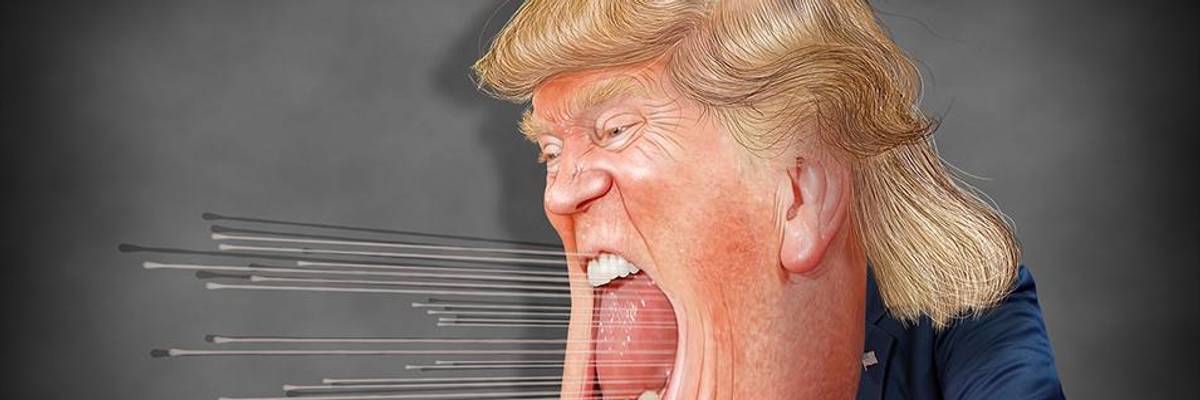
Donald Trump (DonkeyHotey/cc)
Against Donald J. Trump, House Speaker Nancy Pelosi wanted narrow impeachment charges, despite key House Committee Chairs' arguments for broadening the impeachment charges. These veteran lawmakers, led by House Judiciary Committee Chair Jerry Nadler, urged Speaker Pelosi to include the ten obstructions of justice documented in the Mueller Report. These House Committee Chairs also wanted to add a count of bribery regarding Ukraine - a stance Pelosi took herself in a November 14, 2019 press conference. She then overruled her chairs and rejected the bribery count.
Against Donald J. Trump, House Speaker Nancy Pelosi wanted narrow impeachment charges, despite key House Committee Chairs' arguments for broadening the impeachment charges. These veteran lawmakers, led by House Judiciary Committee Chair Jerry Nadler, urged Speaker Pelosi to include the ten obstructions of justice documented in the Mueller Report. These House Committee Chairs also wanted to add a count of bribery regarding Ukraine - a stance Pelosi took herself in a November 14, 2019 press conference. She then overruled her chairs and rejected the bribery count.
Speaker Pelosi told reporters on November 14:
"The devastating testimony corroborated evidence of bribery uncovered in the inquiry, and that the president abused his power and violated his oath by threatening to withhold military aid and a White House meeting in exchange for an investigation into his political rival - a clear attempt by the president to give himself an advantage in the 2020 election."
"Bribery" is explicitly listed as an impeachable offense in the Constitution in Article II, Section 4 and resonates with the public. No matter, Pelosi dropped this crucial charge.
Since the two articles of impeachment - abuse of power and obstruction of justice (limited to the Ukraine matter) - passed the House on December 18, 2019, the Republicans may have given Pelosi reason to accept some of her colleagues' pleas to broaden the impeachment charges.
First, Senator Mitch McConnell indicated that he was going to follow Trump's White House in establishing the rules of the trial. What about the oath to "do impartial justice according to the Constitution and laws: So help me God?" The Senatorial jurors are going to let the defendant, Donald Trump, have a say on the rules in his own impeachment? That bad faith action prompted Pelosi to hold back sending the two approved impeachment articles to the Senate. Currently the stage is being set for the Senate to be a kangaroo court.
Second, more incriminating e-mails have emerged, linking Trump and his cronies to the Ukraine extortion/bribe. On January 3, 2020, the U.S. Court of Appeals for the D.C. Circuit is set to review two cases that will weigh heavily on Trump's legal team. In one case, the district judge ruled that the White House had to obey a Congressional subpoena for the testimony of Trump's lawyer, Donald McGahn, as the "most important" witness regarding Trump's obstruction of justice in Robert S. Mueller's investigation of Russian interference in the 2016 election. The second case involves the House Judiciary Committee's access to grand jury testimony in the Mueller investigation to determine if Trump lied. The lower court judge said the White House must turn them over.
To add to these developments, Trump mocked Pelosi, asserting that the various impeachment charges she did not allow her colleagues to include in the impeachment articles means the other impeachment offenses were, according to Trump, all "lies" and "fake." This should bother Pelosi because Trump is trying to legitimize these numerous impeachable offenses due to Pelosi's inaction. Trump has defiantly refused to "faithfully execute" the laws for health, safety, and economic protections - enriching himself and displaying contempt for Congress by installing cabinet and other high officials without Senate confirmation. Trump also obstructs Congress by blocking Congressional Committee access to testimonies and documents. Getting away with very serious impeachable offenses sets a terrible precedent for future presidential lawlessness. See a listing of twelve such counts by me, constitutional law experts Bruce Fein, and Louis Fisher in the Congressional Record (December 18, 2019, page H 12197).
Nothing in the Constitution or federal statutes bars second or third rounds of impeachments. Indeed, attorneys for the House Judiciary Committee told the Circuit Court that it "is continuing to conduct its inquiry into whether the President committed other impeachable offenses. The Committee's investigations did not cease with the House's recent impeachment vote."
Moreover, Nancy Pelosi has encouraged five House Committees to continue their probe into the outlaw president, whom Pelosi has called "a crook, a thief, a liar" and said she wants to see "in prison." The question is whether she wants only "oversight investigations" or she also wants "impeachment investigations." The difference is critical to Trump's tenure, to the rule of law, and to making the Senate conduct a fair trial with witnesses (the latter backed by 71 percent of the people).
Prosecuting Trump's other grave constitutional violations would demonstrate the important personal stakes for Americans who have borne the brunt of the President's monarchical, illegal defiance that takes away life-preserving safeguards for the American people, which protects them from rampant corporate ravages.
With the coming of the New Year, Speaker Pelosi has a historic choice regarding constitutional order and compliance with the law by Donald J. Trump. Either she sends a boomerang to the White House or she delivers a solid, broad-based eviction notice that the Senate Republicans can try to defend in a public trial viewed by tens of millions of Americans.
Dear Common Dreams reader, It’s been nearly 30 years since I co-founded Common Dreams with my late wife, Lina Newhouser. We had the radical notion that journalism should serve the public good, not corporate profits. It was clear to us from the outset what it would take to build such a project. No paid advertisements. No corporate sponsors. No millionaire publisher telling us what to think or do. Many people said we wouldn't last a year, but we proved those doubters wrong. Together with a tremendous team of journalists and dedicated staff, we built an independent media outlet free from the constraints of profits and corporate control. Our mission has always been simple: To inform. To inspire. To ignite change for the common good. Building Common Dreams was not easy. Our survival was never guaranteed. When you take on the most powerful forces—Wall Street greed, fossil fuel industry destruction, Big Tech lobbyists, and uber-rich oligarchs who have spent billions upon billions rigging the economy and democracy in their favor—the only bulwark you have is supporters who believe in your work. But here’s the urgent message from me today. It's never been this bad out there. And it's never been this hard to keep us going. At the very moment Common Dreams is most needed, the threats we face are intensifying. We need your support now more than ever. We don't accept corporate advertising and never will. We don't have a paywall because we don't think people should be blocked from critical news based on their ability to pay. Everything we do is funded by the donations of readers like you. When everyone does the little they can afford, we are strong. But if that support retreats or dries up, so do we. Will you donate now to make sure Common Dreams not only survives but thrives? —Craig Brown, Co-founder |
Against Donald J. Trump, House Speaker Nancy Pelosi wanted narrow impeachment charges, despite key House Committee Chairs' arguments for broadening the impeachment charges. These veteran lawmakers, led by House Judiciary Committee Chair Jerry Nadler, urged Speaker Pelosi to include the ten obstructions of justice documented in the Mueller Report. These House Committee Chairs also wanted to add a count of bribery regarding Ukraine - a stance Pelosi took herself in a November 14, 2019 press conference. She then overruled her chairs and rejected the bribery count.
Speaker Pelosi told reporters on November 14:
"The devastating testimony corroborated evidence of bribery uncovered in the inquiry, and that the president abused his power and violated his oath by threatening to withhold military aid and a White House meeting in exchange for an investigation into his political rival - a clear attempt by the president to give himself an advantage in the 2020 election."
"Bribery" is explicitly listed as an impeachable offense in the Constitution in Article II, Section 4 and resonates with the public. No matter, Pelosi dropped this crucial charge.
Since the two articles of impeachment - abuse of power and obstruction of justice (limited to the Ukraine matter) - passed the House on December 18, 2019, the Republicans may have given Pelosi reason to accept some of her colleagues' pleas to broaden the impeachment charges.
First, Senator Mitch McConnell indicated that he was going to follow Trump's White House in establishing the rules of the trial. What about the oath to "do impartial justice according to the Constitution and laws: So help me God?" The Senatorial jurors are going to let the defendant, Donald Trump, have a say on the rules in his own impeachment? That bad faith action prompted Pelosi to hold back sending the two approved impeachment articles to the Senate. Currently the stage is being set for the Senate to be a kangaroo court.
Second, more incriminating e-mails have emerged, linking Trump and his cronies to the Ukraine extortion/bribe. On January 3, 2020, the U.S. Court of Appeals for the D.C. Circuit is set to review two cases that will weigh heavily on Trump's legal team. In one case, the district judge ruled that the White House had to obey a Congressional subpoena for the testimony of Trump's lawyer, Donald McGahn, as the "most important" witness regarding Trump's obstruction of justice in Robert S. Mueller's investigation of Russian interference in the 2016 election. The second case involves the House Judiciary Committee's access to grand jury testimony in the Mueller investigation to determine if Trump lied. The lower court judge said the White House must turn them over.
To add to these developments, Trump mocked Pelosi, asserting that the various impeachment charges she did not allow her colleagues to include in the impeachment articles means the other impeachment offenses were, according to Trump, all "lies" and "fake." This should bother Pelosi because Trump is trying to legitimize these numerous impeachable offenses due to Pelosi's inaction. Trump has defiantly refused to "faithfully execute" the laws for health, safety, and economic protections - enriching himself and displaying contempt for Congress by installing cabinet and other high officials without Senate confirmation. Trump also obstructs Congress by blocking Congressional Committee access to testimonies and documents. Getting away with very serious impeachable offenses sets a terrible precedent for future presidential lawlessness. See a listing of twelve such counts by me, constitutional law experts Bruce Fein, and Louis Fisher in the Congressional Record (December 18, 2019, page H 12197).
Nothing in the Constitution or federal statutes bars second or third rounds of impeachments. Indeed, attorneys for the House Judiciary Committee told the Circuit Court that it "is continuing to conduct its inquiry into whether the President committed other impeachable offenses. The Committee's investigations did not cease with the House's recent impeachment vote."
Moreover, Nancy Pelosi has encouraged five House Committees to continue their probe into the outlaw president, whom Pelosi has called "a crook, a thief, a liar" and said she wants to see "in prison." The question is whether she wants only "oversight investigations" or she also wants "impeachment investigations." The difference is critical to Trump's tenure, to the rule of law, and to making the Senate conduct a fair trial with witnesses (the latter backed by 71 percent of the people).
Prosecuting Trump's other grave constitutional violations would demonstrate the important personal stakes for Americans who have borne the brunt of the President's monarchical, illegal defiance that takes away life-preserving safeguards for the American people, which protects them from rampant corporate ravages.
With the coming of the New Year, Speaker Pelosi has a historic choice regarding constitutional order and compliance with the law by Donald J. Trump. Either she sends a boomerang to the White House or she delivers a solid, broad-based eviction notice that the Senate Republicans can try to defend in a public trial viewed by tens of millions of Americans.
Against Donald J. Trump, House Speaker Nancy Pelosi wanted narrow impeachment charges, despite key House Committee Chairs' arguments for broadening the impeachment charges. These veteran lawmakers, led by House Judiciary Committee Chair Jerry Nadler, urged Speaker Pelosi to include the ten obstructions of justice documented in the Mueller Report. These House Committee Chairs also wanted to add a count of bribery regarding Ukraine - a stance Pelosi took herself in a November 14, 2019 press conference. She then overruled her chairs and rejected the bribery count.
Speaker Pelosi told reporters on November 14:
"The devastating testimony corroborated evidence of bribery uncovered in the inquiry, and that the president abused his power and violated his oath by threatening to withhold military aid and a White House meeting in exchange for an investigation into his political rival - a clear attempt by the president to give himself an advantage in the 2020 election."
"Bribery" is explicitly listed as an impeachable offense in the Constitution in Article II, Section 4 and resonates with the public. No matter, Pelosi dropped this crucial charge.
Since the two articles of impeachment - abuse of power and obstruction of justice (limited to the Ukraine matter) - passed the House on December 18, 2019, the Republicans may have given Pelosi reason to accept some of her colleagues' pleas to broaden the impeachment charges.
First, Senator Mitch McConnell indicated that he was going to follow Trump's White House in establishing the rules of the trial. What about the oath to "do impartial justice according to the Constitution and laws: So help me God?" The Senatorial jurors are going to let the defendant, Donald Trump, have a say on the rules in his own impeachment? That bad faith action prompted Pelosi to hold back sending the two approved impeachment articles to the Senate. Currently the stage is being set for the Senate to be a kangaroo court.
Second, more incriminating e-mails have emerged, linking Trump and his cronies to the Ukraine extortion/bribe. On January 3, 2020, the U.S. Court of Appeals for the D.C. Circuit is set to review two cases that will weigh heavily on Trump's legal team. In one case, the district judge ruled that the White House had to obey a Congressional subpoena for the testimony of Trump's lawyer, Donald McGahn, as the "most important" witness regarding Trump's obstruction of justice in Robert S. Mueller's investigation of Russian interference in the 2016 election. The second case involves the House Judiciary Committee's access to grand jury testimony in the Mueller investigation to determine if Trump lied. The lower court judge said the White House must turn them over.
To add to these developments, Trump mocked Pelosi, asserting that the various impeachment charges she did not allow her colleagues to include in the impeachment articles means the other impeachment offenses were, according to Trump, all "lies" and "fake." This should bother Pelosi because Trump is trying to legitimize these numerous impeachable offenses due to Pelosi's inaction. Trump has defiantly refused to "faithfully execute" the laws for health, safety, and economic protections - enriching himself and displaying contempt for Congress by installing cabinet and other high officials without Senate confirmation. Trump also obstructs Congress by blocking Congressional Committee access to testimonies and documents. Getting away with very serious impeachable offenses sets a terrible precedent for future presidential lawlessness. See a listing of twelve such counts by me, constitutional law experts Bruce Fein, and Louis Fisher in the Congressional Record (December 18, 2019, page H 12197).
Nothing in the Constitution or federal statutes bars second or third rounds of impeachments. Indeed, attorneys for the House Judiciary Committee told the Circuit Court that it "is continuing to conduct its inquiry into whether the President committed other impeachable offenses. The Committee's investigations did not cease with the House's recent impeachment vote."
Moreover, Nancy Pelosi has encouraged five House Committees to continue their probe into the outlaw president, whom Pelosi has called "a crook, a thief, a liar" and said she wants to see "in prison." The question is whether she wants only "oversight investigations" or she also wants "impeachment investigations." The difference is critical to Trump's tenure, to the rule of law, and to making the Senate conduct a fair trial with witnesses (the latter backed by 71 percent of the people).
Prosecuting Trump's other grave constitutional violations would demonstrate the important personal stakes for Americans who have borne the brunt of the President's monarchical, illegal defiance that takes away life-preserving safeguards for the American people, which protects them from rampant corporate ravages.
With the coming of the New Year, Speaker Pelosi has a historic choice regarding constitutional order and compliance with the law by Donald J. Trump. Either she sends a boomerang to the White House or she delivers a solid, broad-based eviction notice that the Senate Republicans can try to defend in a public trial viewed by tens of millions of Americans.

