SUBSCRIBE TO OUR FREE NEWSLETTER
Daily news & progressive opinion—funded by the people, not the corporations—delivered straight to your inbox.
5
#000000
#FFFFFF
To donate by check, phone, or other method, see our More Ways to Give page.
Daily news & progressive opinion—funded by the people, not the corporations—delivered straight to your inbox.
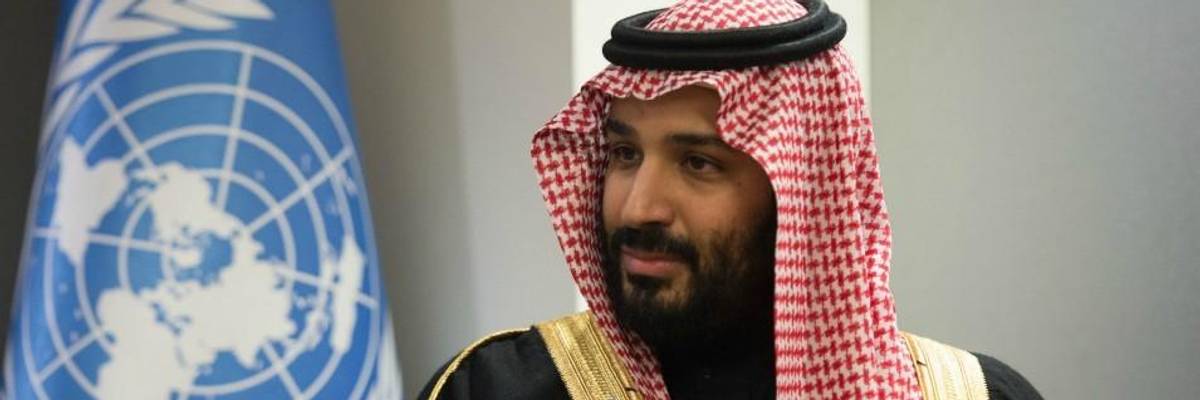
Crown Prince Mohammed bin Salman of Saudi Arabia in Riyadh earlier this month. (Photo: Bryan R. Smith/AFP/Getty Images)
On Monday, the Saudi public prosecutor announced that five people had been sentenced to death for last year's murder of Jamal Khashoggi inside the Saudi Consulate in Istanbul, while three others were sentenced to jail. Notably, the prosecutor also revealed that his office had investigated two top advisers to Crown Prince Mohammed bin Salman--Saud al-Qahtani and Ahmed al-Assiri--but cleared them because of "insufficient evidence."
These verdicts are the antithesis of justice: the hit men are sentenced to death, potentially permanently silencing key witnesses, but the apparent masterminds walk free--barely touched by the investigation and trial. This is exactly what impunity looks like, and it must be denounced. Anyone who cares about freedom of the press--governments, as well as members of the public -- must denounce this travesty until an actual impartial investigation holds those at the highest level responsible.
To this point, the Saudi investigation and trial have been grossly inadequate, failing to meet even minimal international standards. Under international human rights law, the murder of Khashoggi, a Post contributing columnist, was an extrajudicial execution for which the state of Saudi Arabia is responsible. Yet at no point did the investigation or trial consider the responsibilities of the state.
The execution of Khashoggi demands an investigation into the chain of command to identify the masterminds as well as those who incited, allowed or turned a blind eye to the murder, potentially up to Mohammed bin Salman himself. Such an investigation has not taken place. The proceedings so far have also neglected to address the cleanup of the murder scene by 18 Saudi officials at the consulate in Istanbul over more than 10 days. This itself constituted obstruction of justice and a violation of the Minnesota Protocol for the investigation of arbitrary killings. All of this was then compounded by holding the trial behind closed doors, even though there was no justification for doing so under international law.
It is worth noting that, in other cases, the Saudi government has chosen to publicize charges against human rights activists. Its improper secrecy on this occasion thus raises serious questions.
At a bare minimum, Saudi Arabia should not be rewarded with diplomatic visits, or allowed to host international events such as the Group of 20 summit, until true justice has been achieved.
The court's verdict itself makes little sense, given the evidence. It appears to have determined either that the killing was an accident or was planned at the last minute by team leaders on site once they determined they could not kidnap Khashoggi alive. But the evidence clearly shows that his killing was no accident: dismemberment requires planning. The forensic doctor was recruited at least 24 hours before the crime, and that dismemberment was discussed before it actually occurred.
It beggars belief to claim that these five men, now sentenced to death, decided on their own, once in Turkey, to kill a prominent journalist without seeking direction or informing their superiors in Riyadh. Indeed, the defendants themselves repeatedly stated that they were obeying orders. According to my sources, even the Saudi prosecutor had argued that the killing was premeditated. Nonetheless, the crown prince argues, against all the evidence, that this was either an accident or the actions of rogue players. It is no surprise that the judge decided to follow his lead.
As detailed in my report, however, there is credible evidence, warranting further criminal investigation, of the involvement of top Saudi officials, including Qahtani and Mohammed bin Salman. The prosecutor publicly stated that Qahtani had demanded the abduction of Khashoggi on the grounds that he was a threat to national security. The consul general allowed his office to become a crime scene, knowing, at minimum, that kidnapping was intended. He also took all necessary precautions to ensure that there would be no eyewitnesses. The state then appears to have attempted to hide the murder, engaging in what amounted to a state-sponsored cleanup of the crime scene. None of these actions suggests a state committed to justice, to protecting the lives of its citizens, or ensuring that such murders or attempted renditions never occur again.
This trial could not have been held in secret without the complicity of governments who attended and agreed to secrecy. Judging by their participation in several recent events hosted by the kingdom, it is clear that the government officials, chief executives and investors are hoping to move on, given the wealth and geopolitical prominence of Saudi Arabia.
The Saudi verdict may offer them a fig leaf for their complicity. But there has been no justice. The government of Saudi Arabia should not be excused from holding a proper investigation and impartial trial. If it continues to fail to do so, other governments should act in its stead. They should investigate whether criminal prosecutions can occur within their nations. A standing mechanism should be established within the United Nations to make possible investigations of murders such as these.
At a bare minimum, Saudi Arabia should not be rewarded with diplomatic visits, or allowed to host international events such as the Group of 20 summit, until true justice has been achieved. The public should continue to demand that their national leaders seek justice from Saudi Arabia.
Dear Common Dreams reader, It’s been nearly 30 years since I co-founded Common Dreams with my late wife, Lina Newhouser. We had the radical notion that journalism should serve the public good, not corporate profits. It was clear to us from the outset what it would take to build such a project. No paid advertisements. No corporate sponsors. No millionaire publisher telling us what to think or do. Many people said we wouldn't last a year, but we proved those doubters wrong. Together with a tremendous team of journalists and dedicated staff, we built an independent media outlet free from the constraints of profits and corporate control. Our mission has always been simple: To inform. To inspire. To ignite change for the common good. Building Common Dreams was not easy. Our survival was never guaranteed. When you take on the most powerful forces—Wall Street greed, fossil fuel industry destruction, Big Tech lobbyists, and uber-rich oligarchs who have spent billions upon billions rigging the economy and democracy in their favor—the only bulwark you have is supporters who believe in your work. But here’s the urgent message from me today. It's never been this bad out there. And it's never been this hard to keep us going. At the very moment Common Dreams is most needed, the threats we face are intensifying. We need your support now more than ever. We don't accept corporate advertising and never will. We don't have a paywall because we don't think people should be blocked from critical news based on their ability to pay. Everything we do is funded by the donations of readers like you. When everyone does the little they can afford, we are strong. But if that support retreats or dries up, so do we. Will you donate now to make sure Common Dreams not only survives but thrives? —Craig Brown, Co-founder |
On Monday, the Saudi public prosecutor announced that five people had been sentenced to death for last year's murder of Jamal Khashoggi inside the Saudi Consulate in Istanbul, while three others were sentenced to jail. Notably, the prosecutor also revealed that his office had investigated two top advisers to Crown Prince Mohammed bin Salman--Saud al-Qahtani and Ahmed al-Assiri--but cleared them because of "insufficient evidence."
These verdicts are the antithesis of justice: the hit men are sentenced to death, potentially permanently silencing key witnesses, but the apparent masterminds walk free--barely touched by the investigation and trial. This is exactly what impunity looks like, and it must be denounced. Anyone who cares about freedom of the press--governments, as well as members of the public -- must denounce this travesty until an actual impartial investigation holds those at the highest level responsible.
To this point, the Saudi investigation and trial have been grossly inadequate, failing to meet even minimal international standards. Under international human rights law, the murder of Khashoggi, a Post contributing columnist, was an extrajudicial execution for which the state of Saudi Arabia is responsible. Yet at no point did the investigation or trial consider the responsibilities of the state.
The execution of Khashoggi demands an investigation into the chain of command to identify the masterminds as well as those who incited, allowed or turned a blind eye to the murder, potentially up to Mohammed bin Salman himself. Such an investigation has not taken place. The proceedings so far have also neglected to address the cleanup of the murder scene by 18 Saudi officials at the consulate in Istanbul over more than 10 days. This itself constituted obstruction of justice and a violation of the Minnesota Protocol for the investigation of arbitrary killings. All of this was then compounded by holding the trial behind closed doors, even though there was no justification for doing so under international law.
It is worth noting that, in other cases, the Saudi government has chosen to publicize charges against human rights activists. Its improper secrecy on this occasion thus raises serious questions.
At a bare minimum, Saudi Arabia should not be rewarded with diplomatic visits, or allowed to host international events such as the Group of 20 summit, until true justice has been achieved.
The court's verdict itself makes little sense, given the evidence. It appears to have determined either that the killing was an accident or was planned at the last minute by team leaders on site once they determined they could not kidnap Khashoggi alive. But the evidence clearly shows that his killing was no accident: dismemberment requires planning. The forensic doctor was recruited at least 24 hours before the crime, and that dismemberment was discussed before it actually occurred.
It beggars belief to claim that these five men, now sentenced to death, decided on their own, once in Turkey, to kill a prominent journalist without seeking direction or informing their superiors in Riyadh. Indeed, the defendants themselves repeatedly stated that they were obeying orders. According to my sources, even the Saudi prosecutor had argued that the killing was premeditated. Nonetheless, the crown prince argues, against all the evidence, that this was either an accident or the actions of rogue players. It is no surprise that the judge decided to follow his lead.
As detailed in my report, however, there is credible evidence, warranting further criminal investigation, of the involvement of top Saudi officials, including Qahtani and Mohammed bin Salman. The prosecutor publicly stated that Qahtani had demanded the abduction of Khashoggi on the grounds that he was a threat to national security. The consul general allowed his office to become a crime scene, knowing, at minimum, that kidnapping was intended. He also took all necessary precautions to ensure that there would be no eyewitnesses. The state then appears to have attempted to hide the murder, engaging in what amounted to a state-sponsored cleanup of the crime scene. None of these actions suggests a state committed to justice, to protecting the lives of its citizens, or ensuring that such murders or attempted renditions never occur again.
This trial could not have been held in secret without the complicity of governments who attended and agreed to secrecy. Judging by their participation in several recent events hosted by the kingdom, it is clear that the government officials, chief executives and investors are hoping to move on, given the wealth and geopolitical prominence of Saudi Arabia.
The Saudi verdict may offer them a fig leaf for their complicity. But there has been no justice. The government of Saudi Arabia should not be excused from holding a proper investigation and impartial trial. If it continues to fail to do so, other governments should act in its stead. They should investigate whether criminal prosecutions can occur within their nations. A standing mechanism should be established within the United Nations to make possible investigations of murders such as these.
At a bare minimum, Saudi Arabia should not be rewarded with diplomatic visits, or allowed to host international events such as the Group of 20 summit, until true justice has been achieved. The public should continue to demand that their national leaders seek justice from Saudi Arabia.
On Monday, the Saudi public prosecutor announced that five people had been sentenced to death for last year's murder of Jamal Khashoggi inside the Saudi Consulate in Istanbul, while three others were sentenced to jail. Notably, the prosecutor also revealed that his office had investigated two top advisers to Crown Prince Mohammed bin Salman--Saud al-Qahtani and Ahmed al-Assiri--but cleared them because of "insufficient evidence."
These verdicts are the antithesis of justice: the hit men are sentenced to death, potentially permanently silencing key witnesses, but the apparent masterminds walk free--barely touched by the investigation and trial. This is exactly what impunity looks like, and it must be denounced. Anyone who cares about freedom of the press--governments, as well as members of the public -- must denounce this travesty until an actual impartial investigation holds those at the highest level responsible.
To this point, the Saudi investigation and trial have been grossly inadequate, failing to meet even minimal international standards. Under international human rights law, the murder of Khashoggi, a Post contributing columnist, was an extrajudicial execution for which the state of Saudi Arabia is responsible. Yet at no point did the investigation or trial consider the responsibilities of the state.
The execution of Khashoggi demands an investigation into the chain of command to identify the masterminds as well as those who incited, allowed or turned a blind eye to the murder, potentially up to Mohammed bin Salman himself. Such an investigation has not taken place. The proceedings so far have also neglected to address the cleanup of the murder scene by 18 Saudi officials at the consulate in Istanbul over more than 10 days. This itself constituted obstruction of justice and a violation of the Minnesota Protocol for the investigation of arbitrary killings. All of this was then compounded by holding the trial behind closed doors, even though there was no justification for doing so under international law.
It is worth noting that, in other cases, the Saudi government has chosen to publicize charges against human rights activists. Its improper secrecy on this occasion thus raises serious questions.
At a bare minimum, Saudi Arabia should not be rewarded with diplomatic visits, or allowed to host international events such as the Group of 20 summit, until true justice has been achieved.
The court's verdict itself makes little sense, given the evidence. It appears to have determined either that the killing was an accident or was planned at the last minute by team leaders on site once they determined they could not kidnap Khashoggi alive. But the evidence clearly shows that his killing was no accident: dismemberment requires planning. The forensic doctor was recruited at least 24 hours before the crime, and that dismemberment was discussed before it actually occurred.
It beggars belief to claim that these five men, now sentenced to death, decided on their own, once in Turkey, to kill a prominent journalist without seeking direction or informing their superiors in Riyadh. Indeed, the defendants themselves repeatedly stated that they were obeying orders. According to my sources, even the Saudi prosecutor had argued that the killing was premeditated. Nonetheless, the crown prince argues, against all the evidence, that this was either an accident or the actions of rogue players. It is no surprise that the judge decided to follow his lead.
As detailed in my report, however, there is credible evidence, warranting further criminal investigation, of the involvement of top Saudi officials, including Qahtani and Mohammed bin Salman. The prosecutor publicly stated that Qahtani had demanded the abduction of Khashoggi on the grounds that he was a threat to national security. The consul general allowed his office to become a crime scene, knowing, at minimum, that kidnapping was intended. He also took all necessary precautions to ensure that there would be no eyewitnesses. The state then appears to have attempted to hide the murder, engaging in what amounted to a state-sponsored cleanup of the crime scene. None of these actions suggests a state committed to justice, to protecting the lives of its citizens, or ensuring that such murders or attempted renditions never occur again.
This trial could not have been held in secret without the complicity of governments who attended and agreed to secrecy. Judging by their participation in several recent events hosted by the kingdom, it is clear that the government officials, chief executives and investors are hoping to move on, given the wealth and geopolitical prominence of Saudi Arabia.
The Saudi verdict may offer them a fig leaf for their complicity. But there has been no justice. The government of Saudi Arabia should not be excused from holding a proper investigation and impartial trial. If it continues to fail to do so, other governments should act in its stead. They should investigate whether criminal prosecutions can occur within their nations. A standing mechanism should be established within the United Nations to make possible investigations of murders such as these.
At a bare minimum, Saudi Arabia should not be rewarded with diplomatic visits, or allowed to host international events such as the Group of 20 summit, until true justice has been achieved. The public should continue to demand that their national leaders seek justice from Saudi Arabia.