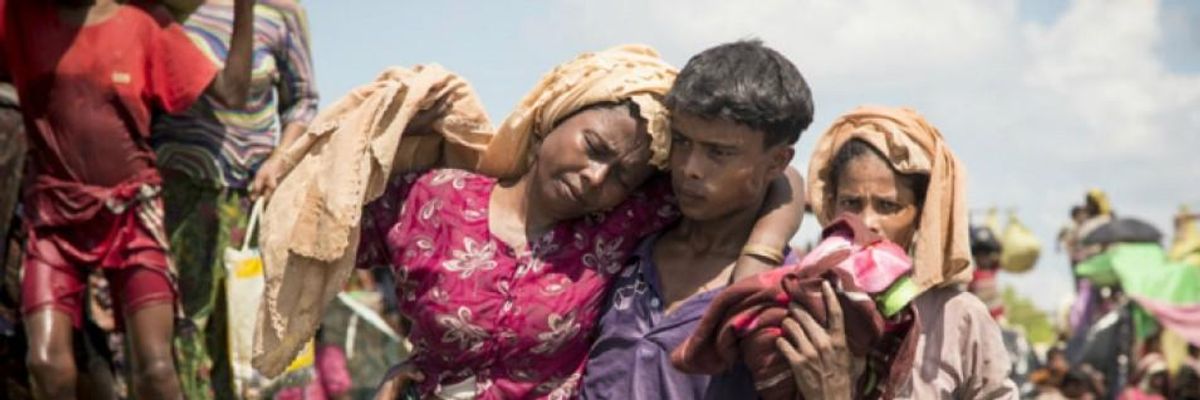
Thousands of new Rohingya refugee arrivals cross the border near Anzuman Para village, Palong Khali, Bangladesh. (Photo: Roger Arnold/UNHCR)
Will Congress Hold Those Who Commit and Profit From Genocide Accountable?
The next phase of the genocide against the Rohingya ethnic minority of Myanmar, formerly known as Burma, is underway. Congress can help stop it by passing a National Defense Authorization Act (NDAA) that incorporates what the House passed a few weeks ago -- sanctions on military-controlled business conglomerates that funded the genocide and are now underwriting its cover-up.
The next phase of the genocide against the Rohingya ethnic minority of Myanmar, formerly known as Burma, is underway. Congress can help stop it by passing a National Defense Authorization Act (NDAA) that incorporates what the House passed a few weeks ago -- sanctions on military-controlled business conglomerates that funded the genocide and are now underwriting its cover-up.
The horrific mass atrocity crimes that the military of Burma committed against the Rohingya have been well documented by the State Department, a U.N. fact-finding mission, and independent human rights organizations. Untold numbers of Rohingya were murdered and maimed and more than 700,000 were forced to run for their lives over the border into Bangladesh. The human rights group Fortify Rights found that military officials made "extensive and systematic preparations" for these genocidal attacks, deploying upwards of 11,000 soldiers.
Those responsible for these horrific crimes have yet to be held accountable. Instead, military-owned business conglomerates have been underwriting construction projects that are destroying evidence as they bulldoze what remain of Rohingya villages. The generals appear eager to make a profit by permanently eliminating the Rohingya from Burma.
This week an independent factfinding mission of the U.N. urged that governments and businesses severe ties with these military owned and controlled companies: "The revenue the military earns from domestic and foreign business deals substantially enhances its ability to carry out gross violations of human rights with impunity."
The report also documents continued cooperation between Burma and North Korea. The Korea Mining Development Trading Corporation continues to export weapons to Burma despite UN Security Council sanctions. The report notes that these exports probably include rocket launchers, surface-to-air missiles and other weapons used to attack ethnic minorities including those in Kachin and Shan State. More than 100,000 ethnic minorities have been forcibly displaced as fighting between the Kachin and Shan and military forces of Burma continues.
Meanwhile, the Rohingya who remain in Rakhine State continue to flee into refugee camps in Bangladesh. The government of Burma has blocked aid to those who remain and last month cut the internet to the more than 1 million people who live in the area. Human rights groups believe that this blackout is masking even more crimes against innocent civilians.
U.S. Secretary of State Pompeo has criticized the internet blackout and a visa ban was recently imposed on four senior military generals -- Commander-in-Chief Min Aung Hlaing, Deputy Commander-in-Chief Soe Win, Brigadier General Than Oo, and Brigadier General Aung Aung. They are among those reportedly responsible for the most egregious human rights violations. While a small step forward, this is woefully inadequate. It would be tragic if the only action taken by our government against those who commit and profit from genocide are words and a prohibition to enter the United States.
It is imperative that further steps are taken and Congress has an excellent opportunity to do so. The NDAA that was recently passed by the U.S. House includes a bipartisan provision that imposes sanctions against military owned and controlled businesses. It also prohibits expansion of American military assistance until reforms take place and requires reporting on crimes against humanity, war crimes and genocide. The provision also supports investigations for the prosecution of war criminals and promotes reforms to limit the military's stranglehold on Burma's economy.
These provisions should be made law. The House-Senate conference committee that will reconcile the two versions of the NDAA should include these important provisions in the bill that they send back to their congressional colleagues for final action. Failure to do so would risk U.S. complicity in a genocide and condemn even more innocent people in Burma to further attacks by signaling that the military of Burma can continue its carnage with impunity. It would also make clear that the U.S. could care less about the lives of the ethnic minorities of Burma who are under siege not because of anything that they have done, but because of who they are.
There is no time to lose.
We are at a crossroads
This country and this world are at a monumental crossroads. In a few short weeks, US voters will have an opportunity to beat back the forces of fascism and confront the billionaires who are rigging the economy, our media system, and our democracy, making it increasingly impossible for ordinary people to get by. We’re not just talking about the election. We’re talking about what must be done once these fascist elements are vanquished from power. We need a bolder set of solutions than what either major party has so far been willing to offer and a working-class movement ready to fight like hell for it. Trump didn't emerge from nowhere. The conditions that fueled MAGA authoritarianism were created by decades of radical neoliberal economic policies and a corrupt political system dominated by corporate interests. They slashed taxes on the super-rich, promising that the benefits would trickle down. They said giveaways to the corporate titans would make life more affordable for the rest of us. It was all bullshit. And when a bitter, betrayed populace searches for someone to blame, right-wing demagogues have little trouble finding scapegoats. People know when they're being lied to, but you won't hear any of this from the corporate media. Only independent journalism—powered and funded by people who believe in building a better world—can deliver truly trustworthy daily news. Our Fall Campaign is underway, and we need your help. To power our newsroom through the rest of the year, we need to raise $125,000 by midnight on October 31. So if you share our vision, please contribute whatever you can to sustain our work. |
The next phase of the genocide against the Rohingya ethnic minority of Myanmar, formerly known as Burma, is underway. Congress can help stop it by passing a National Defense Authorization Act (NDAA) that incorporates what the House passed a few weeks ago -- sanctions on military-controlled business conglomerates that funded the genocide and are now underwriting its cover-up.
The horrific mass atrocity crimes that the military of Burma committed against the Rohingya have been well documented by the State Department, a U.N. fact-finding mission, and independent human rights organizations. Untold numbers of Rohingya were murdered and maimed and more than 700,000 were forced to run for their lives over the border into Bangladesh. The human rights group Fortify Rights found that military officials made "extensive and systematic preparations" for these genocidal attacks, deploying upwards of 11,000 soldiers.
Those responsible for these horrific crimes have yet to be held accountable. Instead, military-owned business conglomerates have been underwriting construction projects that are destroying evidence as they bulldoze what remain of Rohingya villages. The generals appear eager to make a profit by permanently eliminating the Rohingya from Burma.
This week an independent factfinding mission of the U.N. urged that governments and businesses severe ties with these military owned and controlled companies: "The revenue the military earns from domestic and foreign business deals substantially enhances its ability to carry out gross violations of human rights with impunity."
The report also documents continued cooperation between Burma and North Korea. The Korea Mining Development Trading Corporation continues to export weapons to Burma despite UN Security Council sanctions. The report notes that these exports probably include rocket launchers, surface-to-air missiles and other weapons used to attack ethnic minorities including those in Kachin and Shan State. More than 100,000 ethnic minorities have been forcibly displaced as fighting between the Kachin and Shan and military forces of Burma continues.
Meanwhile, the Rohingya who remain in Rakhine State continue to flee into refugee camps in Bangladesh. The government of Burma has blocked aid to those who remain and last month cut the internet to the more than 1 million people who live in the area. Human rights groups believe that this blackout is masking even more crimes against innocent civilians.
U.S. Secretary of State Pompeo has criticized the internet blackout and a visa ban was recently imposed on four senior military generals -- Commander-in-Chief Min Aung Hlaing, Deputy Commander-in-Chief Soe Win, Brigadier General Than Oo, and Brigadier General Aung Aung. They are among those reportedly responsible for the most egregious human rights violations. While a small step forward, this is woefully inadequate. It would be tragic if the only action taken by our government against those who commit and profit from genocide are words and a prohibition to enter the United States.
It is imperative that further steps are taken and Congress has an excellent opportunity to do so. The NDAA that was recently passed by the U.S. House includes a bipartisan provision that imposes sanctions against military owned and controlled businesses. It also prohibits expansion of American military assistance until reforms take place and requires reporting on crimes against humanity, war crimes and genocide. The provision also supports investigations for the prosecution of war criminals and promotes reforms to limit the military's stranglehold on Burma's economy.
These provisions should be made law. The House-Senate conference committee that will reconcile the two versions of the NDAA should include these important provisions in the bill that they send back to their congressional colleagues for final action. Failure to do so would risk U.S. complicity in a genocide and condemn even more innocent people in Burma to further attacks by signaling that the military of Burma can continue its carnage with impunity. It would also make clear that the U.S. could care less about the lives of the ethnic minorities of Burma who are under siege not because of anything that they have done, but because of who they are.
There is no time to lose.