SUBSCRIBE TO OUR FREE NEWSLETTER
Daily news & progressive opinion—funded by the people, not the corporations—delivered straight to your inbox.
5
#000000
#FFFFFF
To donate by check, phone, or other method, see our More Ways to Give page.
Daily news & progressive opinion—funded by the people, not the corporations—delivered straight to your inbox.
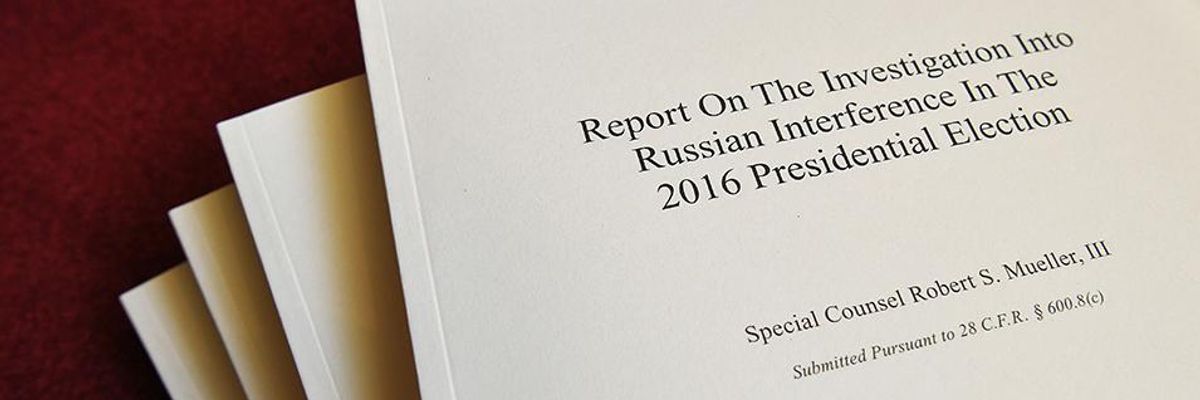
Copies of the "Mueller Report" printed by the US Government Publishing Office are seen at the US Capitol in Washington, DC on April 24, 2019. (MANDEL NGAN/AFP/Getty Images)
Imagine for a moment that political discussions can assume the same evidence-based knowledge as active components in decision making as treatment pathways do when responding to illness and disease. The impact of care is studied out of a need for protecting and preserving quality of life. Politics should also serve these same ends, but, indeed, politics carries a burden healthcare does not: different values. Forgetting that there are legitimate differences in values--like I prioritize equality over security or others prioritize fiscal responsibility over freedom--let's briefly return to the idea of truth as a foundation for politics and policy.
Ignorance presents a challenge to truth. After all, there is no way to accommodate good decision making when there are serious gaps in information. Medical professionals make diagnostic tests in order to figure out what's wrong, the same as mechanics do when the check engine light comes on in your car. Drinking water, for example, will help alleviate a headache caused by dehydration but is unlikely to help much for a headache caused by meningitis.
The (then) War Department, published, in Washington, D.C., November 30, 1928. It provides instruction on being a citizen, and describes and defines key terms. "These precise and scholarly definitions of a Democracy and a Republic were carefully considered as a proper guide for U.S. soldiers and U.S. citizens by the Chief of Staff of the United States Army." What people should, or should not do, has always been a source of conflict, but "a well informed public" is enumerated in most democratic proscriptions. After all, the power is in the hands of the people and information is prerequisite to good decision making. The current political crisis in the United States could actually be resolved with evidence-based decision making.
Do not take my word for it, read the "Report on the Investigation into Russian Interference in the 2016 Presidential Election" (in short: "Mueller Report") yourself. Once you have read it you will likely have the same conclusion that everyone (except William Barr, but virtually literally everyone else) has. An abbreviated list of the evidence:
Or, read the executive summaries provided with the report, volume 1 (pp. 4-10) and volume 2 (pp. 1-8) provide the reader with the important conclusions from an assessment of the evidence.
If, as a country, we do not seriously push back against dishonest politicians and the politics of corruption, then we are responsible for the ugly outcomes. Walter Cronkite said, "Freedom is a package deal... with it comes responsibilities and consequences." I believe we have moved past the point of debate; the facts are crystal clear as is the next step. But we have not moved at all; we are living in the gross injustice of dishonesty--we are failed by citizens ignoring their patriotic responsibilities to inform themselves and respond to the undeniable corruption and we are more supremely punished by the death of democracy. Political thieves are getting away with their immoral and illegitimate inaction by claiming all the power, even though the numb and fatigued public could seize it legitimately. Reclaim the urgency and higher ground by addressing the ignorance and dishonesty of our times--read and react to the Mueller Report--or you will be sorry.
Dear Common Dreams reader, It’s been nearly 30 years since I co-founded Common Dreams with my late wife, Lina Newhouser. We had the radical notion that journalism should serve the public good, not corporate profits. It was clear to us from the outset what it would take to build such a project. No paid advertisements. No corporate sponsors. No millionaire publisher telling us what to think or do. Many people said we wouldn't last a year, but we proved those doubters wrong. Together with a tremendous team of journalists and dedicated staff, we built an independent media outlet free from the constraints of profits and corporate control. Our mission has always been simple: To inform. To inspire. To ignite change for the common good. Building Common Dreams was not easy. Our survival was never guaranteed. When you take on the most powerful forces—Wall Street greed, fossil fuel industry destruction, Big Tech lobbyists, and uber-rich oligarchs who have spent billions upon billions rigging the economy and democracy in their favor—the only bulwark you have is supporters who believe in your work. But here’s the urgent message from me today. It's never been this bad out there. And it's never been this hard to keep us going. At the very moment Common Dreams is most needed, the threats we face are intensifying. We need your support now more than ever. We don't accept corporate advertising and never will. We don't have a paywall because we don't think people should be blocked from critical news based on their ability to pay. Everything we do is funded by the donations of readers like you. When everyone does the little they can afford, we are strong. But if that support retreats or dries up, so do we. Will you donate now to make sure Common Dreams not only survives but thrives? —Craig Brown, Co-founder |
Imagine for a moment that political discussions can assume the same evidence-based knowledge as active components in decision making as treatment pathways do when responding to illness and disease. The impact of care is studied out of a need for protecting and preserving quality of life. Politics should also serve these same ends, but, indeed, politics carries a burden healthcare does not: different values. Forgetting that there are legitimate differences in values--like I prioritize equality over security or others prioritize fiscal responsibility over freedom--let's briefly return to the idea of truth as a foundation for politics and policy.
Ignorance presents a challenge to truth. After all, there is no way to accommodate good decision making when there are serious gaps in information. Medical professionals make diagnostic tests in order to figure out what's wrong, the same as mechanics do when the check engine light comes on in your car. Drinking water, for example, will help alleviate a headache caused by dehydration but is unlikely to help much for a headache caused by meningitis.
The (then) War Department, published, in Washington, D.C., November 30, 1928. It provides instruction on being a citizen, and describes and defines key terms. "These precise and scholarly definitions of a Democracy and a Republic were carefully considered as a proper guide for U.S. soldiers and U.S. citizens by the Chief of Staff of the United States Army." What people should, or should not do, has always been a source of conflict, but "a well informed public" is enumerated in most democratic proscriptions. After all, the power is in the hands of the people and information is prerequisite to good decision making. The current political crisis in the United States could actually be resolved with evidence-based decision making.
Do not take my word for it, read the "Report on the Investigation into Russian Interference in the 2016 Presidential Election" (in short: "Mueller Report") yourself. Once you have read it you will likely have the same conclusion that everyone (except William Barr, but virtually literally everyone else) has. An abbreviated list of the evidence:
Or, read the executive summaries provided with the report, volume 1 (pp. 4-10) and volume 2 (pp. 1-8) provide the reader with the important conclusions from an assessment of the evidence.
If, as a country, we do not seriously push back against dishonest politicians and the politics of corruption, then we are responsible for the ugly outcomes. Walter Cronkite said, "Freedom is a package deal... with it comes responsibilities and consequences." I believe we have moved past the point of debate; the facts are crystal clear as is the next step. But we have not moved at all; we are living in the gross injustice of dishonesty--we are failed by citizens ignoring their patriotic responsibilities to inform themselves and respond to the undeniable corruption and we are more supremely punished by the death of democracy. Political thieves are getting away with their immoral and illegitimate inaction by claiming all the power, even though the numb and fatigued public could seize it legitimately. Reclaim the urgency and higher ground by addressing the ignorance and dishonesty of our times--read and react to the Mueller Report--or you will be sorry.
Imagine for a moment that political discussions can assume the same evidence-based knowledge as active components in decision making as treatment pathways do when responding to illness and disease. The impact of care is studied out of a need for protecting and preserving quality of life. Politics should also serve these same ends, but, indeed, politics carries a burden healthcare does not: different values. Forgetting that there are legitimate differences in values--like I prioritize equality over security or others prioritize fiscal responsibility over freedom--let's briefly return to the idea of truth as a foundation for politics and policy.
Ignorance presents a challenge to truth. After all, there is no way to accommodate good decision making when there are serious gaps in information. Medical professionals make diagnostic tests in order to figure out what's wrong, the same as mechanics do when the check engine light comes on in your car. Drinking water, for example, will help alleviate a headache caused by dehydration but is unlikely to help much for a headache caused by meningitis.
The (then) War Department, published, in Washington, D.C., November 30, 1928. It provides instruction on being a citizen, and describes and defines key terms. "These precise and scholarly definitions of a Democracy and a Republic were carefully considered as a proper guide for U.S. soldiers and U.S. citizens by the Chief of Staff of the United States Army." What people should, or should not do, has always been a source of conflict, but "a well informed public" is enumerated in most democratic proscriptions. After all, the power is in the hands of the people and information is prerequisite to good decision making. The current political crisis in the United States could actually be resolved with evidence-based decision making.
Do not take my word for it, read the "Report on the Investigation into Russian Interference in the 2016 Presidential Election" (in short: "Mueller Report") yourself. Once you have read it you will likely have the same conclusion that everyone (except William Barr, but virtually literally everyone else) has. An abbreviated list of the evidence:
Or, read the executive summaries provided with the report, volume 1 (pp. 4-10) and volume 2 (pp. 1-8) provide the reader with the important conclusions from an assessment of the evidence.
If, as a country, we do not seriously push back against dishonest politicians and the politics of corruption, then we are responsible for the ugly outcomes. Walter Cronkite said, "Freedom is a package deal... with it comes responsibilities and consequences." I believe we have moved past the point of debate; the facts are crystal clear as is the next step. But we have not moved at all; we are living in the gross injustice of dishonesty--we are failed by citizens ignoring their patriotic responsibilities to inform themselves and respond to the undeniable corruption and we are more supremely punished by the death of democracy. Political thieves are getting away with their immoral and illegitimate inaction by claiming all the power, even though the numb and fatigued public could seize it legitimately. Reclaim the urgency and higher ground by addressing the ignorance and dishonesty of our times--read and react to the Mueller Report--or you will be sorry.