

SUBSCRIBE TO OUR FREE NEWSLETTER
Daily news & progressive opinion—funded by the people, not the corporations—delivered straight to your inbox.
5
#000000
#FFFFFF
To donate by check, phone, or other method, see our More Ways to Give page.
Daily news & progressive opinion—funded by the people, not the corporations—delivered straight to your inbox.
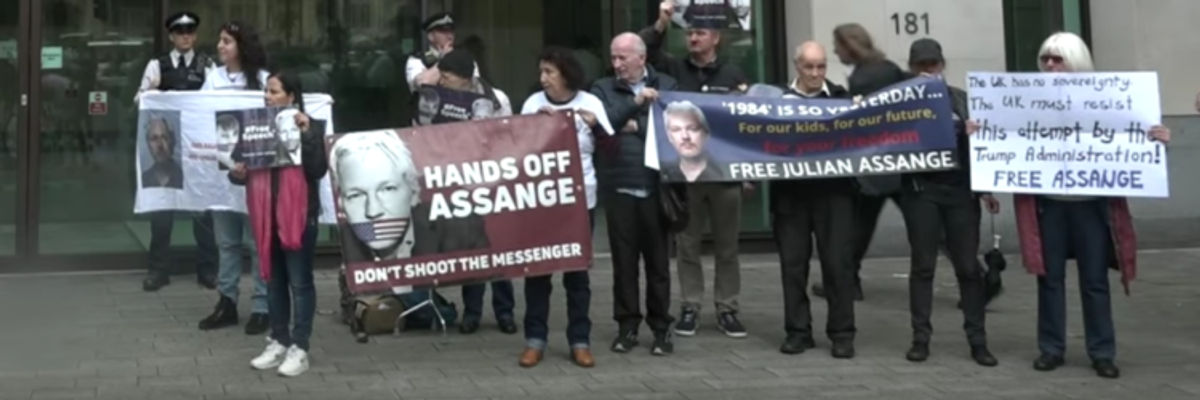
Supporters of Julian Assange demonstrate outside court in London. (Photo: Screen shot from Ruptly livestream)
In the United States government's extradition case against WikiLeaks founder Julian Assange, his attorneys agreed to a "long timetable" so he may prepare his defense against "incredibly serious charges, which impact upon typical newsgathering activities."
Judge Emma Arbuthnot set a five-day hearing over the extradition request that will take place in late February 2020. One of the first major filings in the case will come from the U.S. government in July.
Assange faces 17 counts of allegedly violating the Espionage Act for publishing classified information from Chelsea Manning and one conspiracy to commit computer intrusion charge related to the publication.
During brief proceedings at the Westminster Magistrates Court, Assange appeared via video from Belmarsh prison, where he is serving a 50-week sentence for violating bail conditions when he sought political asylum from Ecuador. His attorneys are appealing his sentence.
"We are very concerned about his health," declared Jen Robinson, one of Assange's attorneys. "He remains in the health care ward of Belmarsh, and he is under a huge amount of pressure and in very difficult circumstances.
"He's facing a significant complex case of huge size and scale. And that is an incredible pressure to be placed on someone who's already suffered significant health impacts as a result of his continued confinement inside the embassy and now inside prison," Robinson added.
Assange's attorneys said they are having trouble accessing him while he is in Belmarsh, and they foresee difficulties in preparing a defense against the U.S. government's accusations. He does not have access to a computer.
While appearing via video, Assange reportedly criticized media coverage of his case and said there was significant misreporting. He addressed the computer intrusion charge and asserted he engaged in no hacking.
Sajid Javid, the UK's Home Secretary, signed the extradition request from the U.S. on June 13, clearing the way for the legal process to unfold against Assange. "He's rightly behind bars."
"I want to see justice done at all times, and we've got a legitimate extradition request, so I've signed it," he suggested.
Like with prior procedural hearings since Assange was expelled from the Ecuador embassy and arrested on April 11, there were dozens of supporters outside the courthouse. They chanted, "There's only one position! No extradition!"
Lauri Love, an activist and computer scientist who faced extradition to the U.S. for allegedly hacking into U.S. systems but won his case, spoke to Assange supporters.
"Nobody in a position of power is able to absolve themselves of considering the human rights of the people whose fates they decide and so we have a duty and an obligation to continue fighting, as people fought for me, which I will be eternally grateful for the rest of my life," Love stated.
If Assange is extradited, Love maintained "none of us should be able to live with ourselves because we'll have betrayed a human being of immense courage and principles, and we'll have betrayed journalism and truth."
"This indictment is a direct attack on free speech and a direct attack on journalists and publishers everywhere," Robinson contended. "It should be a matter of grave concern for all media organizations and free speech groups, which is why we've heard significant criticisms of the U.S. attempt to extradite him on these terms."
Manning remains in jail at the William G. Truesdale Adult Detention Center in Alexandria, Virginia. She refuses to testify before a grand jury investigating WikiLeaks.
Starting June 16, Manning will be fined $500 every day she resists the grand jury for the next 30 days. She will be fined $1,000 every day that she resists the grand jury until it is no longer empaneled.
The fines could total more than $440,000 by the time the grand jury's term expires, and her attorneys have challenged the process in which a federal judge levied these sanctions against Manning.
Espionage Act charges against Assange revealed the Justice Department is relying on a theory of the case, which was concocted and partly tested during Manning's military trial in 2013.
The theory adopts the CIA's viewpoint, which is that WikiLeaks is a "non-state hostile intelligence service," and suggests Assange recruited Manning as an insider or spy.
A statement Manning provided to the military court when she pled guilty to some charges in February 2013 contradicts substantial parts of the government's claims.
The need to discredit Manning's testimony and attack the relationship that allegedly formed between a source and a publisher is and will remain central to the U.S. government's case.
Dear Common Dreams reader, It’s been nearly 30 years since I co-founded Common Dreams with my late wife, Lina Newhouser. We had the radical notion that journalism should serve the public good, not corporate profits. It was clear to us from the outset what it would take to build such a project. No paid advertisements. No corporate sponsors. No millionaire publisher telling us what to think or do. Many people said we wouldn't last a year, but we proved those doubters wrong. Together with a tremendous team of journalists and dedicated staff, we built an independent media outlet free from the constraints of profits and corporate control. Our mission has always been simple: To inform. To inspire. To ignite change for the common good. Building Common Dreams was not easy. Our survival was never guaranteed. When you take on the most powerful forces—Wall Street greed, fossil fuel industry destruction, Big Tech lobbyists, and uber-rich oligarchs who have spent billions upon billions rigging the economy and democracy in their favor—the only bulwark you have is supporters who believe in your work. But here’s the urgent message from me today. It's never been this bad out there. And it's never been this hard to keep us going. At the very moment Common Dreams is most needed, the threats we face are intensifying. We need your support now more than ever. We don't accept corporate advertising and never will. We don't have a paywall because we don't think people should be blocked from critical news based on their ability to pay. Everything we do is funded by the donations of readers like you. When everyone does the little they can afford, we are strong. But if that support retreats or dries up, so do we. Will you donate now to make sure Common Dreams not only survives but thrives? —Craig Brown, Co-founder |
In the United States government's extradition case against WikiLeaks founder Julian Assange, his attorneys agreed to a "long timetable" so he may prepare his defense against "incredibly serious charges, which impact upon typical newsgathering activities."
Judge Emma Arbuthnot set a five-day hearing over the extradition request that will take place in late February 2020. One of the first major filings in the case will come from the U.S. government in July.
Assange faces 17 counts of allegedly violating the Espionage Act for publishing classified information from Chelsea Manning and one conspiracy to commit computer intrusion charge related to the publication.
During brief proceedings at the Westminster Magistrates Court, Assange appeared via video from Belmarsh prison, where he is serving a 50-week sentence for violating bail conditions when he sought political asylum from Ecuador. His attorneys are appealing his sentence.
"We are very concerned about his health," declared Jen Robinson, one of Assange's attorneys. "He remains in the health care ward of Belmarsh, and he is under a huge amount of pressure and in very difficult circumstances.
"He's facing a significant complex case of huge size and scale. And that is an incredible pressure to be placed on someone who's already suffered significant health impacts as a result of his continued confinement inside the embassy and now inside prison," Robinson added.
Assange's attorneys said they are having trouble accessing him while he is in Belmarsh, and they foresee difficulties in preparing a defense against the U.S. government's accusations. He does not have access to a computer.
While appearing via video, Assange reportedly criticized media coverage of his case and said there was significant misreporting. He addressed the computer intrusion charge and asserted he engaged in no hacking.
Sajid Javid, the UK's Home Secretary, signed the extradition request from the U.S. on June 13, clearing the way for the legal process to unfold against Assange. "He's rightly behind bars."
"I want to see justice done at all times, and we've got a legitimate extradition request, so I've signed it," he suggested.
Like with prior procedural hearings since Assange was expelled from the Ecuador embassy and arrested on April 11, there were dozens of supporters outside the courthouse. They chanted, "There's only one position! No extradition!"
Lauri Love, an activist and computer scientist who faced extradition to the U.S. for allegedly hacking into U.S. systems but won his case, spoke to Assange supporters.
"Nobody in a position of power is able to absolve themselves of considering the human rights of the people whose fates they decide and so we have a duty and an obligation to continue fighting, as people fought for me, which I will be eternally grateful for the rest of my life," Love stated.
If Assange is extradited, Love maintained "none of us should be able to live with ourselves because we'll have betrayed a human being of immense courage and principles, and we'll have betrayed journalism and truth."
"This indictment is a direct attack on free speech and a direct attack on journalists and publishers everywhere," Robinson contended. "It should be a matter of grave concern for all media organizations and free speech groups, which is why we've heard significant criticisms of the U.S. attempt to extradite him on these terms."
Manning remains in jail at the William G. Truesdale Adult Detention Center in Alexandria, Virginia. She refuses to testify before a grand jury investigating WikiLeaks.
Starting June 16, Manning will be fined $500 every day she resists the grand jury for the next 30 days. She will be fined $1,000 every day that she resists the grand jury until it is no longer empaneled.
The fines could total more than $440,000 by the time the grand jury's term expires, and her attorneys have challenged the process in which a federal judge levied these sanctions against Manning.
Espionage Act charges against Assange revealed the Justice Department is relying on a theory of the case, which was concocted and partly tested during Manning's military trial in 2013.
The theory adopts the CIA's viewpoint, which is that WikiLeaks is a "non-state hostile intelligence service," and suggests Assange recruited Manning as an insider or spy.
A statement Manning provided to the military court when she pled guilty to some charges in February 2013 contradicts substantial parts of the government's claims.
The need to discredit Manning's testimony and attack the relationship that allegedly formed between a source and a publisher is and will remain central to the U.S. government's case.
In the United States government's extradition case against WikiLeaks founder Julian Assange, his attorneys agreed to a "long timetable" so he may prepare his defense against "incredibly serious charges, which impact upon typical newsgathering activities."
Judge Emma Arbuthnot set a five-day hearing over the extradition request that will take place in late February 2020. One of the first major filings in the case will come from the U.S. government in July.
Assange faces 17 counts of allegedly violating the Espionage Act for publishing classified information from Chelsea Manning and one conspiracy to commit computer intrusion charge related to the publication.
During brief proceedings at the Westminster Magistrates Court, Assange appeared via video from Belmarsh prison, where he is serving a 50-week sentence for violating bail conditions when he sought political asylum from Ecuador. His attorneys are appealing his sentence.
"We are very concerned about his health," declared Jen Robinson, one of Assange's attorneys. "He remains in the health care ward of Belmarsh, and he is under a huge amount of pressure and in very difficult circumstances.
"He's facing a significant complex case of huge size and scale. And that is an incredible pressure to be placed on someone who's already suffered significant health impacts as a result of his continued confinement inside the embassy and now inside prison," Robinson added.
Assange's attorneys said they are having trouble accessing him while he is in Belmarsh, and they foresee difficulties in preparing a defense against the U.S. government's accusations. He does not have access to a computer.
While appearing via video, Assange reportedly criticized media coverage of his case and said there was significant misreporting. He addressed the computer intrusion charge and asserted he engaged in no hacking.
Sajid Javid, the UK's Home Secretary, signed the extradition request from the U.S. on June 13, clearing the way for the legal process to unfold against Assange. "He's rightly behind bars."
"I want to see justice done at all times, and we've got a legitimate extradition request, so I've signed it," he suggested.
Like with prior procedural hearings since Assange was expelled from the Ecuador embassy and arrested on April 11, there were dozens of supporters outside the courthouse. They chanted, "There's only one position! No extradition!"
Lauri Love, an activist and computer scientist who faced extradition to the U.S. for allegedly hacking into U.S. systems but won his case, spoke to Assange supporters.
"Nobody in a position of power is able to absolve themselves of considering the human rights of the people whose fates they decide and so we have a duty and an obligation to continue fighting, as people fought for me, which I will be eternally grateful for the rest of my life," Love stated.
If Assange is extradited, Love maintained "none of us should be able to live with ourselves because we'll have betrayed a human being of immense courage and principles, and we'll have betrayed journalism and truth."
"This indictment is a direct attack on free speech and a direct attack on journalists and publishers everywhere," Robinson contended. "It should be a matter of grave concern for all media organizations and free speech groups, which is why we've heard significant criticisms of the U.S. attempt to extradite him on these terms."
Manning remains in jail at the William G. Truesdale Adult Detention Center in Alexandria, Virginia. She refuses to testify before a grand jury investigating WikiLeaks.
Starting June 16, Manning will be fined $500 every day she resists the grand jury for the next 30 days. She will be fined $1,000 every day that she resists the grand jury until it is no longer empaneled.
The fines could total more than $440,000 by the time the grand jury's term expires, and her attorneys have challenged the process in which a federal judge levied these sanctions against Manning.
Espionage Act charges against Assange revealed the Justice Department is relying on a theory of the case, which was concocted and partly tested during Manning's military trial in 2013.
The theory adopts the CIA's viewpoint, which is that WikiLeaks is a "non-state hostile intelligence service," and suggests Assange recruited Manning as an insider or spy.
A statement Manning provided to the military court when she pled guilty to some charges in February 2013 contradicts substantial parts of the government's claims.
The need to discredit Manning's testimony and attack the relationship that allegedly formed between a source and a publisher is and will remain central to the U.S. government's case.

