SUBSCRIBE TO OUR FREE NEWSLETTER
Daily news & progressive opinion—funded by the people, not the corporations—delivered straight to your inbox.
5
#000000
#FFFFFF
To donate by check, phone, or other method, see our More Ways to Give page.
Daily news & progressive opinion—funded by the people, not the corporations—delivered straight to your inbox.
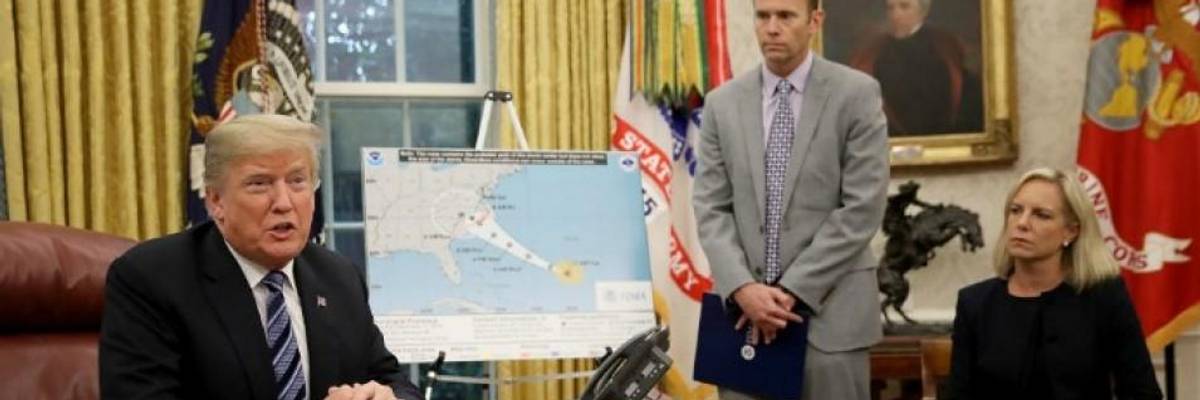
Trump's immigration policies are appalling in almost every aspect. (Photo: Win McNamee/Getty Images)
Kirstjen Nielsen's forced resignation as US Secretary of Homeland Security is no reason to celebrate. Yes, she presided over the forced separation of families at the US border, notoriously housing young children in wire cages. But Nielsen's departure is not likely to bring any improvement, as President Donald Trump wants to replace her with someone who will carry out his anti-immigrant policies even more ruthlessly.
Trump's immigration policies are appalling in almost every aspect. And yet they may not be the worst feature of his administration. Indeed, identifying its foulest aspects has become a popular American parlor game. Yes, he has called immigrants criminals, rapists, and animals. But what about his deep misogyny or his boundless vulgarity and cruelty? Or his winking support of white supremacists? Or his withdrawal from the Paris climate accord, the Iran nuclear deal, and the Intermediate-Range Nuclear Forces Treaty? And, of course, there is his war on the environment, on health care, and on the rules-based international system.
Trump is a disrupting personality, and after he's gone, we may well reflect on how such a deranged and morally challenged person could have been elected president of the world's most powerful country in the first place.
This morbid game never ends, of course, because new contenders for the title emerge almost daily. Trump is a disrupting personality, and after he's gone, we may well reflect on how such a deranged and morally challenged person could have been elected president of the world's most powerful country in the first place.
But what concerns me most is Trump's disruption of the institutions that are necessary for the functioning of society. Trump's "MAGA" (Make America Great Again) agenda is, of course, not about restoring the moral leadership of the United States. It embodies and celebrates unbridled selfishness and self-absorption. MAGA is about economics. But that forces us to ask: what is the basis of America's wealth?
Adam Smith tried to provide an answer in his classic 1776 book The Wealth of Nations. For centuries, Smith noted, standards of living had been stagnant; then, toward the end of the eighteenth century, incomes start to soar. Why?
Smith himself was a leading light of the great intellectual movement known as the Scottish Enlightenment. The questioning of established authority that followed the earlier Reformation in Europe forced society to ask: How do we know the truth? How can we learn about the world around us? And how can and should we organize our society?
From the search for answers to these questions arose a new epistemology, based on the empiricism and skepticism of science, which came to prevail over the forces of religion, tradition, and superstition. Over time, universities and other research institutions were established to help us judge truth and discover the nature of our world. Much of what we take for granted today - from electricity, transistors, and computers to lasers, modern medicine, and smartphones - is the result of this new disposition, undergirded by basic scientific research (most of it financed by government).
The absence of royal or ecclesiastical authority to dictate how society should be organized to ensure that things worked out well, or as well as they could, meant that society had to figure it out for itself. But devising the institutions that would ensure society's wellbeing was a more complicated matter than discovering the truths of nature. In general, one couldn't conduct controlled experiments.
A close study of past experience could, however, be informative. One had to rely on reasoning and discourse - recognizing that no individual had a monopoly on our understandings of social organization. Out of this process emerged an appreciation that governance institutions based on the rule of law, due process, and checks and balances, and supported by foundational values like individual liberty and justice for all, are more likely to produce good and fair decisions. These institutions may not be perfect, but they have been designed so that it is more likely that flaws will be uncovered and eventually corrected.
That process of experimentation, learning, and adaptation, however, requires a commitment to ascertaining the truth. Americans owe much of their economic success to a rich set of truth-telling, truth-discovering, and truth-verifying institutions. Central among them are freedom of expression and independent media. Like all people, journalists are fallible; but, as part of a robust system of checks and balances on those in positions of power, they have traditionally provided an essential public good.
Since Smith's day, it has been shown that a nation's wealth depends on the creativity and productivity of its people, which can be advanced only by embracing the spirit of scientific discovery and technological innovation. And it depends on steady improvements in social, political, and economic organization, discovered through reasoned public discourse.
The attack by Trump and his administration on every one of the pillars of American society - and his especially aggressive vilification of the country's truth-seeking institutions - jeopardizes its continued prosperity and very ability to function as a democracy. Nor do there appear to be checks on corporate giants' efforts to capture the institutions - the courts, legislatures, regulatory agencies, and major media outlets - that are supposed to prevent them from exploiting workers and consumers. A dystopia previously imagined only by science fiction writers is emerging before our eyes. It should give us chills to think of who "wins" in this world, and who or what we might become, just in the struggle to survive.
Dear Common Dreams reader, It’s been nearly 30 years since I co-founded Common Dreams with my late wife, Lina Newhouser. We had the radical notion that journalism should serve the public good, not corporate profits. It was clear to us from the outset what it would take to build such a project. No paid advertisements. No corporate sponsors. No millionaire publisher telling us what to think or do. Many people said we wouldn't last a year, but we proved those doubters wrong. Together with a tremendous team of journalists and dedicated staff, we built an independent media outlet free from the constraints of profits and corporate control. Our mission has always been simple: To inform. To inspire. To ignite change for the common good. Building Common Dreams was not easy. Our survival was never guaranteed. When you take on the most powerful forces—Wall Street greed, fossil fuel industry destruction, Big Tech lobbyists, and uber-rich oligarchs who have spent billions upon billions rigging the economy and democracy in their favor—the only bulwark you have is supporters who believe in your work. But here’s the urgent message from me today. It's never been this bad out there. And it's never been this hard to keep us going. At the very moment Common Dreams is most needed, the threats we face are intensifying. We need your support now more than ever. We don't accept corporate advertising and never will. We don't have a paywall because we don't think people should be blocked from critical news based on their ability to pay. Everything we do is funded by the donations of readers like you. When everyone does the little they can afford, we are strong. But if that support retreats or dries up, so do we. Will you donate now to make sure Common Dreams not only survives but thrives? —Craig Brown, Co-founder |
Kirstjen Nielsen's forced resignation as US Secretary of Homeland Security is no reason to celebrate. Yes, she presided over the forced separation of families at the US border, notoriously housing young children in wire cages. But Nielsen's departure is not likely to bring any improvement, as President Donald Trump wants to replace her with someone who will carry out his anti-immigrant policies even more ruthlessly.
Trump's immigration policies are appalling in almost every aspect. And yet they may not be the worst feature of his administration. Indeed, identifying its foulest aspects has become a popular American parlor game. Yes, he has called immigrants criminals, rapists, and animals. But what about his deep misogyny or his boundless vulgarity and cruelty? Or his winking support of white supremacists? Or his withdrawal from the Paris climate accord, the Iran nuclear deal, and the Intermediate-Range Nuclear Forces Treaty? And, of course, there is his war on the environment, on health care, and on the rules-based international system.
Trump is a disrupting personality, and after he's gone, we may well reflect on how such a deranged and morally challenged person could have been elected president of the world's most powerful country in the first place.
This morbid game never ends, of course, because new contenders for the title emerge almost daily. Trump is a disrupting personality, and after he's gone, we may well reflect on how such a deranged and morally challenged person could have been elected president of the world's most powerful country in the first place.
But what concerns me most is Trump's disruption of the institutions that are necessary for the functioning of society. Trump's "MAGA" (Make America Great Again) agenda is, of course, not about restoring the moral leadership of the United States. It embodies and celebrates unbridled selfishness and self-absorption. MAGA is about economics. But that forces us to ask: what is the basis of America's wealth?
Adam Smith tried to provide an answer in his classic 1776 book The Wealth of Nations. For centuries, Smith noted, standards of living had been stagnant; then, toward the end of the eighteenth century, incomes start to soar. Why?
Smith himself was a leading light of the great intellectual movement known as the Scottish Enlightenment. The questioning of established authority that followed the earlier Reformation in Europe forced society to ask: How do we know the truth? How can we learn about the world around us? And how can and should we organize our society?
From the search for answers to these questions arose a new epistemology, based on the empiricism and skepticism of science, which came to prevail over the forces of religion, tradition, and superstition. Over time, universities and other research institutions were established to help us judge truth and discover the nature of our world. Much of what we take for granted today - from electricity, transistors, and computers to lasers, modern medicine, and smartphones - is the result of this new disposition, undergirded by basic scientific research (most of it financed by government).
The absence of royal or ecclesiastical authority to dictate how society should be organized to ensure that things worked out well, or as well as they could, meant that society had to figure it out for itself. But devising the institutions that would ensure society's wellbeing was a more complicated matter than discovering the truths of nature. In general, one couldn't conduct controlled experiments.
A close study of past experience could, however, be informative. One had to rely on reasoning and discourse - recognizing that no individual had a monopoly on our understandings of social organization. Out of this process emerged an appreciation that governance institutions based on the rule of law, due process, and checks and balances, and supported by foundational values like individual liberty and justice for all, are more likely to produce good and fair decisions. These institutions may not be perfect, but they have been designed so that it is more likely that flaws will be uncovered and eventually corrected.
That process of experimentation, learning, and adaptation, however, requires a commitment to ascertaining the truth. Americans owe much of their economic success to a rich set of truth-telling, truth-discovering, and truth-verifying institutions. Central among them are freedom of expression and independent media. Like all people, journalists are fallible; but, as part of a robust system of checks and balances on those in positions of power, they have traditionally provided an essential public good.
Since Smith's day, it has been shown that a nation's wealth depends on the creativity and productivity of its people, which can be advanced only by embracing the spirit of scientific discovery and technological innovation. And it depends on steady improvements in social, political, and economic organization, discovered through reasoned public discourse.
The attack by Trump and his administration on every one of the pillars of American society - and his especially aggressive vilification of the country's truth-seeking institutions - jeopardizes its continued prosperity and very ability to function as a democracy. Nor do there appear to be checks on corporate giants' efforts to capture the institutions - the courts, legislatures, regulatory agencies, and major media outlets - that are supposed to prevent them from exploiting workers and consumers. A dystopia previously imagined only by science fiction writers is emerging before our eyes. It should give us chills to think of who "wins" in this world, and who or what we might become, just in the struggle to survive.
Kirstjen Nielsen's forced resignation as US Secretary of Homeland Security is no reason to celebrate. Yes, she presided over the forced separation of families at the US border, notoriously housing young children in wire cages. But Nielsen's departure is not likely to bring any improvement, as President Donald Trump wants to replace her with someone who will carry out his anti-immigrant policies even more ruthlessly.
Trump's immigration policies are appalling in almost every aspect. And yet they may not be the worst feature of his administration. Indeed, identifying its foulest aspects has become a popular American parlor game. Yes, he has called immigrants criminals, rapists, and animals. But what about his deep misogyny or his boundless vulgarity and cruelty? Or his winking support of white supremacists? Or his withdrawal from the Paris climate accord, the Iran nuclear deal, and the Intermediate-Range Nuclear Forces Treaty? And, of course, there is his war on the environment, on health care, and on the rules-based international system.
Trump is a disrupting personality, and after he's gone, we may well reflect on how such a deranged and morally challenged person could have been elected president of the world's most powerful country in the first place.
This morbid game never ends, of course, because new contenders for the title emerge almost daily. Trump is a disrupting personality, and after he's gone, we may well reflect on how such a deranged and morally challenged person could have been elected president of the world's most powerful country in the first place.
But what concerns me most is Trump's disruption of the institutions that are necessary for the functioning of society. Trump's "MAGA" (Make America Great Again) agenda is, of course, not about restoring the moral leadership of the United States. It embodies and celebrates unbridled selfishness and self-absorption. MAGA is about economics. But that forces us to ask: what is the basis of America's wealth?
Adam Smith tried to provide an answer in his classic 1776 book The Wealth of Nations. For centuries, Smith noted, standards of living had been stagnant; then, toward the end of the eighteenth century, incomes start to soar. Why?
Smith himself was a leading light of the great intellectual movement known as the Scottish Enlightenment. The questioning of established authority that followed the earlier Reformation in Europe forced society to ask: How do we know the truth? How can we learn about the world around us? And how can and should we organize our society?
From the search for answers to these questions arose a new epistemology, based on the empiricism and skepticism of science, which came to prevail over the forces of religion, tradition, and superstition. Over time, universities and other research institutions were established to help us judge truth and discover the nature of our world. Much of what we take for granted today - from electricity, transistors, and computers to lasers, modern medicine, and smartphones - is the result of this new disposition, undergirded by basic scientific research (most of it financed by government).
The absence of royal or ecclesiastical authority to dictate how society should be organized to ensure that things worked out well, or as well as they could, meant that society had to figure it out for itself. But devising the institutions that would ensure society's wellbeing was a more complicated matter than discovering the truths of nature. In general, one couldn't conduct controlled experiments.
A close study of past experience could, however, be informative. One had to rely on reasoning and discourse - recognizing that no individual had a monopoly on our understandings of social organization. Out of this process emerged an appreciation that governance institutions based on the rule of law, due process, and checks and balances, and supported by foundational values like individual liberty and justice for all, are more likely to produce good and fair decisions. These institutions may not be perfect, but they have been designed so that it is more likely that flaws will be uncovered and eventually corrected.
That process of experimentation, learning, and adaptation, however, requires a commitment to ascertaining the truth. Americans owe much of their economic success to a rich set of truth-telling, truth-discovering, and truth-verifying institutions. Central among them are freedom of expression and independent media. Like all people, journalists are fallible; but, as part of a robust system of checks and balances on those in positions of power, they have traditionally provided an essential public good.
Since Smith's day, it has been shown that a nation's wealth depends on the creativity and productivity of its people, which can be advanced only by embracing the spirit of scientific discovery and technological innovation. And it depends on steady improvements in social, political, and economic organization, discovered through reasoned public discourse.
The attack by Trump and his administration on every one of the pillars of American society - and his especially aggressive vilification of the country's truth-seeking institutions - jeopardizes its continued prosperity and very ability to function as a democracy. Nor do there appear to be checks on corporate giants' efforts to capture the institutions - the courts, legislatures, regulatory agencies, and major media outlets - that are supposed to prevent them from exploiting workers and consumers. A dystopia previously imagined only by science fiction writers is emerging before our eyes. It should give us chills to think of who "wins" in this world, and who or what we might become, just in the struggle to survive.