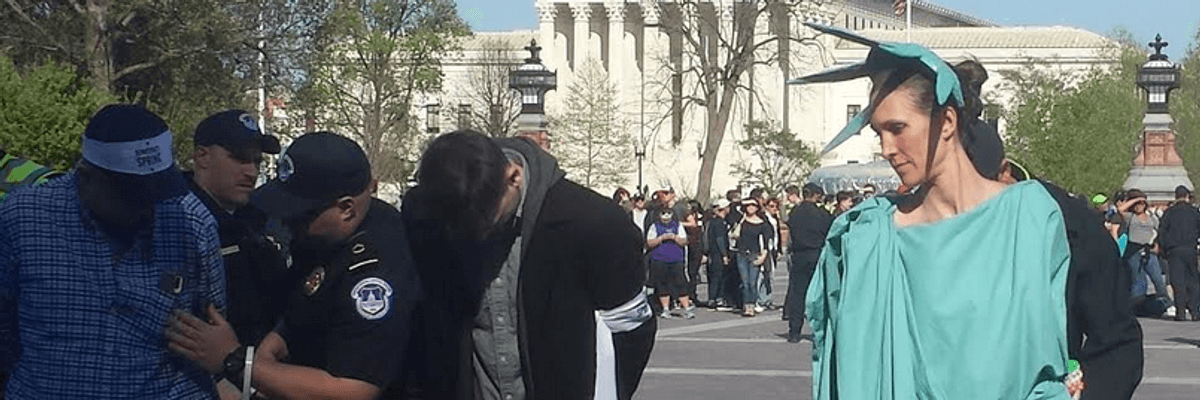
Lady Liberty getting arrested. "Being 'good'--kind and honest with those we touch directly--is admirable and desirable, but we need more," writes the author. "It's time to elevate another virtue: courage." (Democracy Spring - April 2016)
The Opposite of Evil Is No Longer Goodness
My point is simple. It's now time to focus on courage.
My headline is provocative, so let me quickly explain, starting with a huge claim about what's unique about our world in this moment. Then I ask, What, right now, is most required of our species?
Our era has been dubbed the Anthropocene because for the first time we humans are making our mark on the entire planet. Isn't it high time we nail down the most basic traits of this master species--traits that will determine how it might handle responsibility of such magnitude...a whole planet?
Let's start with a common observation that humans are self-absorbed, too self-absorbed...and challenge it: Maybe we got that one wrong, very wrong. Humans are pack animals. Just like wolves and elephants, we're social. Anthropologists make the case that we are the most social of primates. We are, above all, obsessed with staying inside the pack. We know our preservation depends on its preservation.
So our crisis might be understood this way:
Life on earth as we've known it is in grave danger because humanity's hyper-pack--defined as those whose members have the greatest destructive power on our earthly habitat--is heading right over the proverbial cliff. That cliff is climate chaos. That cliff is murderous conflict generated by fear of non-existent scarcity. That cliff is life-destroying inequality so extreme that now eight Homo sapiens control wealth equal to half all 7.6 billion of our species.
Yet, relatively few defy or even call out the anti-life rules and norms driving us over this cliff. In such a moment, what is the primary moral virtue needed?
Being "good"--kind and honest with those we touch directly--is admirable and desirable, but we need more. It's time to elevate another virtue: courage. We can be "good" within our pack, but can we break with the pack? Can we stand when we're the only one standing?
I recall a moment I didn't.
In 2004, I canvassed door to door in the suburbs of Philly for Democrat Lois Murphy, a distinguished attorney running for a seat in Congress against Republican Jim Gerlach. One evening the community gathered in the social hall of a synagogue to hear the candidates debate.
Taking our seats, we all fell silent as Murphy asked Gerlach to apologize before they began. Robo-calls from his campaign had linked Murphy to the Taliban, and she believed he should accept responsibility. I then recalled earlier in the day canvassing at the door of a man with a threatening dog. He asked: "Are you with the Taliban lady?" As I stood speechless, I remembered that on top of Murphy's strong legal background, she'd made her mark defending women's rights. What twisted irony to be linked to the Taliban.
Gerlach refused to apologize, and the debate proceeded.
But burned in my memory is self-recrimination. Why didn't I simply stand up and declare that I'd remain standing until an apology was forthcoming? Others would have quickly risen with me, I'm sure. But I didn't even think of it. Later, I had approached Gerlach and told him his ads were scandalous. For that, I lightly patted myself on the back, but, honestly, I felt crushed by what I had not done.
My point is that in that moment an obvious action didn't even occur to me because I am, like most of us, programmed to go along with the group, not to make a fuss, not to stand out.
Much later, in another situation in which I was out of synch with the group, I recalled how I'd failed that night in Philly. The still-raw regret stoked my courage, and I did get my hand up to make the challenge.
My point is simple. It's now time to focus on courage. It makes all other virtues possible.
"Courage is the most important of all the virtues," the poet Maya Angelou has said, "because without courage you can't practice any other virtue consistently."
Whatever it takes, let's fortify our backbones as part of a rising Democracy Movement. Making pledges not only to ourselves but to others can help. Acknowledging we're social animals--that's a given--let's discover together the thrill of risking hostility, humiliation, and failure to say and to do what we know is necessary to create democracy bringing out the best in us. In the process, we create new "packs" with willing to risk on behalf of life.
Goodness without courage is no longer good enough.
Note: Don't miss watching the companion video to this article - one of Frances Moore Lappe's Thought Sparks Video Series in which she opens her heart about what fortifies her in this scary time. Each week for nine weeks or more, her Small Planet Institute will release an informal 2-to-5-minute video in which Frances shares her often-surprising, liberating takes on hope, democracy, and courage.
We are at a crossroads
This country and this world are at a monumental crossroads. In a few short weeks, US voters will have an opportunity to beat back the forces of fascism and confront the billionaires who are rigging the economy, our media system, and our democracy, making it increasingly impossible for ordinary people to get by. We’re not just talking about the election. We’re talking about what must be done once these fascist elements are vanquished from power. We need a bolder set of solutions than what either major party has so far been willing to offer and a working-class movement ready to fight like hell for it. Trump didn't emerge from nowhere. The conditions that fueled MAGA authoritarianism were created by decades of radical neoliberal economic policies and a corrupt political system dominated by corporate interests. They slashed taxes on the super-rich, promising that the benefits would trickle down. They said giveaways to the corporate titans would make life more affordable for the rest of us. It was all bullshit. And when a bitter, betrayed populace searches for someone to blame, right-wing demagogues have little trouble finding scapegoats. People know when they're being lied to, but you won't hear any of this from the corporate media. Only independent journalism—powered and funded by people who believe in building a better world—can deliver truly trustworthy daily news. Our Fall Campaign is underway, and we need your help. To power our newsroom through the rest of the year, we need to raise $125,000 by midnight on October 31. So if you share our vision, please contribute whatever you can to sustain our work. |
My headline is provocative, so let me quickly explain, starting with a huge claim about what's unique about our world in this moment. Then I ask, What, right now, is most required of our species?
Our era has been dubbed the Anthropocene because for the first time we humans are making our mark on the entire planet. Isn't it high time we nail down the most basic traits of this master species--traits that will determine how it might handle responsibility of such magnitude...a whole planet?
Let's start with a common observation that humans are self-absorbed, too self-absorbed...and challenge it: Maybe we got that one wrong, very wrong. Humans are pack animals. Just like wolves and elephants, we're social. Anthropologists make the case that we are the most social of primates. We are, above all, obsessed with staying inside the pack. We know our preservation depends on its preservation.
So our crisis might be understood this way:
Life on earth as we've known it is in grave danger because humanity's hyper-pack--defined as those whose members have the greatest destructive power on our earthly habitat--is heading right over the proverbial cliff. That cliff is climate chaos. That cliff is murderous conflict generated by fear of non-existent scarcity. That cliff is life-destroying inequality so extreme that now eight Homo sapiens control wealth equal to half all 7.6 billion of our species.
Yet, relatively few defy or even call out the anti-life rules and norms driving us over this cliff. In such a moment, what is the primary moral virtue needed?
Being "good"--kind and honest with those we touch directly--is admirable and desirable, but we need more. It's time to elevate another virtue: courage. We can be "good" within our pack, but can we break with the pack? Can we stand when we're the only one standing?
I recall a moment I didn't.
In 2004, I canvassed door to door in the suburbs of Philly for Democrat Lois Murphy, a distinguished attorney running for a seat in Congress against Republican Jim Gerlach. One evening the community gathered in the social hall of a synagogue to hear the candidates debate.
Taking our seats, we all fell silent as Murphy asked Gerlach to apologize before they began. Robo-calls from his campaign had linked Murphy to the Taliban, and she believed he should accept responsibility. I then recalled earlier in the day canvassing at the door of a man with a threatening dog. He asked: "Are you with the Taliban lady?" As I stood speechless, I remembered that on top of Murphy's strong legal background, she'd made her mark defending women's rights. What twisted irony to be linked to the Taliban.
Gerlach refused to apologize, and the debate proceeded.
But burned in my memory is self-recrimination. Why didn't I simply stand up and declare that I'd remain standing until an apology was forthcoming? Others would have quickly risen with me, I'm sure. But I didn't even think of it. Later, I had approached Gerlach and told him his ads were scandalous. For that, I lightly patted myself on the back, but, honestly, I felt crushed by what I had not done.
My point is that in that moment an obvious action didn't even occur to me because I am, like most of us, programmed to go along with the group, not to make a fuss, not to stand out.
Much later, in another situation in which I was out of synch with the group, I recalled how I'd failed that night in Philly. The still-raw regret stoked my courage, and I did get my hand up to make the challenge.
My point is simple. It's now time to focus on courage. It makes all other virtues possible.
"Courage is the most important of all the virtues," the poet Maya Angelou has said, "because without courage you can't practice any other virtue consistently."
Whatever it takes, let's fortify our backbones as part of a rising Democracy Movement. Making pledges not only to ourselves but to others can help. Acknowledging we're social animals--that's a given--let's discover together the thrill of risking hostility, humiliation, and failure to say and to do what we know is necessary to create democracy bringing out the best in us. In the process, we create new "packs" with willing to risk on behalf of life.
Goodness without courage is no longer good enough.
Note: Don't miss watching the companion video to this article - one of Frances Moore Lappe's Thought Sparks Video Series in which she opens her heart about what fortifies her in this scary time. Each week for nine weeks or more, her Small Planet Institute will release an informal 2-to-5-minute video in which Frances shares her often-surprising, liberating takes on hope, democracy, and courage.