SUBSCRIBE TO OUR FREE NEWSLETTER
Daily news & progressive opinion—funded by the people, not the corporations—delivered straight to your inbox.
5
#000000
#FFFFFF
To donate by check, phone, or other method, see our More Ways to Give page.
Daily news & progressive opinion—funded by the people, not the corporations—delivered straight to your inbox.
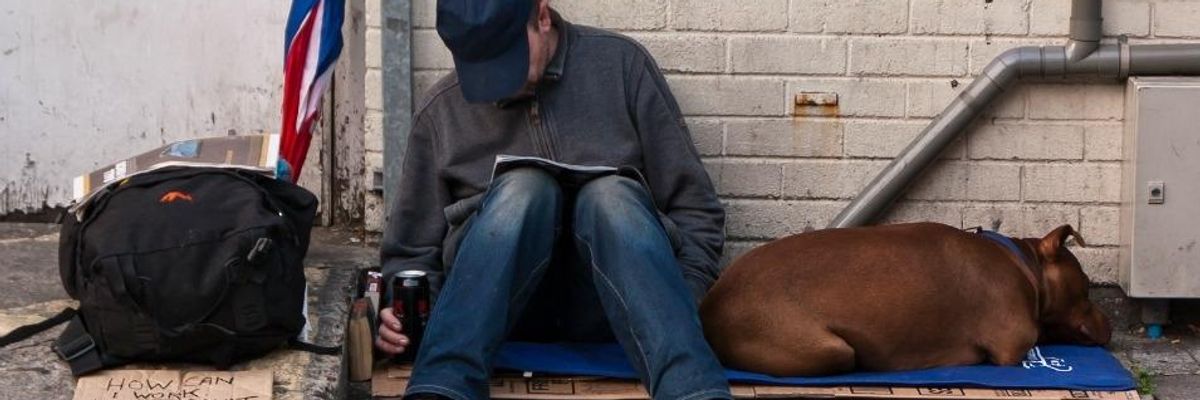
The extreme levels of American poverty and inequality are ripping apart once-interdependent communities with mental health and homelessness problems, and with a surge in drug and alcohol and suicide "deaths of despair." (Photo: kuriasity/flickr/cc)
A White House report recently proclaimed that the "War on Poverty is largely over and a success." United Nations Ambassador Nikki Haley said it was "ridiculous for the United Nations to examine poverty in America."
Well-positioned Americans must talk like this, of course, because admitting the debilitating state of poverty in America might provoke feelings of guilt for 35 years of oppressive economic policies. Wealthier people need to take an honest look at the facts. They need to face reality as it sadly exists in America today.
1 in 7 Americans is Part of the World's Poorest 10%
According to the Credit Suisse 2018 Global Wealth Databook, 34 million American adults are among the WORLD'S POOREST 10%. How is that possible? In a word, debt. In more excruciating words: stifling, misery-inducing, deadly amounts of debt for the poorest Americans. And it goes beyond dollars to the "deaths of despair" caused by the stresses of inferior health care coverage, stagnating incomes, and out-of-control inequality.
Numerous sources report on the rising debt for the poor half of America, especially for the lowest income group, and largely because of health care and education costs. Since 2008 consumer debt has risen almost 50 percent. The percentage of families with more debt than savings is higher now than at any time since 1962.
It could be argued that Scandinavian countries face the same degrees of debt as Americans. But far less of the debt is for health and education costs. And the Scandinavian safety net is renowned for its generous provisions for all citizens.
Half of Us are In or Near Poverty
$1 in expenses twenty years ago is now $1.25. $1 in earnings twenty years ago is now still $1.
More and more Americans are facing financial difficulty. Estimates of adults living from paycheck to paycheck range from half to 60 percent to 78 percent. Any sign of a recession would be devastating for most of us.
It's estimated that a typical U.S. household needs about $60,000 annually to meet all expenses. That's only manageable if two adults are working full-time for $15 per hour. Beyond that, little cushion exists. No American adult in the bottom 40% has more than $31,124 in total wealth, including house and car and savings (Table 3-4).
Booming Economy, Low Unemployment, and Other Deceptions
While 1 in 7 Americans is part of the world's poorest 10%, nearly 3 in 7 Americans are part of the world's richest 10%. The economy is booming for THEM. Yet the Wall Street Journal has the arrogance to claim that "Americans traditionally left behind...are reaping the benefits.."
How about the "jobs for everyone" fantasy? The official unemployment rate, according to the Bureau of Labor Statistics (BLS) itself, is based on employees "who did any work for pay or profit during the survey reference week." The BLS workforce includes contingent and alternative employment arrangements that make up about 10% of the workforce. It includes part-time workers (even one hour a week!), who make up about 16% of the workforce. And, inexplicably, it fails to count as unemployed those who have given up looking for work -- 4% more Americans than in the year 2000.
Many of today's 'gig' jobs don't pay a living wage, and most have no retirement or health benefits, no job security, no government regulations backing them, and usually a longer work day, with many people putting in 10- to 12-hour days for $13 per hour or less. According to a New York Times report, "41.7 million laborers -- nearly a third of the American work force -- earn less than $12 an hour, and almost none of their employers offer health insurance."
Safety Net Failures
While it's true that the U.S. spends a greater percentage of its GDP on social safety net programs than developing countries, Americans generally have to face much higher costs for housing, heating, transportation, child care, and other basic expenses.
Beyond this, there are significant shortcomings in American social protections, as pointed out by the UN. These include the "shockingly high number of children living in poverty" and the "reliance on criminalization to conceal the underlying poverty problem." Furthermore, with the call for work requirements comes the realization that the job market for the poorest Americans is "extraordinarily limited."
Poverty: Not Just a Number
Poverty is living without health care, and choosing the life-threatening alternative of opioid painkillers. Poverty is the stress of overwhelming debt; the steady decline of jobs that pay enough to support a family; the inability to afford a move to a desired neighborhood; the deadening impact of inequality on physical and mental well-being. The United Nations describes America as a nation near the bottom of the developed world in safety net support and economic mobility, with its citizens living "shorter and sicker lives compared to those living in all other rich democracies," with the highest infant mortality rate in the developed world, the world's highest incarceration rate, and the highest obesity levels. Low-income Americans are often surrounded by food deserts, with insufficient access to clean water and sanitation, and with the pollution levels of third-world countries. The poorest among us are even susceptible -- unbelievably -- to rare tropical diseases and once-eradicated scourges like hookworm.
The extreme levels of American poverty and inequality are ripping apart once-interdependent communities with mental health and homelessness problems, and with a surge in drug and alcohol and suicide "deaths of despair."
Part of the definition of poverty is "the state of being inferior in quality." As one of the most unequal nations in the entire world, America is also, in many ways, one of the most poverty-stricken.
Dear Common Dreams reader, It’s been nearly 30 years since I co-founded Common Dreams with my late wife, Lina Newhouser. We had the radical notion that journalism should serve the public good, not corporate profits. It was clear to us from the outset what it would take to build such a project. No paid advertisements. No corporate sponsors. No millionaire publisher telling us what to think or do. Many people said we wouldn't last a year, but we proved those doubters wrong. Together with a tremendous team of journalists and dedicated staff, we built an independent media outlet free from the constraints of profits and corporate control. Our mission has always been simple: To inform. To inspire. To ignite change for the common good. Building Common Dreams was not easy. Our survival was never guaranteed. When you take on the most powerful forces—Wall Street greed, fossil fuel industry destruction, Big Tech lobbyists, and uber-rich oligarchs who have spent billions upon billions rigging the economy and democracy in their favor—the only bulwark you have is supporters who believe in your work. But here’s the urgent message from me today. It's never been this bad out there. And it's never been this hard to keep us going. At the very moment Common Dreams is most needed, the threats we face are intensifying. We need your support now more than ever. We don't accept corporate advertising and never will. We don't have a paywall because we don't think people should be blocked from critical news based on their ability to pay. Everything we do is funded by the donations of readers like you. When everyone does the little they can afford, we are strong. But if that support retreats or dries up, so do we. Will you donate now to make sure Common Dreams not only survives but thrives? —Craig Brown, Co-founder |
A White House report recently proclaimed that the "War on Poverty is largely over and a success." United Nations Ambassador Nikki Haley said it was "ridiculous for the United Nations to examine poverty in America."
Well-positioned Americans must talk like this, of course, because admitting the debilitating state of poverty in America might provoke feelings of guilt for 35 years of oppressive economic policies. Wealthier people need to take an honest look at the facts. They need to face reality as it sadly exists in America today.
1 in 7 Americans is Part of the World's Poorest 10%
According to the Credit Suisse 2018 Global Wealth Databook, 34 million American adults are among the WORLD'S POOREST 10%. How is that possible? In a word, debt. In more excruciating words: stifling, misery-inducing, deadly amounts of debt for the poorest Americans. And it goes beyond dollars to the "deaths of despair" caused by the stresses of inferior health care coverage, stagnating incomes, and out-of-control inequality.
Numerous sources report on the rising debt for the poor half of America, especially for the lowest income group, and largely because of health care and education costs. Since 2008 consumer debt has risen almost 50 percent. The percentage of families with more debt than savings is higher now than at any time since 1962.
It could be argued that Scandinavian countries face the same degrees of debt as Americans. But far less of the debt is for health and education costs. And the Scandinavian safety net is renowned for its generous provisions for all citizens.
Half of Us are In or Near Poverty
$1 in expenses twenty years ago is now $1.25. $1 in earnings twenty years ago is now still $1.
More and more Americans are facing financial difficulty. Estimates of adults living from paycheck to paycheck range from half to 60 percent to 78 percent. Any sign of a recession would be devastating for most of us.
It's estimated that a typical U.S. household needs about $60,000 annually to meet all expenses. That's only manageable if two adults are working full-time for $15 per hour. Beyond that, little cushion exists. No American adult in the bottom 40% has more than $31,124 in total wealth, including house and car and savings (Table 3-4).
Booming Economy, Low Unemployment, and Other Deceptions
While 1 in 7 Americans is part of the world's poorest 10%, nearly 3 in 7 Americans are part of the world's richest 10%. The economy is booming for THEM. Yet the Wall Street Journal has the arrogance to claim that "Americans traditionally left behind...are reaping the benefits.."
How about the "jobs for everyone" fantasy? The official unemployment rate, according to the Bureau of Labor Statistics (BLS) itself, is based on employees "who did any work for pay or profit during the survey reference week." The BLS workforce includes contingent and alternative employment arrangements that make up about 10% of the workforce. It includes part-time workers (even one hour a week!), who make up about 16% of the workforce. And, inexplicably, it fails to count as unemployed those who have given up looking for work -- 4% more Americans than in the year 2000.
Many of today's 'gig' jobs don't pay a living wage, and most have no retirement or health benefits, no job security, no government regulations backing them, and usually a longer work day, with many people putting in 10- to 12-hour days for $13 per hour or less. According to a New York Times report, "41.7 million laborers -- nearly a third of the American work force -- earn less than $12 an hour, and almost none of their employers offer health insurance."
Safety Net Failures
While it's true that the U.S. spends a greater percentage of its GDP on social safety net programs than developing countries, Americans generally have to face much higher costs for housing, heating, transportation, child care, and other basic expenses.
Beyond this, there are significant shortcomings in American social protections, as pointed out by the UN. These include the "shockingly high number of children living in poverty" and the "reliance on criminalization to conceal the underlying poverty problem." Furthermore, with the call for work requirements comes the realization that the job market for the poorest Americans is "extraordinarily limited."
Poverty: Not Just a Number
Poverty is living without health care, and choosing the life-threatening alternative of opioid painkillers. Poverty is the stress of overwhelming debt; the steady decline of jobs that pay enough to support a family; the inability to afford a move to a desired neighborhood; the deadening impact of inequality on physical and mental well-being. The United Nations describes America as a nation near the bottom of the developed world in safety net support and economic mobility, with its citizens living "shorter and sicker lives compared to those living in all other rich democracies," with the highest infant mortality rate in the developed world, the world's highest incarceration rate, and the highest obesity levels. Low-income Americans are often surrounded by food deserts, with insufficient access to clean water and sanitation, and with the pollution levels of third-world countries. The poorest among us are even susceptible -- unbelievably -- to rare tropical diseases and once-eradicated scourges like hookworm.
The extreme levels of American poverty and inequality are ripping apart once-interdependent communities with mental health and homelessness problems, and with a surge in drug and alcohol and suicide "deaths of despair."
Part of the definition of poverty is "the state of being inferior in quality." As one of the most unequal nations in the entire world, America is also, in many ways, one of the most poverty-stricken.
A White House report recently proclaimed that the "War on Poverty is largely over and a success." United Nations Ambassador Nikki Haley said it was "ridiculous for the United Nations to examine poverty in America."
Well-positioned Americans must talk like this, of course, because admitting the debilitating state of poverty in America might provoke feelings of guilt for 35 years of oppressive economic policies. Wealthier people need to take an honest look at the facts. They need to face reality as it sadly exists in America today.
1 in 7 Americans is Part of the World's Poorest 10%
According to the Credit Suisse 2018 Global Wealth Databook, 34 million American adults are among the WORLD'S POOREST 10%. How is that possible? In a word, debt. In more excruciating words: stifling, misery-inducing, deadly amounts of debt for the poorest Americans. And it goes beyond dollars to the "deaths of despair" caused by the stresses of inferior health care coverage, stagnating incomes, and out-of-control inequality.
Numerous sources report on the rising debt for the poor half of America, especially for the lowest income group, and largely because of health care and education costs. Since 2008 consumer debt has risen almost 50 percent. The percentage of families with more debt than savings is higher now than at any time since 1962.
It could be argued that Scandinavian countries face the same degrees of debt as Americans. But far less of the debt is for health and education costs. And the Scandinavian safety net is renowned for its generous provisions for all citizens.
Half of Us are In or Near Poverty
$1 in expenses twenty years ago is now $1.25. $1 in earnings twenty years ago is now still $1.
More and more Americans are facing financial difficulty. Estimates of adults living from paycheck to paycheck range from half to 60 percent to 78 percent. Any sign of a recession would be devastating for most of us.
It's estimated that a typical U.S. household needs about $60,000 annually to meet all expenses. That's only manageable if two adults are working full-time for $15 per hour. Beyond that, little cushion exists. No American adult in the bottom 40% has more than $31,124 in total wealth, including house and car and savings (Table 3-4).
Booming Economy, Low Unemployment, and Other Deceptions
While 1 in 7 Americans is part of the world's poorest 10%, nearly 3 in 7 Americans are part of the world's richest 10%. The economy is booming for THEM. Yet the Wall Street Journal has the arrogance to claim that "Americans traditionally left behind...are reaping the benefits.."
How about the "jobs for everyone" fantasy? The official unemployment rate, according to the Bureau of Labor Statistics (BLS) itself, is based on employees "who did any work for pay or profit during the survey reference week." The BLS workforce includes contingent and alternative employment arrangements that make up about 10% of the workforce. It includes part-time workers (even one hour a week!), who make up about 16% of the workforce. And, inexplicably, it fails to count as unemployed those who have given up looking for work -- 4% more Americans than in the year 2000.
Many of today's 'gig' jobs don't pay a living wage, and most have no retirement or health benefits, no job security, no government regulations backing them, and usually a longer work day, with many people putting in 10- to 12-hour days for $13 per hour or less. According to a New York Times report, "41.7 million laborers -- nearly a third of the American work force -- earn less than $12 an hour, and almost none of their employers offer health insurance."
Safety Net Failures
While it's true that the U.S. spends a greater percentage of its GDP on social safety net programs than developing countries, Americans generally have to face much higher costs for housing, heating, transportation, child care, and other basic expenses.
Beyond this, there are significant shortcomings in American social protections, as pointed out by the UN. These include the "shockingly high number of children living in poverty" and the "reliance on criminalization to conceal the underlying poverty problem." Furthermore, with the call for work requirements comes the realization that the job market for the poorest Americans is "extraordinarily limited."
Poverty: Not Just a Number
Poverty is living without health care, and choosing the life-threatening alternative of opioid painkillers. Poverty is the stress of overwhelming debt; the steady decline of jobs that pay enough to support a family; the inability to afford a move to a desired neighborhood; the deadening impact of inequality on physical and mental well-being. The United Nations describes America as a nation near the bottom of the developed world in safety net support and economic mobility, with its citizens living "shorter and sicker lives compared to those living in all other rich democracies," with the highest infant mortality rate in the developed world, the world's highest incarceration rate, and the highest obesity levels. Low-income Americans are often surrounded by food deserts, with insufficient access to clean water and sanitation, and with the pollution levels of third-world countries. The poorest among us are even susceptible -- unbelievably -- to rare tropical diseases and once-eradicated scourges like hookworm.
The extreme levels of American poverty and inequality are ripping apart once-interdependent communities with mental health and homelessness problems, and with a surge in drug and alcohol and suicide "deaths of despair."
Part of the definition of poverty is "the state of being inferior in quality." As one of the most unequal nations in the entire world, America is also, in many ways, one of the most poverty-stricken.