SUBSCRIBE TO OUR FREE NEWSLETTER
Daily news & progressive opinion—funded by the people, not the corporations—delivered straight to your inbox.
5
#000000
#FFFFFF
To donate by check, phone, or other method, see our More Ways to Give page.
Daily news & progressive opinion—funded by the people, not the corporations—delivered straight to your inbox.
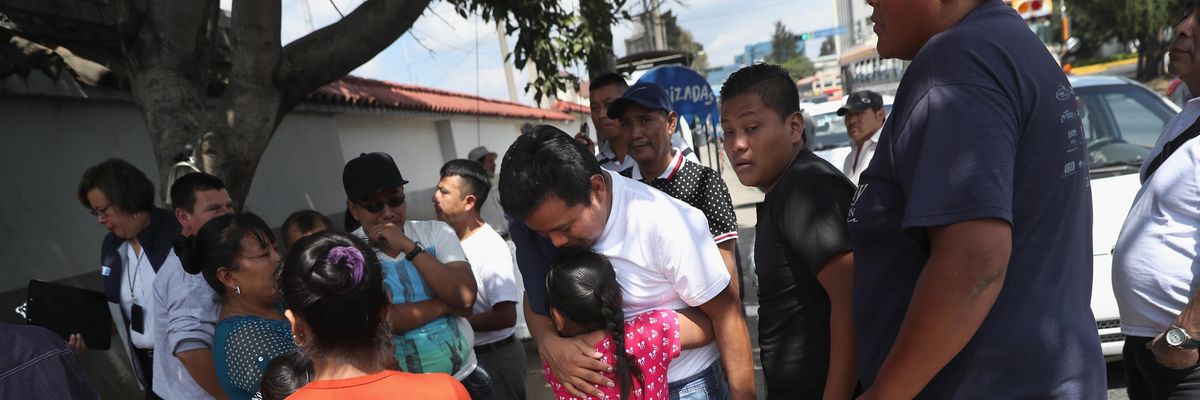
Guatemalan deportee Eric Perez embraces his daughter after he arrived on an ICE deportation flight on February 9, 2017 to Guatemala City, Guatemala.(Photo by John Moore/Getty Images)
"Don't come to our country illegally," President Trump blasted in a recent tweet, his solution to the current immigrant crisis - one in which thousands of immigrants are fleeing violence in Central America and attempting to cross into the United States. He went on to emphasize the importance of borders, national sovereignty, and "rule of law."
"Don't invade our country," Central Americans might well have tweeted back.
"Don't invade our country," Central Americans might well have tweeted back. What goes 'round, comes around, and whether you believe in laws of kharma and the spiritual interconnectedness of life on this planet or not, there is plenty of evidence that the "crises" we see today were initiated long ago by actions that our country took. And the actions we take today will have profound effects on the future.
In most of the reports I have read about the "immigrant crisis," there is some recognition that there are reasons families take the tremendous risks they do to cross the border into the United States - a migration that costs thousands of dollars and potentially their lives, with no guarantee of success. These reports usually mention the rampant gang violence in Central America, and sometimes domestic violence as well.
But there is scant mention of the role of the United States played in begetting that violence, through "interventions" we took over the last century. Interventions, by their very name, involve a disrespecting of national sovereignty, borders, and the rule of law. They are achieved militarily - i.e. through violence.
But there is scant mention of the role of the United States played in begetting that violence, through "interventions" we took over the last century. Take the case of Guatemala. In 1954, the CIA engineered a coup that overthrew the democratically-elected presidency of Jacobo Arbenz, because Arbenz had instituted land reform that threatened the U.S.-based United Fruit Company, which was owned by Allen Dulles, brother to CIA director John Foster Dulles. (For details on this history see Steve Kinzer's book, The Brothers: John Foster Dulles, Allen Dulles, and their Secret World War.) This ushered in fifty years of military dictatorships that were supported and funded by the United States, leading to the "disappearance" or murder of some 200,000 civilians and a legacy of violence that now reverberates in everyday life.
My point is simple: violence begets violence; for every action there is a reaction; and what we do today will have profound effects on tomorrow.
The United States' recent decision to separate young children from their families at the border, regardless of their requests for asylum (asylum from violence that we are implicated in), will have repercussions far into the future: trauma layered on historical trauma. Recognizing our own role in creating these conditions would offer us an opportunity to right the historical record, to repair, restore, and set in place a different legacy.
Let me end on a more uplifting note. Last week's international efforts to rescue the soccer team from the cave in Thailand shows the good that can happen when people come together to support life, not thwart it. While some psychologists have warned that the boys may be traumatized by their experience, all reports thus far are that the boys are happy and at peace. This is likely due to the great efforts their coach took to care for them during their time in the cave, and to ensure that they cared for each other. And now, the mothers of the boys are promising to help "heal the heart" of the young coach who is suffering from his feelings of responsibility - such a different response than the press seemed to expect.
A situation that could have been tragic, traumatic, and full of blame or shame, has become an opportunity to see the power of interconnectedness, the good that can happen when we work together, and the healing power of care. We can choose how we respond to any situation in the world, and how we choose matters for what we set in play. There seem to be many forces that perpetuate violence and negativity, but perhaps we could tip the balance toward positivity and love.
This country and this world are at a monumental crossroads. US voters have an opportunity to beat back the forces of fascism and confront the billionaires who are rigging the economy, our media system, and our democracy, making it increasingly impossible for ordinary people to get by. We’re not just talking about the election. We’re talking about what must be done once these fascist elements are vanquished from power. We need a bolder set of solutions than what either major party has so far been willing to offer and a working-class movement ready to fight like hell for it. Trump didn't emerge from nowhere. The conditions that fueled MAGA authoritarianism were created by decades of radical neoliberal economic policies and a corrupt political system dominated by corporate interests. They slashed taxes on the super-rich, promising that the benefits would trickle down. They said giveaways to the corporate titans would make life more affordable for the rest of us. It was all bullshit. And when a bitter, betrayed populace searches for someone to blame, right-wing demagogues have little trouble finding scapegoats. People know when they're being lied to, but you won't hear any of this from the corporate media. Only independent journalism—powered and funded by people who believe in building a better world—can deliver truly trustworthy daily news. If you share our vision, please contribute whatever you can to sustain our work. |
"Don't come to our country illegally," President Trump blasted in a recent tweet, his solution to the current immigrant crisis - one in which thousands of immigrants are fleeing violence in Central America and attempting to cross into the United States. He went on to emphasize the importance of borders, national sovereignty, and "rule of law."
"Don't invade our country," Central Americans might well have tweeted back.
"Don't invade our country," Central Americans might well have tweeted back. What goes 'round, comes around, and whether you believe in laws of kharma and the spiritual interconnectedness of life on this planet or not, there is plenty of evidence that the "crises" we see today were initiated long ago by actions that our country took. And the actions we take today will have profound effects on the future.
In most of the reports I have read about the "immigrant crisis," there is some recognition that there are reasons families take the tremendous risks they do to cross the border into the United States - a migration that costs thousands of dollars and potentially their lives, with no guarantee of success. These reports usually mention the rampant gang violence in Central America, and sometimes domestic violence as well.
But there is scant mention of the role of the United States played in begetting that violence, through "interventions" we took over the last century. Interventions, by their very name, involve a disrespecting of national sovereignty, borders, and the rule of law. They are achieved militarily - i.e. through violence.
But there is scant mention of the role of the United States played in begetting that violence, through "interventions" we took over the last century. Take the case of Guatemala. In 1954, the CIA engineered a coup that overthrew the democratically-elected presidency of Jacobo Arbenz, because Arbenz had instituted land reform that threatened the U.S.-based United Fruit Company, which was owned by Allen Dulles, brother to CIA director John Foster Dulles. (For details on this history see Steve Kinzer's book, The Brothers: John Foster Dulles, Allen Dulles, and their Secret World War.) This ushered in fifty years of military dictatorships that were supported and funded by the United States, leading to the "disappearance" or murder of some 200,000 civilians and a legacy of violence that now reverberates in everyday life.
My point is simple: violence begets violence; for every action there is a reaction; and what we do today will have profound effects on tomorrow.
The United States' recent decision to separate young children from their families at the border, regardless of their requests for asylum (asylum from violence that we are implicated in), will have repercussions far into the future: trauma layered on historical trauma. Recognizing our own role in creating these conditions would offer us an opportunity to right the historical record, to repair, restore, and set in place a different legacy.
Let me end on a more uplifting note. Last week's international efforts to rescue the soccer team from the cave in Thailand shows the good that can happen when people come together to support life, not thwart it. While some psychologists have warned that the boys may be traumatized by their experience, all reports thus far are that the boys are happy and at peace. This is likely due to the great efforts their coach took to care for them during their time in the cave, and to ensure that they cared for each other. And now, the mothers of the boys are promising to help "heal the heart" of the young coach who is suffering from his feelings of responsibility - such a different response than the press seemed to expect.
A situation that could have been tragic, traumatic, and full of blame or shame, has become an opportunity to see the power of interconnectedness, the good that can happen when we work together, and the healing power of care. We can choose how we respond to any situation in the world, and how we choose matters for what we set in play. There seem to be many forces that perpetuate violence and negativity, but perhaps we could tip the balance toward positivity and love.