SUBSCRIBE TO OUR FREE NEWSLETTER
Daily news & progressive opinion—funded by the people, not the corporations—delivered straight to your inbox.
5
#000000
#FFFFFF
To donate by check, phone, or other method, see our More Ways to Give page.
Daily news & progressive opinion—funded by the people, not the corporations—delivered straight to your inbox.
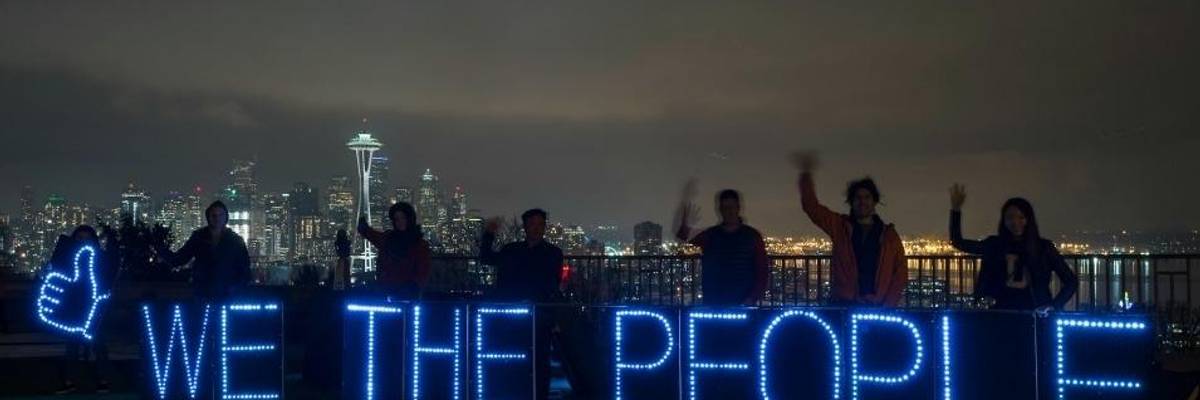
"Older immigrants, the more than 10 million people here without documentation but who do not qualify for DACA, are in similar straits, living under the daily threat of arrest and deportation, living in the shadows." (Photo: Backbone Campaign/cc/flickr)
President Donald Trump delivered his first State of the Union address Tuesday night. It was to be his clarion call to bipartisanship. Instead, under the guise of a compromise position on the fate of nearly 800,000 DACA (Deferred Action for Childhood Arrivals) recipients, Trump bashed Latino immigrants just like he did on the day he launched his presidential campaign in 2015, when he said of Mexicans: "They're bringing drugs. They're bringing crime. They're rapists."
Hours before the State of the Union, U.S. District Judge Nicholas Garaufis in New York released a scathing rebuke of Trump during a court hearing on whether Trump's cancellation of DACA was illegal. Garaufis said he would not ignore the president's "vicious ... recurring, redundant drumbeat of anti-Latino commentary." The judge's words could have served as a summary of Trump's address.
Many members of Congress had invited special guests to attend the State of the Union, among them "Dreamers," undocumented immigrants and their advocates. Republican Rep. Paul Gosar of Arizona asked the U.S. Capitol Police to check the identification of all those attending, and to arrest undocumented immigrants in attendance. His request was ignored.
For millions of immigrants and their family members around the U.S., the State of the Union was not just a political speech; their lives hang in the balance. President Barack Obama enacted DACA through executive order in 2012, allowing people who were brought to the U.S. as children, without proper documentation, to register with the federal government in order to receive a work permit and protection from deportation. Among other things, they undergo a background check and provide their address and biometric data.
Commonly referred to as "Dreamers," they are, in essence, stateless. Their status in the U.S. is uncertain, and they have little or no connection to their nation of origin. Older immigrants, the more than 10 million people here without documentation but who do not qualify for DACA, are in similar straits, living under the daily threat of arrest and deportation, living in the shadows.
Trump cited the U.S.-based Salvadoran criminal gang MS-13 four times in his speech, fanning the flames of racism and fear of violent crime. As a sop to Democrats, he suggested that 1.8 million Dreamers (who he referred to only as "illegal immigrants") might be given a pathway to citizenship. But in exchange, he demanded a slew of restrictive changes to U.S. immigration policy, which would be the most significant overhaul in more than 50 years, including the elimination of the green-card lottery, limiting family unification by preventing immigrants from joining family members already in the U.S., and $25 billion to build a border wall and to further militarize the U.S.-Mexico border.
Democratic Sen. Maria Cantwell of Washington invited a woman who has been targeted for deportation by the Trump administration. Maru Mora Villalpando is a leader with the group Northwest Detention Center Resistance. The morning after the speech, Mora Villalpando told us on the "Democracy Now!" news hour: "He scapegoated my community, along with many other communities. But it was important to show that we're not afraid, and we're going to continue in the struggle."
Despite boycotting the speech herself, Brooklyn Congressmember Yvette Clarke invited immigrant leader Ravi Ragbir, executive director of the New York City-based New Sanctuary Coalition. Remarkably, he had been released from nearly three weeks of detention just the night before. He was detained by Immigration and Customs Enforcement on Jan. 11 and rushed into deportation proceedings. Mass protests and legal action prevented his deportation to Trinidad and Tobago on Jan. 12. A judge then ordered him returned from the Krome Detention Center in Florida back to a New York detention center while his case proceeded. Then, in a stunning decision Monday, U.S. District Judge Katherine B. Forrest ordered Ravi Ragbir immediately released.
She wrote: "It ought not to be--and it has never before been--that those who have lived without incident in this country for years are subjected to treatment we associate with regimes we revile as unjust, regimes where those who have long lived in a country may be taken without notice from streets, home, and work. And sent away. We are not that country, and woe be the day when we become that country under a fiction that laws allow it. We have a law higher than any that may be so interpreted -- and that is our Constitution."
The opening words of the U.S. Constitution are "We the People." Far more powerful than any single president, it is that collective force that will save us.
Dear Common Dreams reader, It’s been nearly 30 years since I co-founded Common Dreams with my late wife, Lina Newhouser. We had the radical notion that journalism should serve the public good, not corporate profits. It was clear to us from the outset what it would take to build such a project. No paid advertisements. No corporate sponsors. No millionaire publisher telling us what to think or do. Many people said we wouldn't last a year, but we proved those doubters wrong. Together with a tremendous team of journalists and dedicated staff, we built an independent media outlet free from the constraints of profits and corporate control. Our mission has always been simple: To inform. To inspire. To ignite change for the common good. Building Common Dreams was not easy. Our survival was never guaranteed. When you take on the most powerful forces—Wall Street greed, fossil fuel industry destruction, Big Tech lobbyists, and uber-rich oligarchs who have spent billions upon billions rigging the economy and democracy in their favor—the only bulwark you have is supporters who believe in your work. But here’s the urgent message from me today. It's never been this bad out there. And it's never been this hard to keep us going. At the very moment Common Dreams is most needed, the threats we face are intensifying. We need your support now more than ever. We don't accept corporate advertising and never will. We don't have a paywall because we don't think people should be blocked from critical news based on their ability to pay. Everything we do is funded by the donations of readers like you. When everyone does the little they can afford, we are strong. But if that support retreats or dries up, so do we. Will you donate now to make sure Common Dreams not only survives but thrives? —Craig Brown, Co-founder |
President Donald Trump delivered his first State of the Union address Tuesday night. It was to be his clarion call to bipartisanship. Instead, under the guise of a compromise position on the fate of nearly 800,000 DACA (Deferred Action for Childhood Arrivals) recipients, Trump bashed Latino immigrants just like he did on the day he launched his presidential campaign in 2015, when he said of Mexicans: "They're bringing drugs. They're bringing crime. They're rapists."
Hours before the State of the Union, U.S. District Judge Nicholas Garaufis in New York released a scathing rebuke of Trump during a court hearing on whether Trump's cancellation of DACA was illegal. Garaufis said he would not ignore the president's "vicious ... recurring, redundant drumbeat of anti-Latino commentary." The judge's words could have served as a summary of Trump's address.
Many members of Congress had invited special guests to attend the State of the Union, among them "Dreamers," undocumented immigrants and their advocates. Republican Rep. Paul Gosar of Arizona asked the U.S. Capitol Police to check the identification of all those attending, and to arrest undocumented immigrants in attendance. His request was ignored.
For millions of immigrants and their family members around the U.S., the State of the Union was not just a political speech; their lives hang in the balance. President Barack Obama enacted DACA through executive order in 2012, allowing people who were brought to the U.S. as children, without proper documentation, to register with the federal government in order to receive a work permit and protection from deportation. Among other things, they undergo a background check and provide their address and biometric data.
Commonly referred to as "Dreamers," they are, in essence, stateless. Their status in the U.S. is uncertain, and they have little or no connection to their nation of origin. Older immigrants, the more than 10 million people here without documentation but who do not qualify for DACA, are in similar straits, living under the daily threat of arrest and deportation, living in the shadows.
Trump cited the U.S.-based Salvadoran criminal gang MS-13 four times in his speech, fanning the flames of racism and fear of violent crime. As a sop to Democrats, he suggested that 1.8 million Dreamers (who he referred to only as "illegal immigrants") might be given a pathway to citizenship. But in exchange, he demanded a slew of restrictive changes to U.S. immigration policy, which would be the most significant overhaul in more than 50 years, including the elimination of the green-card lottery, limiting family unification by preventing immigrants from joining family members already in the U.S., and $25 billion to build a border wall and to further militarize the U.S.-Mexico border.
Democratic Sen. Maria Cantwell of Washington invited a woman who has been targeted for deportation by the Trump administration. Maru Mora Villalpando is a leader with the group Northwest Detention Center Resistance. The morning after the speech, Mora Villalpando told us on the "Democracy Now!" news hour: "He scapegoated my community, along with many other communities. But it was important to show that we're not afraid, and we're going to continue in the struggle."
Despite boycotting the speech herself, Brooklyn Congressmember Yvette Clarke invited immigrant leader Ravi Ragbir, executive director of the New York City-based New Sanctuary Coalition. Remarkably, he had been released from nearly three weeks of detention just the night before. He was detained by Immigration and Customs Enforcement on Jan. 11 and rushed into deportation proceedings. Mass protests and legal action prevented his deportation to Trinidad and Tobago on Jan. 12. A judge then ordered him returned from the Krome Detention Center in Florida back to a New York detention center while his case proceeded. Then, in a stunning decision Monday, U.S. District Judge Katherine B. Forrest ordered Ravi Ragbir immediately released.
She wrote: "It ought not to be--and it has never before been--that those who have lived without incident in this country for years are subjected to treatment we associate with regimes we revile as unjust, regimes where those who have long lived in a country may be taken without notice from streets, home, and work. And sent away. We are not that country, and woe be the day when we become that country under a fiction that laws allow it. We have a law higher than any that may be so interpreted -- and that is our Constitution."
The opening words of the U.S. Constitution are "We the People." Far more powerful than any single president, it is that collective force that will save us.
President Donald Trump delivered his first State of the Union address Tuesday night. It was to be his clarion call to bipartisanship. Instead, under the guise of a compromise position on the fate of nearly 800,000 DACA (Deferred Action for Childhood Arrivals) recipients, Trump bashed Latino immigrants just like he did on the day he launched his presidential campaign in 2015, when he said of Mexicans: "They're bringing drugs. They're bringing crime. They're rapists."
Hours before the State of the Union, U.S. District Judge Nicholas Garaufis in New York released a scathing rebuke of Trump during a court hearing on whether Trump's cancellation of DACA was illegal. Garaufis said he would not ignore the president's "vicious ... recurring, redundant drumbeat of anti-Latino commentary." The judge's words could have served as a summary of Trump's address.
Many members of Congress had invited special guests to attend the State of the Union, among them "Dreamers," undocumented immigrants and their advocates. Republican Rep. Paul Gosar of Arizona asked the U.S. Capitol Police to check the identification of all those attending, and to arrest undocumented immigrants in attendance. His request was ignored.
For millions of immigrants and their family members around the U.S., the State of the Union was not just a political speech; their lives hang in the balance. President Barack Obama enacted DACA through executive order in 2012, allowing people who were brought to the U.S. as children, without proper documentation, to register with the federal government in order to receive a work permit and protection from deportation. Among other things, they undergo a background check and provide their address and biometric data.
Commonly referred to as "Dreamers," they are, in essence, stateless. Their status in the U.S. is uncertain, and they have little or no connection to their nation of origin. Older immigrants, the more than 10 million people here without documentation but who do not qualify for DACA, are in similar straits, living under the daily threat of arrest and deportation, living in the shadows.
Trump cited the U.S.-based Salvadoran criminal gang MS-13 four times in his speech, fanning the flames of racism and fear of violent crime. As a sop to Democrats, he suggested that 1.8 million Dreamers (who he referred to only as "illegal immigrants") might be given a pathway to citizenship. But in exchange, he demanded a slew of restrictive changes to U.S. immigration policy, which would be the most significant overhaul in more than 50 years, including the elimination of the green-card lottery, limiting family unification by preventing immigrants from joining family members already in the U.S., and $25 billion to build a border wall and to further militarize the U.S.-Mexico border.
Democratic Sen. Maria Cantwell of Washington invited a woman who has been targeted for deportation by the Trump administration. Maru Mora Villalpando is a leader with the group Northwest Detention Center Resistance. The morning after the speech, Mora Villalpando told us on the "Democracy Now!" news hour: "He scapegoated my community, along with many other communities. But it was important to show that we're not afraid, and we're going to continue in the struggle."
Despite boycotting the speech herself, Brooklyn Congressmember Yvette Clarke invited immigrant leader Ravi Ragbir, executive director of the New York City-based New Sanctuary Coalition. Remarkably, he had been released from nearly three weeks of detention just the night before. He was detained by Immigration and Customs Enforcement on Jan. 11 and rushed into deportation proceedings. Mass protests and legal action prevented his deportation to Trinidad and Tobago on Jan. 12. A judge then ordered him returned from the Krome Detention Center in Florida back to a New York detention center while his case proceeded. Then, in a stunning decision Monday, U.S. District Judge Katherine B. Forrest ordered Ravi Ragbir immediately released.
She wrote: "It ought not to be--and it has never before been--that those who have lived without incident in this country for years are subjected to treatment we associate with regimes we revile as unjust, regimes where those who have long lived in a country may be taken without notice from streets, home, and work. And sent away. We are not that country, and woe be the day when we become that country under a fiction that laws allow it. We have a law higher than any that may be so interpreted -- and that is our Constitution."
The opening words of the U.S. Constitution are "We the People." Far more powerful than any single president, it is that collective force that will save us.