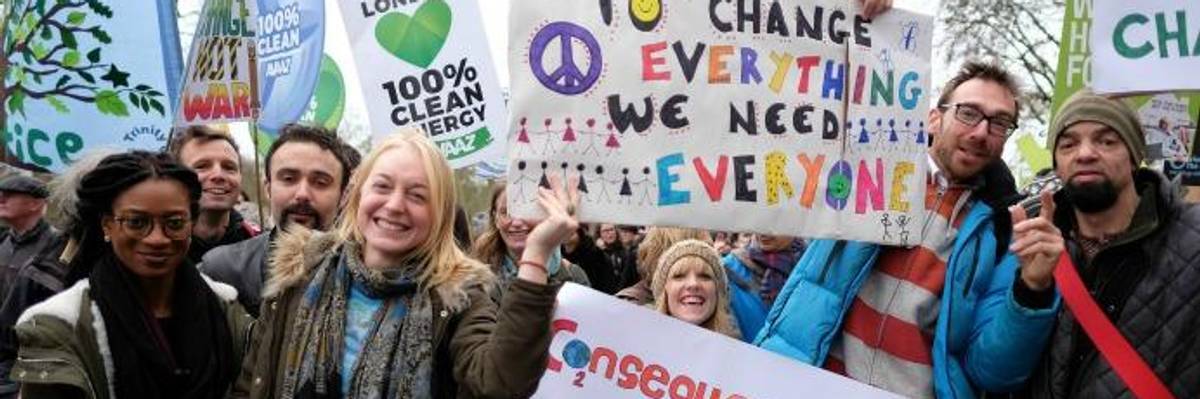
"Under Donald Trump, the US is contributing mightily to our self-destruction," the author writes. (Photo: Alisdare Hickson/flickr/cc)
Reaching Paris Without Stopping in Washington
History may record that the planet's climate crisis was avoided thanks to the efforts of three countries: China, Germany, and France. Or not. The preparedness of those three, and the other EU member-states, to follow through on commitments under the Paris Accord despite the US pull-out is key to planetary survival. Chancellor Angela Merkel has made no bones about it, announcing that the Europeans are determined, in the name of Western values, to meet the Paris goal of keeping planetary temperature rise to 1.5-2 degrees Celsius while also welcoming immigrants and upholding the global trad
History may record that the planet's climate crisis was avoided thanks to the efforts of three countries: China, Germany, and France. Or not. The preparedness of those three, and the other EU member-states, to follow through on commitments under the Paris Accord despite the US pull-out is key to planetary survival. Chancellor Angela Merkel has made no bones about it, announcing that the Europeans are determined, in the name of Western values, to meet the Paris goal of keeping planetary temperature rise to 1.5-2 degrees Celsius while also welcoming immigrants and upholding the global trade system.
The Discouraging News
Every expert opinion on climate change includes a dire warning: We haven't got much time. The latest warning comes from a group of scientists and supportive others called Mission 2020. Reporting in Nature, they believe that if greenhouse gas emissions can turn downward by 2020--emissions have actually flattened out over the last three years--we have a chance to avoid the worst consequences of climate change. But if the Paris goals cannot be met, we are on the way to catastrophic decline. The group reminds us that economic growth in many countries is occurring precisely where use of non-carbon renewable sources has increased dramatically.
Mission 2020 makes a number of specific, entirely doable suggestions on land-use policy, city structures, transportation, and other subjects. But for its ideas to see the light of day, the group emphasizes that we must "use science to guide decisions and set targets. Policies and actions must be based on robust evidence... Those in power must also stand up for science." Its closing observation is well worth heeding: "There will always be those who hide their heads in the sand and ignore the global risks of climate change. But there are many more of us committed to overcoming this inertia. Let us stay optimistic and act boldly together."
But optimism will be hard to sustain, especially for future generations. Two other studies just published in Nature Climate Change cast doubt on reaching the 1.5degC target. In fact, these studies, using very different methodologies, conclude that a rise of 2degC or even 3degC by the end of the century is more likely. And the studies were completed before US withdrawal from the Paris Accord. Bill McKibben writes: "These studies are part of the emerging scientific understanding that we're in even hotter water than we'd thought. We're a long ways down the path to disastrous global warming, and the policy response--especially in the United States--has been pathetically underwhelming."
Indeed, under Donald Trump, the US is contributing mightily to our self-destruction. Deep cuts in the EPA budget; appointments to the environment and energy cabinet posts of dogmatic amateurs; restrictions on scientists' professional activities, climate-change research, and the climate data base; the purely politically-motivated efforts to salvage the dying coal industry; official obliviousness to Antarctica's breakup; unabashed promotion of oil and gas industry fracking and other dangerous ventures; systematic elimination of environmental protection regulations--it's an extraordinary list that future historians will point to as evidence of a bizarre suicidal urge in a certain segment of American society.
It will come as no surprise that a Pew Research Center poll based on opinion in five countries (France, Britain, Spain, Poland, and Germany) finds a major shift in attitudes about the US. Whereas in 2016 favorable opinion of the US in these countries averaged 61 percent to 26 percent unfavorable, now unfavorable opinion is at 52 percent and 46 percent is favorable. Pew did international polling on the US under Trump in more than 30 other countries, and found very little confidence in his leadership--"arrogant, intolerant, and dangerous" were the decisive assessments--a sharp departure from polling when Obama was president. Trump's Paris decision, along with his Muslim ban and his intention to build a wall on the Mexico border, clearly affected these opinions of him.
Some More Encouraging News
But if crisis breeds opportunity, the failure of US leadership on climate change may be fracturing the old international order in a positive way. While American politicians may still believe the US is destined to lead or is (in Madeleine Albright's famous phrase) the "indispensable nation," the rest of the world is moving on. And that's not necessarily a bad thing that others step forward to fill the leadership gap. As Merkel has said: "The times in which we could completely rely on others are over to a certain extent. That is what I experienced in the last few days. That is why I can only say: We Europeans must really take our fate into our own hands." Canada's foreign minister, Chrystia Freeland, added that since the new US administration "has come to question the very worth of its mantle of global leadership," Canadians must "set our own clear and sovereign course."
Trump's transactional approach to international affairs, under which "the deal" must always advantage America first, will be shown to be bankrupt soon enough. The Europeans, the Chinese, and others--including major US cities, states, businesses, and institutions that will make their own deals on the environment, and will benefit as a result in terms of energy savings, cleaner air, employment opportunities, and technological advances. California's governor Jerry Brown and New York City's former mayor, Michael Bloomberg, lead a group called America's Pledge that has a formidable and growing membership committed to working with the UN to reduce greenhouse emissions. The group now numbers 227 cities and counties, nine states, and more than 1600 businesses and investors.
So long as Trump is in power, however, we and the planet are going to pay a high price. US reliability will become increasingly uncertain on issues aside from climate change. After all, if the US can suddenly pull out of major international commitments such as the Paris accord and the Trans-Pacific Partnership, and raises doubts about its participation in NATO, how credible will its word be on arms control, immigration, and humanitarian aid? Moreover, without US support, dealing with climate change will be that much more difficult. And for Americans, the evisceration of the EPA will have real consequences, starting with public health.
We were warned.

Urgent. It's never been this bad.
Dear Common Dreams reader, It’s been nearly 30 years since I co-founded Common Dreams with my late wife, Lina Newhouser. We had the radical notion that journalism should serve the public good, not corporate profits. It was clear to us from the outset what it would take to build such a project. No paid advertisements. No corporate sponsors. No millionaire publisher telling us what to think or do. Many people said we wouldn't last a year, but we proved those doubters wrong. Together with a tremendous team of journalists and dedicated staff, we built an independent media outlet free from the constraints of profits and corporate control. Our mission from the outset was simple. To inform. To inspire. To ignite change for the common good. Building Common Dreams was not easy. Our survival was never guaranteed. When you take on the most powerful forces—Wall Street greed, fossil fuel industry destruction, Big Tech lobbyists, and uber-rich oligarchs who have spent billions upon billions rigging the economy and democracy in their favor—the only bulwark you have is supporters who believe in your work. But here’s the urgent message from me today. It’s never been this bad out there. And it’s never been this hard to keep us going. At the very moment Common Dreams is most needed and doing some of its best and most important work, the threats we face are intensifying. Right now, with just three days to go in our Spring Campaign, we're falling short of our make-or-break goal. When everyone does the little they can afford, we are strong. But if that support retreats or dries up, so do we. Can you make a gift right now to make sure Common Dreams not only survives but thrives? There is no backup plan or rainy day fund. There is only you. —Craig Brown, Co-founder |
History may record that the planet's climate crisis was avoided thanks to the efforts of three countries: China, Germany, and France. Or not. The preparedness of those three, and the other EU member-states, to follow through on commitments under the Paris Accord despite the US pull-out is key to planetary survival. Chancellor Angela Merkel has made no bones about it, announcing that the Europeans are determined, in the name of Western values, to meet the Paris goal of keeping planetary temperature rise to 1.5-2 degrees Celsius while also welcoming immigrants and upholding the global trade system.
The Discouraging News
Every expert opinion on climate change includes a dire warning: We haven't got much time. The latest warning comes from a group of scientists and supportive others called Mission 2020. Reporting in Nature, they believe that if greenhouse gas emissions can turn downward by 2020--emissions have actually flattened out over the last three years--we have a chance to avoid the worst consequences of climate change. But if the Paris goals cannot be met, we are on the way to catastrophic decline. The group reminds us that economic growth in many countries is occurring precisely where use of non-carbon renewable sources has increased dramatically.
Mission 2020 makes a number of specific, entirely doable suggestions on land-use policy, city structures, transportation, and other subjects. But for its ideas to see the light of day, the group emphasizes that we must "use science to guide decisions and set targets. Policies and actions must be based on robust evidence... Those in power must also stand up for science." Its closing observation is well worth heeding: "There will always be those who hide their heads in the sand and ignore the global risks of climate change. But there are many more of us committed to overcoming this inertia. Let us stay optimistic and act boldly together."
But optimism will be hard to sustain, especially for future generations. Two other studies just published in Nature Climate Change cast doubt on reaching the 1.5degC target. In fact, these studies, using very different methodologies, conclude that a rise of 2degC or even 3degC by the end of the century is more likely. And the studies were completed before US withdrawal from the Paris Accord. Bill McKibben writes: "These studies are part of the emerging scientific understanding that we're in even hotter water than we'd thought. We're a long ways down the path to disastrous global warming, and the policy response--especially in the United States--has been pathetically underwhelming."
Indeed, under Donald Trump, the US is contributing mightily to our self-destruction. Deep cuts in the EPA budget; appointments to the environment and energy cabinet posts of dogmatic amateurs; restrictions on scientists' professional activities, climate-change research, and the climate data base; the purely politically-motivated efforts to salvage the dying coal industry; official obliviousness to Antarctica's breakup; unabashed promotion of oil and gas industry fracking and other dangerous ventures; systematic elimination of environmental protection regulations--it's an extraordinary list that future historians will point to as evidence of a bizarre suicidal urge in a certain segment of American society.
It will come as no surprise that a Pew Research Center poll based on opinion in five countries (France, Britain, Spain, Poland, and Germany) finds a major shift in attitudes about the US. Whereas in 2016 favorable opinion of the US in these countries averaged 61 percent to 26 percent unfavorable, now unfavorable opinion is at 52 percent and 46 percent is favorable. Pew did international polling on the US under Trump in more than 30 other countries, and found very little confidence in his leadership--"arrogant, intolerant, and dangerous" were the decisive assessments--a sharp departure from polling when Obama was president. Trump's Paris decision, along with his Muslim ban and his intention to build a wall on the Mexico border, clearly affected these opinions of him.
Some More Encouraging News
But if crisis breeds opportunity, the failure of US leadership on climate change may be fracturing the old international order in a positive way. While American politicians may still believe the US is destined to lead or is (in Madeleine Albright's famous phrase) the "indispensable nation," the rest of the world is moving on. And that's not necessarily a bad thing that others step forward to fill the leadership gap. As Merkel has said: "The times in which we could completely rely on others are over to a certain extent. That is what I experienced in the last few days. That is why I can only say: We Europeans must really take our fate into our own hands." Canada's foreign minister, Chrystia Freeland, added that since the new US administration "has come to question the very worth of its mantle of global leadership," Canadians must "set our own clear and sovereign course."
Trump's transactional approach to international affairs, under which "the deal" must always advantage America first, will be shown to be bankrupt soon enough. The Europeans, the Chinese, and others--including major US cities, states, businesses, and institutions that will make their own deals on the environment, and will benefit as a result in terms of energy savings, cleaner air, employment opportunities, and technological advances. California's governor Jerry Brown and New York City's former mayor, Michael Bloomberg, lead a group called America's Pledge that has a formidable and growing membership committed to working with the UN to reduce greenhouse emissions. The group now numbers 227 cities and counties, nine states, and more than 1600 businesses and investors.
So long as Trump is in power, however, we and the planet are going to pay a high price. US reliability will become increasingly uncertain on issues aside from climate change. After all, if the US can suddenly pull out of major international commitments such as the Paris accord and the Trans-Pacific Partnership, and raises doubts about its participation in NATO, how credible will its word be on arms control, immigration, and humanitarian aid? Moreover, without US support, dealing with climate change will be that much more difficult. And for Americans, the evisceration of the EPA will have real consequences, starting with public health.
We were warned.
History may record that the planet's climate crisis was avoided thanks to the efforts of three countries: China, Germany, and France. Or not. The preparedness of those three, and the other EU member-states, to follow through on commitments under the Paris Accord despite the US pull-out is key to planetary survival. Chancellor Angela Merkel has made no bones about it, announcing that the Europeans are determined, in the name of Western values, to meet the Paris goal of keeping planetary temperature rise to 1.5-2 degrees Celsius while also welcoming immigrants and upholding the global trade system.
The Discouraging News
Every expert opinion on climate change includes a dire warning: We haven't got much time. The latest warning comes from a group of scientists and supportive others called Mission 2020. Reporting in Nature, they believe that if greenhouse gas emissions can turn downward by 2020--emissions have actually flattened out over the last three years--we have a chance to avoid the worst consequences of climate change. But if the Paris goals cannot be met, we are on the way to catastrophic decline. The group reminds us that economic growth in many countries is occurring precisely where use of non-carbon renewable sources has increased dramatically.
Mission 2020 makes a number of specific, entirely doable suggestions on land-use policy, city structures, transportation, and other subjects. But for its ideas to see the light of day, the group emphasizes that we must "use science to guide decisions and set targets. Policies and actions must be based on robust evidence... Those in power must also stand up for science." Its closing observation is well worth heeding: "There will always be those who hide their heads in the sand and ignore the global risks of climate change. But there are many more of us committed to overcoming this inertia. Let us stay optimistic and act boldly together."
But optimism will be hard to sustain, especially for future generations. Two other studies just published in Nature Climate Change cast doubt on reaching the 1.5degC target. In fact, these studies, using very different methodologies, conclude that a rise of 2degC or even 3degC by the end of the century is more likely. And the studies were completed before US withdrawal from the Paris Accord. Bill McKibben writes: "These studies are part of the emerging scientific understanding that we're in even hotter water than we'd thought. We're a long ways down the path to disastrous global warming, and the policy response--especially in the United States--has been pathetically underwhelming."
Indeed, under Donald Trump, the US is contributing mightily to our self-destruction. Deep cuts in the EPA budget; appointments to the environment and energy cabinet posts of dogmatic amateurs; restrictions on scientists' professional activities, climate-change research, and the climate data base; the purely politically-motivated efforts to salvage the dying coal industry; official obliviousness to Antarctica's breakup; unabashed promotion of oil and gas industry fracking and other dangerous ventures; systematic elimination of environmental protection regulations--it's an extraordinary list that future historians will point to as evidence of a bizarre suicidal urge in a certain segment of American society.
It will come as no surprise that a Pew Research Center poll based on opinion in five countries (France, Britain, Spain, Poland, and Germany) finds a major shift in attitudes about the US. Whereas in 2016 favorable opinion of the US in these countries averaged 61 percent to 26 percent unfavorable, now unfavorable opinion is at 52 percent and 46 percent is favorable. Pew did international polling on the US under Trump in more than 30 other countries, and found very little confidence in his leadership--"arrogant, intolerant, and dangerous" were the decisive assessments--a sharp departure from polling when Obama was president. Trump's Paris decision, along with his Muslim ban and his intention to build a wall on the Mexico border, clearly affected these opinions of him.
Some More Encouraging News
But if crisis breeds opportunity, the failure of US leadership on climate change may be fracturing the old international order in a positive way. While American politicians may still believe the US is destined to lead or is (in Madeleine Albright's famous phrase) the "indispensable nation," the rest of the world is moving on. And that's not necessarily a bad thing that others step forward to fill the leadership gap. As Merkel has said: "The times in which we could completely rely on others are over to a certain extent. That is what I experienced in the last few days. That is why I can only say: We Europeans must really take our fate into our own hands." Canada's foreign minister, Chrystia Freeland, added that since the new US administration "has come to question the very worth of its mantle of global leadership," Canadians must "set our own clear and sovereign course."
Trump's transactional approach to international affairs, under which "the deal" must always advantage America first, will be shown to be bankrupt soon enough. The Europeans, the Chinese, and others--including major US cities, states, businesses, and institutions that will make their own deals on the environment, and will benefit as a result in terms of energy savings, cleaner air, employment opportunities, and technological advances. California's governor Jerry Brown and New York City's former mayor, Michael Bloomberg, lead a group called America's Pledge that has a formidable and growing membership committed to working with the UN to reduce greenhouse emissions. The group now numbers 227 cities and counties, nine states, and more than 1600 businesses and investors.
So long as Trump is in power, however, we and the planet are going to pay a high price. US reliability will become increasingly uncertain on issues aside from climate change. After all, if the US can suddenly pull out of major international commitments such as the Paris accord and the Trans-Pacific Partnership, and raises doubts about its participation in NATO, how credible will its word be on arms control, immigration, and humanitarian aid? Moreover, without US support, dealing with climate change will be that much more difficult. And for Americans, the evisceration of the EPA will have real consequences, starting with public health.
We were warned.