SUBSCRIBE TO OUR FREE NEWSLETTER
Daily news & progressive opinion—funded by the people, not the corporations—delivered straight to your inbox.
5
#000000
#FFFFFF
To donate by check, phone, or other method, see our More Ways to Give page.
Daily news & progressive opinion—funded by the people, not the corporations—delivered straight to your inbox.
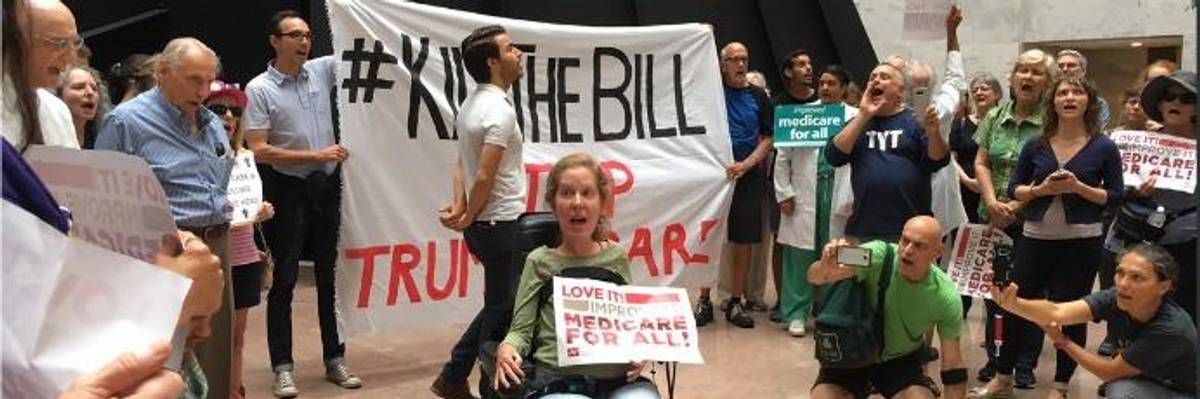
A repeal-only bill, explains Indivisible, is "the most extreme attempt yet at dismantling people's healthcare." (Photo: Amirah Sequeira/TwitPic)
Republicans considered going this same route in January but abandoned that approach after just a few weeks of thinking about it. That's because the effects of full repeal are devastating, and even Republicans know it:
Republicans considered going this same route in January but abandoned that approach after just a few weeks of thinking about it. That's because the effects of full repeal are devastating, and even Republicans know it:
And unlike earlier versions of TrumpCare--as entirely inadequate as they were--there isn't even an attempt to replace the ACA. Under this framework, which repeals as much of the law they can get away with through reconciliation, the Congressional Budget Office estimates that 18 million Americans would lose their insurance in the first year, and a staggering 32 million by 2026. CBO also said premiums would increase by 25% in the first year and that they would double by 2026.
The Senate passed full repeal in 2015, knowing they didn't need a replacement. That's because everyone knew at the time President Obama would veto the repeal bill, so Republican Senators didn't bother to come up with a different way to help people afford insurance once the tax credits were repealed, or a way to replace the coverage millions of Americans got for the first time through the Medicaid expansion. They didn't have to consider that their plan would cause premiums to double. Unfortunately, it passed the Senate with 52 Republican votes, including many of the Senators now expressing doubts about TrumpCare. It was a reckless bill that would have been a catastrophe for the American people that fortunately died a prompt death under President Obama's veto pen.
But, like all Republican health care bills apparently, it has now risen from the dead.
Republicans may try to argue that they are repealing now and will work on a replacement later that Democrats will be forced to negotiate on. This is nothing short of holding millions of lives hostage for their failed partisan agenda. Considering Republicans have been talking about this for 7 years, and McConnell just tried to construct a replacement that would pass the Senate--only to utterly fail--there is no reason to think they could craft a replacement later. And while McConnell plays this political game, millions of people will lose insurance, see their premiums skyrocket, delay important medical care, or go bankrupt.
The first hurdle Mitch McConnell and Senate Republicans have to clear is a procedural vote called the "motion to proceed." That vote means the Senate is agreeing to debate the bill. He intends to use the TrumpCare bill the House narrowly passed in May--the American Health Care Act--as the vehicle for this full repeal bill. That means when the Senate votes on the motion to proceed, they'll actually be agreeing to debate the House bill. But the first amendment that McConnell will offer is one that strikes the entire House bill, and replaces it with the repeal bill from 2015.
No Senator should support this bill, whether they supported TrumpCare or not. The full repeal goes far beyond even what TrumpCare would do. That means every Senator should oppose both the bill and the motion to proceed, but especially the ones that "had concerns" with previous versions of TrumpCare. This is the most extreme attempt yet at dismantling people's healthcare, but we've stopped or delayed all previous attempts. We can kill this bill, too.
Caller: Hello! My name is [name] and I'm calling from [part of state]. Can you tell me how Senator [ ] plans to vote on the motion to proceed on the health care bill?
Staffer: The Senator hasn't made a decision on that yet.
Caller: That's terrible. Senator [ ] should absolutely oppose any attempt to repeal the Affordable Care Act. This is a reckless move that Mitch McConnell is making out of desperation with no plan whatsoever as to how the ACA would be replaced. The Congressional Budget Office says 32 million people will lose their insurance and that premiums will double. How could Senator support that?
Staffer: But those numbers aren't accurate because this is just repealing now with a replacement to come later. We won't let people go without health insurance.
Calle: That's ridiculous. If Congress can't find a compromise today, why should we believe it will find one in a year or two? This is playing games with people's lives.
Staffer: Again, Senator hasn't made a decision yet.
Caller: Well I want Senator [ ] to make a decision, and oppose any effort to repeal the Affordable Care Act, especially if there is no plan in place to replace it. I want the Senator to vote against the motion to proceed and against the bill itself.
Staffer: Thank you. I'll let the Senator know your thoughts.
Caller: Thank you. Please take down my contact information so you can let me know how Senator [ ] votes.
Dear Common Dreams reader, It’s been nearly 30 years since I co-founded Common Dreams with my late wife, Lina Newhouser. We had the radical notion that journalism should serve the public good, not corporate profits. It was clear to us from the outset what it would take to build such a project. No paid advertisements. No corporate sponsors. No millionaire publisher telling us what to think or do. Many people said we wouldn't last a year, but we proved those doubters wrong. Together with a tremendous team of journalists and dedicated staff, we built an independent media outlet free from the constraints of profits and corporate control. Our mission has always been simple: To inform. To inspire. To ignite change for the common good. Building Common Dreams was not easy. Our survival was never guaranteed. When you take on the most powerful forces—Wall Street greed, fossil fuel industry destruction, Big Tech lobbyists, and uber-rich oligarchs who have spent billions upon billions rigging the economy and democracy in their favor—the only bulwark you have is supporters who believe in your work. But here’s the urgent message from me today. It's never been this bad out there. And it's never been this hard to keep us going. At the very moment Common Dreams is most needed, the threats we face are intensifying. We need your support now more than ever. We don't accept corporate advertising and never will. We don't have a paywall because we don't think people should be blocked from critical news based on their ability to pay. Everything we do is funded by the donations of readers like you. When everyone does the little they can afford, we are strong. But if that support retreats or dries up, so do we. Will you donate now to make sure Common Dreams not only survives but thrives? —Craig Brown, Co-founder |
Republicans considered going this same route in January but abandoned that approach after just a few weeks of thinking about it. That's because the effects of full repeal are devastating, and even Republicans know it:
And unlike earlier versions of TrumpCare--as entirely inadequate as they were--there isn't even an attempt to replace the ACA. Under this framework, which repeals as much of the law they can get away with through reconciliation, the Congressional Budget Office estimates that 18 million Americans would lose their insurance in the first year, and a staggering 32 million by 2026. CBO also said premiums would increase by 25% in the first year and that they would double by 2026.
The Senate passed full repeal in 2015, knowing they didn't need a replacement. That's because everyone knew at the time President Obama would veto the repeal bill, so Republican Senators didn't bother to come up with a different way to help people afford insurance once the tax credits were repealed, or a way to replace the coverage millions of Americans got for the first time through the Medicaid expansion. They didn't have to consider that their plan would cause premiums to double. Unfortunately, it passed the Senate with 52 Republican votes, including many of the Senators now expressing doubts about TrumpCare. It was a reckless bill that would have been a catastrophe for the American people that fortunately died a prompt death under President Obama's veto pen.
But, like all Republican health care bills apparently, it has now risen from the dead.
Republicans may try to argue that they are repealing now and will work on a replacement later that Democrats will be forced to negotiate on. This is nothing short of holding millions of lives hostage for their failed partisan agenda. Considering Republicans have been talking about this for 7 years, and McConnell just tried to construct a replacement that would pass the Senate--only to utterly fail--there is no reason to think they could craft a replacement later. And while McConnell plays this political game, millions of people will lose insurance, see their premiums skyrocket, delay important medical care, or go bankrupt.
The first hurdle Mitch McConnell and Senate Republicans have to clear is a procedural vote called the "motion to proceed." That vote means the Senate is agreeing to debate the bill. He intends to use the TrumpCare bill the House narrowly passed in May--the American Health Care Act--as the vehicle for this full repeal bill. That means when the Senate votes on the motion to proceed, they'll actually be agreeing to debate the House bill. But the first amendment that McConnell will offer is one that strikes the entire House bill, and replaces it with the repeal bill from 2015.
No Senator should support this bill, whether they supported TrumpCare or not. The full repeal goes far beyond even what TrumpCare would do. That means every Senator should oppose both the bill and the motion to proceed, but especially the ones that "had concerns" with previous versions of TrumpCare. This is the most extreme attempt yet at dismantling people's healthcare, but we've stopped or delayed all previous attempts. We can kill this bill, too.
Caller: Hello! My name is [name] and I'm calling from [part of state]. Can you tell me how Senator [ ] plans to vote on the motion to proceed on the health care bill?
Staffer: The Senator hasn't made a decision on that yet.
Caller: That's terrible. Senator [ ] should absolutely oppose any attempt to repeal the Affordable Care Act. This is a reckless move that Mitch McConnell is making out of desperation with no plan whatsoever as to how the ACA would be replaced. The Congressional Budget Office says 32 million people will lose their insurance and that premiums will double. How could Senator support that?
Staffer: But those numbers aren't accurate because this is just repealing now with a replacement to come later. We won't let people go without health insurance.
Calle: That's ridiculous. If Congress can't find a compromise today, why should we believe it will find one in a year or two? This is playing games with people's lives.
Staffer: Again, Senator hasn't made a decision yet.
Caller: Well I want Senator [ ] to make a decision, and oppose any effort to repeal the Affordable Care Act, especially if there is no plan in place to replace it. I want the Senator to vote against the motion to proceed and against the bill itself.
Staffer: Thank you. I'll let the Senator know your thoughts.
Caller: Thank you. Please take down my contact information so you can let me know how Senator [ ] votes.
Republicans considered going this same route in January but abandoned that approach after just a few weeks of thinking about it. That's because the effects of full repeal are devastating, and even Republicans know it:
And unlike earlier versions of TrumpCare--as entirely inadequate as they were--there isn't even an attempt to replace the ACA. Under this framework, which repeals as much of the law they can get away with through reconciliation, the Congressional Budget Office estimates that 18 million Americans would lose their insurance in the first year, and a staggering 32 million by 2026. CBO also said premiums would increase by 25% in the first year and that they would double by 2026.
The Senate passed full repeal in 2015, knowing they didn't need a replacement. That's because everyone knew at the time President Obama would veto the repeal bill, so Republican Senators didn't bother to come up with a different way to help people afford insurance once the tax credits were repealed, or a way to replace the coverage millions of Americans got for the first time through the Medicaid expansion. They didn't have to consider that their plan would cause premiums to double. Unfortunately, it passed the Senate with 52 Republican votes, including many of the Senators now expressing doubts about TrumpCare. It was a reckless bill that would have been a catastrophe for the American people that fortunately died a prompt death under President Obama's veto pen.
But, like all Republican health care bills apparently, it has now risen from the dead.
Republicans may try to argue that they are repealing now and will work on a replacement later that Democrats will be forced to negotiate on. This is nothing short of holding millions of lives hostage for their failed partisan agenda. Considering Republicans have been talking about this for 7 years, and McConnell just tried to construct a replacement that would pass the Senate--only to utterly fail--there is no reason to think they could craft a replacement later. And while McConnell plays this political game, millions of people will lose insurance, see their premiums skyrocket, delay important medical care, or go bankrupt.
The first hurdle Mitch McConnell and Senate Republicans have to clear is a procedural vote called the "motion to proceed." That vote means the Senate is agreeing to debate the bill. He intends to use the TrumpCare bill the House narrowly passed in May--the American Health Care Act--as the vehicle for this full repeal bill. That means when the Senate votes on the motion to proceed, they'll actually be agreeing to debate the House bill. But the first amendment that McConnell will offer is one that strikes the entire House bill, and replaces it with the repeal bill from 2015.
No Senator should support this bill, whether they supported TrumpCare or not. The full repeal goes far beyond even what TrumpCare would do. That means every Senator should oppose both the bill and the motion to proceed, but especially the ones that "had concerns" with previous versions of TrumpCare. This is the most extreme attempt yet at dismantling people's healthcare, but we've stopped or delayed all previous attempts. We can kill this bill, too.
Caller: Hello! My name is [name] and I'm calling from [part of state]. Can you tell me how Senator [ ] plans to vote on the motion to proceed on the health care bill?
Staffer: The Senator hasn't made a decision on that yet.
Caller: That's terrible. Senator [ ] should absolutely oppose any attempt to repeal the Affordable Care Act. This is a reckless move that Mitch McConnell is making out of desperation with no plan whatsoever as to how the ACA would be replaced. The Congressional Budget Office says 32 million people will lose their insurance and that premiums will double. How could Senator support that?
Staffer: But those numbers aren't accurate because this is just repealing now with a replacement to come later. We won't let people go without health insurance.
Calle: That's ridiculous. If Congress can't find a compromise today, why should we believe it will find one in a year or two? This is playing games with people's lives.
Staffer: Again, Senator hasn't made a decision yet.
Caller: Well I want Senator [ ] to make a decision, and oppose any effort to repeal the Affordable Care Act, especially if there is no plan in place to replace it. I want the Senator to vote against the motion to proceed and against the bill itself.
Staffer: Thank you. I'll let the Senator know your thoughts.
Caller: Thank you. Please take down my contact information so you can let me know how Senator [ ] votes.