SUBSCRIBE TO OUR FREE NEWSLETTER
Daily news & progressive opinion—funded by the people, not the corporations—delivered straight to your inbox.
5
#000000
#FFFFFF
To donate by check, phone, or other method, see our More Ways to Give page.
By any definition, 2011 was a good year for the world left - however narrowly or broadly one defines the world left. The basic reason was the negative economic conditions from which most of the world was suffering. Unemployment was high and becoming higher. Most governments were faced with high debt levels and reduced income. Their response was to try to impose austerity measures on their populations while at the same time they were trying to protect their banks.
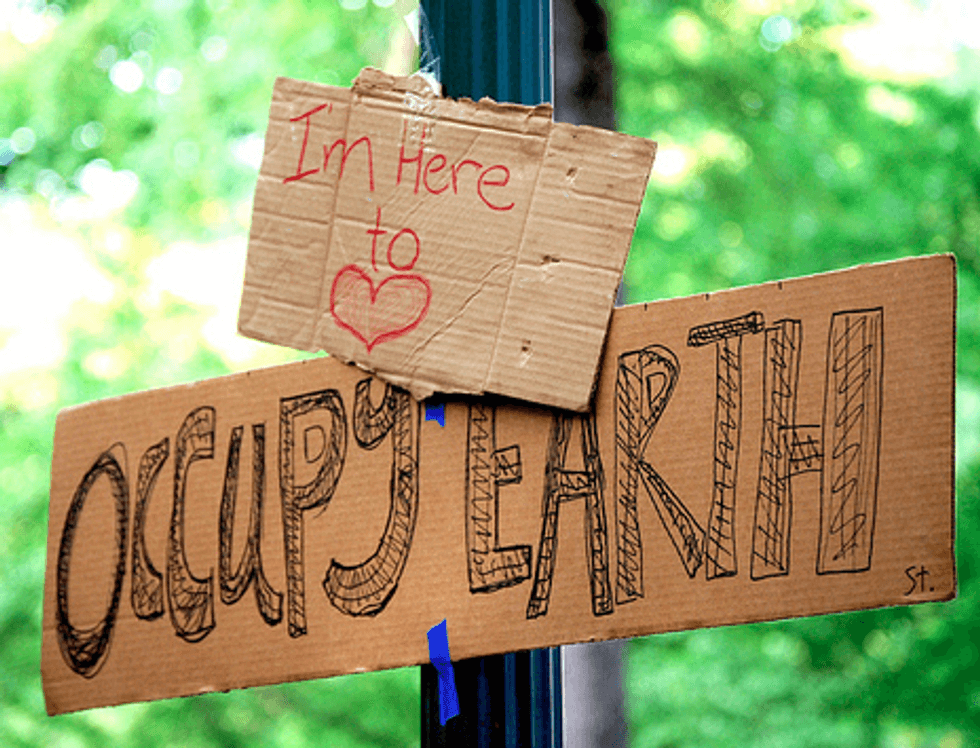
The result was a worldwide revolt of what the Occupy Wall Street (OWS) movements called "the 99%." The revolt was against the excessive polarization of wealth, the corrupt governments, and the essentially undemocratic nature of these governments whether or not they had multiparty systems.
It is not that the OWS, the Arab Spring, or the indignados achieved everything they hoped for. It is that they managed to change world discourse, moving it away from the ideological mantras of neo-liberalism to themes like inequality, injustice, and decolonization. For the first time in a long time, ordinary people were discussing the very nature of the system in which they lived; they were no longer taking it for granted.
The question now for the world left is how it can move forward and translate this initial discursive success into political transformation. The problem can be posed quite simply. Even if, in economic terms, there exists a clear and growing cleavage between a very small group (the 1%) and a very large one (the 99%), it does not follow that this is the political division. Worldwide, right-of-center forces still command something like half of the world's populations, or at least of those who are politically active in any way.
To transform the world therefore, the world left will need a degree of political unity it does not yet have. Indeed, there are profound disagreements about both long-range objectives and short-range tactics. It is not that these issues are not being debated. To the contrary, they are being debated heatedly, and little progress is occurring to overcome the divisions.
These divisions are not new. That doesn't make them the easier to resolve. There are two major ones. The first has to do with elections. There are not two, but three, positions concerning elections. There is one group that is deeply suspicious of elections, arguing that participating in them is not only politically ineffectual but reinforces the legitimacy of the existing world-system.
The others think it's crucial to take part in the electoral process. But this group is divided in two. On the one hand, there are those who claim to be pragmatic. They want to work from within - within the major left-of-center party when there is a functioning multi-party system, or within the de facto single party when parliamentary alternance is not permitted.
And of course there are those who decry this policy of choosing the so-called lesser evil. They insist that there is no significant difference between the principal alternative parties and support voting for some party that is "genuinely" on the left.
We are all familiar with this debate and we have all heard the arguments over and over. However, it is clear, at least to me, that if there isn't some coming together of the three groups concerning electoral tactics, the world left does not have much of a chance of prevailing either in the short or the longer run.
I believe there is a mode of reconciliation. It is to make a distinction between short-term tactics and longer-term strategy. I very much agree with those who argue that obtaining state power is irrelevant to, and possibly endangers the possibility of, the longer-term transformation of the world-system. As a strategy of transformation, it has been tried many times and it has failed.
It does not follow from this that short-run electoral participation is a waste of time. The fact is that a very large part of the 99% are suffering acutely in the short-run. And it is this short-run suffering that is their principal concern. They are trying to survive, and to aid their families and friends to survive. If we think of governments not as potential agents of social transformation but as structures that can affect short-term suffering by their immediate policy decisions, then the world left is obligated to do what it can to get decisions from them that will minimize the pain.
Working to minimize the pain requires electoral participation. And what of the debate between the proponents of the lesser evil and the proponents of supporting genuinely left parties? This becomes a decision of local tactics, which vary enormously according to many factors: size of country, formal political structure, demographics of country, geopolitical location, political history. There is no standard answer, nor can there be. Nor is the answer of 2012 necessarily going to hold for 2014 or 2016. It is not, for me at least, a debate of principle but rather of an evolving tactical situation in each country.
The second basic debate that consumes the world left is that between what I call "developmentalism" and what may be called the priority of civilizational change. We can observe this debate in many parts of the world. One sees it in Latin America in the ongoing and quite angry debates between left governments and movements of indigenous peoples - for example, in Bolivia, in Ecuador, in Venezuela. One sees it in North America and in Europe in debates between environmentalists/Greens and the trade-unions which give priority to retaining and expanding available employment.
On the one side the "developmentalist" option, whether put forward by left governments or by trade-unions is that without such economic growth, there is no way to rectify the economic imbalances of the present-day world, whether we are talking about the polarization within countries or the polarization between countries. This group accuses their opponents of supporting, at least objectively and possibly subjectively, the interests of right-wing forces.
The proponents of the anti-developmentalist option say that the concentration on the priority of economic growth is wrong on two grounds. It is a policy that simply continues the worst features of the capitalist system. And it is a policy that causes irreparable damage - ecological and social damage.
This division is even more passionate, if that is possible, than the one about electoral participation. The only way to resolve it is by compromises, on a case-by-case basis. To make this possible, both groups need to accept the good faith left credentials of the other. It will not be easy.
Can these divisions on the left be overcome in the next five to ten years? I am not sure. But if they are not, I do not believe the world left can win the battle of the next twenty to forty years over what kind of successor system we shall have as the capitalist system collapses definitively.
By any definition, 2011 was a good year for the world left - however narrowly or broadly one defines the world left. The basic reason was the negative economic conditions from which most of the world was suffering. Unemployment was high and becoming higher. Most governments were faced with high debt levels and reduced income. Their response was to try to impose austerity measures on their populations while at the same time they were trying to protect their banks.
The result was a worldwide revolt of what the Occupy Wall Street (OWS) movements called "the 99%." The revolt was against the excessive polarization of wealth, the corrupt governments, and the essentially undemocratic nature of these governments whether or not they had multiparty systems.
It is not that the OWS, the Arab Spring, or the indignados achieved everything they hoped for. It is that they managed to change world discourse, moving it away from the ideological mantras of neo-liberalism to themes like inequality, injustice, and decolonization. For the first time in a long time, ordinary people were discussing the very nature of the system in which they lived; they were no longer taking it for granted.
The question now for the world left is how it can move forward and translate this initial discursive success into political transformation. The problem can be posed quite simply. Even if, in economic terms, there exists a clear and growing cleavage between a very small group (the 1%) and a very large one (the 99%), it does not follow that this is the political division. Worldwide, right-of-center forces still command something like half of the world's populations, or at least of those who are politically active in any way.
To transform the world therefore, the world left will need a degree of political unity it does not yet have. Indeed, there are profound disagreements about both long-range objectives and short-range tactics. It is not that these issues are not being debated. To the contrary, they are being debated heatedly, and little progress is occurring to overcome the divisions.
These divisions are not new. That doesn't make them the easier to resolve. There are two major ones. The first has to do with elections. There are not two, but three, positions concerning elections. There is one group that is deeply suspicious of elections, arguing that participating in them is not only politically ineffectual but reinforces the legitimacy of the existing world-system.
The others think it's crucial to take part in the electoral process. But this group is divided in two. On the one hand, there are those who claim to be pragmatic. They want to work from within - within the major left-of-center party when there is a functioning multi-party system, or within the de facto single party when parliamentary alternance is not permitted.
And of course there are those who decry this policy of choosing the so-called lesser evil. They insist that there is no significant difference between the principal alternative parties and support voting for some party that is "genuinely" on the left.
We are all familiar with this debate and we have all heard the arguments over and over. However, it is clear, at least to me, that if there isn't some coming together of the three groups concerning electoral tactics, the world left does not have much of a chance of prevailing either in the short or the longer run.
I believe there is a mode of reconciliation. It is to make a distinction between short-term tactics and longer-term strategy. I very much agree with those who argue that obtaining state power is irrelevant to, and possibly endangers the possibility of, the longer-term transformation of the world-system. As a strategy of transformation, it has been tried many times and it has failed.
It does not follow from this that short-run electoral participation is a waste of time. The fact is that a very large part of the 99% are suffering acutely in the short-run. And it is this short-run suffering that is their principal concern. They are trying to survive, and to aid their families and friends to survive. If we think of governments not as potential agents of social transformation but as structures that can affect short-term suffering by their immediate policy decisions, then the world left is obligated to do what it can to get decisions from them that will minimize the pain.
Working to minimize the pain requires electoral participation. And what of the debate between the proponents of the lesser evil and the proponents of supporting genuinely left parties? This becomes a decision of local tactics, which vary enormously according to many factors: size of country, formal political structure, demographics of country, geopolitical location, political history. There is no standard answer, nor can there be. Nor is the answer of 2012 necessarily going to hold for 2014 or 2016. It is not, for me at least, a debate of principle but rather of an evolving tactical situation in each country.
The second basic debate that consumes the world left is that between what I call "developmentalism" and what may be called the priority of civilizational change. We can observe this debate in many parts of the world. One sees it in Latin America in the ongoing and quite angry debates between left governments and movements of indigenous peoples - for example, in Bolivia, in Ecuador, in Venezuela. One sees it in North America and in Europe in debates between environmentalists/Greens and the trade-unions which give priority to retaining and expanding available employment.
On the one side the "developmentalist" option, whether put forward by left governments or by trade-unions is that without such economic growth, there is no way to rectify the economic imbalances of the present-day world, whether we are talking about the polarization within countries or the polarization between countries. This group accuses their opponents of supporting, at least objectively and possibly subjectively, the interests of right-wing forces.
The proponents of the anti-developmentalist option say that the concentration on the priority of economic growth is wrong on two grounds. It is a policy that simply continues the worst features of the capitalist system. And it is a policy that causes irreparable damage - ecological and social damage.
This division is even more passionate, if that is possible, than the one about electoral participation. The only way to resolve it is by compromises, on a case-by-case basis. To make this possible, both groups need to accept the good faith left credentials of the other. It will not be easy.
Can these divisions on the left be overcome in the next five to ten years? I am not sure. But if they are not, I do not believe the world left can win the battle of the next twenty to forty years over what kind of successor system we shall have as the capitalist system collapses definitively.
By any definition, 2011 was a good year for the world left - however narrowly or broadly one defines the world left. The basic reason was the negative economic conditions from which most of the world was suffering. Unemployment was high and becoming higher. Most governments were faced with high debt levels and reduced income. Their response was to try to impose austerity measures on their populations while at the same time they were trying to protect their banks.
The result was a worldwide revolt of what the Occupy Wall Street (OWS) movements called "the 99%." The revolt was against the excessive polarization of wealth, the corrupt governments, and the essentially undemocratic nature of these governments whether or not they had multiparty systems.
It is not that the OWS, the Arab Spring, or the indignados achieved everything they hoped for. It is that they managed to change world discourse, moving it away from the ideological mantras of neo-liberalism to themes like inequality, injustice, and decolonization. For the first time in a long time, ordinary people were discussing the very nature of the system in which they lived; they were no longer taking it for granted.
The question now for the world left is how it can move forward and translate this initial discursive success into political transformation. The problem can be posed quite simply. Even if, in economic terms, there exists a clear and growing cleavage between a very small group (the 1%) and a very large one (the 99%), it does not follow that this is the political division. Worldwide, right-of-center forces still command something like half of the world's populations, or at least of those who are politically active in any way.
To transform the world therefore, the world left will need a degree of political unity it does not yet have. Indeed, there are profound disagreements about both long-range objectives and short-range tactics. It is not that these issues are not being debated. To the contrary, they are being debated heatedly, and little progress is occurring to overcome the divisions.
These divisions are not new. That doesn't make them the easier to resolve. There are two major ones. The first has to do with elections. There are not two, but three, positions concerning elections. There is one group that is deeply suspicious of elections, arguing that participating in them is not only politically ineffectual but reinforces the legitimacy of the existing world-system.
The others think it's crucial to take part in the electoral process. But this group is divided in two. On the one hand, there are those who claim to be pragmatic. They want to work from within - within the major left-of-center party when there is a functioning multi-party system, or within the de facto single party when parliamentary alternance is not permitted.
And of course there are those who decry this policy of choosing the so-called lesser evil. They insist that there is no significant difference between the principal alternative parties and support voting for some party that is "genuinely" on the left.
We are all familiar with this debate and we have all heard the arguments over and over. However, it is clear, at least to me, that if there isn't some coming together of the three groups concerning electoral tactics, the world left does not have much of a chance of prevailing either in the short or the longer run.
I believe there is a mode of reconciliation. It is to make a distinction between short-term tactics and longer-term strategy. I very much agree with those who argue that obtaining state power is irrelevant to, and possibly endangers the possibility of, the longer-term transformation of the world-system. As a strategy of transformation, it has been tried many times and it has failed.
It does not follow from this that short-run electoral participation is a waste of time. The fact is that a very large part of the 99% are suffering acutely in the short-run. And it is this short-run suffering that is their principal concern. They are trying to survive, and to aid their families and friends to survive. If we think of governments not as potential agents of social transformation but as structures that can affect short-term suffering by their immediate policy decisions, then the world left is obligated to do what it can to get decisions from them that will minimize the pain.
Working to minimize the pain requires electoral participation. And what of the debate between the proponents of the lesser evil and the proponents of supporting genuinely left parties? This becomes a decision of local tactics, which vary enormously according to many factors: size of country, formal political structure, demographics of country, geopolitical location, political history. There is no standard answer, nor can there be. Nor is the answer of 2012 necessarily going to hold for 2014 or 2016. It is not, for me at least, a debate of principle but rather of an evolving tactical situation in each country.
The second basic debate that consumes the world left is that between what I call "developmentalism" and what may be called the priority of civilizational change. We can observe this debate in many parts of the world. One sees it in Latin America in the ongoing and quite angry debates between left governments and movements of indigenous peoples - for example, in Bolivia, in Ecuador, in Venezuela. One sees it in North America and in Europe in debates between environmentalists/Greens and the trade-unions which give priority to retaining and expanding available employment.
On the one side the "developmentalist" option, whether put forward by left governments or by trade-unions is that without such economic growth, there is no way to rectify the economic imbalances of the present-day world, whether we are talking about the polarization within countries or the polarization between countries. This group accuses their opponents of supporting, at least objectively and possibly subjectively, the interests of right-wing forces.
The proponents of the anti-developmentalist option say that the concentration on the priority of economic growth is wrong on two grounds. It is a policy that simply continues the worst features of the capitalist system. And it is a policy that causes irreparable damage - ecological and social damage.
This division is even more passionate, if that is possible, than the one about electoral participation. The only way to resolve it is by compromises, on a case-by-case basis. To make this possible, both groups need to accept the good faith left credentials of the other. It will not be easy.
Can these divisions on the left be overcome in the next five to ten years? I am not sure. But if they are not, I do not believe the world left can win the battle of the next twenty to forty years over what kind of successor system we shall have as the capitalist system collapses definitively.