
The assassination of Osama bin Laden has rekindled the discourse about the efficacy and legality of using torture in the "war on terror." Torture is illegal under all circumstances, even in wartime. Moreover, the United States located Bin Laden with traditional interrogation methods over several years, not by the use of torture.
When the United States ratified the Convention against Torture and Other Cruel, Inhuman or Degrading Treatment or Punishment, it became part of U.S. law under the Supremacy Clause of the Constitution, which says treaties are the supreme law of the land. The Torture Convention states, "No exceptional circumstances whatsoever, whether a state of war or a threat of war, internal political instability or any other public emergency, may be invoked as a justification of torture." The prohibition against torture is unequivocal, regardless of the circumstances.
Pundits proclaim that the successful hit on Bin Laden exonerates the Bush administration for its use of "enhanced interrogation techniques" - aka torture. John Yoo wrote in the Wall Street Journal that the kill "vindicates the Bush administration, whose intelligence architecture marked the path to bin Laden's door." The author of the most egregious torture memos, Yoo maintains that "the tough interrogations" of Khalid Sheikh Mohammed and Abu Faraj al-Libi provided the United States with the identity of Bin Laden's courier.
Yoo's claims are false. Senator John McCain declared in a speech on the Senate floor yesterday, "It was not torture, or cruel, inhuman and degrading treatment of detainees that got us the major leads that ultimately enabled our intelligence community to find Osama bin Laden." McCain said that CIA Director Leon Panetta told him: "The first mention of Abu Ahmed al-Kuwaiti - the nickname of the al-Qaeda courier who ultimately led us to bin Laden - as well as a description of him as an important member of al-Qaeda, came from a detainee held in another country, who we believe was not tortured. None of the three detainees who were waterboarded provided Abu Ahmed's real name, his whereabouts or an accurate description of his role in al-Qaeda."
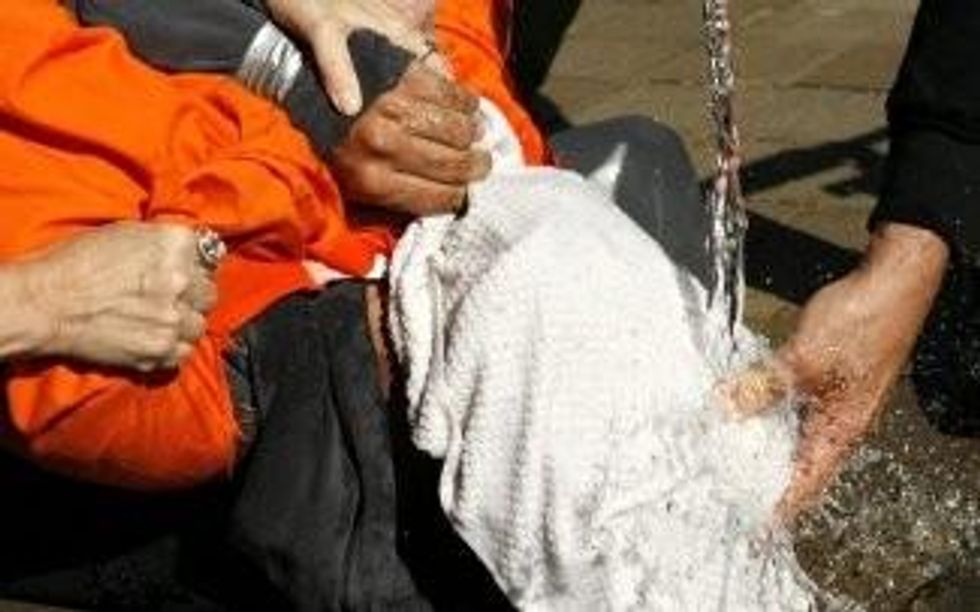
McCain added, "In fact, the use of 'enhanced interrogation techniques' on Khalid Sheik Mohammed produced false and misleading information." Mohammed was waterboarded 183 times in 2003. It is well-established in U.S. case law that waterboarding constitutes torture.
Tommy Vietor, spokesman for the National Security Council, agrees that waterboarding didn't lead us to Bin Laden. He said, "The bottom line is this: If we had some kind of smoking-gun intelligence from waterboarding in 2003, we would have taken out Osama bin Laden in 2003." He added: "It took years of collection and analysis from many different sources to develop the case that enabled us to identify this compound, and reach a judgment that Bin Laden was likely to be living there."
White House Press Secretary Jay Carney concurs: "It simply strains credulity to suggest that a piece of information that may or may not have been gathered eight years ago somehow led to a successful mission [on May 1]. That's just not the case." Dianne Feinstein, chairwoman of the Senate Intelligence Committee, confirmed that "none of it came as a result of harsh interrogation practices."
A 2006 study by the National Defense Intelligence College found that traditional, rapport-building interrogation techniques are extremely effective even with the most hardened detainees, but coercive tactics create resistance and resentment.
Interrogators agree that torture is not efficacious to glean intelligence. Glenn L. Carle, who supervised the 2002 interrogation of a high-level detainee for the CIA, told The New York Times that coercive techniques "didn't provide useful, meaningful, trustworthy information."
Likewise, Ali Soufan, who interrogated Abu Zubaydah, testified before Congress that harsh interrogation techniques "are ineffective, slow, and unreliable, and as a result harmful to our efforts to defeat al Qaeda." Soufan wrote in the Times that any useful information Zubaydah provided happened before the "enhanced interrogation techniques" were utilized.
Matthew Alexander, a former senior military interrogator who supervised or conducted 1,300 interrogations in Iraq, which led to the capture of several al-Qaeda leaders, echoes Soufan's sentiments. Alexander said, "I think that without a doubt, torture and enhanced interrogation techniques slowed down the hunt for Bin Laden."
When I testified in 2008 before the House Judiciary Committee's Subcommittee on the Constitution, Civil Rights, and Civil Liberties about Bush administration interrogation policy, one of the Republican congressmen asked me how I would fashion an interrogation statute. I replied that it would require humane, kind, respectful treatment to develop trust. As the questioner sniggered, Professor Philippe Sands, who also testified on the same panel that day, said I was correct, that the British got much better intelligence from the Irish Republican Army when they used humane techniques.
In her chapter in The United States and Torture: Interrogation, Incarceration, and Abuse, journalist Jane Mayer discusses Ibn Sheikh al Libi, who was tortured in CIA custody. Al Libi provided a link between Saddam Hussein and al Qaeda, which Colin Powell cited in his speech before the Security Council as he tried to secure a resolution authorizing the invasion of Iraq. The CIA knew Al Libi's information was false; indeed, he later recanted, and died under mysterious circumstances.
Torture is not simply illegal, immoral and ineffective. It is also counter-productive. Former Navy General Counsel Alberto Mora testified before Congress that the two most effective recruiting tools for those who would do harm to our soldiers in Iraq were Abu Ghraib and Guantanamo. When people see the U.S. government torturing detainees from their countries, they resent us even more.
Indeed, an interrogator currently serving in Afghanistan, told Forbes, "I cannot even count the amount of times that I personally have come face to face with detainees, who told me they were primarily motivated to do what they did, because of hearing that we committed torture . . . Torture committed by Americans in the past continues to kill Americans today."
Until the United States completely revamps our foreign policy and ends the wars, occupations, and harsh treatment of people in U.S. custody, we will continue to be vulnerable to terrorism.
The assassination of Osama bin Laden has rekindled the discourse about the efficacy and legality of using torture in the "war on terror." Torture is illegal under all circumstances, even in wartime. Moreover, the United States located Bin Laden with traditional interrogation methods over several years, not by the use of torture.
When the United States ratified the Convention against Torture and Other Cruel, Inhuman or Degrading Treatment or Punishment, it became part of U.S. law under the Supremacy Clause of the Constitution, which says treaties are the supreme law of the land. The Torture Convention states, "No exceptional circumstances whatsoever, whether a state of war or a threat of war, internal political instability or any other public emergency, may be invoked as a justification of torture." The prohibition against torture is unequivocal, regardless of the circumstances.
Pundits proclaim that the successful hit on Bin Laden exonerates the Bush administration for its use of "enhanced interrogation techniques" - aka torture. John Yoo wrote in the Wall Street Journal that the kill "vindicates the Bush administration, whose intelligence architecture marked the path to bin Laden's door." The author of the most egregious torture memos, Yoo maintains that "the tough interrogations" of Khalid Sheikh Mohammed and Abu Faraj al-Libi provided the United States with the identity of Bin Laden's courier.
Yoo's claims are false. Senator John McCain declared in a speech on the Senate floor yesterday, "It was not torture, or cruel, inhuman and degrading treatment of detainees that got us the major leads that ultimately enabled our intelligence community to find Osama bin Laden." McCain said that CIA Director Leon Panetta told him: "The first mention of Abu Ahmed al-Kuwaiti - the nickname of the al-Qaeda courier who ultimately led us to bin Laden - as well as a description of him as an important member of al-Qaeda, came from a detainee held in another country, who we believe was not tortured. None of the three detainees who were waterboarded provided Abu Ahmed's real name, his whereabouts or an accurate description of his role in al-Qaeda."
McCain added, "In fact, the use of 'enhanced interrogation techniques' on Khalid Sheik Mohammed produced false and misleading information." Mohammed was waterboarded 183 times in 2003. It is well-established in U.S. case law that waterboarding constitutes torture.
Tommy Vietor, spokesman for the National Security Council, agrees that waterboarding didn't lead us to Bin Laden. He said, "The bottom line is this: If we had some kind of smoking-gun intelligence from waterboarding in 2003, we would have taken out Osama bin Laden in 2003." He added: "It took years of collection and analysis from many different sources to develop the case that enabled us to identify this compound, and reach a judgment that Bin Laden was likely to be living there."
White House Press Secretary Jay Carney concurs: "It simply strains credulity to suggest that a piece of information that may or may not have been gathered eight years ago somehow led to a successful mission [on May 1]. That's just not the case." Dianne Feinstein, chairwoman of the Senate Intelligence Committee, confirmed that "none of it came as a result of harsh interrogation practices."
A 2006 study by the National Defense Intelligence College found that traditional, rapport-building interrogation techniques are extremely effective even with the most hardened detainees, but coercive tactics create resistance and resentment.
Interrogators agree that torture is not efficacious to glean intelligence. Glenn L. Carle, who supervised the 2002 interrogation of a high-level detainee for the CIA, told The New York Times that coercive techniques "didn't provide useful, meaningful, trustworthy information."
Likewise, Ali Soufan, who interrogated Abu Zubaydah, testified before Congress that harsh interrogation techniques "are ineffective, slow, and unreliable, and as a result harmful to our efforts to defeat al Qaeda." Soufan wrote in the Times that any useful information Zubaydah provided happened before the "enhanced interrogation techniques" were utilized.
Matthew Alexander, a former senior military interrogator who supervised or conducted 1,300 interrogations in Iraq, which led to the capture of several al-Qaeda leaders, echoes Soufan's sentiments. Alexander said, "I think that without a doubt, torture and enhanced interrogation techniques slowed down the hunt for Bin Laden."
When I testified in 2008 before the House Judiciary Committee's Subcommittee on the Constitution, Civil Rights, and Civil Liberties about Bush administration interrogation policy, one of the Republican congressmen asked me how I would fashion an interrogation statute. I replied that it would require humane, kind, respectful treatment to develop trust. As the questioner sniggered, Professor Philippe Sands, who also testified on the same panel that day, said I was correct, that the British got much better intelligence from the Irish Republican Army when they used humane techniques.
In her chapter in The United States and Torture: Interrogation, Incarceration, and Abuse, journalist Jane Mayer discusses Ibn Sheikh al Libi, who was tortured in CIA custody. Al Libi provided a link between Saddam Hussein and al Qaeda, which Colin Powell cited in his speech before the Security Council as he tried to secure a resolution authorizing the invasion of Iraq. The CIA knew Al Libi's information was false; indeed, he later recanted, and died under mysterious circumstances.
Torture is not simply illegal, immoral and ineffective. It is also counter-productive. Former Navy General Counsel Alberto Mora testified before Congress that the two most effective recruiting tools for those who would do harm to our soldiers in Iraq were Abu Ghraib and Guantanamo. When people see the U.S. government torturing detainees from their countries, they resent us even more.
Indeed, an interrogator currently serving in Afghanistan, told Forbes, "I cannot even count the amount of times that I personally have come face to face with detainees, who told me they were primarily motivated to do what they did, because of hearing that we committed torture . . . Torture committed by Americans in the past continues to kill Americans today."
Until the United States completely revamps our foreign policy and ends the wars, occupations, and harsh treatment of people in U.S. custody, we will continue to be vulnerable to terrorism.
The assassination of Osama bin Laden has rekindled the discourse about the efficacy and legality of using torture in the "war on terror." Torture is illegal under all circumstances, even in wartime. Moreover, the United States located Bin Laden with traditional interrogation methods over several years, not by the use of torture.
When the United States ratified the Convention against Torture and Other Cruel, Inhuman or Degrading Treatment or Punishment, it became part of U.S. law under the Supremacy Clause of the Constitution, which says treaties are the supreme law of the land. The Torture Convention states, "No exceptional circumstances whatsoever, whether a state of war or a threat of war, internal political instability or any other public emergency, may be invoked as a justification of torture." The prohibition against torture is unequivocal, regardless of the circumstances.
Pundits proclaim that the successful hit on Bin Laden exonerates the Bush administration for its use of "enhanced interrogation techniques" - aka torture. John Yoo wrote in the Wall Street Journal that the kill "vindicates the Bush administration, whose intelligence architecture marked the path to bin Laden's door." The author of the most egregious torture memos, Yoo maintains that "the tough interrogations" of Khalid Sheikh Mohammed and Abu Faraj al-Libi provided the United States with the identity of Bin Laden's courier.
Yoo's claims are false. Senator John McCain declared in a speech on the Senate floor yesterday, "It was not torture, or cruel, inhuman and degrading treatment of detainees that got us the major leads that ultimately enabled our intelligence community to find Osama bin Laden." McCain said that CIA Director Leon Panetta told him: "The first mention of Abu Ahmed al-Kuwaiti - the nickname of the al-Qaeda courier who ultimately led us to bin Laden - as well as a description of him as an important member of al-Qaeda, came from a detainee held in another country, who we believe was not tortured. None of the three detainees who were waterboarded provided Abu Ahmed's real name, his whereabouts or an accurate description of his role in al-Qaeda."
McCain added, "In fact, the use of 'enhanced interrogation techniques' on Khalid Sheik Mohammed produced false and misleading information." Mohammed was waterboarded 183 times in 2003. It is well-established in U.S. case law that waterboarding constitutes torture.
Tommy Vietor, spokesman for the National Security Council, agrees that waterboarding didn't lead us to Bin Laden. He said, "The bottom line is this: If we had some kind of smoking-gun intelligence from waterboarding in 2003, we would have taken out Osama bin Laden in 2003." He added: "It took years of collection and analysis from many different sources to develop the case that enabled us to identify this compound, and reach a judgment that Bin Laden was likely to be living there."
White House Press Secretary Jay Carney concurs: "It simply strains credulity to suggest that a piece of information that may or may not have been gathered eight years ago somehow led to a successful mission [on May 1]. That's just not the case." Dianne Feinstein, chairwoman of the Senate Intelligence Committee, confirmed that "none of it came as a result of harsh interrogation practices."
A 2006 study by the National Defense Intelligence College found that traditional, rapport-building interrogation techniques are extremely effective even with the most hardened detainees, but coercive tactics create resistance and resentment.
Interrogators agree that torture is not efficacious to glean intelligence. Glenn L. Carle, who supervised the 2002 interrogation of a high-level detainee for the CIA, told The New York Times that coercive techniques "didn't provide useful, meaningful, trustworthy information."
Likewise, Ali Soufan, who interrogated Abu Zubaydah, testified before Congress that harsh interrogation techniques "are ineffective, slow, and unreliable, and as a result harmful to our efforts to defeat al Qaeda." Soufan wrote in the Times that any useful information Zubaydah provided happened before the "enhanced interrogation techniques" were utilized.
Matthew Alexander, a former senior military interrogator who supervised or conducted 1,300 interrogations in Iraq, which led to the capture of several al-Qaeda leaders, echoes Soufan's sentiments. Alexander said, "I think that without a doubt, torture and enhanced interrogation techniques slowed down the hunt for Bin Laden."
When I testified in 2008 before the House Judiciary Committee's Subcommittee on the Constitution, Civil Rights, and Civil Liberties about Bush administration interrogation policy, one of the Republican congressmen asked me how I would fashion an interrogation statute. I replied that it would require humane, kind, respectful treatment to develop trust. As the questioner sniggered, Professor Philippe Sands, who also testified on the same panel that day, said I was correct, that the British got much better intelligence from the Irish Republican Army when they used humane techniques.
In her chapter in The United States and Torture: Interrogation, Incarceration, and Abuse, journalist Jane Mayer discusses Ibn Sheikh al Libi, who was tortured in CIA custody. Al Libi provided a link between Saddam Hussein and al Qaeda, which Colin Powell cited in his speech before the Security Council as he tried to secure a resolution authorizing the invasion of Iraq. The CIA knew Al Libi's information was false; indeed, he later recanted, and died under mysterious circumstances.
Torture is not simply illegal, immoral and ineffective. It is also counter-productive. Former Navy General Counsel Alberto Mora testified before Congress that the two most effective recruiting tools for those who would do harm to our soldiers in Iraq were Abu Ghraib and Guantanamo. When people see the U.S. government torturing detainees from their countries, they resent us even more.
Indeed, an interrogator currently serving in Afghanistan, told Forbes, "I cannot even count the amount of times that I personally have come face to face with detainees, who told me they were primarily motivated to do what they did, because of hearing that we committed torture . . . Torture committed by Americans in the past continues to kill Americans today."
Until the United States completely revamps our foreign policy and ends the wars, occupations, and harsh treatment of people in U.S. custody, we will continue to be vulnerable to terrorism.